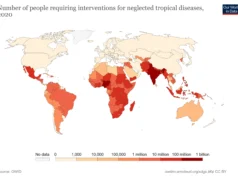
The countries with the worst water crises have almost no desalination capacity. Large-scale desalination has existed since the 1960s, and it has been pitched to these countries repeatedly, but the economics have never worked for them. Yemen, Ethiopia, Pakistan and much of sub-Saharan Africa are facing acute, worsening water scarcity. Between them they have only a sliver of the world’s desalination capacity: a Saudi-funded seawater desalination plant for Yemen’s port city of Aden is still being prepared, and landlocked Ethiopia has essentially none. The technology’s reach and the crisis’s location have almost no overlap.
This is the central problem with treating desalination as the answer to global water scarcity. The technology has a reputation as a gleaming fix to a planet-wide problem, but its plants get built where capital and coastline meet, and that gap is economic rather than technical. The remedies that would reach everyone else are not being implemented either, for reasons that also have nothing to do with technology.
What Desalination Is, What It Does, and Where the Math Breaks
Desalination works either by forcing seawater through semi-permeable membranes under high pressure, a process called reverse osmosis, or by heating it until it evaporates and condensing the resulting vapour, separating fresh water from salt. Both processes are technically mature, and both are commercially deployed at large scale.
The Gulf states run on it. Kuwait, Qatar and Bahrain draw around 90 percent or more of their drinking water from desalination, and Saudi Arabia roughly 70 percent. Israel’s large seawater plants along the Mediterranean coast produce roughly 80 percent of its drinking water, or about a third of all the fresh water it supplied in 2022. A sixth plant, Sorek 2, began delivering water in 2025, and the Water Authority’s long-term forecast has desalination capacity nearly tripling, from about 600 million cubic metres a year in 2022 to some 1,700 million by 2050. These are operational, large-scale systems that work as designed. Whether desalination can solve the global water crisis is a matter of economics.
The first limit is energy. Reverse osmosis needs about 3 to 4 kilowatt-hours to produce one cubic metre of fresh water from seawater, and the most advanced plants achieve around 2.5 kWh/m³ under ideal conditions. Conventional treatment of river or lake water takes roughly 0.2 to 0.6 kWh/m³. Desalination uses roughly five to twenty times more energy per unit of water produced. The gap is large, and physics limits how far it can shrink: desalinating seawater has a thermodynamic floor of about 1 kWh/m³.
Scale that against global consumption. Annual freshwater withdrawal runs to approximately 4,000 cubic kilometres, and agriculture alone accounts for around 2,800 km³ of that. Replacing even a meaningful fraction of global agricultural water demand with desalinated water would require energy inputs that don’t exist at the necessary scale. Future efficiency gains cannot remove a limit set by physics, and that limit has direct and permanent economic consequences. The argument that solar power will eventually make desalination viable at this scale is technically coherent but comes too slowly to help. The capital cost of building both solar and desalination infrastructure at the required scale remains prohibitive for water-stressed low-income nations, and the aquifers currently being depleted do not have the decades required for that transition to materialise.
The second is what comes out the other end. For every litre of fresh water produced, desalination generates approximately 1.5 litres of hypersaline brine — a concentrate up to about twice as salty as seawater, carrying residual treatment chemicals such as chlorine and anti-scalants, and traces of metals such as copper. The world’s desalination plants were estimated in 2019 to discharge about 142 million cubic metres of this brine a day. Saudi Arabia, the UAE, Kuwait and Qatar together produce 55 percent of it.
The vast majority of this returns to the sea. Local ecological impacts near discharge points are documented: hypersaline, often warmer plumes can lower dissolved oxygen, stress seabed organisms and sensitive habitats such as seagrass beds, and raise concentrations of copper and other metals. The Persian Gulf, ringed by roughly half of the world’s seawater desalination capacity, is where these effects concentrate: one model has brine raising salinity by up to about 4 grams per kilogram in the Gulf’s south-western reaches along the Arabian coast. A separate study of the basin as a whole found that salinity increases from desalination stay well within the Gulf’s natural variability, even with the growth in capacity projected to 2050. Its authors are clear that this is a basin-scale verdict, and that what happens around individual plants needs further research. Inland desalination faces different but equally serious brine disposal problems. With no ocean nearby, brine must be injected underground, evaporated in expensive lined ponds, or transported, and none of these options is cheap or environmentally benign. Inland, brine disposal is solved only at a price, and it adds substantially to the real cost of desalination wherever it is attempted away from the coast. The full economic cost of desalination, properly accounted, includes these downstream environmental costs, and little of that appears in the price of desalinated water.
The third is capital. Large-scale reverse osmosis plants cost hundreds of millions to over a billion dollars to build, with substantial ongoing operating costs. Yemen, Ethiopia, Pakistan and large parts of sub-Saharan Africa, where the water crises are most acute, cannot raise capital on the scale and terms this infrastructure demands; even the seawater plant being prepared for Aden in Yemen depends on Saudi development funding. The Gulf states, Israel, Australia, Spain and coastal California can, and they are using desalination to top up water systems that already function.
The technology’s benefits flow overwhelmingly to the water-secure. Its costs in energy and in environmental damage at discharge sites are distributed more broadly. And it barely reaches the 2.1 billion people worldwide who still lack safely managed drinking water. That has been true for the six decades desalination has operated at industrial scale, too long to be a deployment lag that more time and investment will correct.
The 70 Percent Problem
Agriculture withdraws approximately 70 percent of all freshwater extracted globally. In many poorer countries where subsistence and commercial irrigation dominate, the share reaches 90 percent or more, and about 95 percent in Afghanistan, Mali, Nepal, Somalia and Sudan. Against that, every desalination plant in the world combined, run flat out on roughly 100 million cubic metres a day of capacity, would produce under 40 km³ a year, enough to cover only one or two percent of what agriculture withdraws.
The dominant irrigation method globally is still flood irrigation, in which water is released down furrows and channels and floods across fields. It is the least efficient method available: water runs between crop rows, evaporates in the sun and percolates below root zones where plants cannot take it up. Typical water application efficiency for flood irrigation is around 40 to 60 percent, so roughly half the water applied never reaches the crop’s roots, though some of it seeps back to rivers and aquifers downstream. Drip irrigation, which delivers water directly to the root zone through tubes and emitters, achieves efficiencies of 85 to 90 percent. The technology is not experimental: it is commercially available and decades old. What holds it back is cost. Drip systems are expensive to install and maintain, so farmers adopt them for high-value crops or where water is scarce and priced, and rarely where water is free.
The reason flood irrigation persists is that agricultural water is systematically free or near-free in most of the world. When water has no price or a nominal one, the main economic incentive to invest in efficiency disappears. Farmers who keep flooding their fields are responding rationally to the incentives they face.
The subsidies are large and mostly out of sight. California’s agricultural sector consumes about 80 percent of the state’s developed, managed water supply, or about 40 percent of total statewide water use once environmental flows are counted, while contributing around 2 percent of state GDP. Much of this water moves through federal infrastructure built and operated by the US Bureau of Reclamation, which has historically delivered water to agricultural users at prices representing a small fraction of full cost. The Environmental Working Group calculated that in 2002 the average price of irrigation water from the Central Valley Project was less than 2 percent of what Los Angeles residents paid for drinking water, and that the total subsidy the project’s farmers received exceeded the roughly $48 million they paid for their water that year. Irrigators on Bureau of Reclamation projects have repaid their share of construction costs without interest since the programme began in 1902, and by 1996 about half of the $7.1 billion in construction costs allocated to irrigators had been shifted to other payers, chiefly hydropower customers.
The same dynamic operates globally, adapted to local political arrangements. Subsidised irrigation drives water-intensive crop production in regions that cannot support it without depleted aquifers or diverted rivers. In Central Asia, Soviet-era irrigation schemes for cotton, continued under post-Soviet governments, have collapsed the Aral Sea. Once the fourth-largest lake on Earth, it is now largely a salt flat and a health disaster. Rice is cultivated in the water-scarce Punjab and Sindh regions of Pakistan, consuming water at rates the Indus system cannot sustainably provide. Almonds and pistachios, among California’s largest agricultural exports by value, are perennial crops requiring water year-round, grown in a near-desert on water priced far below its scarcity value.
The fix is straightforward on paper: price agricultural water at or near its real scarcity value, use the revenue to fund transition assistance for smaller and subsistence farmers switching to more efficient systems, and protect poor smallholders through targeted subsidies tied to consumption volume rather than blanket below-market pricing. Some governments have already moved toward it. Israel, under sustained pressure from scarcity, has charged farmers close to the real cost of their water and capped their use through enforced quotas — Israeli growers complain that their water rates are the highest in the OECD, and a 2025 amendment to the Water Law trims some of them. Australia has done so in the Murray-Darling Basin, imperfectly and incompletely, but measurably.
The political obstacle is that agricultural constituencies hold disproportionate power in most democratic systems. Rural votes are structurally overweighted in legislatures, and farm lobbies are generously funded. The financial models of large-scale water-intensive operations are built around cheap water, and reform threatens those models directly.
Agricultural water reform also reaches into crop choice. The economic case for growing water-intensive crops in arid regions rests heavily on cheap water. Price water correctly and the economics of cotton in Uzbekistan, almonds in Fresno County and rice in Sindh change, and markets adjust what gets grown.
Pricing the Rest of It
Agricultural water is by far the largest lever, but the mispricing problem extends across all water use. Urban residential water, industrial water, and commercial consumption are systematically underpriced in most of the world, producing predictable overuse. Resources at or near zero cost get consumed in ways that would not survive price scrutiny: lawns in desert cities, car washes, industrial processes that use water wastefully, hotel pools in water-stressed regions.
The standard political objection to water pricing is that it denies a human right, and part of that argument holds. Access to a minimum quantity of water for drinking, cooking, and basic sanitation is a human right, and pricing systems that put basic water out of reach for poor households are unjust.
In practice, though, the argument has become a political shield deployed primarily by large water consumers to protect their subsidies. Poor households use modest quantities of water: around 20 litres per person per day is often enough for drinking, cooking and handwashing, and households with a tap on the plot typically use about 50. The people whose water bills rise most under correct pricing are wealthy residential users, commercial operations, and most significantly, the agricultural interests already discussed. When farm lobbies, golf course operators, and industrial users invoke the human right to water to oppose pricing reform, they are mainly defending their own access to cheap water rather than that of subsistence farmers or the urban poor.
The policy design that answers this objection has been implemented and documented. South Africa’s Free Basic Water policy, introduced in 2001 as part of the post-apartheid government’s service delivery commitments, gives each household its first 6,000 litres a month free, enough for basic drinking, cooking and sanitation, and charges escalating block tariffs above that threshold, so that heavy users pay progressively more per unit. The explicit logic was that poor households, which use little water, would pay nothing, while heavy users would pay real prices. The execution has been imperfect. Over time, cash-strapped municipalities have limited the free allowance to registered poor households and enforced it with flow-restricting devices, and in Tshwane the steep block prices used to pay for the allowance can leave some low-income households worse off. But the underlying design, a free or cheap lifeline block with progressively higher prices above it, is workable, and versions of it exist elsewhere: Chile has subsidised the water bills of low-income households under a law passed in 1989, and Flanders in Belgium gave every resident 15 cubic metres of free water a year from 1997 until the scheme was abolished in 2016.
Where lifeline pricing is opposed, the opposition tends to come from industry, agriculture and upper-income residential consumers, not primarily from the poor households the objection claims to protect. In South Africa, the pressure on the free allowance has come from municipalities prioritising cost recovery, not from the township residents who depend on it. In California, the agricultural lobby that has spent decades blocking water pricing reform invokes small family farmers in its public messaging while representing operations consuming hundreds of thousands of acre-feet annually at subsidised rates.
The Crisis in the Aquifer
Groundwater depletion is a water emergency that builds out of sight. Major aquifers globally are being drawn down at rates with no precedent and no equilibrium. The Ogallala Aquifer, under the American Great Plains, supplies roughly 30 percent of all US groundwater used for irrigation. Across the southern High Plains of Texas, rainfall recharges the aquifer by only about a centimetre a year on average, and between the region’s playa lakes recharge is close to zero. In western Kansas and the Texas Panhandle the water table commonly falls 1 to 3 feet a year. In some areas of the aquifer it has dropped more than 100 feet since large-scale pumping began after World War II. Between the start of heavy pumping and 2015, the aquifer lost about 273 million acre-feet of stored water, roughly 18 years of the Colorado River’s natural flow.
The North China Plain aquifer, which irrigates wheat and maize production feeding hundreds of millions of people, shows both the scale of the damage and the way out. It was drawn down relentlessly: across the wider North China region of Beijing, Tianjin, Hebei and Shanxi, groundwater was being lost at roughly 8 km³ a year between 2003 and 2010. Then China closed hundreds of thousands of wells, restricted pumping and piped in water from the south, and the trend reversed. Since 2020, water levels across the plain have risen by about 0.7 metres a year, and by 2024 they were back above their 2005 levels. Major aquifer systems under Punjab in India and Pakistan, where rice and wheat cultivation at enormous scale has depended on groundwater extraction for decades, are in the kind of trouble North China was in. Wherever governance has not stepped in, these regional problems add up to simultaneous, large-scale depletions of water stocks accumulated over millennia, being liquidated on timescales measured in decades.
The economics of unmanaged groundwater is the tragedy of the commons. Every individual farmer has a rational incentive to pump as much as possible before neighbours do. Any water left in the aquifer is available to everyone. The individually rational strategy, extracting now, produces the collectively catastrophic outcome of depletion. For fossil aquifers with geological recharge timescales, depletion is effectively permanent. Hundreds to thousands of years of rainfall would be needed to replace what has been extracted from parts of the Ogallala.
The connection to desalination shows how misaligned the dominant policy response is. In parts of the American West and the Middle East, desalination plants are being built or seriously proposed in regions simultaneously depleting their aquifers through agricultural extraction. Desalination provides urban drinking water while agriculture continues to drain the shared aquifer below. The most capital-intensive, energy-intensive water solution available is deployed against the symptom, an urban water shortfall, while the underlying cause, unpriced agricultural groundwater extraction, continues largely unchecked, so the expensive solution and the liquidation of the common resource proceed side by side.
The answer to groundwater depletion is governance: extraction limits based on sustainable yield, monitoring infrastructure, enforceable water rights reform, and institutions with real authority to reduce allocations when aquifer levels decline. None of this requires new technology. The hard part is overriding the interests of current extractors, who hold significant economic and political power in the regions where this matters most.
Australia’s Murray-Darling Basin is a river system rather than an aquifer, but it shows what serious governance of a shared water resource looks like once a government commits to it. By the 2000s, the river system was so severely over-allocated, with irrigation licences issued for more water than the system could sustainably provide, that during the Millennium Drought the Murray’s mouth had to be kept open by dredging for eight years, and the basin’s ecosystems were in documented decline. The Murray-Darling Basin Plan was legislated in November 2012, imposing mandatory caps on extraction on top of an existing market in which water rights could be traded. It was backed by the federal government’s A$12.9 billion Water for the Future programme, which set aside A$3.1 billion to buy irrigation entitlements from willing sellers and A$5.8 billion to subsidise more efficient irrigation infrastructure. The original target was 3,000 to 4,000 gigalitres of water returned to environmental flows. After years of agricultural industry pressure, the legislated figure was a lower 2,750 GL, with a further 450 GL to be found through efficiency projects, and the numbers have been adjusted again since.
In 2015, the government capped water buybacks at 1,500 GL under lobbying from irrigators and farm groups including the National Farmers’ Federation. The plan has been fought over, litigated and amended downward ever since. In December 2023 the Restoring Our Rivers Act repealed the buyback cap and extended the recovery deadlines, and the Murray-Darling Basin Authority’s first full statutory review of the plan is due in 2026. The plan is also a rare attempt by a government to treat a major shared water system as a managed commons rather than a free extraction resource, and ecological conditions in the river have measurably improved in reaches where environmental water has been returned. Its history, which falls short of a success story, shows what serious governance requires: years of conflict with powerful agricultural constituencies, political retreats and incomplete implementation.
Why the Wrong Answer Keeps Getting Built
Desalination gets funded by governments, development banks and infrastructure investors because it is politically cheap. It creates new water supply without taking water from anyone: it requires no agricultural pricing reform, no groundwater extraction limits and no confrontation with any powerful water-using constituency. Politicians can announce a water solution and cut a ribbon on a new plant without the fight a real solution requires.
The pattern extends into international development finance. Multilateral development banks and bilateral aid programmes have directed significant capital into desalination projects in water-stressed developing nations while the same regions’ agricultural water pricing goes unreformed and groundwater governance stays weak. The reason is mundane: a desalination plant is a capital project with a defined cost, a measurable output (cubic metres of water per day), and a loan structure that development finance institutions understand. It generates engineering contracts, often for firms in donor countries. Governance reform, whether repricing agricultural water, establishing groundwater extraction limits or building and enforcing a water rights regime, has few of those features. It cannot be structured as a fixed-capital loan and does not produce a ribbon-cutting ceremony. It requires sustained institutional engagement over decades and generates opposition from constituencies with political access. In the vocabulary of development finance, it is not fundable in the same way. So well-intentioned money goes to the plant, and the reform the plant cannot substitute for waits.
The water crisis is a governance failure that has been persistent enough, and politically convenient enough to misdiagnose, that it now presents itself as a technology gap. The solutions are known and economically coherent, and they have worked in the jurisdictions that implemented them under sufficient pressure. Israel built serious water governance alongside its desalination capacity: real agricultural pricing, wastewater recycling at scale (Israel reuses over 80 percent of treated wastewater for agriculture, the highest rate in the world), and managed demand. Australia’s Murray-Darling reform, for all its limitations, is more ambitious than anything attempted in most of the world’s over-allocated river systems. Singapore, a small island that cannot catch enough rain for its needs and has long relied on water piped from Malaysia, built a ‘four national taps’ strategy of local catchment, imported water, desalination and heavily treated reclaimed wastewater branded NEWater, which can now meet up to 40 percent of national demand. It paired that with tiered pricing that charges households more per cubic metre above 40 cubic metres a month.
In Israel and Australia, serious governance reform came when the politically easier options had visibly failed and the political cost of reform fell below the cost of continuing without it.
Most of the world is still exhausting the easier options. Whether governance reform arrives before the aquifers run out depends on which interests lose power when water is priced correctly, and on whether the people who bear the cost of delay, mostly future water users, can organise against the people who benefit from the present arrangement. Until then the plants will keep going up along the coasts, and the water tables will keep going down behind them.
Gen AI Disclaimer
Some contents of this page were generated and/or edited with the help of a Generative AI.
Media
Reverse osmosis desalination plant – Wikipedia (James Grellier)
Key Sources and References
Desalination capacity, energy and brine
Arab News (2026). Saudi-backed projects boost reconstruction, services in Yemen’s Aden (preparations for a seawater desalination plant in Aden, financed by the Saudi Development and Reconstruction Program for Yemen). https://www.arabnews.pk/node/2653037/saudi-arabia
Frost & Sullivan (12 March 2019). Frost & Sullivan study shows desalination investments in Africa on the rise (North Africa holds 79.9% of Africa’s capacity; high capital and operating costs restrain sub-Saharan growth). https://www.frost.com/news/press-releases/frost-sullivan-study-shows-desalination-investments-in-africa-on-the-rise/
Arab Center Washington DC (2023). The Costs and Benefits of Water Desalination in the Gulf (share of drinking water from desalination: Kuwait 90%, Saudi Arabia 70%, UAE 42%). https://arabcenterdc.org/resource/the-costs-and-benefits-of-water-desalination-in-the-gulf/
Al Jazeera (12 March 2026). How much of the Gulf’s water comes from desalination plants? (drinking water: Qatar more than 99%, Bahrain more than 90%). https://www.aljazeera.com/news/2026/3/12/how-much-of-the-gulfs-water-comes-from-desalination-plants
Water Resources Podcast, Bureau of Economic Geology, University of Texas at Austin (2023). Importance of Seawater Desalination and Wastewater Reuse in Israel (~80% of potable water from desalination). https://wrp.beg.utexas.edu/node/31
State Comptroller of Israel (November 2024). Regulation and Oversight of Seawater Desalination Facilities, Annual Report 75A (33% of freshwater supplied in 2022 came from desalination; capacity forecast to rise from about 596 MCM in 2022 to about 1,700 MCM by 2050). https://library.mevaker.gov.il/sites/DigitalLibrary/Documents/2024/2024.11-75A-PartB/EN/2024.11-75A-PartB-301-Hatpala-Taktzir-EN.pdf
IDE Water Technologies (18 March 2025). IDE Water Technologies pioneers sustainable desalination with Sorek 2 – Be’er Miriam. https://ide-tech.com/en/ide-water-technologies-pioneers-sustainable-desalination-with-sorek-2-beer-miriam/
Ghaffour, N., Missimer, T.M. and Amy, G.L. (2013). Technical review and evaluation of the economics of water desalination: Current and future challenges for better water supply sustainability. Desalination, 309, 197–207. https://doi.org/10.1016/j.desal.2012.10.015
Ritchie, H. (September 2024). How much energy does desalinisation use? Sustainability by Numbers. https://hannahritchie.substack.com/p/how-much-energy-does-desalinisation
Plappally, A.K. and Lienhard V, J.H. (2012). Energy requirements for water production, treatment, end use, reclamation, and disposal. Renewable and Sustainable Energy Reviews, 16(7), 4818–4848. https://doi.org/10.1016/j.rser.2012.05.022
International Desalination and Reuse Association (September 2025). Road to Reykjavik Part 2: Mitigation through innovation – decarbonizing desalination and reuse (installed capacity about 91.5 million m³/day in 2024; about 105 million m³/day including contracted projects). https://idrawater.org/news/road-to-reykjavik-part-2-mitigation-through-innovation-decarbonizing-desalination-and-reuse/
European Commission, EU Blue Economy Observatory. Desalination (global capacity estimates). https://blue-economy-observatory.ec.europa.eu/eu-blue-economy-sectors/desalination_en
Jones, E., Qadir, M., van Vliet, M.T.H., Smakhtin, V. and Kang, S. (2019). The state of desalination and brine production: A global outlook. Science of the Total Environment, 657, 1343–1356. https://doi.org/10.1016/j.scitotenv.2018.12.076
UN University / Phys.org (14 January 2019). UN warns of rising levels of toxic brine as desalination plants meet growing water needs (142 million m³ of brine a day; 1.5 litres of brine per litre of fresh water; 55% from Saudi Arabia, the UAE, Kuwait and Qatar; copper and chlorine the main chemical concerns). https://phys.org/news/2019-01-toxic-brine-desalination.html
Babajide, O.E. et al. (2026). A Review on Engineering Approaches to Reverse Osmosis Brine Management: Disposal, Volume Reduction and Emerging Resource Recovery (seawater RO brine typically 60–85 g/L, about 1.5–2 times seawater; residual antiscalants and treatment chemicals). Journal of Applied Membrane Science & Technology, 30, 23–61. https://amst.utm.my/index.php/amst/article/download/344/353/2017
The Persian Gulf
Sharifinia, M. et al. (2019). Prevention is better than cure: Persian Gulf biodiversity vulnerability to the impacts of desalination plants. Global Change Biology, 25(12), 4022–4033. https://doi.org/10.1111/gcb.14808
Ibrahim, H.D. and Eltahir, E.A.B. (2019). Impact of brine discharge from seawater desalination plants on Persian/Arabian Gulf salinity. Journal of Environmental Engineering, 145(12), doi:10.1061/(ASCE)EE.1943-7870.0001604 (Gulf plants hold about 50% of world seawater desalination capacity; salinity raised by about 4.3 g/kg in the south-western Gulf). https://eltahir.mit.edu/journals/impact-of-brine-discharge-from-seawater-desalination-plants-on-persian-arabian-gulf-salinity
Paparella, F., D’Agostino, D. and Burt, J.A. (2022). Long-term, basin-scale salinity impacts from desalination in the Arabian/Persian Gulf. Scientific Reports, 12, 20549. https://doi.org/10.1038/s41598-022-25167-5
NYU Abu Dhabi / Phys.org (December 2022). Team predicts environmental effects of increased desalination and climate change in the Gulf region through 2050. https://phys.org/news/2022-12-team-environmental-effects-desalination-climate.html
Access to water
WHO/UNICEF Joint Monitoring Programme (26 August 2025). 1 in 4 people globally still lack access to safe drinking water (2.1 billion people lack safely managed drinking water). https://www.who.int/news/item/26-08-2025-1-in-4-people-globally-still-lack-access-to-safe-drinking-water—who–unicef
World Health Organization (2020). Domestic water quantity, service level and health, 2nd edition (about 20 L/person/day often sufficient for drinking, cooking, food hygiene and handwashing; about 50 L/person/day with one tap on-plot). https://www.who.int/publications/i/item/9789240015241
Agriculture and irrigation
FAO (2012). FAO Statistical Yearbook 2012: World Food and Agriculture, Part 4 (Sustainability dimensions), “Water” (3,941 km³ withdrawn in 2005; agriculture about 70%). https://www.fao.org/4/i2490e/i2490e04b.pdf
FAO AQUASTAT. Water use: methodology. https://www.fao.org/aquastat/en/overview/methodology/water-use/
UNESCO (2024). United Nations World Water Development Report 2024. https://www.unesco.org/reports/wwdr/en/2024/s
UN News (12 December 2025). UN sounds alarm over rising demands on water resources as scarcity increases (agriculture about 72% of withdrawals; 95% in Afghanistan, Lao PDR, Mali, Nepal, Somalia and Sudan). https://news.un.org/en/story/2025/12/1166582
Water Footprint Calculator. Why All Farms Don’t Use Drip Irrigation (flood irrigation loses about 50% of water applied; drip can be expensive to install and operate). https://watercalculator.org/footprint/farmers-use-drip-irrigation/
FAO. Irrigation Water Management: Irrigation Methods, chapter 6, Drip irrigation (“Generally only high value crops are considered because of the high capital costs”). https://www.fao.org/4/S8684E/s8684e07.htm
Bali, K. (2016). Irrigation methods and efficiencies (drip 85–90%). California Department of Food and Agriculture, FREP conference presentation. https://www.cdfa.ca.gov/is/ffldrs/frep/pdfs/2016FREPPresentations/1-8BaliIrrigationETMethods.pdf
Jägermeyr, J. et al. (2015). Water savings potentials of irrigation systems: global simulation of processes and linkages. Hydrology and Earth System Sciences, 19, 3073–3091. https://hess.copernicus.org/articles/19/3073/2015/
Public Policy Institute of California. Water Use in California’s Agriculture (about 40% of statewide water use and 80% of human water use; about 2% of state GDP). https://www.ppic.org/publication/water-use-in-californias-agriculture/
Simon, E. (6 May 2015). With urban water use in California cut, agriculture regulations scrutinized. ABC News. https://abcnews.com/US/california-water-rules-leave-agriculture/story?id=30843208
Environmental Working Group (December 2004). California Water Subsidies. https://www.ewg.org/research/california-water-subsidies
US General Accounting Office (1996). Bureau of Reclamation: Information on Allocation and Repayment of Costs of Constructing Water Projects (RCED-96-109). https://www.govinfo.gov/content/pkg/GAOREPORTS-RCED-96-109/html/GAOREPORTS-RCED-96-109.htm
Micklin, P. (2007). The Aral Sea Disaster. Annual Review of Earth and Planetary Sciences, 35, 47–72. https://doi.org/10.1146/annurev.earth.35.031306.140120
NASA Earth Observatory. The Aral Sea before the streams ran dry. https://science.nasa.gov/earth/earth-observatory/the-aral-sea-before-the-streams-ran-dry-77193
California Department of Food and Agriculture. California Agricultural Exports 2024–2025. https://www.cdfa.ca.gov/Statistics/PDFs/2024-2025_california_agricultural_exports.pdf
Times of Israel (3 April 2025). Government amends Water Law to cut price for farmers. https://www.timesofisrael.com/government-amends-water-law-to-cut-price-for-farmers/
OECD (2010). OECD Review of Agricultural Policies: Israel 2010. https://doi.org/10.1787/9789264079397-en
Water pricing and lifeline tariffs
Szabó, A., University of Houston Center for Economic Growth and Opportunity. The value of free water: Analyzing South Africa’s Free Basic Water Policy (6 kl per household per month free since 2001; in Tshwane, the high unit prices needed to fund the free allowance “unintentionally hurt” low-income households). https://www.uh.edu/class/economics/cego/research/economic-development/water-project/study-one/
Scheba, S. (15 October 2022). South African “Free Basic Water” policy: from progressive to regressive agenda? Water Alternatives blog. https://www.water-alternatives.org/index.php/blog/fbw
Republic of Chile (1989). Ley 18.778, que establece subsidio al pago de consumo de agua potable y servicio de alcantarillado de aguas servidas (FAOLEX text). https://faolex.fao.org/docs/pdf/chi180333.pdf
Belgian Court of Arbitration (1998). Judgment 36/1998 on the Flemish decree of 20 December 1996 (free supply of 15 m³ per person per year from 1 January 1997). https://nl.const-court.be/public/n/1998/1998-036n.pdf
De Watergroep (January 2016). Een nieuwe waterfactuur voor huishoudelijke klanten (the free 15 m³ ended on 1 January 2016). https://www.dewatergroep.be/-/media/de-watergroep/drinkwater/tarieven-en-facturatie/folder-een-nieuwe-waterfactuur-voor-huishoudelijke-klantenpdf.pdf · https://corporate.dewatergroep.be/en/drinking-water/the-flemish-water-bill-explained
Groundwater
McGuire, V.L. (2017). Water-level and recoverable water in storage changes, High Plains aquifer, predevelopment to 2015 and 2013–15. US Geological Survey Scientific Investigations Report 2017-5040 (about 175,000 square miles in eight states; storage down about 273.2 million acre-feet since predevelopment). https://pubs.usgs.gov/publication/sir20175040
Dennehy, K.F., Litke, D.W. and McMahon, P.B. (2002). The High Plains Aquifer, USA: groundwater development and sustainability (about 30% of the nation’s groundwater used for irrigation). US Geological Survey. https://pubs.usgs.gov/publication/70024629
Wood, W.W. and Sanford, W.E. (1995). Chemical and isotopic methods for quantifying ground-water recharge in a regional, semiarid environment (Southern High Plains recharge about 11 mm a year). Ground Water, 33(3), 458–468, doi:10.1111/j.1745-6584.1995.tb00302.x. https://www.usgs.gov/publications/chemical-and-isotopic-methods-quantifying-ground-water-recharge-a-regional-semiarid
Texas Water Development Board. Southern Ogallala groundwater availability model, report appendices (recharge between playas). https://www.twdb.texas.gov/groundwater/models/gam/ogll_s/OGLL_S_Report_Appendices.pdf
Texas A&M AgriLife, Ogallala Aquifer Program (water-level declines of 1 to 3 feet per year). https://ogallala.tamu.edu/?p=301
TreeFlow. The first reconstruction of streamflow for Lees Ferry (natural flow record of the Colorado River averaged 15.0 million acre-feet a year to 1975). https://www.treeflow.info/node/28
Feng, W. et al. (2013). Evaluation of groundwater depletion in North China using the Gravity Recovery and Climate Experiment (GRACE) data and ground-based measurements. Water Resources Research, 49(4), 2110–2118 (8.3 ± 1.1 km³ a year in 2003–2010 across about 370,000 km² of Beijing, Tianjin, Hebei and Shanxi). https://doi.org/10.1002/wrcr.20192
China Daily (1 March 2023). Nation reverses major decline in northern groundwater levels (279,000 wells closed). https://mobile.chinadaily.com.cn/html5/2023-03/01/content_004_63fe6497ed5071e117b53949.htm
Long, D. et al. (2020). South-to-North Water Diversion stabilizing Beijing’s groundwater levels. Nature Communications, 11, 3665 (doi:10.1038/s41467-020-17428-6). https://www.ncbi.nlm.nih.gov/pmc/articles/PMC7374106/
Long, D. et al. (2025). Unprecedented large-scale aquifer recovery through human intervention. Nature Communications, 16, 7296 (North China Plain groundwater levels rising about 0.7 m a year since 2020, above 2005 levels by 2024). https://www.nature.com/articles/s41467-025-62719-5
Nature (2009). Satellite data show Indian water stocks shrinking. https://www.nature.com/articles/460789a
The Murray-Darling Basin
Government of South Australia, Department for Environment and Water. Millennium Drought (the Murray Mouth almost closed in 2002, triggering round-the-clock dredging for the following eight years). https://www.environment.sa.gov.au/topics/water-and-river-murray/basin-river-murray-lakes-and-the-coorong/river-murray-droughts/millennium-drought
Wheeler, S.A. (27 February 2023). Water buybacks are back on the table in the Murray-Darling Basin. Here’s a refresher on how they work. Global Water Forum (republished from The Conversation). https://globalwaterforum.org/2023/02/27/water-buybacks-are-back-on-the-table-in-the-murray-darling-basin-heres-a-refresher-on-how-they-work/
Senate Environment and Communications References Committee, Parliament of Australia. Chapter 3: Water buybacks and infrastructure investment (Water for the Future: A$3.1 billion for purchasing water entitlements, A$5.8 billion for irrigation infrastructure). https://www.aph.gov.au/Parliamentary_Business/Committees/Senate/Environment_and_Communications/Completed_inquiries/2010-13/waterlicences/report/c03
Senate Rural and Regional Affairs and Transport References Committee, Parliament of Australia. Inquiry into the management of the Murray-Darling Basin, chapter 5 (Restoring the Balance buyback, A$3.1 billion over 10 years; A$5.8 billion infrastructure programme). https://www.aph.gov.au/Parliamentary_Business/Committees/Senate/Rural_and_Regional_Affairs_and_Transport/Completed_inquiries/2008-10/murray_darling/report/c05
Quiggin, J. (1 December 2011). Sausages, legislation and the Draft Basin Plan (2,750 GL against the 3,000 to 4,000 GL suggested in the 2010 Guide as the minimum for a sustainable outcome). https://johnquiggin.com/2011/12/01/sausages-legislation-and-the-draft-basin-plan/
National Farmers’ Federation (2015). Farmers stress importance of legislating cap on water buybacks. https://nff.org.au/media-release/farmers-stress-importance-of-legislating-cap-on-water-buybacks/
Parliament of Australia (2023). Water Amendment (Restoring Our Rivers) Bill 2023 (repeals the statutory 1,500 GL cap on Commonwealth water purchases; extends deadlines). https://www.aph.gov.au/Parliamentary_Business/Bills_LEGislation/Bills_Search_Results/Result?bId=r7076
Government of South Australia, Department for Environment and Water. Basin Plan (2,750 GL plus a further 450 GL, a package equivalent to 3,200 GL; Restoring Our Rivers Act commenced 7 December 2023; first full review of the Basin Plan due in 2026). https://www.environment.sa.gov.au/topics/water-and-river-murray/projects-plans-security-and-legislation/legislation-and-policies/basin-plan
Australian Water Association. MDBA report shows plan aims have “a long way to go” (positive local-scale environmental outcomes where environmental water was delivered). https://www.awa.asn.au/resources/latest-news/environment/natural-environment/mdba-report-shows-plan-aims-have-a-long-way-to-go
The Conversation (23 April 2019). Australia’s ‘watergate’: here’s what taxpayers need to know about water buybacks. https://theconversation.com/australias-watergate-heres-what-taxpayers-need-to-know-about-water-buybacks-115838
Development finance, Israel and Singapore
International Finance Corporation. Aqaba-Amman Water Desalination & Conveyance (AAWDC), project disclosure. https://disclosures.ifc.org/project-detail/SII/47924/aqaba-amman-water-desalination-conveyance-aawdc
Haaretz (23 March 2015), via York University Middle East Environment archive. Israeli wastewater policy continues to pay off (85.6% of wastewater reused, the highest rate in the world). https://mideastenvironment.apps01.yorku.ca/2015/03/israeli-wastewater-policy-continues-to-pay-off-haaretz/
GovTech / McClatchy (24 March 2014). Desalination in Israel means robust water resilience (more than 80% of wastewater treated and recycled, mainly for agriculture). https://www.govtech.com/fs/desalination-in-israel-means-robust-water-resilience-.html
PUB, Singapore’s National Water Agency. Our Water Story (the four national taps: local catchment, imported water, NEWater and desalinated water). https://www.pub.gov.sg/Public/WaterLoop/OurWaterStory
WaterTechOnline. WaterTechOnline interviews Harry Seah, PUB (two-thirds of Singapore’s land area is water catchment; 17 reservoirs). https://watertechonline.com/watertechonline-interviews-harry-seah
Water & Wastes Digest (26 January 2017). Singapore opens fifth NEWater plant (enough NEWater capacity to meet up to 40% of total daily water demand). https://www.wwdmag.com/wastewater-treatment/news/10935243/singapore-opens-fifth-newater-plant
PUB (September 2023). Water price to rise from April 2024; Government to provide support (domestic tariffs for 0–40 m³ and above 40 m³ a month). https://www.pub.gov.sg/Resources/News-Room/PressReleases/2023/09/Water-price-to-rise-from-April-2024-Government-to-provide-support
Tortajada, C. (2006). Water Management in Singapore. International Journal of Water Resources Development, 22(2), 227–240. https://doi.org/10.1080/07900620600691944