The physics behind the most ordinary miracle in the sky — and how that sky has changed, in color, across 4.5 billion years of Earth history
An Old Question, Two Answers
Why the sky is blue has a short answer in physics and a longer one in Earth history. Today’s sky is only the latest of several the planet has had, and they include stretches when an orange, Titan-like haze hung over the early Earth.
During the late Archean, more than 2.5 billion years ago, methane released by microbes fed an organic haze that tinted the sky orange. The rise of oxygen brought those hazy episodes to an end.
That oxygen came from other microscopic organisms, which didn’t set out to change the atmosphere; they just wanted to eat sunlight. Why any of this changed the color of the sky is a question about how air handles light.
Rayleigh Scattering: The Mechanism
Sunlight is not a single color. It is a mixture of all visible wavelengths, from violet (roughly 380 nanometers) through blue, green, yellow and orange to red (roughly 700 nm), plus wavelengths beyond either end that human eyes cannot see. When that light enters Earth’s atmosphere, it meets the nitrogen and oxygen molecules that make up roughly 99% of the air. Those molecules are tiny, roughly 0.3 to 0.4 nanometers across, about a thousand times smaller than even the shortest wavelength of visible light.
When an electromagnetic wave meets a particle far smaller than its wavelength, the wave’s oscillating electric field sets the charges within that particle vibrating at the same frequency. The particle becomes a tiny radiating dipole, re-emitting the light in all directions. This is Rayleigh scattering, named for the British physicist John William Strutt, Lord Rayleigh, who worked out the mathematics beginning in 1871 and later confirmed its molecular basis.
The critical insight is the wavelength dependence: the intensity of Rayleigh scattering is inversely proportional to the fourth power of the wavelength, so a modest difference in wavelength becomes a large difference in scattering. Red light, with a wavelength about 1.5 times that of blue light, is scattered roughly five to six times less efficiently, and deep violet at 400 nm is scattered about ten times more strongly than red at 700 nm. Blue light is flung sideways across the entire sky, while red and orange light mostly passes straight through the atmosphere to your eyes.
That’s why the sky appears blue: you’re looking at scattered light, not direct sunlight. In every direction away from the sun, you are seeing the blue end of the spectrum that has been re-radiated sideways by billions of air molecules throughout the atmospheric column above you.
Expert Capsule — Why Not Violet? The Sun and the Eye

Violet light (wavelength ~380–420 nm) is scattered even more efficiently than blue by Rayleigh scattering, since it has a shorter wavelength. So why does the sky appear blue rather than violet? Part of the answer is the Sun, which emits less violet than blue: its emission spectrum peaks in the blue-green range, so more blue light enters the atmosphere to begin with. The atmosphere, by contrast, does not remove violet selectively in any important way: ozone absorbs strongly only in the ultraviolet, and its much weaker visible absorption (the Chappuis band) preferentially removes longer, orange-red wavelengths — one reason the twilight sky overhead can look an even deeper blue. The rest is down to our eyes, which are far less sensitive to violet than to blue: the short-wavelength cones respond most strongly in the blue, and the broad spectrum of skylight also stimulates the green- and red-sensitive cones, so the brain reads the mixture as a slightly pale blue rather than violet.
Sunsets and the Long Way Round
Sunsets are the same physics, viewed at an extreme angle. When the sun is near the horizon, its light must travel through a far thicker column of atmosphere to reach your eyes; the path length grows to tens of times the noon value. By the time it arrives, nearly all the blue has been scattered out along the way, leaving red, orange and yellow to dominate. The sun turns red, and the low sky does too.
Large volcanic eruptions can intensify sunsets dramatically for months or years, by loading the stratosphere with sulfate aerosol particles. These particles are much larger than air molecules and scatter light by Mie scattering rather than Rayleigh scattering. Mie scattering is less wavelength-selective, but it enhances extinction of shorter wavelengths and produces extraordinary reds. The 1815 eruption of Mount Tambora in Indonesia is thought to explain the vivid red skies recorded in J. M. W. Turner’s paintings in the years that followed.
Expert Capsule — Rayleigh vs. Mie Scattering: Why Particle Size Is Everything

The distinction between Rayleigh and Mie scattering governs sky color across the solar system. Rayleigh scattering applies when the particle is much smaller than the wavelength of light (~1/10 or less): scattering intensity scales as λ⁻⁴, giving strongly wavelength-dependent, blue-biased sky color. Mie scattering applies when particle size approaches the wavelength of light, as with dust grains, fog droplets, volcanic aerosols and the iron-oxide particles of the Martian atmosphere. Mie scattering is generally far less wavelength-selective: it spreads visible wavelengths more evenly, and the size, shape and absorption properties of the particles, rather than scattering physics alone, determine the sky color. Volcanic sulfate aerosols, Martian iron-oxide dust and Titan's tholin haze (fractal clumps of tiny grains, which need their own scattering treatment) all fall in the Mie or near-Mie regime. Earth's blue sky is specifically the result of a Rayleigh-dominated atmosphere — one cleared of large aerosols and composed primarily of small gas molecules.
The Sky’s Color History: 4.5 Billion Years
The sky has not always looked the way it does today. Its most dramatic departure came in the late Archean, when a Titan-like organic haze came and went. The infographic accompanying this article charts one possible history. The colors assigned to each era are artist’s reconstructions, based on what we know of the atmosphere’s composition and the physics of scattering, rather than direct observations.
The Hadean (4.5 – 4.0 Ga): Magma, Then Water
When Earth formed about 4.54 billion years ago, it had no sky in any recognizable sense: the surface was initially a magma ocean, bombarded by debris from the early solar system. Within roughly 150 million years, though, the crust had cooled enough for liquid water to exist; zircon crystals 4.4 billion years old record it. As the planet cooled and volcanic outgassing built up an atmosphere, it was dominated by water vapor and carbon dioxide, with nitrogen and volcanic gases such as sulfur dioxide, and essentially no free oxygen. Until the Great Oxidation Event, oxygen stayed at less than about 0.001% of today’s level.
No direct evidence of that sky survives; the best guess is a milky, pale-yellow one under a thick, steamy atmosphere. Volcanic sulfur dioxide is converted by sunlight into sulfate aerosol droplets, the same chemistry behind Venus’s clouds today. These particles are much larger than gas molecules and scatter in the Mie regime, and during periods of intense volcanism they would have whitened and dimmed the sky, while steam and ash would have added to the murk.
The Eo- and Paleoarchean (4.0 – 3.2 Ga): A Blue Sky Over a Water World
The atmosphere of this era was dominated by nitrogen and carbon dioxide, with little or no free oxygen. A nitrogen–carbon-dioxide sky scatters sunlight much as ours does (CO₂ molecules scatter even more strongly than N₂), so wherever the air was clear of thick haze, the sky over this young water world was probably blue, with no oxygen required.
The Meso- and Neoarchean (3.2 – 2.5 Ga): Orange Episodes — A Living Haze
Life appears in the geological record by at least 3.5 billion years ago. The earliest organisms were anaerobic. Methane-producing microbes (methanogens) were active by at least 3.46 billion years ago, releasing methane as a metabolic byproduct. As these organisms spread, methane built up in the atmosphere to an estimated 100 to 1,000 parts per million. When methane reached about a tenth of the carbon-dioxide level, ultraviolet light from the Sun broke it apart into reactive fragments that polymerized into complex organic aerosol particles, often called tholins: the same kind of reddish-brown haze that gives Saturn’s moon Titan its color today. The geochemical record shows this haze switching on and off rather than hanging on continuously. The best-documented hazy intervals fall between about 2.7 and 2.5 billion years ago; sulfur-isotope records hint at an earlier one around 2.9 billion years ago, and some models stretch the hazy era back to about 3.2 billion years ago.
This organic haze efficiently absorbs short-wavelength light below roughly 500 nm, stripping most of the blue and violet from the sky and leaving mainly longer, warmer wavelengths. During each hazy episode, the sky turned orange. Between those episodes the sky was blue again, and around 2.7 billion years ago probably a deeper, darker blue than ours: gas bubbles frozen into 2.7-billion-year-old lava flows that erupted at sea level show that the air pressure was less than half of today’s, and thinner air scatters less light, leaving a darker, more saturated sky overhead. Titan’s nitrogen-methane atmosphere, with its abundant tholins, is the closest living analog to the late-Archean sky during those episodes. Computer models that couple climate, atmospheric chemistry and haze-particle physics show that hydrocarbon haze of this kind cools the surface by around 20 °C but is still compatible with liquid surface water, even under the fainter young Sun, which shone at roughly 80% of its present luminosity in the late Archean.
Expert Capsule — The Faint Young Sun Paradox and the Methane Greenhouse

The Sun was roughly 70–75% as luminous 4 billion years ago as it is today, a well-established consequence of stellar evolution. By straightforward radiative balance, this should have left early Earth well below freezing. Yet geological evidence is unambiguous that liquid surface water existed throughout the Archean. The leading explanation is a powerful greenhouse effect from CO₂ and from the high methane levels produced by methanogens. Methane gas would have added greenhouse warming, while the organic haze it fed partly offset that warming by shading the surface. Liquid surface water was still possible under it. The loss of methane as oxygen rose is a prime suspect behind the Paleoproterozoic glaciations (including those recorded in the Huronian rocks of Canada), which began about 2.45 billion years ago. These were not the planet's first ice age, since glacial deposits about 2.9 billion years old are known from South Africa, but they were among its most severe.
The Great Oxidation Event (~2.4 Ga)
Around 2.46 to 2.43 billion years ago, Earth crossed the threshold geologists call the Great Oxidation Event (GOE). Cyanobacteria, the first organisms capable of oxygenic photosynthesis, split water molecules and release O₂ as a byproduct. The free oxygen they released began accumulating in the atmosphere, at first unsteadily, oscillating for some 200 million years before it became a permanent feature by about 2.2 billion years ago.
The effect on the haze was decisive. Oxygen reacted with atmospheric methane and shut down the chemistry that had fed the recurring orange haze episodes. What replaced it was a blue sky much like ours, because Rayleigh scattering needs only nitrogen and carbon dioxide molecules, not oxygen. Oxygen itself stayed scarce for a long time afterward: through the mid-Proterozoic “boring billion” it sat at only a small fraction of today’s level.
Microscopic single-celled organisms, extracting energy from sunlight and water, helped clear the haze from the sky. Their oxygen also changed the chemistry of the oceans. It altered microbial habitats and put oxygen-sensitive organisms at a disadvantage, although extensive oxygen-free environments persisted, and anaerobic life still thrives in them today. In the long run, every complex multicellular organism would depend on it.
The Paleoproterozoic (2.5 – 1.6 Ga): Haze-Free Skies
With the methane haze gone, the sky would have been blue. Oxygen was present, but at only a fraction of today’s level. Because oxygen contributes only a minor part of the air’s scattering, its scarcity would have made little difference to the sky’s color; differences in total air pressure, humidity and dust would have mattered more.
The “Boring Billion” (1.8 – 0.8 Ga): Steady Blue
The period from about 1.8 to 0.8 billion years ago is often called the “boring billion” by geologists: an epoch of relative environmental stability and slow biological innovation, with oxygen low. Exactly how low is still debated, with estimates from under 0.1% to several percent of today’s level. A human observer transported to this era would have seen a familiar blue sky and been unable to breathe under it.
The Late Neoproterozoic and the Cambrian (800 – 487 Ma): Approaching Modern
Oxygen rose, probably in steps, through the late Neoproterozoic as complex multicellular life appeared. The Snowball Earth glaciations of this period, roughly 720 to 635 million years ago, covered much of the planet in ice. By the Cambrian explosion around 539 million years ago, oxygen had risen substantially (the standard model reconstruction puts it at 15–20% in the Cambrian and Ordovician, though newer reconstructions suggest a later rise), and the sky looked much like today’s.
Expert Capsule — Does Oxygen Change the Sky's Color?

Surprisingly little. Rayleigh scattering depends on the number of gas molecules and on how easily their electron clouds are distorted, a property called polarizability. Oxygen is slightly less polarizable than nitrogen, and carbon dioxide more so, so swapping some nitrogen for oxygen hardly changes the scattering. Because changing the oxygen-nitrogen proportions alone would only modestly affect scattering, the Permo-Carboniferous oxygen peak (around 30% in the standard model reconstruction) did not make the blue any deeper. If the extra oxygen raised the total air pressure, the added scattering would have made the sky slightly brighter, with a slightly whiter horizon, but overhead it was essentially the same blue as today.
The Carboniferous and Permian (359 – 252 Ma): Peak Oxygen
Oxygen levels during the Carboniferous and Permian periods, roughly 310–260 million years ago, were among the highest reconstructed for the past 540 million years. As large woody vascular land plants evolved, the coal-forming forests of the Carboniferous buried vast quantities of organic carbon, drawing down CO₂ and raising atmospheric oxygen. The geochemist Robert Berner’s widely used model calculates oxygen peaking at about 30% in the Permian, although newer models differ in detail. The coal seams that powered the Industrial Revolution are the compressed, fossilized remains of those forests.
An oxygen level roughly 40% above today’s did not make the sky any deeper blue, but it left its mark on life on the ground. The oxygen-rich air is linked to the period’s giant arthropods: griffinflies such as Meganeura (relatives of dragonflies), with wingspans up to about 70 centimeters, whose tracheal breathing works better in oxygen-rich air. The link is still debated, though: the giant millipede-relative Arthropleura, up to about 2.6 meters long, had already reached its huge size before oxygen peaked. The end-Permian mass extinction 252 million years ago, the most severe in Earth’s history, eliminated a large majority of marine species, about 81% by one recent estimate. It coincided, in Berner’s model, with a sharp drop in atmospheric oxygen.
The Mesozoic and Cenozoic (252 Ma – Now): The Familiar Blue
After the Permian extinction, oxygen stayed low through much of the Triassic and Jurassic, dipping to about 12% in the Triassic in Berner’s reconstruction, and then climbed more or less steadily through the rest of the age of dinosaurs and on toward the present, never returning to its late-Paleozoic peak. Throughout, the sky was recognizably blue; the oxygen swings alone would have had little effect on its color. By 66 million years ago, as the Chicxulub impact ended the Cretaceous, oxygen was approaching the modern value, and through the Cenozoic it stayed close to today’s level: about 78% nitrogen and 21% oxygen, with most of the rest argon and a little carbon dioxide.
Other Skies: What the Universe Offers
The variety of sky colors on the planets and moons we have visited, or can constrain from atmospheric data, shows that Earth’s blue is one outcome among many, set by what the air is made of, how large its particles are and what the star emits. The most instructive cases run from direct measurements on Mars, Titan and Venus to more speculative exoplanet skies.
Mars: Butterscotch Days, Blue Sunsets
Mars is the most instructively inverted case. The Martian atmosphere is approximately 95% CO₂, but surface pressure is only about 0.6% of Earth’s, making Rayleigh scattering from gas molecules negligible. Instead, the sky is shaped by fine iron-oxide-rich dust about the consistency of talcum powder, its particles typically around 1.5 microns in radius. In the weak Martian gravity, winds and dust storms keep it continually lifted, carried and redeposited. These particles absorb blue and green light efficiently while scattering longer wavelengths more uniformly, producing the yellowy-butterscotch to orangey-pink sky that Mars rovers have consistently measured.
At sunset the geometry reverses. The forward-scattering character of Mie scattering by the dust particles concentrates blue-scattered light near the Sun’s disk, producing a distinctive blue glow surrounded by the reddish sky. Mars has blue sunsets and orange days: the precise opposite of Earth. This inversion has been directly imaged by the Opportunity, Spirit, and Curiosity rovers.
Expert Capsule — If Mars Had No Dust

If all the dust were removed, scattering physics suggests the Martian sky would be a deep, dark blue, darker than Earth's high-altitude sky, because the thin atmosphere offers so few molecules to scatter sunlight. The Sun would appear as a sharp, bright disk.
Titan: The Living Archive of Earth’s Archean Sky
Saturn’s moon Titan is the most direct observational analog to Earth’s Late Archean atmosphere available in the solar system. Its atmosphere is about 95–98% nitrogen, with methane making up about 1.5% in the stratosphere and about 5% near the surface. That is roughly the mix reconstructed for Earth’s air before the GOE, though Titan is far colder and receives far less sunlight. In Titan’s upper atmosphere, ultraviolet light breaks methane apart and continuously produces tholin haze particles: the same class of complex organic molecules modeled for Archean Earth.
The result, measured directly by the Huygens probe during its 2005 descent through Titan’s atmosphere, is a sky dominated by Mie scattering from the multilayer tholin haze, made of fractal aggregate particles and reaching from the surface to several hundred kilometers up, with a detached layer near 500 km. The sky is approximately 100–1,000 times dimmer than an Earth afternoon and uniformly dark orange in all directions. Radiative-transfer models predict that Titan’s sunsets are “underwhelming events” at visible wavelengths: the Sun fades out while still well above the horizon, and the light dims only slowly into a long, diffuse twilight. The Dragonfly rotorcraft mission, planned to reach Titan around 2034, will study this chemistry directly.
Venus: Dim Orange-Yellow Under Sulfuric Clouds
Venus has an atmosphere with roughly 90 times Earth’s surface pressure, composed almost entirely of CO₂, with thick clouds of sulfuric acid droplets 45–70 km up. Only about 2.6% of the sunlight arriving at the top of Venus’s atmosphere reaches the surface. Lander images from the Soviet Venera probes show a sky that appears dim orange to yellowish-brown at the surface. The light has passed through the thick clouds, whose upper layers contain a still-unidentified absorber, and through the dense carbon-dioxide atmosphere below them, which together strip out blue and violet light and pass mostly longer wavelengths to the ground. The surface itself, illuminated by this filtered light, appears in the Venera images as orange-red rock under a perpetually warm, hazy sky. In some ways Venus, with its CO₂-dominated air, sulfur chemistry and sulfate aerosols, offers a hot, high-pressure illustration of processes that may also have operated on the very early Earth.
Exoplanets: A Full Palette
Beyond the solar system, sky color is contingent on so many variables that almost any color is physically plausible. The host star’s emission spectrum is a primary driver. A cool M-dwarf star emits mostly red and infrared light with relatively little blue, so a planet orbiting one would have a sky whose color is shifted toward longer wavelengths compared with ours, even with an Earth-like nitrogen-oxygen atmosphere: there is less blue starlight to scatter. Atmospheric pressure matters too: a very thick atmosphere scatters light so many times that the sky turns brighter and paler, while a thin one leaves it dark.
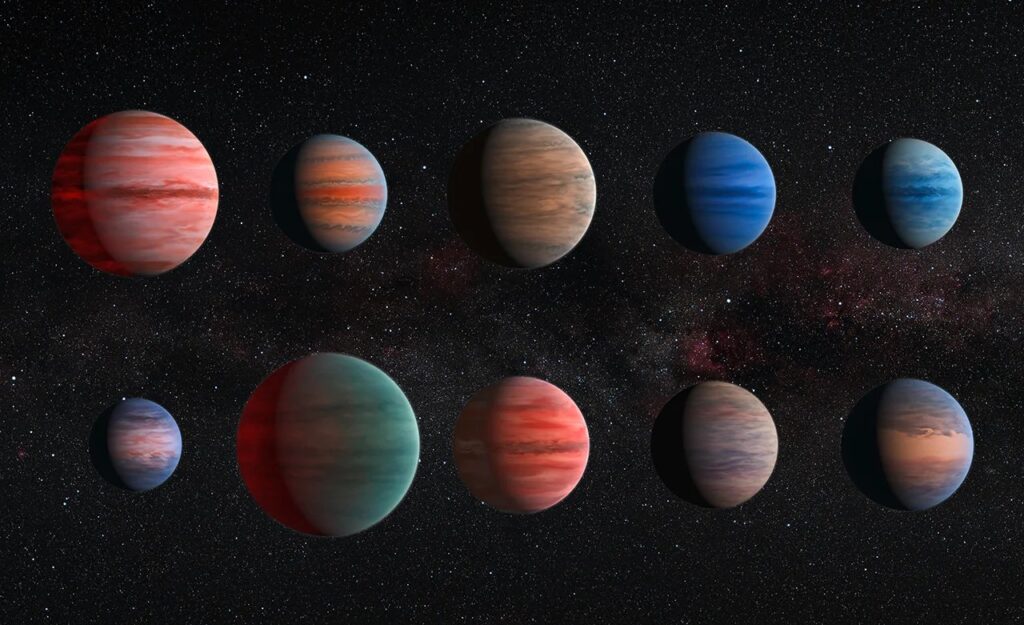
HD 189733b, a hot Jupiter roughly 63 light-years away, looks deep blue in reflected light, though not because of Rayleigh scattering by gas. Its blue is thought to come from a hazy atmosphere laced with silicate particles (effectively tiny glass grains) that scatter blue light, while sodium absorbs much of the red. Its dayside runs to well over 1,000 °C and its winds exceed 8,000 km/h, so the blue says nothing about whether anything could live there.
Expert Capsule — What Would a Green Sky Require?

Green light (~520–560 nm) sits in the middle of the visible spectrum: scattered less efficiently than blue by Rayleigh scattering, but more so than red. A sky dominated by green is essentially impossible through Rayleigh scattering alone, because any atmosphere that preferentially scatters green would scatter blue and violet even more strongly, and those shorter wavelengths would dominate. Green skies are possible but need an unusual combination of illumination, scattering and absorption. After some large volcanic eruptions, stratospheric sulfate particles of just the right size have produced green twilights by combining anomalous scattering with the long light path of twilight and ozone's Chappuis absorption. In anomalous scattering, across part of the visible spectrum the particles' scattering grows with wavelength, the reverse of Rayleigh scattering. Ordinary clear-air Rayleigh scattering under sunlight cannot produce a green daytime sky.
The Blue We Inherited
Other worlds have other skies. Earth’s clear blue is what remained after a chain of events: the origin of oxygenic photosynthesis, the Great Oxidation Event, and the disappearance of the methane haze that had episodically veiled the young planet. The blue overhead is physics, and also a sky kept clear of methane haze by the oxygen that cyanobacteria release.
Lord Rayleigh worked out the physics in 1871. The cyanobacteria, which evolved oxygen-producing photosynthesis back in the Archean, had started clearing it long before: their oxygen began building up in the air about 2.4 billion years ago.
Gen AI Disclaimer
Some contents of this page were generated and/or edited with the help of a Generative AI.
Media
Ten Clear to Cloudy Hot Jupiters – NASA
Key Sources and References
Bohren, C. F., & Huffman, D. R. (1983). Absorption and Scattering of Light by Small Particles. Wiley-Interscience. ISBN 047105772X. (Rayleigh and Mie scattering theory; wavelength-dependence of scattering; particle-size regimes.) https://openlibrary.org/isbn/9780471057727
Chandrasekhar, S. (1960). Radiative Transfer. Dover Publications. ISBN 0486605906. (Classical mathematical treatment of radiative transfer and Rayleigh scattering in planetary atmospheres.)
Young, A. T. (1982). Rayleigh scattering. Physics Today, 35(1), 42–48. doi:10.1063/1.2890003. (Rayleigh scattering terminology, history, and the molecular basis established by Rayleigh in 1899.) https://doi.org/10.1063/1.2890003
Strutt, J. W. (1871). On the light from the sky, its polarization and colour. Philosophical Magazine, 41, 107–120. (Rayleigh’s original derivation of the scattering law.) https://doi.org/10.1080/14786447108640452
Gibbs, P. (1997). Why is the sky blue? Physics FAQ, University of California, Riverside. (Red/blue and violet/red scattering ratios; why the sky is not violet (solar spectrum and eye sensitivity).) https://math.ucr.edu/home/baez/physics/General/BlueSky/blue_sky.html
NASA Space Place. Why is the sky blue? (Sky color, sunsets and the Martian sky explained.) https://spaceplace.nasa.gov/blue-sky/en/
NIST Computational Chemistry Comparison and Benchmark Database (CCCBDB). Experimental polarizabilities. (Polarizabilities of CO₂ (2.51 ų), N₂ (1.71 ų) and O₂ (1.56 ų).) https://cccbdb.nist.gov/pollistx.asp
Nassau, K. (1983). The Physics and Chemistry of Color: The Fifteen Causes of Color. Wiley-Interscience. ISBN 0471867764. (Sky color and color perception.) https://openlibrary.org/isbn/0471867764
Lee, R. L., Meyer, W., & Hoeppe, G. (2011). Atmospheric ozone and colors of the Antarctic twilight sky. Applied Optics, 50(28), F162–F171. (Ozone’s Chappuis-band absorption and the blue of the twilight sky.) https://opg.optica.org/ao/abstract.cfm?uri=ao-50-28-F162
von Savigny, C., et al. (2024). Explaining the green volcanic sunsets after the 1883 eruption of Krakatoa. Atmospheric Chemistry and Physics, 24, 2415–2422. (Green sunsets and twilights after volcanic eruptions, explained by aerosol scattering; role of ozone’s Chappuis band.) https://acp.copernicus.org/articles/24/2415/2024/acp-24-2415-2024.html
Zerefos, C. S., et al. (2007). Atmospheric effects of volcanic eruptions as seen by famous artists and depicted in their paintings. Atmospheric Chemistry and Physics, 7, 4027–4042. (Volcanic sunsets, Tambora 1815 and Turner’s skies.) https://acp.copernicus.org/articles/7/4027/2007/
Wilde, S. A., Valley, J. W., Peck, W. H., & Graham, C. M. (2001). Evidence from detrital zircons for the existence of continental crust and oceans on the Earth 4.4 Gyr ago. Nature, 409, 175–178. (Liquid water on Earth by 4.4 billion years ago.) https://doi.org/10.1038/35051550
Ueno, Y., et al. (2006). Evidence from fluid inclusions for microbial methanogenesis in the early Archaean era. Nature, 440, 516–519. (Methanogenesis by more than 3.46 billion years ago.) https://doi.org/10.1038/nature04584
Marty, B., Zimmermann, L., Pujol, M., Burgess, R., & Philippot, P. (2013). Nitrogen isotopic composition and density of the Archean atmosphere. Science, 342, 101–104. doi:10.1126/science.1240971. (Fluid inclusions in 3.0–3.5-billion-year-old quartz limit the partial pressure of nitrogen to at most ~1.1 bar, possibly as low as 0.5 bar.) https://doi.org/10.1126/science.1240971
Som, S. M., Buick, R., Hagadorn, J. W., Blake, T. S., Perreault, J. M., Harnmeijer, J. P., & Catling, D. C. (2016). Earth’s air pressure 2.7 billion years ago constrained to less than half of modern levels. Nature Geoscience, 9, 448–451. doi:10.1038/ngeo2713. (Gas-bubble sizes in 2.7-billion-year-old sea-level lava flows show air pressure below half of today’s.) https://doi.org/10.1038/ngeo2713
Pavlov, A. A., Brown, L. L., & Kasting, J. F. (2001). UV shielding of NH₃ and O₂ by organic hazes in the Archean atmosphere. Journal of Geophysical Research: Planets, 106(E10), 23267–23287. doi:10.1029/2000JE001448. (Methane-derived hydrocarbon haze in the Archean; optical properties and UV-shielding role.) https://doi.org/10.1029/2000JE001448
Zerkle, A. L., Claire, M. W., Domagal-Goldman, S. D., Farquhar, J., & Poulton, S. W. (2012). A bistable organic-rich atmosphere on the Neoarchaean Earth. Nature Geoscience, 5, 359–363. doi:10.1038/ngeo1425. (Geochemical evidence that the Archean haze switched on and off.) https://doi.org/10.1038/ngeo1425
Arney, G., Domagal-Goldman, S. D., Meadows, V. S., Wolf, E. T., Schwieterman, E., Charnay, B., Claire, M., Hébrard, E., & Trainer, M. G. (2016). The Pale Orange Dot: The Spectrum and Habitability of Hazy Archean Earth. Astrobiology, 16(11), 873–899. doi:10.1089/ast.2015.1422. (Coupled climate-photochemical-microphysical simulations of hazy Archean Earth; haze cools the surface ~20 K but habitable conditions persist; planet would appear orange from space; Titan analog.) https://doi.org/10.1089/ast.2015.1422
Feulner, G. (2012). The faint young Sun problem. Reviews of Geophysics, 50, RG2006. (Solar luminosity through Earth history; greenhouse solutions.) https://arxiv.org/abs/1204.4449
University of Johannesburg. Earth’s first glaciation at 2.9 Ga revealed by triple oxygen isotopes (research record). (Pongola glaciation, about 2.9 billion years ago.) https://pure.uj.ac.za/en/publications/earths-first-glaciation-at-29-ga-revealed-by-triple-oxygen-isotop/
Sessions, A. L., Doughty, D. M., Welander, P. V., Summons, R. E., & Newman, D. K. (2009). The continuing puzzle of the Great Oxidation Event. Current Biology, 19(14), R567–R574. doi:10.1016/j.cub.2009.05.054. (GOE timing and mechanisms; O₂ < 10⁻⁵ PAL before the GOE.) https://doi.org/10.1016/j.cub.2009.05.054
Gumsley, A. P., et al. (2017). Timing and tempo of the Great Oxidation Event. PNAS, 114(8), 1811–1816. (GOE onset 2.46–2.43 billion years ago; Paleoproterozoic glaciations.) https://portal.research.lu.se/en/publications/timing-and-tempo-of-the-great-oxidation-event/
Poulton, S. W., et al. (2021). A 200-million-year delay in permanent atmospheric oxygenation. Nature, 592, 232–236. doi:10.1038/s41586-021-03393-7. (Oxygen oscillations after the GOE; permanent oxygenation by about 2.22 billion years ago.) https://doi.org/10.1038/s41586-021-03393-7
Lyons, T. W., Reinhard, C. T., & Planavsky, N. J. (2014). The rise of oxygen in Earth’s early ocean and atmosphere. Nature, 506, 307–315. doi:10.1038/nature13068. (Review of Earth’s oxygenation history; Proterozoic atmospheric constraints.) https://doi.org/10.1038/nature13068
Planavsky, N. J., et al. (2014). Low Mid-Proterozoic atmospheric oxygen levels and the delayed rise of animals. Science, 346, 635–638. doi:10.1126/science.1258410. (Chromium-isotope evidence for oxygen at or below 0.1% of present levels.) https://doi.org/10.1126/science.1258410
Zhang, S., et al. (2016). Sufficient oxygen for animal respiration 1,400 million years ago. PNAS, 113(7), 1731–1736. (Oxygen above ~4% of present levels at 1.4 billion years ago.) https://pmc.ncbi.nlm.nih.gov/articles/PMC4763753/
Hoffman, P. F., et al. (2017). Snowball Earth climate dynamics and Cryogenian geology-geobiology. Science Advances, 3, e1600983. (Cryogenian Snowball Earth glaciations.) https://doi.org/10.1126/sciadv.1600983
Berner, R. A. (2006). GEOCARBSULF: A combined model for Phanerozoic atmospheric O₂ and CO₂. Geochimica et Cosmochimica Acta, 70(23), 5653–5664. doi:10.1016/j.gca.2005.11.032. (Quantitative reconstruction of Phanerozoic O₂; Silurian–Devonian secondary peak; Permian peak ~30% O₂; sharp drop at the Permian–Triassic boundary; Triassic low held at a floor of ~12% by fossil charcoal, then a more or less continuous rise from the late Triassic to the present.) https://doi.org/10.1016/j.gca.2005.11.032
Beerling, D. J., & Berner, R. A. (2000). Impact of a Permo-Carboniferous high O₂ event on the terrestrial carbon cycle. PNAS, 97(23), 12428–12432. doi:10.1073/pnas.220280097. (Modeled effects of a Permo-Carboniferous rise to ~35% O₂ on terrestrial productivity and carbon storage.) https://doi.org/10.1073/pnas.220280097
Krause, A. J., et al. (2018). Stepwise oxygenation of the Paleozoic atmosphere. Nature Communications, 9, 4081. (A newer, later trajectory for Paleozoic oxygenation.) https://doi.org/10.1038/s41467-018-06383-y
Harrison, J. F., Kaiser, A., & VandenBrooks, J. M. (2010). Atmospheric oxygen level and the evolution of insect body size. Proceedings of the Royal Society B, 277, 1937–1946. (The debated link between oxygen and insect gigantism.) https://doi.org/10.1098/rspb.2010.0001
Clapham, M. E., & Karr, J. A. (2012). Environmental and biotic controls on the evolutionary history of insect body size. PNAS, 109(27), 10927–10930. (Giant griffinflies with wingspans up to ~70 cm.) https://doi.org/10.1073/pnas.1204026109
Davies, N. S., et al. (2021). The largest arthropod in Earth history: insights from newly discovered Arthropleura remains. Journal of the Geological Society, 179. (Arthropleura size and its gigantism before the oxygen peak.) https://doi.org/10.1144/jgs2021-115
Stanley, S. M. (2016). Estimates of the magnitudes of major marine mass extinctions in earth history. PNAS, 113(42), E6325–E6334. (End-Permian marine species loss of about 81%.) https://doi.org/10.1073/pnas.1613094113
NASA Space Science Data Coordinated Archive. Earth, Mars and Venus fact sheets. (Atmospheric composition, surface pressure and gravity.) https://nssdc.gsfc.nasa.gov/planetary/factsheet/earthfact.html
Lemmon, M. T., et al. (2004). Atmospheric imaging results from the Mars Exploration Rovers: Spirit and Opportunity. Science, 306, 1753–1756. (Martian dust particle size (effective radius ~1.5 µm).) https://doi.org/10.1126/science.1104474
NASA Photojournal. Sunset in Mars’ Gale Crater (PIA19400). (Blue Martian sunset imaged by Curiosity.) https://science.nasa.gov/photojournal/sunset-in-mars-gale-crater
Tomasko, M. G., Doose, L., Engel, S., Dafoe, L. E., West, R., Lemmon, M., Karkoschka, E., & See, C. (2008). A model of Titan’s aerosols based on measurements made inside the atmosphere. Planetary and Space Science, 56(5), 669–707. doi:10.1016/j.pss.2007.11.019. (Titan’s haze measured by the Huygens probe’s DISR instrument; fractal aggregate particles with monomer radius ~0.05 microns.) https://doi.org/10.1016/j.pss.2007.11.019
Barnes, J. W., et al. (2018). Titan’s twilight and sunset solar illumination. The Astronomical Journal, 156, 247. (Titan’s “underwhelming” sunsets at visible wavelengths.) https://doi.org/10.3847/1538-3881/aae519
NASA Science. Titan: facts. (Titan’s atmospheric composition and orange haze.) https://science.nasa.gov/saturn/moons/titan/facts/
Titov, D. V., Ignatiev, N. I., McGouldrick, K., Wilquet, V., & Wilson, C. F. (2018). Clouds and hazes of Venus. Space Science Reviews, 214, 126. doi:10.1007/s11214-018-0552-z. (Review of Venus cloud and haze structure, composition and optical properties.) https://doi.org/10.1007/s11214-018-0552-z
Venus Science and Technology Definition Team (2009). Venus Flagship Mission Study. NASA/LPI. (Fraction of sunlight reaching the Venusian surface (~2.6%); the unknown cloud-top absorber.) https://www.lpi.usra.edu/vexag/documents/reports/Venus-STDT-Report-0409.pdf
Evans, T. M., et al. (2013). The deep blue color of HD 189733b: albedo measurements with Hubble Space Telescope/Space Telescope Imaging Spectrograph at visible wavelengths. The Astrophysical Journal Letters, 772, L16. (The blue reflected color of HD 189733b.) https://doi.org/10.1088/2041-8205/772/2/L16
Pierrehumbert, R. T. (2010). Principles of Planetary Climate. Cambridge University Press. (Atmospheric physics of planetary climates; faint young Sun and greenhouse gas discussion.)
Seager, S. (2010). Exoplanet Atmospheres: Physical Processes. Princeton University Press. (Exoplanet atmospheric physics; scattering and radiative transfer background.)
French, K. L., et al. (2015). Reappraisal of hydrocarbon biomarkers in Archean rocks. PNAS, 112(19), 5915–5920. (Archean biomarkers once used to date cyanobacteria shown to be contamination.) https://doi.org/10.1073/pnas.1419563112
Fournier, G. P., et al. (2021). The Archean origin of oxygenic photosynthesis and extant cyanobacterial lineages. Proceedings of the Royal Society B, 288, 20210675. (Oxygenic photosynthesis likely arose in the Archean, before the GOE.) https://pubmed.ncbi.nlm.nih.gov/34583585/