Il s'agit d'un article traduit par une machine. La version originale est disponible en anglais.
Driven to Distraction – How the car industry put a slot machine on your dashboard — and why no one stopped them
In March 2020, the Transport Research Laboratory published a study that should have changed everything. Commissioned by road safety charity IAM RoadSmart and conducted on a professional driving simulator, it tested what happened to drivers when they used Apple CarPlay and Android Auto via touchscreen while behind the wheel. The results were not ambiguous. Reaction times slowed by more than fifty percent. Drivers took their eyes off the road for up to sixteen seconds at a stretch — the equivalent, at motorway speeds, of travelling more than five hundred metres effectively blind. When researchers compared those figures against the existing literature on impaired driving, the finding was stark: a driver using a built-in touchscreen infotainment system was more impaired than a driver at the legal alcohol limit. The study — TRL Report PPR948 — is publicly available. IAM RoadSmart called for urgent action. The European Transport Safety Council covered it. The automotive press noted it, briefly.
Then almost nothing happened.
In the years that followed, car manufacturers continued to remove physical buttons and controls from their vehicles at an accelerating pace. The screens got larger. The menus got deeper. The tasks that once required a single physical gesture — turn up the heat, find a radio station, activate the heated seat — migrated into multi-layer software interfaces that demanded sustained visual attention to navigate. By 2022, a Swedish automotive magazine called Vi Bilägare decided to measure what this meant in practice. They drove twelve vehicles, including a Tesla Model 3 and a BMW iX, at 110 kilometres per hour along a closed course, asking drivers who had been given familiarisation time to perform four common in-car tasks. The 2005 Volvo V70 against which they were measured — a seventeen-year-old car with nothing but physical buttons — completed the same tasks in ten seconds. The BMW iX required 30.4 seconds. At those speeds, that difference represents the car travelling the length of roughly six football pitches while the driver’s attention was elsewhere.
In 2024, approximately 3,208 people died in distraction-affected crashes in the United States, according to the National Highway Traffic Safety Administration’s own figures. NHTSA also acknowledges, in its own internal analysis, that the officially reported number is likely less than a third of the real one — that the actual death toll attributable to driver distraction is closer to 12,400 annually. That gap exists, in part, because the crash reporting system has no field specifically for built-in infotainment distraction. The data that would build the legal and political case for regulation is, structurally, not collected.
This is a story about how that happened. It involves decisions made in boardrooms in Detroit, Munich, and Shenzhen. It involves a regulatory system that chose, repeatedly and by name, not to act. It involves the most successful consumer technology launch of the twenty-first century, an $8 billion acquisition that imported Silicon Valley logic into the automotive supply chain, and a Chinese industrial policy that made the economics of the whole transition possible. It involves, at its centre, a question that is easier to ask than to answer: if the research was available, if the risk was documented, if the deaths were real — why did no one stop it?
Part I: The Obvious Explanation Is Wrong
Ask most people why cars have screens instead of buttons and they will give you one of two answers. Consumers wanted them, they will say. Or: they’re cheaper to make. Both of these answers contain truth. The point is not that cost and consumer demand were irrelevant — they were real forces. The point is that neither caused this. They were the surface through which deeper forces operated.
On the question of consumer demand: it is accurate that, from roughly 2012 onward, large touchscreens scored well in automotive consumer surveys. JD Power’s Initial Quality Study, which is among the most widely cited benchmarks in the industry, consistently showed that buyers rated technology-forward interiors highly. What those surveys measured, however, was showroom impression — the feeling a buyer had during a twenty-minute test drive, not the experience of living with a system for three years. The ergonomic superiority of physical controls is not something you perceive during a demonstration. It is something you feel, and then feel grateful for, at six in the morning when you are trying to turn down the fan on a motorway without looking away from the road. The consumer preference data was real. What it measured was not what it appeared to measure.
On the question of cost: it is true that moving functions from physical controls to a software interface reduces assembly complexity in meaningful ways. A dashboard with sixty physical controls requires sixty wiring harness connections, sixty quality assurance checkpoints, and sixty separate SKUs managed across variants and markets. A single screen unit collapses much of that into one component. The savings, however, are in logistics and line complexity — not primarily in component price. For much of the period of rapid screen adoption, automotive-grade displays were not cheap. What made them economically irresistible was a set of forces operating far upstream from the factory floor, in Chinese government industrial policy and the financial strategies of the world’s largest technology companies.
The real answer to why every new car has a screen is not one reason. It is a cascade of approximately forty-four of them, operating across different time horizons and pulling in the same direction. But among those forty-four, ten drove the transition more than all the others combined. Understanding them requires beginning not with the car industry at all, but with a presentation in Geneva.
Part II: The Ten Forces
The first and most immediate force arrived not from inside the car industry at all. On the morning of March 3, 2014, Apple’s press office issued a statement announcing that “leading auto manufacturers are rolling out CarPlay, the smarter, safer and more fun way to use iPhone in the car.” The launch partners named were Ferrari, Mercedes-Benz, and Volvo. Within months, twelve major manufacturers had committed. By 2023, according to aftermarket industry tracking, CarPlay was available in approximately 93.9 percent of new vehicle models sold in the United States, up from 35.2 percent in 2017.
The significance of CarPlay’s arrival is difficult to overstate, and it is routinely underestimated in accounts of the touchscreen transition. The critical mechanism is this: CarPlay requires a touchscreen to function. There is no version of CarPlay that works through a rotary dial or a bank of physical buttons. When Apple announced the system and consumer demand for it became immediate — because hundreds of millions of people already knew how to use an iPhone and wanted that interface in their car — automotive manufacturers faced a binary choice. Install a screen, or lose buyers to competitors who had. The choice had already been made for them by a technology company that had no particular investment in automotive ergonomics or road safety, and whose primary product happened to require a touchscreen to operate. Android Auto, announced by Google later in 2014 and available in vehicles from 2015, imposed the same requirement.
This is a causal claim that can be dated and documented. Before CarPlay, the industry was moving toward screens. After CarPlay, it had no practical alternative. The transition from optional feature to table-stakes requirement happened in a single product announcement at a motor show, made by a company that manufactures telephones.
The second force provided the economic foundation that made screens cheap enough to install universally. The financial architecture that made screens economically rational followed from a development originating in East Asia. Throughout the 2010s, Chinese display manufacturers — led by BOE Technology, CSOT, and Tianma — expanded their production capacity for LCD and OLED panels at a scale that fundamentally restructured the global display market. BOE, whose six largest shareholders as of 2020 were state-owned investment companies from Beijing, Chongqing, and Hefei, grew to become the world’s number one manufacturer of car display panels by shipment volume, a position it announced having reached in 2022. The expansion was, in substantial part, financed by the Chinese state as a matter of industrial policy. The consequence was a chronic oversupply of panels that drove prices down steeply across the decade. Korean manufacturers LG Display and Samsung Display — who had previously led the global LCD market — found themselves unable to compete and began exiting the business. LG Display’s Guangzhou plant, its last remaining LCD factory, was put up for sale in 2024. Samsung had abandoned its LCD business in 2020.
For automotive manufacturers, this price collapse meant that placing a large display in a vehicle went from a significant cost decision to, increasingly, a trivial one. The economics of “just put a screen there” became viable precisely because Chinese state industrial policy had made panels cheap. This is a causal chain that runs from a government ministry in Beijing to the dashboard of a vehicle assembled in Wolfsburg or Coventry or Sunderland — and it almost never appears in accounts of how the screen transition happened.
The third force was corporate rather than governmental. On November 14, 2016, Samsung Electronics announced that it had agreed to acquire Harman International Industries — the company behind automotive infotainment brands including JBL, Harman Kardon, and the majority of the infotainment systems installed in European and American vehicles — for $112 per share in cash, a total equity value of approximately $8 billion. Samsung’s own press release described it as an acquisition designed to “accelerate growth in automotive and connected technologies.” It was the largest overseas acquisition in Samsung’s history. Independent Korean financial reporting, including coverage by The Investor at the time of closing in March 2017, confirmed it as the largest-ever buyout by a South Korean company.
The Harman deal did something the CarPlay launch had begun but not completed: it brought consumer electronics capital, timelines, and competitive logic fully inside the automotive supply chain. Harman had supplied infotainment systems to dozens of manufacturers. Samsung now owned those supply relationships, and brought to them the iteration speed and software-first philosophy of a company whose primary business was selling smartphones. The pressure on automotive OEMs to match consumer electronics standards of display quality, UI responsiveness, and feature velocity became structural. Other technology companies drew the same conclusion: Intel acquired Mobileye in 2017; Qualcomm built its automotive SOC business into a division projecting billions in revenue. The car had become, in the eyes of the technology industry, a very large connected device with wheels.
Against this backdrop, the fourth force — which might otherwise seem merely aesthetic — takes on structural significance. The car industry had, for decades, produced its most important reveals at motor shows in Frankfurt, Detroit, and Geneva. From roughly 2014, that began to change. Major automotive announcements started happening at the Consumer Electronics Show in Las Vegas. The implications were not merely symbolic. CES is evaluated by technology press, using technology criteria. At CES, the relevant comparison for a car’s interior is not the Volkswagen Golf from the previous model year — it is a Samsung television or an Apple iPad. Screen size, UI fluency, and software sophistication became the metrics by which automotive interiors were judged, because the venues in which they were judged had been designed to evaluate those things. Automotive journalism followed directly from this venue shift. The major review outlets — Car and Driver, Motor Trend, What Car, Auto Bild — developed infotainment scoring systems that explicitly weighted technology quality. A poor infotainment score could measurably reduce an overall star rating, which could measurably affect sales. Manufacturers optimising for reviews therefore had a direct financial incentive to invest in screen sophistication, irrespective of whether screen sophistication correlated with driver safety or usability. The reviewers who wrote the scores and the editors who published them were not acting maliciously. They were responding, as institutions do, to what their readers said they wanted. Their readers had been conditioned, by a decade of smartphone ownership, to expect a particular kind of interface. The feedback loop was closed, and physical controls were on the wrong side of it.
The fifth force operated at the psychological level, and it is the one that automotive manufacturers understood best and discussed least openly. A car is an unusual consumer product in that most of the relevant information about it — how it feels to drive over time, how intuitive its controls become after three months of daily use, how much cognitive load a particular interface imposes at highway speed — is invisible during the purchasing decision. What a buyer can assess in a showroom is appearance, and what a large glowing screen conveys, in a showroom, at the moment of first impression, is modernity and technological sophistication. Physical buttons convey nothing. They simply work.
Consumer psychology has a term for products where short-term impressions diverge from long-term experience: “experience goods.” The automotive industry knows this distinction. Internal product research at multiple manufacturers consistently showed that infotainment satisfaction scores declined over the ownership period — buyers who were impressed at purchase became frustrated over time. The industry also knew that this frustration did not feed back into purchase decisions in a meaningful way, because most buyers make their next purchase decision in a showroom, where the screen once again makes its immediate impression. The market correction mechanism that would, in a rational market, have penalised poor long-term usability was broken. Manufacturers with good research departments knew this. They shipped the screens anyway.
The sixth force is the one that automotive executives would most strongly prefer not to discuss, and the one that most clearly explains why the transition became, from the manufacturer’s perspective, irreversible. Screens are not merely a design choice. They are infrastructure for a different business model.
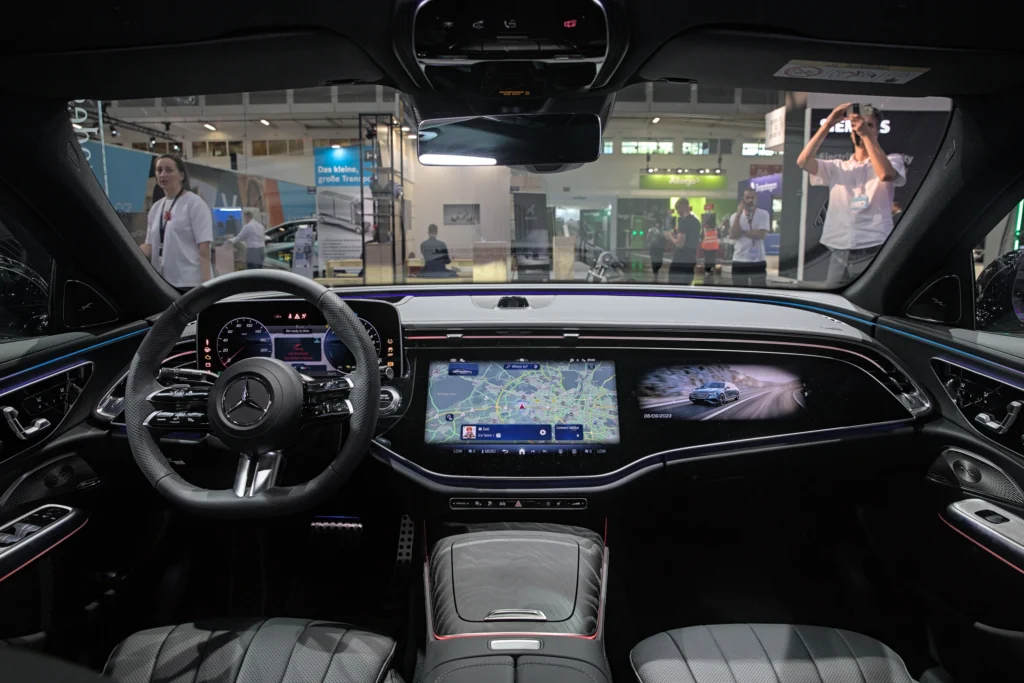
A physical switch can be toggled. It cannot be disabled remotely, unlocked by subscription, or updated over a network. A connected touchscreen can do all three. BMW has charged subscription fees for heated seats — a function the hardware already supported, gated behind a software paywall and unlocked through a touchscreen interface. Mercedes-Benz has sold accelerator response upgrades as a recurring subscription. Cadillac’s Super Cruise driver assistance system operates on a subscription model. These are not peripheral experiments. They represent a fundamental restructuring of the automotive revenue model, from a business in which the manufacturer’s financial relationship with the customer ends at purchase, to one in which the car itself is a recurring revenue platform. This restructuring is only possible if the car contains a connected screen. It is not possible with physical switches.
The subscription model also explains something that pure design logic cannot: why, by the late 2010s, automotive manufacturers had become vocally hostile to any regulatory constraint on screen functionality. A regulation mandating simplified infotainment interfaces, or limiting the number of functions accessible via touchscreen while moving, would directly threaten the infrastructure through which subscription features are delivered and over-the-air updates are monetised. The financial stakes of interface regulation had grown considerably since the first screens appeared.
There is also a legal dimension that manufacturers have not been eager to publicise. When a safety-critical feature — cabin temperature, rear demister, windscreen wiper speed — requires navigating through multiple software menus to access, manufacturers can more credibly argue, in litigation following an accident, that any failure to use the system safely represents driver misuse rather than design defect. Physical buttons create a different liability exposure: a driver who reaches for a knob and finds it immediately has less room to claim that the interface was dangerously complex. The migration of controls into screens was not only a revenue strategy. It was also, as a legal matter, a risk-transfer mechanism — one that shifted responsibility from the designer to the driver.
The seventh force ran parallel to the subscription logic: data. A connected touchscreen does not merely display information. It collects it. Every tap, every menu navigation, every destination entered into a navigation system generates data about driver behaviour, routes, preferences, and patterns. That data has established commercial value — in insurance partnerships, in traffic analytics sold to mapping companies, in product development. Physical buttons generate no data. From the perspective of a connected car platform, they are invisible. The transition from buttons to screens was, among other things, a transition from a product that could not be instrumented to one that could.
The eighth force was demographic and cultural, and it arrived on schedule. Between roughly 2016 and 2019, millennials — defined here as those born between 1981 and 1996 — surpassed baby boomers as the largest car-buying demographic in the United States and Western Europe. This is the first generation of car buyers who learned to navigate before they learned to drive. Their spatial and informational intuitions were formed on touchscreen devices. For them, a rotary dial connected to a nested menu system is not intuitive — it is the legacy interface, the thing that requires learning. A touchscreen running a smartphone-derived operating system is the familiar one. Manufacturers designing for the next decade’s primary buyer had a documented demographic reason to weight software interfaces over physical controls.
The ninth force was internal, and harder to see from outside. The car companies that survived the 2010s were not the car companies of the 1990s. They had reorganised, in many cases dramatically, around software capability — partly because the technology demanded it, partly because investors required it. Ford created “Team Edison.” Volkswagen created “CARIAD.” To staff those organisations, manufacturers needed software engineers. To attract software engineers from Google, Apple, and Amazon, they had to offer work that felt like software work. Designing a button cluster is not software work. Designing a vehicle operating system, building application layers, iterating on UI — that is. The internal talent competition that shaped the hiring strategies of the world’s largest car companies subtly but persistently biased product decisions toward software-forward solutions. Not because anyone mandated it, but because the people building the products had been hired to build software, and software prefers screens.
The tenth force — and in some ways the most architecturally significant — came from the powertrain. The internal combustion vehicle is a constrained design space. A firewall separates engine from cabin. A transmission tunnel runs through the floor. Gear selectors, handbrakes, and HVAC ducting occupy fixed volumes. These physical constraints shaped dashboard architecture for a century, creating inherited positions and logic for controls that successive designers could adapt but rarely eliminate. The electric vehicle has none of these constraints. A flat battery floor, no engine firewall, no transmission tunnel. When Tesla designed the Model S interior, released in 2012, there was no convention to follow and no legacy packaging to accommodate. The blank canvas solution — a seventeen-inch screen in the centre of a bare, flat surface — was not inevitable, but it was available in a way it had never been before. That decision, and the company’s subsequent rise to genuine status symbol, established a template that every manufacturer entering EV development was then measured against.
Part III: The China Chapter
The China dimension of this story has received almost no attention in Western coverage, which is itself a kind of evidence about how the story has been framed.
Begin with the market. China is the world’s largest single automotive market. For Volkswagen, GM, BMW, and Mercedes-Benz, it is not merely large — it represents a disproportionate share of global profit, the market that cross-subsidises product development costs spread across every other geography. What Chinese consumers want, the product planners at those companies pay very serious attention to. And Chinese consumers, consistently across multiple market research sources including McKinsey and JD Power China, have shown a measurably stronger preference for technology-forward vehicle interiors than their European or American counterparts. Large screens score higher. Software features score higher. Physical button-heavy dashboards score lower.
The consequence, which is logical once stated, is that when a global manufacturer designs a single platform for deployment across multiple markets — as all of them do, because parallel platform development is prohibitively expensive — they design it for their most important market. The platform that sells in China becomes the platform that is sold in Germany, the United Kingdom, and the United States. The Chinese consumer preference for screens did not merely influence Chinese-market vehicles. It influenced every vehicle.
This dynamic was then amplified by the entry of Chinese EV manufacturers. NIO, Xpeng, Li Auto, and BYD brought to market vehicles with dual screens, rotating screens, and rear passenger entertainment systems as standard equipment — not as luxury options but as baseline features. These brands reset the reference point for what a modern car interior looked like. When BYD became the world’s top-selling EV brand and began selling vehicles in Europe, Western manufacturers faced a specific kind of competitive pressure: one defined not by powertrain or dynamics, which take years to develop, but by interior specification, which can be changed within a single model cycle. The fastest way for a Western OEM to look competitive against a Chinese rival was to install a larger screen.
Then there is the supply chain. BOE Technology — whose six largest shareholders as of 2020 were state-owned investment companies from Beijing, Chongqing, and Hefei — had by 2022 become the world’s leading manufacturer of automotive display panels by shipment volume. BOE’s expansion, and that of its domestic rivals CSOT and others, was underwritten by a level of state investment that private-sector competitors in South Korea and Japan could not match. The result was a sustained price collapse in LCD and OLED panel markets. LG Display, which had been a global leader, posted operating losses of 2.09 trillion won in 2022 and 2.5 trillion won in 2023. Samsung abandoned its LCD business in 2020. The Korean manufacturers who had dominated global display production were driven out of the market by Chinese competitors operating with structural cost advantages funded by the state.
For automotive manufacturers sitting outside China, this meant that the economics of installing a large display had shifted fundamentally. What had been a meaningful cost became, over the course of a decade, comparatively trivial — not because automotive displays became technically simpler, but because Chinese industrial policy had made the panels that constitute them very cheap. A geopolitical decision taken in Beijing had a direct design consequence in every car sold in Bradford, Baltimore, and Berlin.
Part IV: The Body Count
The TRL study published in March 2020 is, by any reasonable measure, one of the most important automotive safety documents of the past decade. It is available as Report PPR948 on the Transport Research Laboratory’s website. It found that drivers using Apple CarPlay via touchscreen experienced reaction time degradation of 57 percent compared to undistracted driving. For context, the same research tradition — using the same simulator, the same test route — had previously established that driving at the legal alcohol limit degrades reaction times by approximately 12 percent. Cannabis impairs by approximately 21 percent. Texting while driving — the behaviour that prompted legislation across most of the developed world — produces degradation of approximately 35 percent.
The touchscreen impairment figure is worse than all of them.
The study also documented that drivers took their eyes off the road for up to sixteen seconds while interacting with the system. At motorway speeds, sixteen seconds represents a distance of more than five hundred metres travelled without meaningful attention on the road ahead. IAM RoadSmart, which commissioned the study, called for mandatory pre-market testing of infotainment systems and consistent industry standards for driver distraction. “Driver distraction is estimated to be a factor in around a third of all road collisions in Europe each year,” said Neil Greig, IAM RoadSmart’s Policy and Research Director, in the study’s release. “We’re now calling on industry and government to openly test and approve such systems.”
The industry did not openly test and approve such systems.
Two years later, Vi Bilägare’s practical road test confirmed the findings in a format accessible to any reader: a 2005 car with physical buttons was faster and less distracting than every modern touchscreen-equipped vehicle they tested. The BMW iX — a vehicle that costs over £80,000 in the United Kingdom — required a driver to spend 30.4 seconds completing four routine tasks, compared to ten seconds in the Volvo. The tasks selected — adjusting cabin temperature, finding a radio station, activating the heated seat, and resetting a trip computer — are everyday in-car interactions, not edge cases. Critics of the test argued the task selection inherently favoured physical buttons. That argument proves the point: when the most ordinary interactions a driver performs are ones that physical controls handle faster and with less visual attention, the design has failed.
The official American death toll from distracted driving sits at approximately 3,200 per year, according to NHTSA’s own published figures — 3,308 in 2022, 3,275 in 2023, 3,208 in 2024. But NHTSA’s own internal analysis, cited in reporting by Smart Cities Dive in 2024, estimated the true 2021 death toll attributable to driver distraction at closer to 12,400 — a number more than three times higher than what appears in official statistics. The gap exists for a reason that is itself part of the story: NHTSA’s crash coding system — the Fatality Analysis Reporting System — does not have a specific field for built-in infotainment distraction. Crashes involving in-car screens are classified as “distraction/inattention — other.” They disappear into a category that proves nothing specific to anyone.
This is not a technological limitation. It is a categorisation choice. The category structure of a crash reporting system is a policy decision. Without the specific data, the specific regulatory case is much harder to make. Without the regulatory case, the specific standard is much harder to mandate. The architecture of the data collection system is itself a permissive structure for the manufacturers whose products it fails to isolate.
Part V: The Institutions
The story of how regulatory institutions failed to respond to documented evidence of harm in the automotive touchscreen era is not, properly told, a story about corruption or conspiracy. It is a story about how institutional structures produce outcomes that serve the powerful without anyone in those institutions needing to be dishonest or criminal. The mechanism is more mundane than malfeasance, and in some ways more troubling.
Begin with the document. On April 26, 2013, NHTSA published its Visual-Manual Driver Distraction Guidelines for In-Vehicle Electronic Devices in the Federal Register, under Docket No. NHTSA-2010-0053. The document is careful and thorough. It specifies a maximum task completion time of twelve seconds and a maximum individual glance duration of two seconds. It notes that these criteria are derived from research. It acknowledges the safety stakes clearly. And then, in language that the Federal Register reproduces without irony, it states: “NHTSA has opted to pursue nonbinding, voluntary guidelines rather than a mandatory Federal Motor Vehicle Safety Standard.”
The document describes this as “Phase 1” of a three-phase programme. Phases 2 and 3, covering portable devices and voice interfaces, were also to be developed. The administrator who presided over Phase 1 was David Strickland, whom President Obama had nominated to lead NHTSA in 2010.
Strickland left NHTSA in January 2014. On January 8, 2014 — the same month — Venable LLP, a Washington law firm, issued a press release announcing that he would be joining the firm as a partner. Venable described his role as supporting the firm’s “Government Affairs, Automotive, and Technology practices.” Among Venable’s clients at the time were the Alliance of Automobile Manufacturers — the primary lobbying body for the auto industry in Washington — and Chrysler, then owned by Fiat. This was not a secret. It was reported at the time by Streetsblog USA and extensively documented by Safety Research & Strategies, a road safety advocacy organisation. Strickland subsequently served as counsel to the Self-Driving Coalition for Safer Streets — whose members included Google, Ford, Volvo, Uber, and Lyft — before joining General Motors in October 2021 as Vice President of Global Regulatory Affairs.
Phases 2 and 3 of NHTSA’s distraction guidelines programme were never completed as mandatory standards. The twelve-second guideline was never encoded in law. As of 2026, there is no mandatory pre-market testing requirement for automotive infotainment systems in the United States. There is no specific legal category for built-in infotainment distraction in American crash law. A manufacturer may, without violating any federal standard, install a system requiring thirty seconds of eyes-off-road time in a vehicle sold to the American public.
Strickland is one data point in a longer pattern. Safety Research & Strategies has documented that NHTSA’s senior officials have a well-established history of moving into industry roles — either directly with automakers or with law firms that represent them — immediately after leaving the agency. He is not exceptional; he is representative. The revolving door between NHTSA and the industry it regulates is a structural feature, and structural features produce predictable behaviours. Regulators who anticipate post-government careers in industry regulate with a moderation that does not need to be explicitly requested.

The liability dimension of this story connects directly to the regulatory one in a way that is rarely made explicit. As argued in Part II, the migration of controls from physical buttons to software menus shifted legal exposure onto drivers — manufacturers could more credibly claim misuse when a complex interface was operated unsafely. What follows from that, and what belongs in any account of regulatory failure, is this: a manufacturer that has already transferred liability to the driver has a structural disincentive to support regulations that would transfer it back. Mandatory interface standards — maximum task complexity, required physical controls for safety-critical functions — would not only constrain product design. They would re-establish a design standard against which a product could be measured in litigation, and found wanting. The industry’s resistance to interface regulation was not only about protecting subscription revenue or software flexibility. It was also about preserving a legal architecture that had been quietly and profitably constructed over the preceding decade.
In Europe, the picture is different in form but similar in outcome. The EU’s General Safety Regulation 2019/2144 — GSR2, adopted in late 2019 and mandatory from July 2022 — is the most comprehensive vehicle safety regulation the bloc has produced in a generation. It mandated intelligent speed assistance, autonomous emergency braking, lane-keeping systems, event data recorders, and an “Advanced Driver Distraction Warning” system. That last feature sounds directly relevant. It is, in practice, a camera mounted inside the vehicle to monitor the driver’s eye and head position, which warns if the driver looks away from the road. It is a system that detects distraction after the fact. What GSR2 does not contain — anywhere in its considerable length — is a requirement relating to how infotainment systems must be designed. No task complexity limit. No maximum eyes-off-road time for infotainment interactions. No requirement for physical controls for common functions. The regulation that was supposed to address driver distraction tells the car to watch the driver’s eyes. It does not tell the car’s software to stop demanding that those eyes look elsewhere.
This omission did not go unnoticed during the regulation’s development. The European Automobile Manufacturers’ Association — ACEA — which represents BMW, Mercedes-Benz, Volkswagen, Stellantis, Renault, and every other major OEM, is a registered lobbying organisation in the EU Transparency Register, a public database of interest groups that interact with EU institutions. Its president during the period of GSR2’s adoption was Oliver Zipse, the CEO of BMW. Its Director General was Eric-Mark Huitema. ACEA’s public position on the automotive transition was consistently focused on electrification and digitalisation as opportunities. Its position on mandatory infotainment interface standards during GSR2 consultation was not something retrievable from publicly available documents in the course of this research — but what is retrievable is the regulation that emerged, and what it does not contain.
Euro NCAP, the consumer-facing safety ratings body whose five-star rating drives purchasing decisions across Europe more reliably than almost any other signal, operated throughout the entire period of touchscreen deployment — roughly 2012 to 2024 — without meaningfully penalising vehicles for infotainment distraction risk. A car requiring thirty seconds of eyes-off-road time to change the cabin temperature could receive five stars. In November 2025, Euro NCAP’s Secretary General Dr. Michiel van Ratingen announced changes to the organisation’s assessment protocols for 2026. Among the new criteria: evaluation of “the placement, clarity, and ease of use of essential controls — including the availability of physical buttons for commonly used functions.” This announcement, which amounted to an institutional admission that physical button availability matters for safety, came approximately fifteen years after the first large-scale deployments of touchscreen-only interiors.
The explanation that requires the least interpretive charity is institutional capture: an underfunded regulator, staffed by officials who expect post-government careers in the industry they regulate, operating under political pressure from an industry that employs millions in electorally significant states, will systematically under-regulate without anyone in that institution needing to make an explicit corrupt decision. NHTSA’s staffing stood at 620 full-time equivalents in FY2021, rising to 848 by FY2024 only after substantial new infrastructure funding — numbers that, across the entire period of the touchscreen transition, left the agency with fewer than 750 staff to oversee the safety standards of the world’s largest consumer industry. Its budget, while nominally large due to grant programmes distributed to states, allocates less than $250 million to vehicle safety research and rulemaking. It cannot run the research at the pace technology deploys.
There is also the question of framing. Throughout this period, distracted driving was framed — by manufacturers, by regulators, and largely by media — as a behavioural problem. A driver who looked at their screen was making a bad choice. The solution was education: campaigns, public service announcements, “Put the Phone Away or Pay.” The product design question — why does the car require the driver to look at the screen for thirty seconds to adjust the temperature — was almost entirely absent from public discussion. That framing is documented in regulatory language, in industry position papers, and in the coverage record. It is also tactically convenient for manufacturers, because behavioural problems require awareness campaigns, not product recalls.
The parallel that public health researchers have drawn — between the automotive safety response to infotainment risk and the tobacco industry’s management of health evidence in the 1960s and 1970s — is not a casual comparison. It appears in peer-reviewed literature: Braun and Randell, writing in the journal Mobilities in 2025, explicitly document the use of doubt-manufacturing, individual-responsibility framing, and regulatory delay as shared tactics between the tobacco industry and the automotive sector. Miner et al., in the Journal of Transport Geography (2024), document parallels between the lobbying tactics deployed by the automobile industry against safety regulation and those historically used by the tobacco industry. The mechanism described in both cases is the same: manufacture scientific ambiguity. Emphasise individual responsibility. Fund research that reaches more equivocal conclusions. Delay until the product is too deeply embedded to regulate without causing economic disruption. The pattern does not require coordination to operate. It requires only that a well-funded industry with a financial stake in the status quo interact with a structurally weakened regulator in a political environment where the industry employs millions of voters.
Closing
There are signs, as of early 2026, that the wall is cracking. Euro NCAP’s 2026 protocols will penalise vehicles that fail to provide physical buttons for common functions. Some manufacturers — Volkswagen, in certain models; Volvo, with its explicit design reversal — have begun quietly restoring physical controls that were removed only years earlier. The European Commission is, for the first time, generating internal discussion about mandatory infotainment interface standards. The regulatory silence that accompanied fifteen years of screen deployment is, slowly, ending.
Porsche offers the most instructive case study in what acting on the evidence looks like. The Taycan, released in 2019, stripped the centre console of almost all physical controls. Customer feedback was negative. By the 2024 Cayenne, Porsche had quietly begun restoring toggles and knobs for climate, fan speed, and volume — functions that the Taycan had absorbed entirely into its touchscreen. Cayenne electronics manager Dirk Assfalg confirmed to The Drive in October 2025 that Porsches will “always” retain certain physical controls, citing customer demand as the direct driver. He acknowledged, without euphemism, that the Taycan had gone too far. Porsche is not alone in this reversal — Volkswagen has made similar admissions, and Hyundai has committed to returning physical controls to upcoming production models — but Porsche is the clearest example of an institution that had access to the same research as everyone else, received the same customer signals as everyone else, and made a different choice. Its reversal is an implicit indictment of every manufacturer that has not.
What it leaves behind is a fleet. Hundreds of millions of vehicles, sold in the years when the research was available and the regulators did not act, are now on the roads of Europe and North America with interfaces that require their drivers to look away from the road for seconds that are, at speed, significant distances. The 3,208 Americans who died in distraction-affected crashes in 2024 cannot be disaggregated into those killed by phones and those killed by built-in screens, because the crash coding system does not make that distinction. That is, as this piece has attempted to document, not an accident.
I counted the reasons this happened. There are forty-four of them. They are listed in the appendix that follows as a reference document — a research foundation rather than a continuation of the argument above. Some of them are the legitimate consequences of engineering progress and market forces. Several of them are the consequences of institutions that were structured, and in some cases managed, to produce outcomes more favourable to manufacturers than to drivers. Holding both of those things in mind simultaneously is not comfortable. It is, however, accurate.
Appendix: The Complete Research Foundation
The following list constitutes the analytical foundation from which this article was developed. It documents all identified factors — economic, regulatory, engineering, cultural, psychological, and geopolitical — that contributed to the transition from physical controls to touchscreen interfaces in passenger vehicles. It is presented as a reference document and research tool, not as an exhaustive citation list. Primary sources for all factual claims used in the article above are identified in the Source Notes that follow the list.
Economics & Supply Chain
1. Software updates as a product strategy Physical controls are frozen at the moment of manufacture. Screens let manufacturers ship an unfinished product and patch it later — or add features post-sale. Tesla demonstrated that it was possible to sell features years before they functionally existed. The car becomes a subscription platform, not a finished object.
2. Genuine cost reduction — but not the obvious kind The real saving is in assembly complexity. A dashboard with sixty physical controls requires sixty harness connections, sixty QA checkpoints, sixty SKUs for variants. A screen collapses that into one unit. The savings are in logistics, inventory, and line complexity — not in the component price.
3. Localisation became trivially easy Physical buttons need engraved or printed labels — different tooling for every language market. A screen changes language in software. For a global manufacturer selling in fifty-plus countries, this is operationally significant.
4. Platform sharing across brand families Volkswagen Group sells under VW, Audi, Škoda, SEAT, Porsche, Lamborghini, and Bentley nameplates. Stellantis has fourteen brands. One screen platform deployed across all of them is an enormous efficiency. Screens allow the group to maintain the appearance of differentiation while sharing ninety percent of the underlying system. The MEB and STLA platforms both depend on this logic.
5. Warranty and repair economics A broken physical switch requires a specific replacement part. A software fault costs nothing to fix remotely. Hardware screen module failures are often covered by replacing one unit rather than diagnosing one of sixty possible failed switches.
6. Screens consolidate repair into dealer networks A physical switch can be replaced by any mechanic with a commodity part. A screen module failure routes the owner back to the dealer, to proprietary diagnostic software, to authorised repair. This is documentable in repair cost data and is increasingly a legislative issue under right-to-repair frameworks in the US and EU.
Regulatory & Legal Dynamics
7. Regulation arbitrage Physical buttons require type approval and safety certification for each variant. A screen running software can be updated without re-certifying the hardware. One screen can legally replace forty certified switches.
8. Regulatory lag on distracted driving created a permissive environment Multiple studies showed touchscreens significantly more cognitively demanding than physical controls. Regulation consistently lagged deployment by roughly a decade.
9. Liability architecture — screens shift responsibility to the driver When a feature requires deliberate navigation through multiple menus to activate, manufacturers can more credibly argue driver misuse rather than design failure in litigation. Physical buttons create different liability exposure. The shift from buttons to screens was, among other things, a quiet restructuring of where accident liability sits.
10. The eCall mandate created connectivity infrastructure that screens could exploit The EU mandated eCall — automatic emergency calling — in all new cars from 2018, requiring every new car to have a cellular modem. Once that infrastructure existed, the marginal cost of a fully connected touchscreen dropped. A safety mandate inadvertently subsidised the screen transition.
Engineering Inevitabilities
11. The death of the instrument cluster as a separate ECU As processing power became cheap, it became rational to run everything through one central compute node. A screen is the output of that consolidation — an engineering inevitability once system-on-chip became powerful enough.
12. The merger of navigation and entertainment made a screen necessary Once GPS navigation moved in-car in the early 2000s, a screen was already installed. The logic of “why not put everything else here too” became difficult to resist. The screen was the camel’s nose.
13. Feature proliferation genuinely outgrew the physical dashboard A 1990 car had roughly twenty to thirty driver-accessible functions. A 2020 car has two hundred to three hundred. Physical space is finite. Some consolidation onto screens was a genuine engineering response to real complexity growth — not purely aesthetic or economic.
14. EV architecture created a genuine design blank slate ICE vehicles have a firewall, engine tunnel, and transmission hump — physical constraints that shaped dash architecture for a century. EVs have a flat floor and no tunnel. Early EV designers faced an empty canvas. The default — a screen — was available in a way it had never been before.
Platform & Software Strategy
15. Apple CarPlay and Android Auto mandated screens from outside the industry When Apple announced CarPlay on March 3, 2014 at the Geneva Motor Show, consumer demand for it became immediate. CarPlay requires a touchscreen to function. Every manufacturer that wanted to offer it — which was all of them, because buyers demanded it — had no choice but to install a screen. The transition was forced by a technology company with no stake in automotive ergonomics.
16. Subscription feature monetisation requires screens as delivery infrastructure BMW’s heated seat subscription. Mercedes-Benz’s acceleration upgrade. Cadillac’s Super Cruise subscription. None of this works without a connected screen that can gate features behind a paywall. The subscription economy in cars is not possible with physical switches. Screens are the infrastructure for a fundamentally different revenue model.
17. Data collection Connected screens collect detailed behavioural data — what is tapped, when, how the car is used. That data has established monetary value for insurance partnerships, traffic analytics, and product development. Physical buttons generate no data.
18. Perceived differentiation with minimal engineering Changing a button layout requires retooling. Changing a screen UI requires a software update. Brands can offer apparently different-feeling trim levels, special editions, or regional variants with almost no marginal cost.
Corporate Narrative & Investor Relations
19. The “Software Defined Vehicle” narrative was built for Wall Street From roughly 2019, every major OEM needed to tell investors it was a technology company, not a manufacturer, to escape the low valuation multiples applied to traditional automakers. The SDV narrative required screens as physical evidence. Ford, GM, Volkswagen, and Stellantis all restructured around this framing. Screens were, in part, investor communications.
20. Samsung’s acquisition of Harman in 2016 brought consumer electronics logic into the supply chain $8 billion. Announced November 14, 2016. The largest acquisition in Samsung’s history and the largest-ever buyout by a South Korean company. It restructured competitive dynamics for every Tier-1 infotainment supplier. After Harman, the pressure to match consumer electronics quality and iteration velocity became structural.
21. Platform consolidation pressure from suppliers Tier-1 suppliers built large businesses around infotainment platforms and pushed OEMs toward screens because it locked in long-term software contracts. The supply chain pulled manufacturers toward screens as much as consumer demand did.
The China Factor
22. China became the world’s largest car market, with measurably stronger preference for large screens Research from McKinsey, JD Power China, and OEM internal data consistently showed tech-forward interiors scoring dramatically higher with Chinese buyers. When China is your most profitable single market — as it is for VW, GM, BMW, and Mercedes — you design for China first, then ship that platform globally.
23. Chinese panel manufacturers collapsed the price of large displays BOE, CSOT, and Tianma built out massive LCD and OLED capacity — substantially financed by Chinese state investment. This created chronic oversupply that drove panel prices down steeply across the decade, forcing Korean competitors LG Display and Samsung Display out of the LCD business. The economics of placing a large display in a vehicle became viable because Chinese industrial policy made panels cheap.
24. Chinese EV brands normalised extreme screen configurations NIO, Xpeng, Li Auto, and BYD shipped cars with dual screens, rotating screens, and rear entertainment systems as standard equipment. This reset global consumer expectations for what a modern interior looked like.
25. The competitive pressure of Chinese EVs forced Western OEMs to signal modernity quickly When BYD became the world’s top-selling EV brand and Chinese manufacturers began entering European markets, Western OEMs needed a fast, visible signal of modernity. Changing screen specification is a one-cycle change. Rearchitecting a powertrain takes a decade.
26. Huawei and other Chinese tech firms raised the baseline for software capability Huawei’s HarmonyOS for cars, Baidu’s Apollo platform, and Alibaba’s AliOS created a sophisticated ecosystem that made screens functionally richer for Chinese-market vehicles, further raising global expectations.
Consumer Psychology
27. The showroom problem — purchase decisions favour screens, ownership experience does not Cars are typically decided during a twenty-minute test drive. A large screen impresses immediately. The ergonomic superiority of physical buttons is only apparent after months of daily use — after the purchase is complete. This is a documented phenomenon in consumer psychology: the short-term perception and long-term experience diverge, and only the former affects the buying decision.
28. Screens create an illusion of personalisation without surrendering control Wallpapers, themes, widget layouts, and drive mode displays let buyers feel they have customised their car while manufacturers retain complete control of what is actually configurable. This technique — “personalisation theatre” — is documented in UX research as a loyalty and engagement mechanism.
29. The psychology of perceived sophistication A clean screen surface reads as sophisticated. A dashboard with forty labelled buttons reads as complicated, even if it is functionally simpler to operate. Buyers systematically misread visual minimalism as usability. Automotive designers understood this and optimised for it.
30. Mimetic desire — Tesla made screens aspirational Once Tesla became a genuine status symbol, its large screen became an icon of modernity. Cars without comparable screens began to feel dated, not because of any functional argument but because aspiration had attached itself to the interface. The desire was mimetic — people wanted screens because other aspirational buyers wanted screens.
31. Declining tolerance for learning curves By the mid-2010s, consumers across all age groups expected devices to be self-explanatory on first touch. Physical automotive controls required learning — which stalk, which sequence, which model-specific logic. Screens with smartphone-derived metaphors required no learning for the basic interaction layer.
Generational & Cultural Shifts
32. The iPhone effect on buyer perception of modernity After 2007, a touchscreen became the universal shorthand for “modern.” Buyers began perceiving physical buttons as cheap or dated — even when they were functionally superior. JD Power and consumer survey data consistently showed “technology feel” as a top purchase driver across the relevant period.
33. Millennials became the primary car-buying cohort Between roughly 2016 and 2019, millennials surpassed boomers as the largest car-buying demographic in the US and Western Europe. This is the first generation whose spatial intuitions were formed on touchscreen devices. They find software interfaces more natural than legacy control layouts.
34. The shift from driver-centric to passenger-centric design As ADAS and semi-autonomous systems proliferated, designers began conceiving the cabin as a shared space rather than a driver’s workstation. Screens serve passengers; physical controls serve drivers. The design philosophy shifted before the autonomy it assumed had arrived.
35. The autonomous driving assumption shaped interiors for a future that did not arrive From roughly 2016 to 2021, internal roadmaps at every major OEM assumed Level 4 autonomy was five to eight years away. Interiors were designed for a lounge in which the driver would become a passenger. Those interiors shipped. The autonomy did not.
Media & Competitive Dynamics
36. Automotive journalism created a perverse incentive loop Major automotive outlets developed review scoring systems that explicitly rewarded infotainment sophistication. A poor infotainment score reduced overall ratings. Manufacturers optimising for review scores had a direct incentive to invest in screens over ergonomics. The reviewers shaped the product.
37. The auto show and reveal dynamic A screen-dominated interior photographs dramatically. As automotive reveals became global media events, interior design increasingly optimised for the two-second impression in a reveal video or press image. Physical buttons do not create a reveal moment.
38. CES replacing auto shows as the primary reveal venue From roughly 2014, major automotive announcements migrated to the Consumer Electronics Show in Las Vegas, where they were evaluated by technology press using technology criteria. Screen size and UI sophistication became primary metrics. The venue change had real product consequences.
39. Competitive signalling between brands Once Mercedes-Benz installed a large screen in the S-Class, every other luxury brand faced pressure to match it. This cascaded downmarket across the following decade, documented in automotive press coverage throughout 2015 to 2022.
Internal Industry Dynamics
40. Interior designers gained power over UX engineers In many OEMs, dashboard control shifted toward studio designers optimising for visual minimalism and showroom impact. Flat, screen-filled surfaces photograph well. Physical buttons do not. The internal incentive structures of the companies changed.
41. The talent war for software engineers changed internal culture To attract engineers from Google, Apple, and Amazon, automakers had to offer software work. Physical button design does not attract software engineers. This subtly but persistently biased product decisions toward software-forward solutions in organisations whose design culture was being reshaped by hiring requirements.
42. The assumption that voice would solve the usability problem Most OEMs made a bet that voice control would mature quickly enough to compensate for the loss of tactile controls. It did not. But the dashboards were already committed. This is a documented internal tension at multiple manufacturers.
43. Tesla’s direct sales model had an overlooked UX consequence Without dealerships, Tesla could not rely on a salesperson to explain a complex control layout. The car had to be self-teaching. A screen with menus and smartphone metaphors — which buyers already knew — solved that onboarding problem. The retail model had a direct design consequence.
The Central Irony
44. The distracted driving paradox — screens are the problem they were sold as solving In-car screens were positioned as a safety improvement over reaching for a phone. The TRL study commissioned by IAM RoadSmart found that touchscreen use produces worse reaction time impairment than driving at the legal alcohol limit. The research was available. The transition happened anyway.
Disclaimer:
Tesla and the Tesla logo are used here solely for identification, commentary, and criticism in an editorial context. No affiliation with, sponsorship by, or endorsement from Tesla, Inc. is claimed or implied.
Avis de non-responsabilité de Gen AI
Certains contenus de cette page ont été générés et/ou édités à l'aide d'une IA générative.
Les médias
Mercedes-Benz W214 at IAA 2023 – Wikipedia
Principales sources et références
TRL/IAM RoadSmart Infotainment Study Report PPR948: Interacting with Android Auto and Apple CarPlay whilst driving Transport Research Laboratory, March 2020 Commissioned by IAM RoadSmart, the FIA, and the Rees Jeffreys Road Fund Full report: https://www.trl.co.uk/uploads/trl/documents/PPR948-_IAM-RoadSmart—infotainment-sim-study.pdf IAM RoadSmart campaign page: https://www.iamroadsmart.com/campaign-pages/end-customer-campaigns/infotainment ETSC coverage: https://etsc.eu/apple-carplay-and-android-auto-infotainment-systems-weaken-reactions-more-than-alcohol-and-cannabis/ WardsAuto with specific percentage figures: https://www.wardsauto.com/industry/distraction-study-calls-out-touchscreens
Vi Bilägare HMI Test Published August 2022 by Vi Bilägare (Sweden’s largest automotive magazine) Methodology: 12 vehicles at 110km/h on a closed course; four timed tasks; drivers given familiarisation time Coverage confirmed at: Top Gear — https://www.topgear.com/car-news/swedish-test-finds-car-touchscreens-are-worse-buttons The Autopian — https://www.theautopian.com/swedish-test-offers-compelling-evidence-that-buttons-are-less-distracting-than-touchscreen-infotainment-systems/ Auto123 — https://www.auto123.com/en/news/touchscreens-buttons-study-distraction-driving/69529/
NHTSA Distracted Driving Statistics 2022 figures (3,308 killed): https://www.nhtsa.gov/press-releases/2022-traffic-deaths-2023-early-estimates 2023 figures (3,275 killed): NHTSA Research Note DOT HS 813 703, Distracted Driving in 2023 — https://crashstats.nhtsa.dot.gov/Api/Public/ViewPublication/813703 2024 figures (3,208 killed): https://www.nhtsa.gov/risky-driving/distracted-driving ~12,400 estimated true figure: NHTSA internal analysis cited in Smart Cities Dive, April 2, 2024 — https://www.smartcitiesdive.com/news/traffic-deaths-distracted-driving-danger-nhtsa/711890/ National Safety Council citation of NHTSA 2023 data: https://injuryfacts.nsc.org/motor-vehicle/motor-vehicle-safety-issues/distracted-driving/
NHTSA Phase 1 Voluntary Distraction Guidelines Federal Register, April 26, 2013, Docket No. NHTSA-2010-0053 URL: https://www.federalregister.gov/documents/2013/04/26/2013-09883/visual-manual-nhtsa-driver-distraction-guidelines-for-in-vehicle-electronic-devices DOT press release: https://www.transportation.gov/briefing-room/us-dot-releases-guidelines-minimize-vehicle-distractions Key language confirmed: “NHTSA has opted to pursue nonbinding, voluntary guidelines rather than a mandatory Federal Motor Vehicle Safety Standard.”
Apple CarPlay Launch and Market Penetration Apple’s own press release, March 3, 2014: https://www.apple.com/newsroom/2014/03/03Apple-Rolls-Out-CarPlay-Giving-Drivers-a-Smarter-Safer-More-Fun-Way-to-Use-iPhone-in-the-Car/ Wikipedia timeline (independently confirmed): https://en.wikipedia.org/wiki/CarPlay 93.9% penetration figure for 2023 model-year vehicles: Car Tech Studio aftermarket industry tracking data, January 2026 — https://cartechstudio.com/blogs/apple-carplay/cars-with-wireless-carplay-2025
Samsung/Harman Acquisition Samsung Global Newsroom, November 14, 2016: https://news.samsung.com/global/samsung-electronics-to-acquire-harman-accelerating-growth-in-automotive-and-connected-technologies SEC Form 8-K filing confirming $8.02bn total purchase price: https://www.sec.gov/Archives/edgar/data/800459/000119312517078968/d184457d8k.htm TechCrunch contemporaneous coverage: https://techcrunch.com/2016/11/13/samsung-harman/ “Largest-ever buyout by a South Korean company” independently confirmed by The Investor (Korean financial press), March 2017: https://www.theinvestor.co.kr/article/1263984
David Strickland / Revolving Door Venable LLP press release, January 8, 2014: https://www.venable.com/about/news/2014/01/nhtsa-administrator-david-l-strickland-to-join-dc Streetsblog USA coverage of the appointment: https://usa.streetsblog.org/2014/01/10/nhtsa-chief-david-strickland-gets-caught-in-the-revolving-door Safety Research & Strategies on Venable’s auto industry clients: https://www.safetyresearch.net/strickland-takes-express-to-lobbytown/ Center for Auto Safety on NHTSA revolving door pattern: https://www.autosafety.org/automakers-stay-cozy-us-capital/ GM appointment October 2021: https://www.repairerdrivennews.com/2021/09/24/gm-hires-former-nhtsa-administrator-strickland-to-oversee-regulatory-affairs/
EU General Safety Regulation 2019/2144 Full text: https://eur-lex.europa.eu/legal-content/EN/ALL/?uri=CELEX:32019R2144 Thatcham Research explanation of phases: https://www.thatcham.org/thatcham-research-explains-new-eu-vehicle-safety-regulation-and-what-it-means-for-uk-drivers/ Note: The regulation mandates an Advanced Driver Distraction Warning camera (driver monitoring). It does not mandate infotainment interface design standards.
Euro NCAP 2026 Protocol Changes Euro NCAP’s own press release, November 25, 2025: https://www.euroncap.com/en/press-media/press-releases/euro-ncap-announces-2026-protocol-changes-to-tackle-modern-driving-risks/ ETSC coverage: https://etsc.eu/euro-ncap-new-2026-protocols-target-distraction-impairment-and-speeding/
ACEA and EU Lobbying ACEA in EU Transparency Register / LobbyFacts: https://www.lobbyfacts.eu/datacard/association-des-constructeurs-europ%C3%A9ens-dautomobiles Oliver Zipse as ACEA President 2021: https://www.acea.auto/acea-president/ Eric-Mark Huitema as Director General 2019–2022: https://www.acea.auto/press-release/new-acea-director-general-as-of-september-2022/
BOE Technology and Chinese Panel Manufacturing BOE automotive display leadership (world #1 in 2022): https://www.boe.com/en/solution/AutomotiveDisplay BOE state ownership structure: https://en.wikipedia.org/wiki/BOE_Technology Chinese state subsidies driving Korean LCD makers out of business: https://www.kedglobal.com/electronics/newsView/ked202402200013
University of Utah / David Strayer Research Strayer, D.L., Cooper, J.M., Goethe, R.M., McCarty, M.M., Getty, D.J. & Biondi, F. (2017). Visual and Cognitive Demands of Using In-Vehicle Information Systems. AAA Foundation for Traffic Safety. University of Utah news summary: https://psych.utah.edu/news/strayer-infotainment-dangerous.php AAA Foundation report page: https://aaafoundation.org/visual-cognitive-demands-using-vehicle-information-systems/ Supports the claim in Part IV that infotainment system use can be more distracting than mobile phone use. The 2017 study tested 30 model-year 2017 vehicles on a residential test route and found that completing tasks using voice, touchscreen, and other interactive technologies distracted drivers at high or very high levels in the majority of vehicles tested, with navigation programming the most demanding task.
NHTSA Staffing and Budget Congressional Research Service, R48596, “Department of Transportation Funding: FY2021–FY2025 Enacted and FY2026 Requested,” July 2025: https://www.congress.gov/crs-product/R48596 Confirms: 620 FTEs in FY2021, 848 FTEs in FY2024; vehicle safety rulemaking and research appropriation approximately $248 million in FY2025 budget request.
Tobacco Industry Comparison — Peer-Reviewed Sources Braun, R. and Randell, R. (2025). “Automobility violence: the case for adopting tobacco public health policies.” Mobilities, 20(3), pp. 329–351. Published online March 12, 2025. DOI: 10.1080/23800127.2025.2477939 Miner, P., Smith, B.M., Jani, A., McNeill, G. and Gathorne-Hardy, A. (2024). “Car harm: A global review of automobility’s harm to people and the environment.” Journal of Transport Geography, 115, 103817. https://www.sciencedirect.com/science/article/pii/S0966692324000267
Porsche Physical Controls Reversal The Drive interview with Cayenne electronics manager Dirk Assfalg, October 2025: https://www.thedrive.com/news/porsche-knows-it-went-too-far-ditching-buttons-and-knobs-in-the-taycan Autoblog coverage of Porsche button restoration, October 2025: https://www.autoblog.com/news/porsche-tried-killing-buttons-drivers-said-no Slate overview of manufacturers restoring buttons, April 2023: https://slate.com/business/2023/04/cars-buttons-touch-screens-vw-porsche-nissan-hyundai.html Porsche Newsroom on customer feedback integration: https://newsroom.porsche.com/en/2024/company/porsche-customer-feedback-jd-power-study-37921.html
Ulfur Atli
Il écrit principalement sur les thèmes de la science, de la défense et de la technologie.
Les technologies spatiales sont mon principal centre d'intérêt.









 English
  Español
  Français
  Deutsch
  日本語
日本語  Polski
  Português do Brasil
  العربية
  Bahasa Indonesia
  Italiano
  한국어
한국어