The Mina plain lies east of Mecca, a shallow valley three kilometers long. Every year, for three days, it holds more than a million people. The tents are permanent structures — over 100,000 of them, built from fiberglass coated in Teflon, each equipped with air conditioning, each 64 square meters, grouped into walled camps served by kitchens, bathrooms, and plumbing. They cover roughly 20 square kilometers. The infrastructure is built to accommodate up to three million simultaneous occupants.
For the other 362 days of the year, the tents stand empty.
No hotel chain builds rooms for three days of use. No convention center sits vacant for 98 percent of its operating life and remains a rational investment. The Mina tent city is not an anomaly in the Hajj system — it is the system’s most honest expression. It exists because the demand that fills it cannot be moved. The pilgrims arrive in those three days not because the pricing is competitive, not because the weather is favorable, not because Mina came out ahead in some comparison with alternative options. They arrive because they must. Because being there on those specific days is the requirement, and the requirement is non-negotiable in the fullest sense.
That’s the economic question the pilgrimage city poses, and it is unlike anything conventional tourism theory prepares you for. What does a demand curve look like when it cannot be shifted? What does a city become when its visitors are not choosing — when they are, in the most literal economic sense, captive?
The mechanism
Standard tourism economics runs on substitutability. A traveler who finds Barcelona overpriced in August can go to Lisbon, or wait until October, or skip the trip entirely. That elasticity disciplines supply: prices that rise too far, or quality that falls too low, translate into fewer visitors, which disciplines the price back down. The market, in theory, equilibrates.
Remove substitutability entirely and you remove the feedback mechanism with it. The supplier faces a demand curve that is, within broad limits, vertical — price increases do not cause visitors to go elsewhere, because there is no elsewhere.
The vendor at the captive location charges what the traffic bears, not what competition allows.
The Hajj visa quota system illustrates this with unusual clarity. Saudi Arabia’s Ministry of Hajj allocates permits at roughly one per thousand Muslim population per country — Indonesia gets around 221,000 slots, India around 175,000, Nigeria around 95,000. These are not prices. There is no mechanism by which a pilgrim who wants to attend more can simply pay more to do so; the quota is bureaucratically fixed. The system is not a market. It is rationed access to a monopoly supplier, and the supplier is a sovereign state.
The rationing happens at the point of access but not at the point of consumption. Once a pilgrim has their visa, the in-kingdom economy is very much a market — accommodation, food, transport all have prices. But those prices face demand that has already been locked in. The pilgrim who spent years on a waiting list, who liquidated savings, who arranged months of leave from work, is not going to turn around over the cost of a hotel room in Mecca.
Constrained demand, though, is not binary. Hajj sits at one extreme. Other pilgrimage economies exhibit softer forms of the same constraint — social obligation that falls short of religious commandment, cultural compulsion that lacks the force of divine directive. Understanding where each site sits on that spectrum is what explains the different structures they produce, and why the differences matter economically more than any other variable.
Mecca: the infrastructure of compulsion
Mecca’s permanent population is around 1.53 million. In 2019, 2,489,406 pilgrims arrived for Hajj — the peak figure before quota revisions tightened the flow. The historical maximum was 2012: 3,161,573 pilgrims, a number that has not been approached since Saudi Arabia reduced the quota system’s throughput. In 2024, 1.83 million performed Hajj. In 2025, 1.67 million — the lowest non-pandemic figure in three decades, a drop driven by tightened controls rather than any weakening of demand.
The city, then, must maintain infrastructure for a population that can suddenly triple or quadruple, on a schedule determined not by market signals but by the Islamic lunar calendar. And the state that manages this is simultaneously the entity that controls access, owns the primary contractor, and captures much of the commercial income generated by pilgrims once they arrive.
That contractor is Saudi Binladin Group, founded in 1931, the company that built the infrastructure of modern Saudi Arabia and has been the main executor of every major Grand Mosque expansion. As of December 2025, following a debt-to-equity conversion of approximately SAR 23.3 billion in liabilities, the Saudi Ministry of Finance owns 86.38 percent of the company. The state sets the quota. The state controls the contractor. The state captures revenue from hotels, transport, and services operating in the zones around the mosque. This is not a conflict of interest in the routine bureaucratic sense. It is a fully integrated system in which the regulator and the regulated are the same entity, and in which the expansion of pilgrim infrastructure is also the expansion of state income.
This arrangement has attracted almost no sustained international scrutiny. The reason is not subtle: criticising how a religious obligation is managed is politically awkward in ways that criticising a ski resort is not. That awkwardness has served the arrangement well.
The money involved is difficult to verify precisely, because Saudi Arabia does not publish unified accounts for the Hajj economy. The King Abdullah expansion of the Grand Mosque alone was announced at SR80 billion — roughly $21-22 billion at prevailing exchange rates — covering construction of a new building, courtyard expansion, walkways, tunnels, and utilities. The broader Mecca redevelopment, encompassing hotels, transport corridors, and service infrastructure stretching out from the mosque’s perimeter, runs considerably higher; figures cited by analysts range above $100 billion for the full transformation programme.
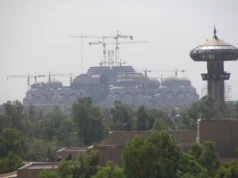
What is beyond dispute is the physical result: the Abraj Al-Bait complex, whose central Mecca Royal Clock Tower is the fourth-tallest building on earth, built on the site of the Ajyad Fortress — an Ottoman citadel demolished by Saudi authorities in January 2002 to clear the land for the development. Turkey’s government condemned it at the time, comparing the demolition to the Taliban’s destruction of the Buddhas of Bamiyan. The Saudi justification was the same justification that has attended every demolition decision in Mecca for the past four decades: more space was needed for pilgrims.
The Islamic Heritage Research Foundation, a UK-based institution whose director Irfan Al-Alawi has documented the demolitions for years, estimates that more than 90 percent of the old quarters of Islam’s holiest cities have been destroyed. The US-based Institute for Gulf Affairs places the figure for millennium-old buildings in Mecca specifically at 95 percent. The numbers are estimates, based on surveys of what remains rather than comprehensive original inventories. But the direction is not disputed. What was the built environment of one of the oldest continuously inhabited cities in the Islamic world has been largely cleared and replaced by infrastructure scaled to periodic peak demand.
Constrained demand, pressed to its extreme, produces a city that optimizes entirely for the days of maximum occupancy and accepts the cost of maintaining that capacity empty the rest of the year. Economically coherent, from the state’s perspective. The fixed cost of the Mina tent city spread across the revenue generated by two million annual pilgrims, each spending thousands of dollars in the in-kingdom economy, is recoverable. What’s lost — the Ottoman streetscape, the medieval city center, the fortress on the hill — was not generating comparable revenue.
Vision 2030 extends the logic further. The target is 30 million Umrah pilgrims annually by 2030, up from 8.5 million in 2019. Umrah — the year-round lesser pilgrimage, no fixed quota, no calendar constraint — is the real engine of the expansion. More pilgrims; more infrastructure; more of Mecca cleared to receive them.
The 2015 Hajj disasters

Two catastrophes struck within a single pilgrimage season, 1436H. On September 11, 2015, a crawler crane operated by Saudi Binladin Group collapsed into the Grand Mosque during construction operations, killing at least 107 people and injuring 238. The cause was determined to be human error combined with high winds; the crane's boom had not been secured to withstand conditions that were within the range the site regularly experiences. On September 24, 2015, a crowd crush in Mina killed a minimum of 769 people — the Saudi official figure, which has never been updated. The Associated Press, tallying deaths reported country by country through foreign government statements, calculated 2,411 dead. Agence France-Presse reached 2,236. Saudi Arabia has not permitted independent investigation of either event. The Hajj continued after both.
Kumbh Mela: the paradox of informal scale
660 million.
The official figure for attendance at the 2025 Maha Kumbh Mela in Prayagraj, India — cited by Uttar Pradesh Chief Minister Yogi Adityanath and repeated in every government communication about the event — is 660 million visits over 45 days, including 80 million on a single peak day, January 29, 2025 (Mauni Amavasya). If accurate, this makes the Kumbh Mela the largest human gathering in recorded history. It is larger, in a six-week window, than the entire population of Europe.
The figure almost certainly is not accurate in the sense the number implies. The Comptroller and Auditor General of India, reviewing the 2013 Maha Kumbh, found that “no scientific criterion or method was adopted for assessing the number of pilgrims and visitors” and that counting methods from prior festivals had not been corrected. The 660 million figure counts cumulative entries to the mela grounds, not unique visitors. A single devotee attending four auspicious bathing days counts as four.
Use 660 million as a base for economic modelling and the numbers that follow are correspondingly inflated. The Confederation of All India Traders estimated total economic transactions at ₹2-3 lakh crore ($25-37 billion). The per-capita implications of that figure depend entirely on whether the denominator is 660 million cumulative entries or a substantially smaller count of unique individuals — and nobody has that number. The economic case for the UP government’s ₹6,382 crore ($765 million) in roads, bridges, and sanitation scales with genuine attendance, not with how many times the same pilgrim was counted.
The Uttar Pradesh government’s $765 million was real money, spent on real infrastructure — a six-lane bridge across the Ganga, a ₹275 crore railway overbridge, 150,000 toilet facilities, 11 hospitals, expanded road networks. The state bought coordination. The most effective coordination wasn’t purchased. It was inherited.
The Akhara orders — traditional religious fraternities with centuries-old precedence rights over bathing times — manage the sequence of the royal bathing processions (Shahi Snan) more efficiently than any government queue management system could. Their authority is hereditary, their protocol is ancient, and their role costs the state nothing at the margin. The infrastructure that determines who bathes when on the most auspicious days is not a government procurement. It is social technology that predates the modern state entirely.
What the state did buy, the informal economy layered on top of. Vendors at captive locations near the bathing ghats on peak days face zero competing alternatives within practical walking distance. The pilgrim who has traveled 800 kilometers to be at the river on Mauni Amavasya is not going to bypass the chai stall because it is charging double the Prayagraj market rate. This micro-level price extraction is structurally identical to the airport newsstand or the stadium concession: the captive customer pays what the location commands, and the location commands more because exit is not available.
Informal payments thread through this structure. Vendors at prime locations — particularly the temporary stalls erected within the mela grounds — routinely pay hafta: daily unofficial fees to local officials or stall managers, amounts reported at ₹50-100 per day at the lower end for smaller traders, higher for better-placed operations. These payments are not documented, are technically extralegal, and are understood by all parties as the cost of access to a captive-demand location. The state-imposed ordering creates the captive location; the informal economy then extracts from it through its own layered hierarchy of access fees.
The Kumbh’s genuine paradox is that this entire system — the informal coordination of the Akharas, the micro-extraction of the ghat vendors, the street-level hafta payments — operates at an efficiency the formalized infrastructure can’t match. The $765 million bought roads and toilets. It did not buy the thing that actually made 660 million visits (or however many unique individuals that figure actually represents) possible: a social order that had already solved the coordination problem before the government arrived.
The result is an economy running on ancient institutional technology the state didn’t build, informal extraction it tolerates because formalizing it would cost political capital, and government investment tied to attendance figures neither the government nor anyone else can verify.
The counting controversy

The 660 million figure cited by UP Chief Minister Yogi Adityanath has no independent methodological validation. The Comptroller and Auditor General of India's performance audit of the 2013 Maha Kumbh — the previous event at the same site — found that counting methods were neither scientific nor watertight, and that errors from prior festivals had not been corrected. The 660 million counts cumulative entries: the same individual bathing on four auspicious days registers as four visitors. The overcounting is structural — built into the methodology, not a margin-of-error problem. Any economic model built on the headline figure without acknowledging this is working from an unexamined premise.
Santiago de Compostela: when the obligation goes optional
Peaks end. The Mecca infrastructure sits empty for 362 days; the Kumbh grounds clear after 45. Santiago never empties. The pilgrims come every day of every year, which is the only version of this mechanism where the structural consequences don’t reset — they accumulate. And by the numbers, right now, it looks like a success story. In 2025, 530,987 pilgrims collected their Compostela certificate — a new annual record, up from 499,239 in 2024, far above the 347,578 who came in 2019. In the extended 2021-2022 Holy Year (Xacobeo), 438,323. The trajectory is sustained, compounding growth.
But the mechanism driving that growth is not the same mechanism that once sustained the route.
Santiago has a permanent population of around 97,000. It is Galicia’s regional capital, with a university, government offices, and a functioning urban economy that would survive the closure of the Cathedral. The old town’s economy is a different matter. Rúa do Franco — the main commercial strip between the Cathedral and the market, whose name derives from the medieval term for pilgrims arriving from beyond the Pyrenees — exists almost entirely to service people who have just finished a pilgrimage. It is end-to-end restaurants, bars, souvenir shops, and hostels. The economic geography of the historic center is organized around the moment of arrival: people who have been walking for days, who are finally done, who have money left and nothing urgent to spend it on.
A 2017 analysis of pilgrim expenditures in Galicia found that each Camino arrival generates the economic equivalent of 2.3 domestic Spanish tourists — longer stays, higher daily spending, stronger multiplier effects through the local supply chain. That equivalence is the economic case for the Camino. It’s also the reason the erosion of constrained demand, which is now visibly underway, matters more than the headline attendance figures suggest.
In 2025, 46 percent of Compostela recipients stated religious reasons as their primary motivation, a further 33 percent cited a combination of religious and other reasons, and just under one in five were walking for entirely secular purposes. The split sounds majority-religious. But the economically relevant distinction isn’t religious versus secular — it’s captive versus substitutable. The pilgrim who walks the Camino Francés because she is completing a personal challenge she could equally have found on the GR10 across the Pyrenees, or the Tour du Mont Blanc, or the John Muir Trail, is a consumer with alternatives. She arrived in Santiago because the Camino appealed to her in a comparison with other options. The pilgrim who walks because her faith requires a pilgrimage and Santiago is the pilgrimage is not making a comparison. She is far less substitutable.
The Camino’s extraordinary growth over the past two decades happened precisely because it shed enough religious exclusivity to attract the challenge-tourism market. Routes were mapped, waymarked, and promoted to a global audience that had no particular stake in St. James. That market is real, is large, and explains how Santiago’s pilgrim numbers grew from under 10,000 annual Compostelas in the early 1990s to more than half a million today. But every new non-religious pilgrim who walks it makes the Camino’s demand structure slightly more elastic. Slightly more like Barcelona, slightly less like Mecca.
The Holy Year mathematics sharpens this into something acute. The Xacobeo calendar is determined by when the feast day of St. James (July 25) falls on a Sunday — a calendrical coincidence that occurs irregularly. 2027 is the next Holy Year. During Holy Years, the Porta Santa is open, offering a plenary indulgence to pilgrims who complete the journey — a theological incentive that has no equivalent outside the Catholic tradition. Holy Years produce measurable spikes: the 2022 extended Xacobeo drew 90,000 more pilgrims than 2019, despite the latter being a normal year with no pandemic disruption. For a city whose old-town economy is pilgrimage-dependent, a Holy Year is something like a guaranteed revenue event. A non-Holy Year is ordinary business. And the gap between the two represents exactly the religious captive-demand premium that the Camino’s growing secular base cannot fully replace.
Holy Year mathematics

A Xacobeo year is declared when July 25 — the feast of St. James — falls on a Sunday. It is, in this respect, an astronomical accident: the Gregorian calendar's structure determines when it recurs, not any ecclesiastical or economic planning process. The years are irregular: 2010, 2021 (extended to 2022), 2027, then 2032 and 2038. For a city whose major infrastructure investment decisions, tourism campaigns, and hostel capacity plans are calibrated around this cycle, the planning horizon is determined by an interaction of solar time and liturgical calendar that no one governs. Urban economics does not have a standard name for an economy whose planning cycle is set by a calendrical coincidence. It probably should.
What the mechanism reveals
Return to Mina in the off-season.
The tents stand. The air conditioning units are off. The walled camps are silent. The capacity for three million people sits in a valley that currently holds, perhaps, a handful of maintenance workers. This is not waste in the ordinary sense — the infrastructure is purpose-built and will be used. But it is visible proof that the economy built here operates outside normal investment logic. No rate-of-return calculation on conventional tourism assets produces this outcome. You build permanent infrastructure for three days of use per year only when the three days of demand are guaranteed, at scale, regardless of cost.
India is now formalizing the infrastructure around a coordination system it didn’t build and cannot replicate. The UP government’s investment in Prayagraj is permanent — bridges, roads, and sanitation that serve the city between Kumbhs. That’s the difference from Mecca: the Saudi state owns the full stack; the Indian state is buying into a system where the Akhara orders still run the actual coordination underneath. Formalization means state capture of the revenue-visible layer. The question of who captures the economic surplus from 2025’s attendance — the state, the formal operators, the informal ghat vendors, the Akharas themselves — isn’t answered by the headline figures.
Spain, meanwhile, has a cathedral city that is quietly becoming something else. The Camino de Santiago is now one of the world’s most recognizable long-distance walking brands. That brand is powerful, commercially, and it extends well beyond Catholicism. Trail runners, backpackers, secular seekers, people in the middle of some life transition who needed the route to hand them a structure: all have found the Camino. They walk the same stones as pilgrims, sleep in the same hostels, eat at the same tables. But the Camino’s economy increasingly rests on the spending of people who, confronted with a closed Pilgrim’s Office or an alternative equally appealing route, would make a different choice. That’s the substitution risk no one in Santiago’s economic planning is naming.
What happens to an economy built on the premise that its customers had no choice, when those customers start developing choices?
Mecca has no answer to that question and no need of one — sovereign control, physical monopoly, and religious obligation combine into a constraint so total that the demand curve stays vertical. Sustaining it required demolishing most of a city, and the costs of that demolition are still arriving.
India’s version is still becoming what it will be. The Kumbh’s social architecture predates the state; the formalization is recent; and the political incentives to inflate attendance figures are growing faster than the methodology to verify them. That’s an economy starting to believe its own press releases before the receipts come in.
Santiago’s constraint is still there. Just no longer as tight as it was. And in a pilgrimage economy, the gap between a vertical demand curve and a merely steep one is the distance between infrastructure built for three days of guaranteed occupation and infrastructure that might, someday, need to justify itself on ordinary economic terms.
The Mina tents are the answer to a demand that cannot be refused. The question no pilgrimage city can yet answer is what it builds when the refusal starts to become optional.
Avis de non-responsabilité de Gen AI
Certains contenus de cette page ont été générés et/ou édités à l'aide d'une IA générative.
Les médias
Principales sources et références
Saudi Press Agency. “Advanced Mina Tents Equipped with Highest Safety Standards, Integrated Services for Hajj Pilgrims.” SPA. 2024. https://spa.gov.sa/en/N2123834
General Authority for Statistics, Saudi Arabia (GASTAT). “Total number of pilgrims performing Hajj 1446H (2025) reaches 1,673,230.” 2025. https://www.stats.gov.sa/en/w/news/49
General Authority for Statistics, Saudi Arabia (GASTAT). “Hajj Statistics.” Historical Hajj pilgrim data. https://www.stats.gov.sa/en/w/hajj-statistics
Al Arabiya English. “Hajj 2024 in numbers: Annual pilgrimage draws over 1.83 mln worshipers.” June 2024. https://english.alarabiya.net/News/saudi-arabia/2024/06/16/hajj-2024-in-numbers-annual-pilgrimage-draws-over-1-83-mln-worshipers-
Salaam Gateway. “Saudi receives 1.67 million pilgrims for Hajj 2025.” 2025. https://salaamgateway.com/story/saudi-receives-167-million-pilgrims-for-hajj-2025
Arab News. “King Abdullah launches SR80 billion Haram expansion project.” Arab News. 2011. https://www.arabnews.com/node/388203
Arab News. “Saudi Finance Ministry acquires 86% stake in Binladin Group through debt-to-equity conversion.” Arab News. December 2025. https://www.arabnews.com/node/2627743/business-economy
Zawya. “Saudi ministry takes 86% stake in Binladin Group after debt settlement.” December 2025. https://www.zawya.com/en/capital-markets/equities/saudi-ministry-takes-86-stake-in-binladin-group-after-debt-settlement-u5dkbxmx
CNN. “Crane collapse kills 107 people at mosque in Mecca days before Hajj.” September 12, 2015. https://www.cnn.com/2015/09/12/middleeast/saudi-arabia-mecca-crane-collapse
Times of Israel. “Hajj stampede death toll tops 2,400, hundreds missing.” December 2015. https://www.timesofisrael.com/hajj-stampede-death-toll-tops-2400-hundreds-missing/
World Socialist Web Site. “Saudi government demolishes historic Ottoman castle.” January 28, 2002. https://www.wsws.org/en/articles/2002/01/fort-j28.html
Encyclopædia Britannica. “Abraj al-Bayt.” https://www.britannica.com/topic/Abraj-al-Bayt
Art Newspaper. “Why is Saudi Arabia destroying the cultural heritage of Mecca and Medina?” November 2015. https://www.theartnewspaper.com/2015/11/19/why-is-saudi-arabia-destroying-the-cultural-heritage-of-mecca-and-medina
Middle East Eye. “Saudi ‘cultural vandalism’ of Muslim heritage continues.” 2015. https://www.middleeasteye.net/features/saudi-cultural-vandalism-muslim-heritage-continues
Pilgrim Experience Program (Saudi Vision 2030). “About the Program.” https://pep.gov.sa/en/about
DD News. “Mahakumbh 2025 concludes, attracting over 660 million visitors.” February 2026. https://ddnews.gov.in/en/mahakumbh-2025-concludes-attracting-over-660-million-visitors/
The Wire. “66 Crore Visitors, 30 Dead in Stampede, Why Govt’s Maha Kumbh Numbers Don’t Add Up.” The Wire. 2025. https://m.thewire.in/article/government/66-crore-visitors-30-dead-in-stampede-why-govts-maha-kumbh-numbers-dont-add-up
Comptroller and Auditor General of India. Performance audit report on the 2013 Prayag Maha Kumbh Mela. 2013. https://cag.gov.in/en/audit-report/details/9271
India.com. “‘Maha Kumbh Mela 2025 expected to boost trade by Rs 2 lakh crore’ says Confederation of All India Traders.” 2025. https://www.india.com/news/india/maha-kumbh-mela-2025-expected-to-boost-trade-by-rs-2-lakh-crore-says-confederation-of-all-india-traders-7534379/
Dr. Syama Prasad Mookerjee Research Foundation. “Case Study: Economic and Digital Impact of Maha Kumbh on Uttar Pradesh’s Economy.” 2025. https://spmrf.org/case-study-economic-and-digital-impact-of-maha-kumbh-on-uttar-pradeshs-economy-and-role-of-the-unsung-heroes/
Follow the Camino. “Camino Statistics for 2025: The Year a Pilgrimage Confirmed Its Global Dimension.” 2026. https://followthecamino.com/en/camino-statistics-for-2025-the-year-a-pilgrimage-confirmed-its-global-dimension/
Pilgrim’s Welcome Office, Cathedral of Santiago. Statistics page. https://oficinadelperegrino.com/en/statistics/
Graave, E.J.E., Klijs, J., and Heijman, W. “The Economic Impact of Pilgrimage: An economic impact analysis of pilgrimage expenditures in Galicia.” International Journal of Religious Tourism and Pilgrimage, Vol. 5, Issue 3, 2017. https://arrow.tudublin.ie/ijrtp/vol5/iss3/7/
Vivecamino. “The Camino de Santiago in 2022: How many pilgrims walked it?” 2023. https://vivecamino.com/en/the-camino-de-santiago-in-2022-how-may-pilgrims-walked-it-no-812/
Pilgrim.es. “Xacobeo 2027.” https://www.pilgrim.es/en/xacobeo-2027/
Lena Martin
Je fais de l'économie. Occasionnellement des mathématiques. En évitant volontairement unetopologie algébrique.




 English
  Español
  Français
  Deutsch
  日本語
日本語  Polski
  Português do Brasil
  العربية
  Bahasa Indonesia
  Italiano
  한국어
한국어