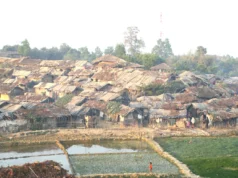
From the ruins of the Korean War to a semiconductor superpower, a cultural exporter with global reach, and a society now confronting the economic strain of demographic decline: the story of how South Korea built one of the modern era’s most remarkable development trajectories, and the costs that came with it.
The Ruins
In March 1961, nearly eight years after the armistice, a New York Times correspondent named A.M. Rosenthal closed a series of dispatches on South Korea with a verdict nobody at the time found controversial. He described the poorer half of one of the world’s poorest countries, a nation trying to survive with “too many people and too few resources,” dependent on American aid for the foreseeable future. The headline read: “Outlook Dreary for South Korea.”
Eight years earlier, the armistice that ended active combat on July 27, 1953 had stopped the fighting without ending the devastation. An estimated three million people had died, roughly a tenth of the peninsula’s prewar population, in a conflict that reduced Seoul to rubble four times, razed the industrial north, and depopulated entire provinces. Per-capita GNP in the Republic of Korea in 1953 stood at approximately $67, lower, by one later estimate, than in Somalia or Haiti. It was a poverty that seemed to admit no exit.
Nearly all of the peninsula’s mines, chemical plants, hydroelectric facilities, and heavy manufacturing sat above the 38th parallel, in North Korea. The South was agricultural, densely populated, and resource-stripped. The Syngman Rhee government in Seoul depended on US aid for the majority of its operating budget. Between 1946 and 1976, the United States provided $12.6 billion in economic assistance to South Korea, nearly twice its total aid to all of Africa and close to its total for all of Latin America.
The aid, moreover, was barely moving the needle. Growth between 1953 and 1961 averaged roughly 4 percent per year, less than 2 percent per head once the country’s surging birthrate was factored in. From 1956 to 1958, aid financed more than 80 percent of the country’s imports, while exports, mostly mining products and fish, amounted to between 1 and 2.4 percent of GNP.
Corruption under Rhee compounded the failure. American assistance intended to build an industrial base was widely alleged, then and since, to have been substantially diverted to private enrichment. By 1960, when student-led protests forced Rhee into exile in Hawaii, South Korea’s path forward was no clearer than it had been in 1953. The New York Times assessment looked prescient.
The Measurement Problem: Was South Korea Really "Poorer Than Kenya"?

A claim that has circulated in development economics circles holds that South Korea in 1960 had a per-capita income comparable to Sub-Saharan African nations. The income figures bear that out, but they say little about the country behind them. South Korea's depressed 1960 numbers reflected the acute aftermath of a devastating war that had ended just seven years earlier, destroying capital, displacing populations, and suppressing measured output far below productive potential. The 1953 to 1961 period is better read as a recovery phase within a partially destroyed economy than as the baseline of a country without economic history. Korea had sophisticated administrative infrastructure, near-universal demand for schooling (despite limited capacity), and a literate population, conditions very different from those of, say, 1960 Kenya.
The General and the Plan
On May 16, 1961, General Park Chung-hee led a military coup that ended the brief, chaotic Second Republic and replaced it with a junta. He was forty-three years old, a compact, intense man who had been a junior officer in the Japanese-run Manchukuo Imperial Army during the colonial period and had absorbed, by his own later account, a deep admiration for the Meiji Restoration’s model of state-directed industrialization. When he came to power, South Korea’s per-capita income was approximately $94, and North Korea’s was higher. Park’s opening speech to the Supreme Council for National Reconstruction contained a phrase he would return to repeatedly: the country had to “escape poverty.”
Within weeks of seizing power, Park established an Economic Planning Board staffed by civilian technocrats rather than military officers and charged them with designing a path from subsistence to industry. The First Five-Year Economic Development Plan, launched in 1962, set the foundation. It prioritized electric power, basic industries such as fertilizer and cement, and infrastructure, with labor-intensive exports added as the plan was revised, in a country that, as Park noted when he declared Ulsan a “Special Industrial Development Zone” that year, had no industrial tradition to speak of in the South. The plan targeted annual GDP growth of roughly 7 percent and achieved 7.8 percent on average over its five years, while GNP per capita rose by about half.
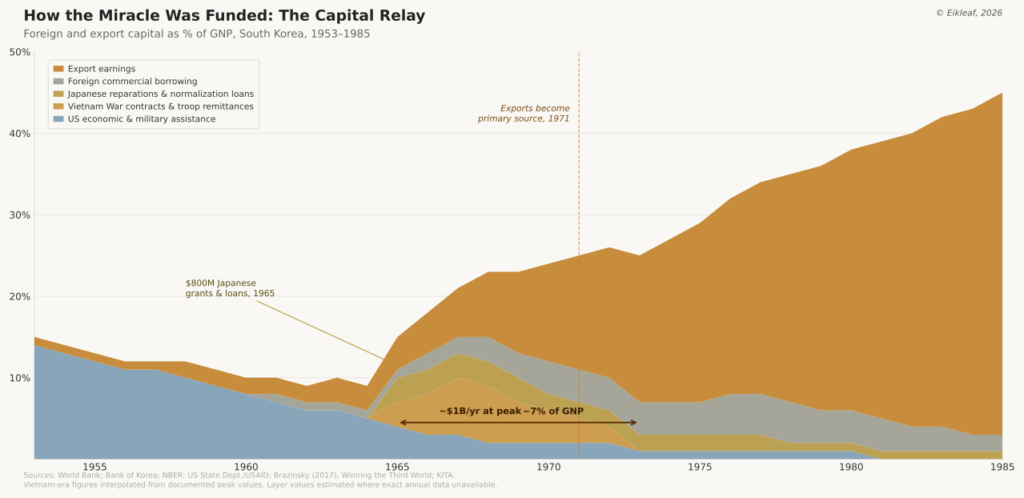
The instrument Park chose to accelerate this process was the chaebol: large, family-owned industrial conglomerates modeled loosely on the Japanese zaibatsu he had observed during his military service. The state-controlled banking sector was directed to channel capital to these groups through guaranteed loans at below-market rates. Performance quotas were set. Companies that hit export targets received further credit, tax relief, easy licensing, and subsidies; companies that missed them faced consequences. The arrangement was corruption and development planning at once, disciplined by export performance.
Textiles show how this worked. In 1961, Korean exports totaled roughly $41 million, with textiles and garments among the largest categories. By 1965, within the first plan, total exports had risen to $175 million, with textiles the largest category. The Cheil Wool Textile Company, founded in 1954 by Samsung’s Lee Byung-chul, became a pillar of the growing Samsung group. The junta had publicly accused Lee of illicit wealth accumulation in 1961 and then forgiven and mobilized him.
The Second Five-Year Plan (1967–1971) laid the groundwork for the strategic pivot that would define the next two decades. In January 1973, early in the Third Plan, Park announced the Heavy and Chemical Industrialization drive into steel, petrochemicals, shipbuilding, machinery, and electronics. It was a huge gamble for a country with little proven experience in most of these industries, and private operators carried it out under explicit government direction. In June 1970, Hyundai Construction Company, a civil engineering firm with no maritime experience, had applied for and received government approval to build a shipyard at Ulsan. By the mid-1970s, Hyundai had built a one-million-ton capacity dry dock there and was producing oil supertankers. The company moved into automobiles, chemicals, cement, and electronics. Its 1975 Pony, styled by Italy’s Giorgetto Giugiaro and built on Mitsubishi mechanicals, was Korea’s first mass-produced indigenous car model.
The Pohang Steel Gambit

In 1968, the Park government announced plans to build an integrated steelworks at Pohang, on South Korea's southeastern coast. The World Bank refused to fund it, concluding that South Korea lacked the technical capacity, management depth, and market conditions to make such a facility viable. Park proceeded anyway, using Japanese reparations money secured under the 1965 normalization treaty to fund the Pohang Iron and Steel Company, now known as POSCO. The treaty was so unpopular at home that protests against its negotiation had been crushed under martial law in 1964. By 1973, Pohang was operational. By the 1980s, POSCO had become one of the most cost-efficient steel producers in the world. The World Bank later cited the Pohang project as a case study in the limits of its own development models.
The Numbers
The scale of what happened between 1962 and 1990 has few close parallels in modern economic history. The table below traces the transformation.
| Indicator | 1962 | 1980 | 1989 | 1996 |
| GDP per capita (nominal USD) | $106 | $1,746 | $5,989 | $13,865 |
| GDP (current USD billions) | ~$2.8 | ~$67 | ~$254 | ~$631 |
| Manufacturing % of GNP | 14.3% | ~28% | 30.3% | ~31% |
| Domestic savings / GNP | 3.3% | ~23% | 35.8% | ~35% |
| Trade volume (USD billions) | $0.48 | ~$39 | ~$128 | ~$280 |
| Avg. annual real GDP growth | — | — | 8%+ | ~8.5% |
These are among the most dramatic growth numbers ever recorded for any economy of comparable size over a comparable period. South Korea’s real GDP expanded by an average of more than 8 percent per year for nearly three decades. The domestic savings rate, about 3 percent in 1962 and so low the country could barely finance its own investment, rose to about 36 percent by 1989. A capital importer dependent on aid and foreign loans had become a country generating its own investment capital. Commodity trade volume increased by a factor of more than two hundred and sixty.
No single cause explains it. The factors that recur in most accounts are these: the outward-oriented export strategy that replaced Rhee’s import substitution model; an educated workforce, the product of the Rhee government’s investment in schooling; the strategic use of directed credit to chaebol groups in exchange for performance against export targets; US security commitments that allowed Korea to spend less on defense than it otherwise might have; Japanese technology transfer and reparations financing after 1965; and the revenue and market access generated by Korean troop deployments to Vietnam, where approximately 300,000 Korean soldiers served in exchange for US payments and contracts worth roughly $1 billion in total over 1965–72.
The Saemaul Undong, or New Village Movement, launched by Park in 1970, extended this logic to rural Korea. It mobilized village communities to build roads, improve housing, and develop cooperative economic activity through competitive matching grants — communities that met development benchmarks received additional resources. The movement was at once a rural development program and a mechanism of political control. The rural-urban income gap, which had been widening through the 1960s, began to narrow in the 1970s. By the 1980s, rural Korea had been substantially integrated into the national industrial economy.
The Divergence: Two Koreas
A fact largely obscured by the eventual scale of South Korea’s success is that, for nearly three decades after partition, North Korea was the more prosperous half of the peninsula. It explains what Park Chung-hee was attempting in 1961, what he was measuring himself against, and why his success so surprised the people who witnessed it.
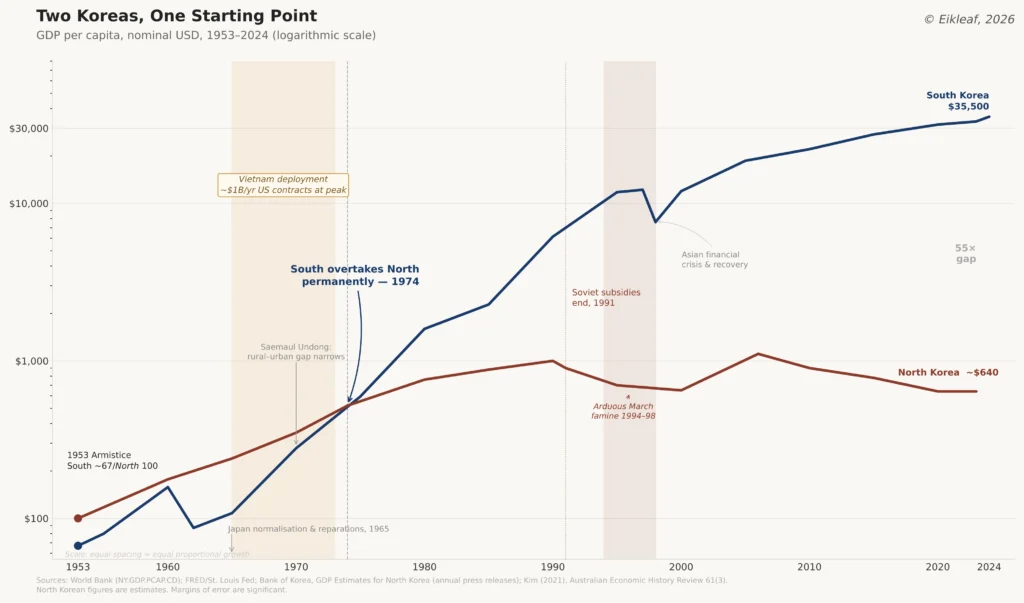
Before the 1960s, North Korea’s GDP per capita was far higher than South Korea’s, by estimates that range from 30–50 percent higher to more than double. The advantage reflected the colonial geography of Japanese industrial development. Japan’s prewar investment in heavy industry (chemical plants, hydroelectric dams, mining operations, and steel works) had been concentrated above the 38th parallel, in what became the DPRK. When Japan withdrew in 1945 and partition hardened in 1948, the South was left with the rice paddies and the fishing villages. Per-capita GDP in 1960 has been estimated at $177 in the North and $79 in the South. In 1963, South Korea’s per-capita GDP of roughly $147 was lower than Ghana’s and only some 40 percent above India’s.
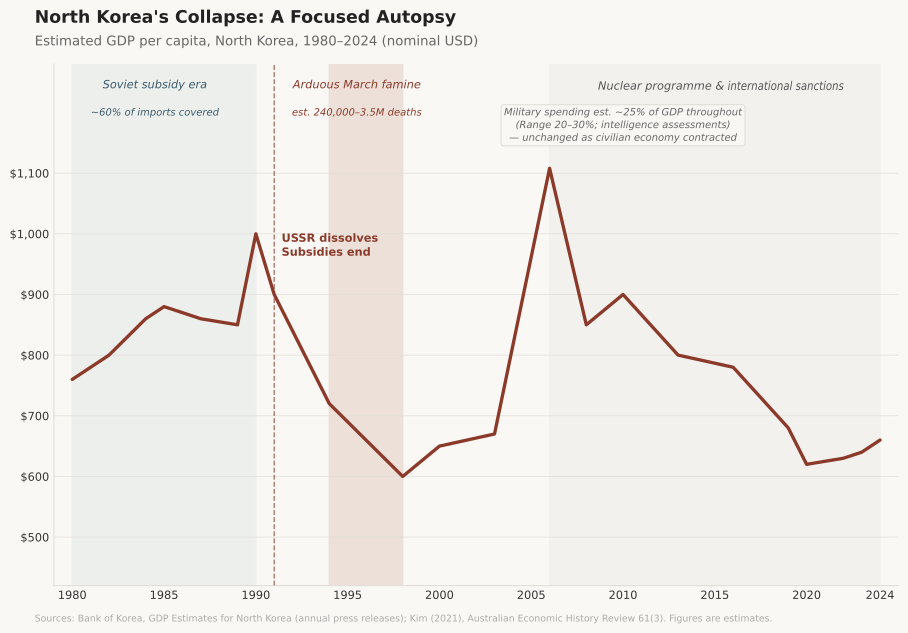
The reversal came in the 1970s. Estimates put South Korea’s per-capita GDP at $569 in 1974 against the North’s $520; from then on the South pulled permanently ahead. From that point the two trajectories diverged fast: one driven by export-oriented capitalism with state direction, the other by Juche self-reliance and command allocation. By 2006, North Korea’s per-capita income was estimated at roughly $1,100, one-seventeenth that of the South. By 2023, the UN estimated the North’s figure at $640 per person against South Korea’s $35,500, a factor of about 56.
The North Korean trajectory is its own economic tragedy. Subsidized Soviet trade, which at its peak accounted for more than half of North Korea’s foreign commerce, sustained the economy through the 1970s and 1980s while the underlying Juche model stagnated. When the Soviet Union collapsed in 1991, the subsidies ended. Agricultural production crashed as farm machinery and fertilizers ran dry. The famine of 1994–1998, known as the Arduous March, killed between 240,000 and 3.5 million people by various estimates. On the Bank of Korea’s estimates, North Korea’s economy was smaller in 2012 than it had been in 1992. In the 1970s, the North had exported locomotives to the Soviet Union, farm machinery to Africa, and synthetic fibers to China. By the early 2000s, it was better known abroad for exporting arms, narcotics, and counterfeit currency.
The North-South comparison matters for development economics in a particular way. The two states started from the same peninsula-wide historical inheritance, shared the same language and much of the same recent social history, and then diverged sharply under different political economies and external alignments. The result is one of the clearest comparative cases in twentieth-century development history. Geography and culture alone do not explain the gap between roughly $640 and $36,000 per person. To a large extent it has been shaped by institutions, strategy, external support, and the radically different ways the two states managed openness, security, and industrialization.
The Juche Paradox: Why Self-Reliance Failed

Kim Il-sung's Juche (주체) ideology, the doctrine of national self-reliance across economic, political, and military affairs, was theoretically coherent as a response to Korea's twentieth-century history of colonial dependency. It failed for structural reasons: it optimized for political survival at the expense of productivity. Agricultural collectivization, military spending that absorbed roughly 25 percent of GDP, isolation from technology transfer, and the substitution of ideological indoctrination for practical skills in the education system combined to produce an economy incapable of the feedback loops industrial development requires. Park Chung-hee also prioritized national security and political control, but he chose to finance them through economic growth rather than sacrifice growth for security. The two responses to the same vulnerability, openness and closure, produced one of the sharpest developmental divergences of the post-war world.The Cost of Velocity
The phrase “Miracle on the Han River” has been traced to Prime Minister Chang Myon’s 1961 New Year address, which held up West Germany’s postwar recovery as a model. The miracle was real, and the speed of the transformation was purchased, in part, with instruments that democratic societies do not typically countenance in peacetime.
Labor rights were systematically suppressed: independent unions were dissolved and strikes prohibited. Real wages rose quickly between 1965 and 1979, but workers had no legal means to bargain over how the gains were divided. The workers in Masan’s free-export-zone factories, on the assembly lines at Hyundai’s Ulsan complex, and in the textile mills of the Kuro Industrial Park produced the export surplus that financed industrial expansion without a say in its returns. Gini coefficients in Korea were, by the standards of comparable economies at similar income levels, relatively low in the 1960s and 1970s; income distribution was constrained but not dramatically unequal. What the regime suppressed was the political capacity to negotiate the terms of distribution.
The political repression was systematic. Park’s Korean Central Intelligence Agency, established by his nephew-in-law and fellow coup-plotter Kim Jong-pil, was the instrument of internal control. Dissidents were imprisoned and the media censored. The 1972 Yushin Constitution eliminated direct presidential elections and gave Park indefinite executive power. Emergency Decree Number Nine, issued in 1975, made it a criminal offense to criticize the constitution. The poet Kim Chi-ha, already jailed for his satirical poem “Five Bandits”, was sentenced to death in 1974 on charges of backing a student conspiracy; the sentence was commuted under international pressure. Park’s rule ended on October 26, 1979, when the head of the KCIA, Kim Jae-gyu, shot him at dinner, reportedly driven by opposition to the regime’s increasing repression. The same record includes the succession of General Chun Doo-hwan, through the December 1979 coup and his seizure of full power in May 1980, and his violent suppression of the Gwangju Uprising that May, in which paratroopers killed pro-democracy demonstrators in numbers that remain contested but certainly exceed 150.
The chaebol themselves accumulated liabilities during this period that would prove catastrophic within a generation. Guaranteed government support enabled them to borrow recklessly. Debt-to-equity ratios exceeded 400 percent for the largest groups by the mid-1990s. The “too big to fail” assumption was written into the structure of Korean capitalism. The belief that the government “would not dare allow a big horse to die” was a reasonable inference from observed behavior. Kia, Hanbo, Sammi, Jinro, and eventually Daewoo would all test this assumption in different ways, and most of them broke it.
The 1987 June Uprising and the Democratic Transition

The economic argument for authoritarianism, that democracy would produce the kind of populist wage inflation and investment disruption that would derail development, had been advanced with some sophistication by Park and his successors. The June 1987 uprising, in which millions of Koreans took to the streets demanding direct presidential elections, tested this thesis. Roh Tae-woo, the ruling party's chairman and hand-picked presidential candidate, faced a military unwilling to repeat Gwangju in the run-up to the 1988 Seoul Olympics and issued the June 29 Declaration conceding direct elections. The democratization that followed did not derail economic growth. The 1990s saw continued expansion, the Seoul Olympics projected Korean modernity to the world, and independent unions, though still weaker than in comparable OECD economies, could organize and strike in the open.
The Education State
The Korean state has managed education as an instrument of policy since the 1950s, and it has generated both Korea’s greatest competitive advantage and some of its most acute social pathologies.
The foundation was laid, somewhat paradoxically, by the Syngman Rhee government that failed at almost everything else. In the decade following the armistice, South Korea built a public school system of unusual breadth and relative uniformity. The government directed aid and resources toward rural schools with a deliberate intent to maintain standards comparable to urban institutions. Parents, driven by a cultural legacy in which Confucian educational attainment had for centuries been the primary route to social mobility and government position, demanded schooling faster than the state could supply it. By 1960, primary schooling was close to universal and under 30 percent of secondary-school-age Koreans were enrolled; by 1990, secondary enrollment was near 90 percent. The literate workforce that Park Chung-hee found waiting when he launched the Five-Year Plans was the product of that first decade.
Park deepened the investment systematically, treating education as part of industrial policy. The Third Five-Year Plan’s Heavy Chemical Industrialization drive required engineers and technically trained workers at a scale the existing system could not produce, and the government responded by expanding technical and vocational education alongside the university system. By the 1980s, South Korea was producing engineering graduates at rates that matched, and in some segments exceeded, OECD norms. The chaebol absorbed them directly from the training pipeline, and the pipeline itself, with its standardized national curricula, competitive examinations, and hierarchical credentialing, was co-designed with chaebol labor requirements in mind.
But the system that produced Korea’s industrial workforce also produced an educational arms race that has spiraled since the 1990s into something quite different from what Park intended. Its instrument is the hagwon: private cram schools, numbering in the tens of thousands across Korea, that students attend after the regular school day ends, sometimes until 10 PM or beyond. The hagwon industry emerged in the 1960s as a modest supplement to public schooling and began its explosive growth in the 1990s, following democratization, rising disposable incomes, and growing anxiety about the post-1997 labor market. In 1980, between 13 and 26 percent of students, depending on the level of school, took private lessons. By 1997, 70 percent of elementary pupils did. As of 2023, nearly 80 percent of Korean primary and secondary students were enrolled in some form of private tutoring.
In 2024, South Korean families spent about 29 trillion won, roughly $21 billion, on private education for school-age children, 60 percent more than a decade earlier. In late 2025, households with two or more children spent an average of about 610,000 won a month on their children’s education, nearly 13 percent of household consumption and second only to food. Relative to income, South Korea has become the most expensive country in the world in which to raise a child. The College Scholastic Ability Test, or CSAT, an eight-hour examination administered each November that anchors university admissions, is so nationally significant that air traffic is rerouted to minimize noise during its listening comprehension sections.
South Korea has the highest share of 25-to-34-year-olds with tertiary education among all OECD countries, over 70 percent, more than 20 percentage points above the OECD average. Korean 15-year-olds consistently rank among the global top performers on the PISA assessments in mathematics, reading, and science. The semiconductor engineers at Samsung and SK Hynix, the design teams at Hyundai, and the architects of the hallyu content industry are, in large part, products of this system.
But the aggregate scores conceal a problem. The share of university graduates among young Koreans is the highest in the OECD, but their employment rate is relatively low. In 2021, about 80 percent of tertiary-educated Korean men aged 25 to 34 were employed, and 73 percent of women, against OECD averages of 88 and 82 percent. The financial return to tertiary education in Korea, once tuition fees and foregone earnings are counted, is among the lowest in the OECD and negative for a substantial proportion of graduates. The credential that the entire system is organized around acquiring has been bid up by competition to a price that no longer reliably covers its cost.
Private tutoring alone consumes approximately 10 percent of the average Korean household’s income. These costs fall hardest on the families who can least absorb them, and they bear directly on the fertility decision: Koreans routinely cite educational costs among their main reasons for choosing not to have children. The hagwon system, designed to give individual children a competitive edge in the race for admission to the SKY universities (Seoul National University, Korea University, Yonsei University), has become a collective trap: each family’s spending raises the price for all the others, while the aggregate effect is to make family formation economically prohibitive for millions of Koreans.
The CSAT and the Curriculum of Anxiety

On one day every November, much of South Korea stops for an exam. On CSAT day, the stock market opens an hour late to keep the morning roads clear for test-takers, and aircraft are grounded during the listening comprehension test. Police motorcades escort late-arriving students to examination centers. Parents gather outside schools in prayer. The exam, eight hours of testing across Korean language, mathematics, English, social studies, and science, shapes the trajectory of a Korean young person's life as few single examinations anywhere do. The mental health consequences are documented and severe. South Korea records one of the highest youth suicide rates among OECD nations.

The number one cause of death for Koreans between the ages of 10 and 30 is suicide. Among middle and high school students surveyed by the government in 2022, almost a quarter of boys and one in three girls reported experiencing depression. The link between academic pressure and this crisis is contested, though widely asserted. Either way, the system that produced Korea's globally competitive workforce has also organized the country's childhood around a single, standardized examination whose results shape lifetime outcomes and leave very little room for anything else.
The Crisis
By 1996, South Korea had reached per-capita income of nearly $14,000. It was the world’s eleventh largest economy and a member of the OECD. Chaebols such as Samsung, Hyundai, LG, Daewoo, and SK were globally recognized brands producing televisions, automobiles, ships, and petrochemicals for world markets. The economy had weathered the 1979 oil shock, the political turbulence of the Chun years, and the structural transition to democracy. Growth in 1991–1996 had averaged more than 8 percent annually. Inflation was under control, and current-account deficits were being financed by buoyant capital inflows.
Then, in 1997, the system failed. The crisis had its origins in the mid-1990s. A rapid depreciation of the Japanese yen in 1995 made Korean exports less competitive just as a global semiconductor glut collapsed prices for Korea’s most important export product. Trade surpluses turned to deficits.
The deeper problem was in the banks. Korean banks had borrowed extensively in short-term foreign currency loans, which by November 1997 accounted for nearly 60 percent of Korea’s total external obligations, and deployed those funds to finance chaebol expansion at debt-to-equity ratios that would not have been survivable without implicit state guarantees. When Hanbo Group collapsed in January 1997 under nearly $6 billion in debt, followed by Sammi, Jinro, and, critically, Kia Motors in July, foreign creditors began reconsidering the value of the guarantees they believed they held.
The cascade was rapid. By late November 1997, South Korea’s usable foreign exchange reserves had fallen to $5 billion, enough to cover barely two weeks of imports. By year-end, the stock market had lost 42 percent of its value and the won about half of its value against the dollar. On November 21, the government requested an IMF bailout. The package agreed on December 3 was $58.4 billion, at the time the largest in IMF history, a figure that signaled both the scale of the crisis and the Fund’s assessment of Korea’s systemic importance to the international monetary system.
The bailout came with conditions that were applied rapidly and controversially: fiscal tightening, capital account liberalization, bank restructuring, labor market reform, and higher interest rates to stabilize the won. Unemployment rose from 2–3 percent to a peak of 8.7 percent in early 1999 as factories closed. Daewoo, the second-largest chaebol, entered a bankruptcy process in 1999 that would eventually dissolve the conglomerate entirely; its automotive division was acquired by General Motors. Samsung Motors, a $5 billion venture launched in 1994, was sold to Renault in 2000. Hundreds of thousands of middle-class Korean families lost savings and jobs. The gold-collection campaign of early 1998, in which ordinary Koreans voluntarily surrendered gold jewelry and trinkets to help rebuild the national foreign reserves, became a defining cultural memory of the crisis, a moment of collective sacrifice that has been retold and contested ever since.
Korea’s recovery was, by IMF standards, remarkably rapid. President Kim Dae-jung, who had campaigned on opposition to the chaebol system, took office in February 1998 and pursued both the structural reforms demanded by the IMF and a selective stimulus. The won was allowed to float freely. Transparency requirements were imposed on corporate finance. By 2001, Korea had repaid its IMF obligations. GDP growth in 1999, less than two years after the $58 billion emergency, was 11.6 percent on the Bank of Korea’s current figures (first reported as 10.7).
The Paradox of the Post-Crisis Chaebol

The 1997 crisis was widely expected to break chaebol dominance. In some respects it did: Daewoo was dissolved, Kia was acquired by Hyundai, and the number of major chaebol groups was reduced. But the crisis also entrenched chaebol power. With small and medium-sized enterprises wiped out by the credit crunch, the surviving chaebols emerged larger relative to the economy than before. In 1998, the top five chaebols accounted for 37 percent of gross output and 44 percent of exports as sub-contractors and SMEs failed. The structural concentration of the Korean economy, which reformers in the Kim Dae-jung and subsequent administrations tried repeatedly to address, survived 1997 and deepened through it.
The Second Miracle: Semiconductors and the Knowledge Economy
What Korea built after 1997 was structurally different from what it had built before. The heavy industrial model of steel, ships, chemicals, and automobiles did not disappear: POSCO remained among the world’s most efficient steelmakers, Hyundai and Kia became competitive global automotive brands, and Korean shipbuilders continued to dominate the market for complex vessels. But the commanding heights of Korean economic growth shifted decisively to semiconductors, and with them came a form of industrial dominance with few precedents in scale.
Samsung had entered the semiconductor business in 1974 through the acquisition of Korea Semiconductor, a small US-affiliated firm in Bucheon. The entry followed state strategy: Park Chung-hee’s government had named electronics one of the six strategic sectors of its 1973 Heavy and Chemical Industrialization drive. Through the 1980s, Samsung, SK Hynix (then Hyundai Electronics), and LG (then GoldStar Semiconductor) received directed capital and state protection to build capacity in DRAM memory production. The technology was licensed from US firms, and the manufacturing processes absorbed and eventually improved upon. Memory chips require massive, consistent capital investment in manufacturing capacity, a disciplined and technically trained workforce, and tolerance for long payback periods. Those were the capabilities the development model had generated, and they gave Korea its structural advantage.
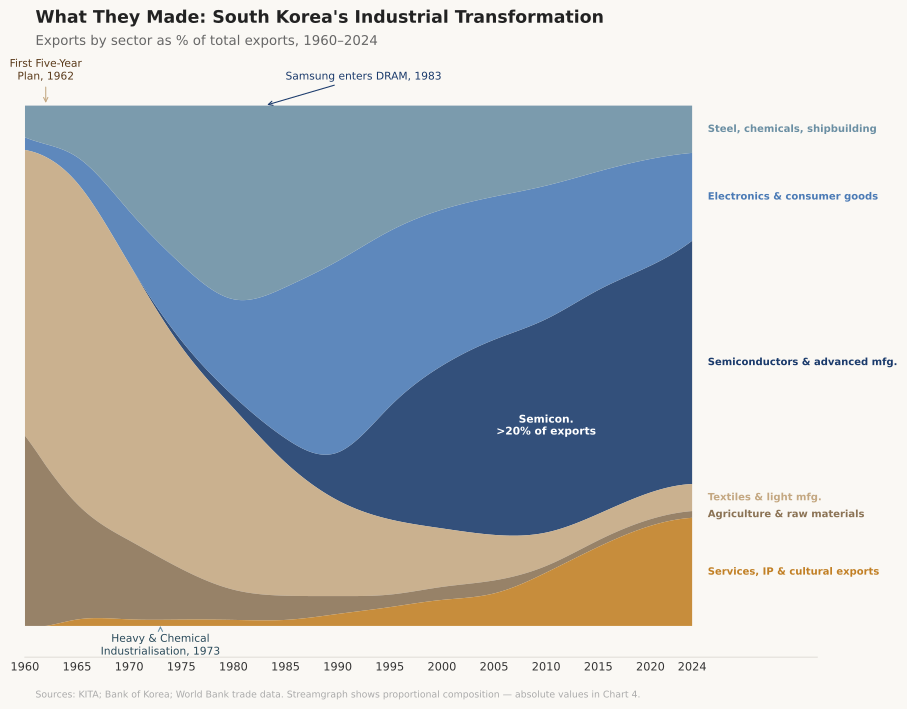
South Korea’s semiconductor exports reached about $142 billion, roughly a fifth of the country’s total exports. Samsung Electronics and SK Hynix together held approximately 70 percent of global DRAM production capacity and more than half of NAND flash memory. South Korea accounted for approximately 20 percent of the world’s total semiconductor production capacity. Chips had come to be called “the rice of the Korean economy,” the staple on which everything else depended.
The AI boom made this dominance more volatile and more strategically significant. High-Bandwidth Memory, the stacked DRAM architecture required for AI GPU acceleration, became one of the most contested products in the global technology supply chain. SK Hynix, which had identified the HBM opportunity earlier and pursued it more aggressively than Samsung, emerged as the primary supplier to Nvidia for Blackwell-generation accelerators and held about 52 percent of the global HBM market in 2024. The shift was large enough that in Q1 2025 SK Hynix overtook Samsung in overall DRAM market share for the first time, with 36 percent against Samsung’s 34 percent. Samsung’s struggles in the HBM market, attributed to yield and specification issues in Nvidia’s qualification process, became the defining business story of the Korean semiconductor sector in 2024–2025.
| Company | Market Segment | Key Metric (2024–2025) | Strategic Position |
| Samsung Electronics | DRAM, NAND, Foundry | World’s largest memory chipmaker by revenue; ~34% DRAM share in Q1 2025 | Dominant but challenged in HBM; foundry lagging TSMC |
| SK Hynix | DRAM, NAND, HBM | Overtook Samsung in DRAM Q1 2025 (36% share); 52.5% of global HBM 2024 | Primary AI memory supplier; key Nvidia partner |
| Korea (Combined) | Semiconductor exports | $141.9B total semiconductor exports (2024); ~20% of global production | World’s largest memory cluster; building non-memory capacity |
The Third Export: Culture
South Korea also exported culture, which defies conventional measurement and has, in the twenty-first century, become an instrument of national power.
The Korean Wave, or hallyu (한류), a term coined by Chinese journalists in 1999 to describe the spread of Korean television dramas and pop music across East Asia, was the product of a deliberate policy shift. Following the 1997 crisis, the Kim Dae-jung government identified cultural industries as a growth sector that required minimal physical capital, generated disproportionate foreign exchange, and enhanced the national brand in ways that translated into tourist arrivals, consumer goods exports, and diplomatic influence. The Ministry of Culture received a substantial budget increase, and hundreds of culture industry departments were established in universities. The government estimated the value of hallyu at $83.2 billion by 2012.
South Korea’s cultural content exports (music, audiovisual content, video games, animation, and webtoons) reached roughly $13 billion in 2023, extending a run of annual records. The Korea Foundation counted 225 million hallyu fans worldwide in 2023, roughly twenty-four times as many as in 2012. Netflix committed $2.5 billion to Korean content production between 2023 and 2027. BTS, one of the most commercially successful musical acts of the 2020s, was appointed “Special Presidential Envoy” for future generations and culture. Han Kang’s 2024 Nobel Prize for Literature, the first ever awarded to a Korean-language author, reflected a cultural confidence that would have been unimaginable in 1953.
The economic spillovers of hallyu run through several channels. Tourism: when foreign visitors were asked at the end of 2023 why they had come, Korean cultural content was the most common answer, given by about a third of them. Consumer goods: K-beauty cosmetics and skincare exports grew from a niche segment into a mainstream global category. Food: Korean cuisine, known internationally through kimchi, bibimbap, and the global success of buldak (Korean fire chicken), has generated an export category that continues to expand. Technology: Samsung’s sponsorship of K-pop tours and its integration of brand identity with cultural content show the loop between the cultural and industrial export economies.
The hallyu phenomenon also illustrates a geopolitical vulnerability. In 2016 South Korea decided to deploy the THAAD missile defense system, a strategic choice driven by North Korea’s accelerating nuclear program and made in coordination with the United States. China responded with an informal boycott of Korean cultural products. Chinese streaming platforms removed Korean content. Beijing banned Chinese group tours to Korea, and Chinese arrivals fell by almost half in 2017. The economic damage, to cultural exports and tourism alike, was material and could be traced directly to a decision about the peninsula’s security.
The Chaebol Question, Unresolved
Whether the chaebol were worth it depends on which metric you prioritize and which time horizon you examine.
The case for the chaebol system is the record up to 1990. South Korea’s industrial transformation was accomplished through concentrated capital allocation to large, diversified, state-directed conglomerates. Waiting for organic market development in a capital-scarce, resource-poor post-war economy was not an available alternative. The chaebol executed the HCI drive, built the shipyards, and manufactured the DRAM chips; they absorbed foreign technology, improved upon it, and made it the basis of globally competitive industries. Without them, or something very like them, the “Miracle on the Han River” probably does not happen.
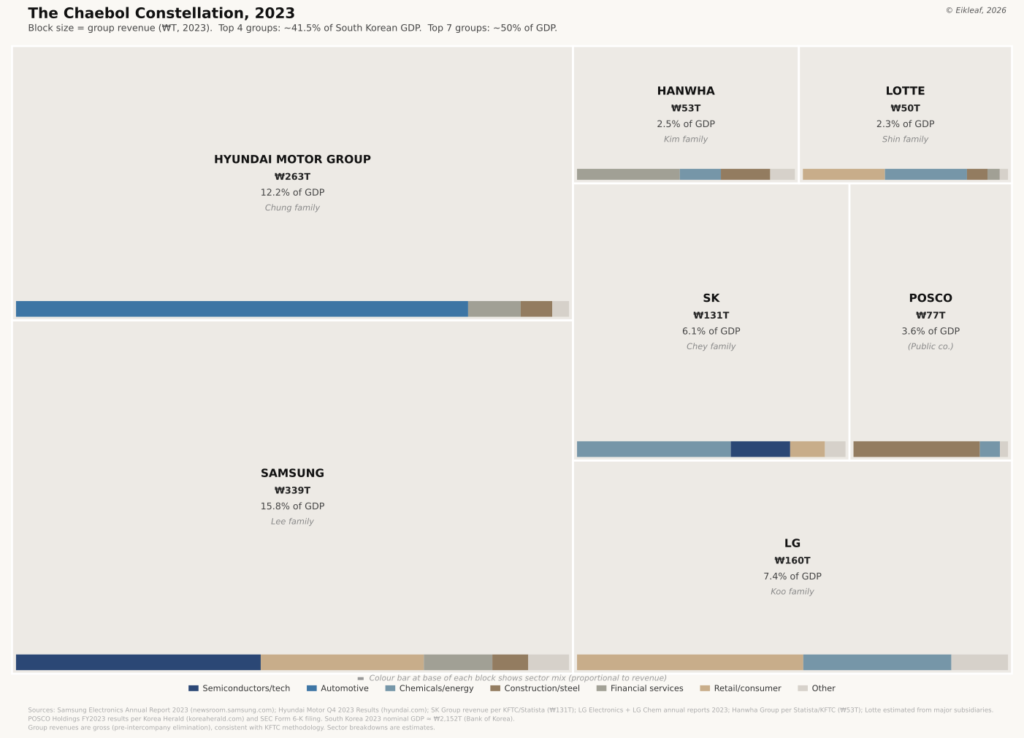
The case against is the record after it. The 1997 crisis was a direct result of chaebol over-leverage enabled by implicit state guarantees and opaque bank relationships. The post-crisis period saw surviving chaebol groups grow more dominant, not less. Corporate governance in the chaebol system remains weak: controlling shareholders, the families, capture large private benefits while diffuse public shareholders bear systemic risks. The list of chaebol chairmen convicted or prosecuted for white-collar crime is long and spans every administration: Chey Tae-won of SK Group, Chung Mong-koo of Hyundai, Kim Seung-youn of Hanwha, Shin Dong-bin of Lotte, and Lee Kun-hee of Samsung. Over decades, the pattern of presidential pardons following conviction has created a settled expectation that economic power insulates against legal consequence. Samsung’s current legal and competitive difficulties, in HBM qualification and in foundry competition with TSMC, suggest that family-governed conglomerates may be poorly adapted to the innovation cycles required in the AI era.
Productivity points the same way. South Korea’s GDP per hour worked remains significantly below the OECD average, an anomaly for a country of its income level. Chaebol dominance, the CEBR argues, has bred a culture of protecting domestic businesses from foreign competition that blunts the pressure productivity growth needs. South Korea’s two-decade refusal to let Google export high-precision map data, which many Koreans read as protection for domestic navigation services, ended only in February 2026 with a conditional approval hedged with security requirements. Read one way it was a security measure; read another, a symptom of an economy still organized around the interests of incumbent domestic firms.
The Park Geun-hye Impeachment and Corporate Accountability

In 2016–2017, a constitutional crisis exposed the interface between chaebol and politics with unusual clarity. President Park Geun-hye, daughter of Park Chung-hee, was impeached and later imprisoned on corruption charges related to her relationship with Choi Soon-sil, a personal confidante with no official position who had leveraged their friendship to extract funds and favors from Korea's largest chaebol. Samsung's Lee Jae-yong was imprisoned for bribery, subsequently released, and eventually given a presidential pardon by President Yoon Suk-yeol. The episode left the question of chaebol governance unresolved, but it made the nature of that governance, and its entanglement with state power, unusually visible.
Hell Joseon: The Social Contract Frays
In the autumn of 2015, a phrase began circulating in South Korean internet forums and social media that captured a generational disillusionment the headline economic statistics had obscured. “Hell Joseon” (헬조선) blends the English word “hell” with the name of the Joseon dynasty that governed Korea from 1392 to 1897. It described modern South Korea as a society with the competitive cruelty of a medieval hierarchy, where birth determined outcome, effort was not fairly rewarded, and the institutions that claimed to provide social mobility functioned primarily to reproduce existing privilege. By 2019, the phrase had a sequel, “Tal-Jo” (“Escape Joseon”), as younger Koreans began to discuss emigration seriously.
The phrase was hyperbole, and on several measures it was accurate. Labor market duality is the core of the problem. In August 2023, 37 percent of South Korean wage workers were non-regular: fixed-term, part-time, or indirectly employed, and excluded from the social protections and career paths available to regular employees. Non-regular workers earned on average about 54 percent of what regular workers earned, and more than 60 percent of them had no retirement benefits or severance. The headline unemployment rate of about 2.8 percent is misleading. It excludes the large population of young Koreans who are not unemployed in the formal statistical sense but are in extended job preparation, enrolled in additional degrees, or working in irregular positions while seeking regular employment. In 2017, 18.4 percent of young Koreans were NEETs (not in employment, education, or training), and 45 percent of Korean NEETs held tertiary degrees, compared with 18 percent in the OECD area as a whole.
Housing is the second axis of compression. The average price of an apartment in Seoul passed 1.3 billion won, roughly $900,000, in April 2025 and 1.4 billion by July, more than thirteen times the median annual household income. Over the decade ending in 2023, Seoul apartment prices more than doubled. Housing makes up over 75 percent of total household assets in South Korea, so families that inherited property before the price surge are a different economic class from those that did not. In 2022, 81 percent of South Koreans in their 20s lived with their parents, the highest rate among OECD nations, primarily because of housing unaffordability.

Conventionally measured income inequality does not capture the severity of the perception. South Korea’s Gini coefficient of 0.329 in 2021 places it in the middle range of developed economies, lower than the United States and broadly comparable to Japan. But South Korea’s relative poverty rate in 2022 was among the highest in the OECD, with about one in seven Koreans living below the poverty line, and its elderly poverty rate, around 40 percent, the highest of all. The apparent contradiction of a middling Gini and high poverty reflects the concentration of poverty among the elderly, a consequence of the development model’s failure to build adequate social insurance during the growth decades, and the sharp divergence in asset values between cohorts. Older Koreans who bought property during the growth era hold much of the nation’s housing wealth, even as many of their peers without such assets face the highest old-age poverty rate in the OECD. Many young people entering the labor market in the 2010s and 2020s, against a backdrop of credential inflation, precarious employment, and prohibitive housing costs, have no such cushion.
These grievances have produced a sustained radicalization of South Korean youth opinion. It has been expressed through online communities, cultural production, and periodic street mobilization instead of the labor movement channels earlier generations used, which the democratic transition and subsequent chaebol dominance of the labor market had substantially dismantled or defused. The Candlelight Revolution of 2016, which drew 1.7 million people to Seoul’s streets at its peak to demand the impeachment of Park Geun-hye, was at once a constitutional crisis, a corruption scandal, and a generational revolt. Parasite, Bong Joon-ho’s 2019 Palme d’Or and Academy Award-winning film about class, parasitism, and the desperation of the educated poor, was the most commercially and critically successful articulation of Hell Joseon’s themes that Korean culture has produced.
The "Sampo Generation" and Structural Choices Deferred

The term "sampo generation" (삼포세대) appeared in the Korean press in 2011 to describe young Koreans who had abandoned, or been forced to abandon, three traditional life milestones: dating, marriage, and children. The concept later expanded to "opo generation" (오포세대, five abandonments, adding home ownership and personal relationships), then "chilpo generation" (칠포세대, seven, adding dreams and hope), and eventually "n-po generation," an indeterminate number of things given up. A society that coins new words every two years for what its young people are giving up has a structural problem, more than a cyclical one. The fertility rate below one child per woman, the housing prices, the labor market duality, and the educational spending spiral all trace back to a developmental model whose instruments for distributing its gains have not kept pace with the speed of its growth.
The Demographic Cliff
The most important economic fact about South Korea in 2026 is its fertility rate. The total fertility rate fell to 0.72 children per woman in 2023, the lowest any country has recorded, then rose to 0.75 in 2024 and 0.80 in 2025. That is still lower than any other OECD country. The replacement rate required to maintain a stable population is 2.1, so South Korea is at well under half that level, after more than two decades of decline. The rebound since 2023, likely a post-pandemic catch-up effect in delayed marriages, has brought real relief among demographers without changing the long-run arithmetic.
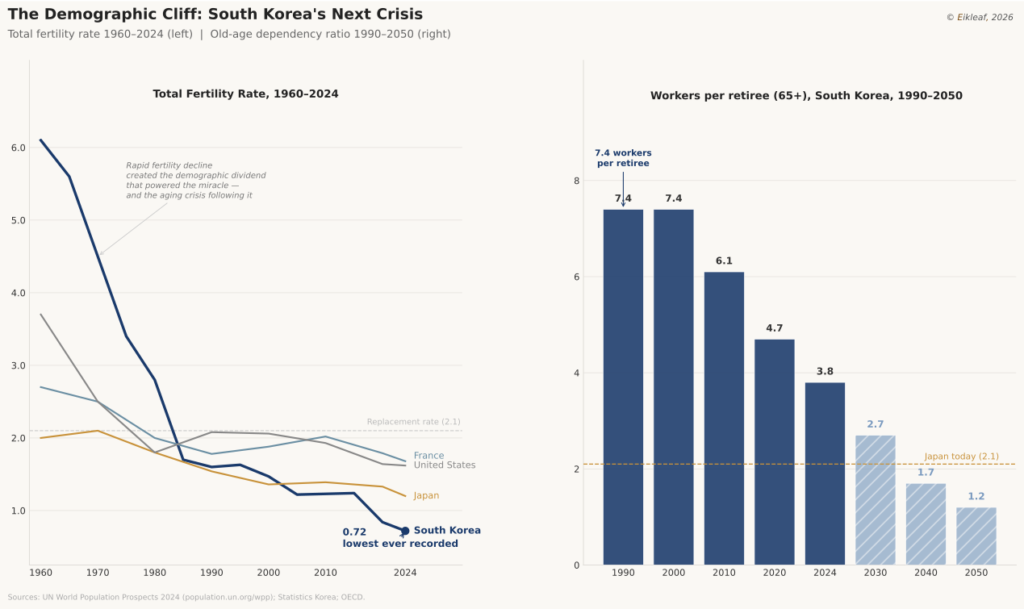
At the end of 2024, South Korea became what the United Nations defines as a “super-aged society,” with more than 20 percent of the population aged 65 or older. Korea reached this threshold in roughly seven years, compared with eleven for Japan and nineteen for the EU bloc. The Bank of Korea has assessed that if the current fertility rate persists, the economy could slip into sustained negative growth by 2050. The OECD projects that the old-age dependency ratio will surge from 28 percent today to 117 percent by 2082. Healthcare, pension, and long-term care costs are expected to more than double as a share of GDP by 2060.
South Korea has spent more than 360 trillion won, about $270 billion, since 2006 on incentives to promote childbirth: baby bonuses, housing benefits, tax relief, and expanded paternity leave. The fertility rate kept falling over most of the period. Women in Korea have the highest educational attainment in the OECD and face its largest gender pay gap. Researchers writing for CEPR have argued that ultra-low fertility results from a mismatch between Korea’s extremely rapid economic modernization and the persistence of traditional gender norms and work cultures. The Nobel laureate economist Claudia Goldin has argued that countries like Korea have ultra-low fertility today because they were pushed into modernity by rapid growth while their citizens’ beliefs, values, and traditions changed more slowly.
The demographic crisis is also an economic identity problem for a country whose development model was built on the logic of an ever-expanding, ever-more-skilled workforce. The directed capital accumulation, the export-oriented manufacturing, and the education investment were all calibrated to a population trajectory that no longer exists. Births fell from 715,000 in 1995 to 238,000 in 2024, recovering only to 254,500 in 2025, and the workforce will feel that collapse with full force in the 2040s.
| Demographic Indicator | Value | Comparison |
| Total Fertility Rate (2024; 2025) | 0.75; 0.80 | Replacement: 2.1; lowest in the OECD |
| Population 65+ (end 2024) | >20% | UN “super-aged” threshold crossed |
| Births (2024; 2025) | 238,000; 254,500 | Down from 715,000 in 1995 |
| Average age at first marriage for women | 31.3 years (2022) | Rising steadily since 1960s |
| Old-age dependency ratio by 2082 | ~117% | Currently 28%; among world’s fastest projected rise |
| Gov’t spending on fertility incentives (since 2006) | ~$270 billion | No significant TFR impact observed |
2025–2026: The Reckoning
The year 2025 arrived in South Korea under conditions that brought together most of the tensions that have defined the country’s modern history: democratic fragility, chaebol governance, export dependency, and geopolitical exposure.
On December 3, 2024, President Yoon Suk-yeol declared martial law, the first such declaration since 1979, claiming that the National Assembly had been infiltrated by “anti-state forces” linked to North Korea. The National Assembly rejected it within six hours. Yoon was impeached on December 14, and on April 4, 2025, the Constitutional Court unanimously upheld the impeachment. The Korean won fell to a fifteen-year low in the immediate aftermath of the declaration, and business confidence collapsed: the Bank of Korea’s business sentiment index fell by January 2025 to its lowest level since 2020. Bond markets, by contrast, drew a distinction between politics and credit. Foreign investors kept buying Korean government bonds through the crisis, adding a net 11.3 trillion won, about $7.9 billion, in April 2025 alone, even as they sold Korean stocks. Real GDP declined 0.2 percent in the first quarter of 2025.
The crisis arrived at a moment of pre-existing economic fragility. Growth in 2023 had been only 1.4 percent. Semiconductor cycles had turned: Samsung’s struggles in the HBM qualification process at Nvidia had depressed the company’s semiconductor revenues and share price, and Samsung’s outsized weight in the Korean economy and equity market dragged the entire KOSPI down with it. Domestic consumption, roughly half of GDP, had been chronically weak since 2019 because of high household debt and elevated interest rates.
The external environment compounded these internal pressures. In April 2025 the Trump administration announced a 25 percent “reciprocal tariff” on Korean goods, suspended within days in favor of a 10 percent baseline and then settled at 15 percent in a July deal. Specific duties of 50 percent on Korean steel and aluminum took effect the day of President Lee Jae-myung’s inauguration in June. The effective US tariff rate on Korean exports, near zero under the US-Korea Free Trade Agreement, averaged 8.3 percent across 2025 and peaked near 13 percent in August. The United States took nearly a fifth of Korea’s total exports in 2024. The OECD cut its 2025 growth forecast for Korea from 2.1 percent in December 2024 to 1.0 percent by June 2025.
Lee Jae-myung, elected president in June 2025, took office against this backdrop. His platform emphasized redistribution, state-led public investment, support for small and medium-sized enterprises, and reopening dialogue with North Korea. His initial economic signals were orthodox crisis management: a supplementary budget, monetary easing, and tariff negotiations with the Trump administration. The larger questions remain unresolved: chaebol governance reform, labor market liberalization, immigration policy sufficient to offset demographic decline, and a trade strategy capable of navigating the US-China technology decoupling that threatens to fracture the semiconductor supply chain on which Korean prosperity depends.
The Reunification Arithmetic

South Korea's economic future is often discussed without reference to the peninsula's most obvious variable: the continued existence of North Korea as a militarized, nuclear-armed state sharing a land border with one of the world's most densely populated and economically productive urban corridors. Per-capita GDP in the South is currently roughly thirty times higher than in the North on the Bank of Korea's estimates, and more than fifty times on UN figures. The CEBR estimated that a unified Korea with South Korean living standards would have ranked as the world's eighth largest economy in 2023 and could reach sixth by 2037. North Korea's population of approximately 26 million and its superior natural resource base, the mineral wealth whose loss was one of the South's structural disadvantages at partition, represent potential economic additions to a unified state. Integration would also be costly: West Germany's experience suggests that bringing North Korean productivity and infrastructure to Southern levels would require sustained investment transfers measured in trillions of dollars over decades, and the politics of getting there remain intractable.
What the Miracle Tells Us
South Korea’s transformation from a war-devastated subsistence economy to a G20 semiconductor and cultural power in roughly seventy years ranks among the fastest large-scale development episodes in modern history. Per-capita income reached about $36,000 in 2024, more than five hundred times the 1953 figure in nominal dollars.
The lessons that development economists, political scientists, and historians have drawn from this record are contested, and appropriately so. The narrative preferred by the Washington Consensus, that liberalization, privatization, and deregulation alone drive development, fits the Korean record poorly in its first three decades. The Korean state directed capital, protected industries, controlled finance, suppressed labor, and managed trade. It was not a liberal market economy in the ordinary sense between 1961 and the mid-1980s. The argument that export discipline imposed by world markets supplied a market test within this statist framework has merit, but it does not map neatly onto a simple neoliberal prescription.
Nor is the lesson as simple as “authoritarianism works.” The development drive that Park initiated was continued, with modifications, through the democratic transition of 1987 and beyond. The institutional investments in education, infrastructure, and technical capacity made during the authoritarian period were real and lasting. The political repression was not a necessary condition for these investments, though it was a feature of the same regime that made them. The question of what Korean growth would have looked like under democratic governance is not answerable by reference to the historical record.
The Korean case involved a state with real capacity and coherent institutional authority; an educated, disciplined, and culturally cohesive workforce willing to defer consumption in pursuit of collective advancement; external conditions that were historically contingent and not replicable on demand (the US security guarantee, Japanese technology transfer, Vietnam War contracts, open Western export markets); and a series of strategic bets on specific industrial sectors, backed by concentrated capital allocation, that paid off over timescales measured in decades. The bets could have failed; on paper, POSCO, a Korean shipbuilding industry, and Korean DRAM production all looked unviable. They succeeded because of capital, execution, and luck, in proportions that remain difficult to disentangle.
The predicament of 2026 grew out of the success of 1963. A country that transformed itself at maximum velocity to escape poverty now confronts the social costs of that velocity: a fertility rate that reflects a population exhausted by competitive pressure, an education system that delivers credentials without fulfillment, housing markets priced beyond the reach of the young, and a gender contract so misaligned with modern life that the country is declining to reproduce.
Dreary, again
In 1961, Rosenthal called the outlook “dreary” because of war damage, overpopulation, and poverty, and Korea’s industrial rise eventually proved him wrong. Now the word has begun to reappear in the national discourse, for almost opposite reasons: the exhaustion of a high-speed society, demographic shrinkage, and renewed political volatility. South Korea’s next seventy years will require a different kind of transformation than its first, and its instruments have not yet been found.
Gen AI Disclaimer
Some contents of this page were generated and/or edited with the help of a Generative AI.
Media
Key Sources and References
Data Sources and Statistical Agencies
1. Federal Reserve Bank of St. Louis, FRED. Gross Domestic Product Per Capita for Republic of Korea (series PCAGDPKRA646NWDB). https://fred.stlouisfed.org/series/PCAGDPKRA646NWDB
2. Bank of Korea. Economic Statistics System (ECOS), National Accounts releases, and Real Gross Domestic Product: First Quarter of 2025 (advance estimate). https://www.bok.or.kr/eng/
3. Statistics Korea. Social Indicators in 2024; and population, birth, and household statistical releases for 2024–2025. https://kostat.go.kr/ansi/eng/
4. Statistics Korea. Private Education Expenditures Survey of Elementary, Middle and High School Students: 2024. https://kostat.go.kr/board.es?mid=a30104010000&bid=11758
Historical and Economic Development
5. Michael J. Seth. “An Unpromising Recovery: South Korea’s Post-Korean War Economic Development, 1953–1961.” Education About Asia. https://www.asianstudies.org/publications/eaa/archives/an-unpromising-recovery-south-koreas-post-korean-war-economic-development-1953-1961/
6. Susan M. Collins and Won-Am Park. “Korea’s Rapid Growth.” In Developing Country Debt and Economic Performance, Volume 3, edited by Jeffrey D. Sachs and Susan M. Collins. University of Chicago Press / NBER, 1989. https://www.nber.org/system/files/chapters/c9037/c9037.pdf
7. Edward M. Graham. Reforming Korea’s Industrial Conglomerates. Peterson Institute / Columbia University Press, 2003. https://cup.columbia.edu/book/reforming-koreas-industrial-conglomerates/9780881323375
8. Byung-Kook Kim and Ezra F. Vogel, eds. The Park Chung Hee Era: The Transformation of South Korea. Harvard University Press, 2011.
9. Duol Kim. “The Great Divergence on the Korean Peninsula (1910–2020).” Australian Economic History Review 61, no. 3 (2021). https://onlinelibrary.wiley.com/doi/10.1111/aehr.12225
10. Foreign Policy Research Institute. “Why Do Some Nations Prosper? The Case of North and South Korea.” https://www.fpri.org/article/2017/04/nations-prosper-case-north-south-korea/
11. Council on Foreign Relations Education. “Two Koreas, Two Development Policies.” https://education.cfr.org/learn/reading/two-koreas-two-development-policies
The 1997 Financial Crisis
12. IMF Working Paper 99/28. The Korean Financial Crisis of 1997 — A Strategy of Financial Sector Reform. https://www.imf.org/external/pubs/ft/wp/1999/wp9928.pdf
13. Kihwan Kim. “The Korean Financial Crisis: Causes, Response and Lessons.” IMF seminar/conference paper. https://www.imf.org/external/np/seminars/eng/2006/cpem/pdf/kihwan.pdf
14. IMF Independent Evaluation Office. The IMF and Recent Capital Account Crises: Indonesia, Korea, Brazil. https://www.imf.org/external/np/ieo/2003/cac/pdf/all.pdf
Semiconductors and Industrial Policy
15. InvestKOREA. “South Korea’s Semiconductor Industry and Investment Status” (2 October 2025). https://www.investkorea.org/ik-en/bbs/i-5025/detail.do?ntt_sn=490812
16. Counterpoint Research. “SK hynix Takes Top Spot for First Time on Continued HBM Demand” (9 April 2025). https://counterpointresearch.com/insight/post-insight-research-notes-blogs-sk-hynix-takes-top-spot-for-first-time-on-continued-hbm-demand
17. TrendForce. “Amid Foundry Overcapacity, Competition for HBM Intensifies Rapidly” (24 April 2024). https://www.trendforce.com/news/2024/04/24/news-amid-foundry-overcapacity-competition-for-hbm-intensifies-rapidly/
18. Reuters. “South Korea unveils $19 bln package to compete in global chip warfare” (23 May 2024). https://www.reuters.com/world/asia-pacific/south-korea-unveils-19-bln-package-compete-global-chip-warfare-2024-05-23/
Hallyu, Culture, and Soft Power
19. Korea Foundation. “Global Hallyu Fans Surpass 225 Million.” https://kf.or.kr/kfNewsletter/mgzinSubViewPage.do?langTy=ENG&mgzinSubSn=27283
20. Netflix. “Netflix to Invest USD 2.5 Billion in Korean Content Over Next Four Years” (24 April 2023). https://about.netflix.com/en/news/netflix-to-invest-us-2-5-billion-in-korean-content-over-next-four-years
21. Nobel Prize Outreach. “The Nobel Prize in Literature 2024” and Han Kang press materials. https://www.nobelprize.org/prizes/literature/2024/summary/
22. Ministry of Culture, Sports and Tourism / Korea.net. Official cultural-industry and K-content policy releases, including 2023 budget and export-support materials. https://www.korea.net/Government/Current-Affairs
22a. Korea JoongAng Daily. “Dramas, K-pop and Instagram drive changing travel trends for tourists in Korea” (30 October 2024), reporting the Korea Culture & Tourism Institute’s Q4 2023 survey of 4,000 foreign visitors. https://v.daum.net/v/20241030220022482
Education, Labor, Inequality, and the Social Contract
23. OECD. Education at a Glance 2025: Korea. https://www.oecd.org/en/publications/education-at-a-glance-2025_1a3543e2-en/korea_252c9ed2-en.html
24. OECD Education GPS. Korea country profile and 2025 indicators. https://gpseducation.oecd.org/CountryProfile?primaryCountry=KOR&topic=EO&treshold=10
25. Sunwoong Kim and Ju-Ho Lee. “Private Tutoring and Demand for Education in South Korea.” Economic Development and Cultural Change 58, no. 2 (2010). https://www.journals.uchicago.edu/doi/10.1086/648186
26. Sonia Exley. “Locked In: Understanding the ‘Irreversibility’ of Powerful Private Supplementary Tutoring Markets.” Oxford Review of Education 48, no. 1 (2022). https://www.tandfonline.com/doi/full/10.1080/03054985.2021.1917352
27. Korea Labor Institute. Recent non-regular worker and youth labor statistics releases. https://www.kli.re.kr
28. OECD. Employment Outlook 2024 — Country Notes: Korea. https://www.oecd.org/en/publications/oecd-employment-outlook-2024-country-notes_d6c84475-en/korea_636e4c7a-en.html
29. OECD. Reviews of Pension Systems: Korea. https://www.oecd.org/content/dam/oecd/en/publications/reports/2022/09/oecd-reviews-of-pension-systems-korea_057d3b66/2f1643f9-en.pdf
Demographic Crisis
30. OECD. Economic Surveys: Korea 2024, especially Chapter 5, “Responding to population decline.” https://www.oecd.org/content/dam/oecd/en/publications/reports/2024/07/oecd-economic-surveys-korea-2024_9f0f34c8/en/korea-2024_6b4a7f0f-en.pdf
31. OECD. Korea’s Unborn Future: Understanding Low-Fertility Trends (2025). https://www.oecd.org/en/publications/korea-s-unborn-future_005ce8f7-en.html
32. OECD. Women, Work and the Population Puzzle (2025). https://www.oecd.org/en/publications/women-work-and-the-population-puzzle_5e2e6aae-en.html
33. Statistics Korea / Ministry of Data and Statistics. Birth statistics releases showing a 2024 fertility rate of 0.75 and 238.3 thousand live births, and 2025 figures of 0.80 and 254.5 thousand. https://sri.kostat.go.kr
34. Bank of Korea. Research and policy materials on aging, labor-force decline, and long-run growth. https://www.bok.or.kr/eng/
2024–2026 Politics and the Recent Economic Shock
35. Reuters. “South Korea’s Yoon removed from office over martial law, election looms” (4 April 2025). https://www.reuters.com/world/asia-pacific/south-koreas-impeached-president-yoon-faces-court-ruling-decide-his-fate-2025-04-03/
36. Reuters. “South Korea’s acting president orders emergency measures over U.S. tariffs” (3 April 2025). https://www.reuters.com/world/asia-pacific/south-koreas-acting-president-orders-emergency-measures-over-us-tariffs-2025-04-02/
37. Reuters. “South Korea to minimise impact of 50% tariff on steel products, ministry says” (2 June 2025). https://www.reuters.com/world/asia-pacific/south-korea-minimise-impact-50-tariff-steel-products-ministry-says-2025-06-02/
38. Korea Development Institute. KDI Economic Outlook, 2025 first-half edition. https://www.kdi.re.kr/eng/research/economy
39. Reuters. Coverage of Lee Jae-myung’s June 2025 inauguration and initial economic agenda. https://www.reuters.com/world/asia-pacific/
Supplementary comparative and analytical sources
40. OECD. Korea country pages and comparative data portals on productivity, labor markets, education, and inequality. https://www.oecd.org/korea/
41. World Bank Data. Korea, Rep. macroeconomic indicators and comparative development series. https://data.worldbank.org/country/korea-rep
42. Brookings Institution. “Korea’s Path from Poverty to Philanthropy.” https://www.brookings.edu/articles/koreas-path-from-poverty-to-philanthropy/
43. Centre for Economics and Business Research. “Sustaining the Economic Miracle: South Korea to Break Global Top Ten by 2026.” https://cebr.com/blogs/sustaining-the-economic-miracle-south-korea-to-break-global-top-ten-by-2026/
44. Rosenthal, A. M. “Outlook Dreary for South Korea.” The New York Times, March 21, 1961 (as cited in Seth, M. J. “An Unpromising Recovery,” Education About Asia 18:3, 2013).