Last updated: · 12 min read
In brief
During the US strikes on Iran, a Hangzhou AI company posted annotated satellite images of American carriers and bombers for anyone to see. It owned no satellites. It bought the pictures, and US intelligence assessed that Iran used them for targeting. Seeing from orbit once took spy satellites costing billions each; now commercial constellations image the Earth’s entire landmass daily and sell to almost anyone. Washington sanctioned the company, but the market that supplied it stayed open. Whoever took those pictures still has satellites in orbit and an archive for sale.
Contents
When US forces, alongside Israel, began striking Iran under Operation Epic Fury on February 28, 2026, a Hangzhou-based AI company called MizarVision was watching. In near real time, the company posted annotated satellite imagery of American military assets across the Middle East to Weibo and X for anyone who wanted to look: aircraft carriers, missile defence batteries, B-2 bombers, individual aircraft on their ramps. A source inside the US Defense Intelligence Agency said Iran’s Revolutionary Guard was monitoring MizarVision’s imagery and using it to pick targets for missile and drone strikes, an assessment another US government source confirmed. On May 8, 2026 the State Department sanctioned the company under its legal name, Meentropy Technology (Hangzhou) Co., Ltd.
MizarVision operates no satellites of its own. It buys imagery from commercial providers and runs the pictures through AI pipelines that annotate military hardware with the same techniques used to annotate container ships and agricultural fields.
Exactly which providers it uses remains disputed. A technical analysis for the House Select Committee on China named Airbus satellites as the most plausible source of some images, which Airbus rejects. The State Department says Chang Guang Satellite Technology, operator of China’s Jilin-1 constellation, collected imagery of US facilities for Iran. Planet Labs and Vantor (formerly Maxar) both say MizarVision is not their customer. Whatever the confirmed sourcing, the entire operation ran on purchased commercial data. What Washington treated as a security breach began as a market transaction: MizarVision bought a product from commercial satellite operators, and the product tracked American forces. That purchase was possible because the price of seeing from orbit has collapsed.
The price of seeing
For most of the Cold War and into the first decade after it, satellite reconnaissance was among the most expensive capabilities a state could possess. A KH-11 Keyhole reconnaissance satellite, the kind the National Reconnaissance Office operates for tasked imaging of specific sites, costs billions of dollars per unit. When the NRO put a public price on its big spacecraft in 2014, two national-security satellites came to more than $5 billion combined. A government that wanted detailed pictures of what was building up on the other side of a border had two options: build this infrastructure, or negotiate access to a government that had.
Planet Labs now operates hundreds of small Dove satellites in low Earth orbit, which together image the entire landmass of the Earth every day.
Planet doesn’t publish per-unit hardware costs, but its Doves are built in-house on a production line, and the company has launched hundreds of them since 2013. Its pictures go to customers monitoring crop yields and tracking container ships as well as to the defence and intelligence agencies that now bring in most of its revenue. Vantor’s (formerly Maxar’s) WorldView constellation, which sells imagery as sharp as 30 centimetres, serves insurance actuaries, municipal planners, and journalists on assignment. The result is near-daily surveillance of the planet’s land surface, for sale to almost anyone who opens an account.
In October 2021, Planet Labs’ SkySat constellation began capturing images of a significant buildup near Yelnya, Russia, roughly 160 miles north of the Ukrainian border. Yelnya is home to the 144th Guards Motorized Rifle Division, but the new arrivals belonged to the 41st Combined Arms Army, normally garrisoned more than 2,000 miles away in Novosibirsk: tanks, self-propelled howitzers and air-defence systems that analysts could count against their own historical baseline. By January 2022, Maxar imagery showed more equipment massed at Klimovo, a military storage facility roughly eight miles from the Ukrainian border.
Journalists and think tanks bought these commercial images, and news organisations published them for any reader with an interest. Anyone with a subscription could follow the Kremlin’s invasion buildup for months before it crossed the border.
The institutional response is still catching up. In July 2024, seventeen NATO member states signed up to the Alliance Persistent Surveillance from Space programme, committing the equivalent of more than $1 billion over five years to draw on commercial and national satellites. It reached initial operational capability in December 2025, an admission that for some tasks, such as revisiting the same ground every day, the commercial market had outrun the allies’ own satellites.
None of which means commercial access is uncontrolled. The US government has shown what leverage it keeps over American providers. Within days of the war starting, Planet Labs began delaying its Middle East imagery, first by four days and then by two weeks. On April 5 it announced that, at the US government’s request, it would withhold imagery of Iran, Iraq, Israel, Lebanon and the Persian Gulf states indefinitely, backdated to March 9. A year earlier, on March 7, 2025, the Trump administration suspended Ukrainian accounts on the US government platform through which Kyiv received Maxar’s high-resolution imagery of Russian positions. Access returned on March 12, the day after US-Ukraine talks in Jeddah.
The leverage is real, but it is late and partial. European providers were unaffected by the Planet Labs restrictions. A request can stop an American company selling new pictures, but imagery sold before the request arrived, or held by providers in other jurisdictions, stays out of its reach. Gating one American company for one region, while the rest of the market and its archives stay open, cuts one supply line and leaves the others running.
The economics of watching

A KH-11-class reconnaissance satellite costs billions of dollars, is irreplaceable if destroyed or degraded, images selected targets on request rather than continuously, and belongs to a small, classified fleet. Planet Labs' Dove constellation consists of hundreds of individually replaceable units, built at commercial scale, imaging the Earth's entire landmass every day. The same archive serves every buyer, so a picture taken for a crop insurer shows an airfield as clearly as one taken for an intelligence agency.
The network that couldn’t be cut
On February 26, 2022, two days into Russia’s invasion of Ukraine, Ukraine’s Vice Prime Minister Mykhailo Fedorov tweeted at Elon Musk asking for Starlink service. Musk replied the same day, service was activated within twelve hours, and the first terminals arrived within 48 hours. By early April, SpaceX and USAID had delivered 5,000 terminals. A dedicated US military satellite communications programme takes years to make the same journey from requirement to deployment.
The military consequences extended well beyond basic connectivity. Ukrainian combat units used Starlink to relay drone surveillance video to artillery batteries in near real-time, compressing what planners call the sensor-to-shooter loop, the time between spotting a target and firing on it. Both surveillance and strike drone operations ran over Starlink connections. When Russian electronic warfare teams targeted terminals with jamming, SpaceX pushed a software update that defeated the jamming within about a day. Russia had spent decades developing EW capabilities specifically designed to sever adversary communications in the opening phase of a conflict. Against a commercial constellation in low orbit distributing connectivity through thousands of small satellites, those capabilities met a network its owner could patch from the ground. The contest did not end there: Russian jamming has degraded Starlink at times since.
The US Advanced Extremely High Frequency satellite communications programme, which provides nuclear-survivable encrypted communications to US and allied forces, saw its estimated acquisition cost more than double, from $6.6 billion to $14.4 billion, as it grew to six satellites. Starlink offers none of that nuclear hardening. But Ukraine received communications resilience beyond anything its defence budget could have procured, carried by a network a commercial company built for rural broadband customers who couldn’t get cable.
Then, in September 2022, Musk refused Ukraine’s request to extend Starlink coverage to Crimea for a naval drone operation targeting Russian ships in Sevastopol Bay.
The Ukrainian military was steering explosive-laden sea drones toward the Russian Black Sea Fleet. Musk declined to activate service in the area, saying it would make SpaceX complicit in a major act of war; his biographer, Walter Isaacson, reported that he feared a nuclear response. Whatever his reasoning, the decision was his alone, and Ukraine had no treaty body or institutional process through which to appeal it. SpaceX subsequently developed Starshield, a separate military-grade satellite service for Pentagon use, while maintaining commercial Starlink under different access terms.
Existing doctrine at least understands the old vulnerability: an adversary physically destroying communications infrastructure. Armies know how to harden command nodes, build redundancy and route around damage. The newer vulnerability sits in a contract: military communications infrastructure is now materially dependent on commercial decisions made by people who answer to shareholders and have their own views on acceptable risk. Military doctrine was built to address an adversary that might destroy your communications. It has barely begun to plan for a supplier who might restrict them.
When cheap weapons hit like expensive ones
GPS began as a US military navigation system, built by the Department of Defense beginning in 1973 and still operated by the U.S. Space Force from Schriever Space Force Base.
Ronald Reagan committed to civilian access after Soviet forces shot down Korean Air Lines Flight 007 in 1983, killing all 269 people on board; the airliner had strayed into Soviet airspace after a navigation error. In 2000 the government eliminated Selective Availability, the deliberate accuracy degradation imposed on civilian GPS receivers. The precision revolution that followed was enabled by government infrastructure. But it was commoditised through commercial manufacturing, and that commoditisation produced the same economic outcome as if the infrastructure had been commercial from the start.
The Joint Direct Attack Munition shows the scale of the shift. A JDAM guidance kit bolted onto an existing unguided iron bomb costs roughly $25,000 to $40,000 in its basic form. It turns a cheap dumb bomb into an all-weather, GPS-guided weapon that the US Air Force rates at five metres or better: with GPS available, half the bombs land within five metres of the aim point. Before JDAM, all-weather precision meant stand-off missiles costing many times as much; laser-guided bombs were cheaper but needed clear skies and a laser held on the target until impact. Boeing had built 250,000 JDAM kits by 2013, and by 2025 the company put its total at more than 550,000. Precision went from a strategic asset, deliverable only by specific aircraft under specific conditions, to a logistics item ordered by the pallet.
Ukraine’s experience with the M982 Excalibur GPS-guided artillery shell showed both the precision revolution and its counter-economy. Excalibur costs around $100,000 per round and gives a standard 155mm howitzer near-surgical accuracy against a target the size of a car, tens of kilometres away.
In January 2023, Ukraine reckoned in classified assessments that 55 percent of Excalibur rounds hit their targets. As Russian GPS jamming spread across the front, the rate fell to 6 percent by August 2023, in a thinner sample of later firings, and the cost of each successful strike rose from about $300,000 to $1.9 million. Ukrainian gunners largely abandoned the shell, and by late 2023 Washington had stopped sending it.
Even so, GPS access plus commercial manufacturing has permanently put guided munitions within reach of any military that can buy the kits. What stays contested is whether the guidance works when it is needed. Adversaries have shown they can degrade the precision at a cost far lower than the cost of the precision itself, so the competition has moved from expensive precision against expensive targets to cheap guidance kits against cheap jamming.
And the commercial pressure is now working on the GPS infrastructure itself. In March 2026, Xona Space Systems closed a $170 million funding round to build Pulsar, a commercial positioning network in low Earth orbit that the company says will broadcast signals roughly 100 times stronger than GPS and resist jamming and spoofing. Initial commercial service is targeted for 2027. The same economic logic that produced Planet Labs and Starlink is now reaching GPS: private capital is trying to replicate and harden government infrastructure that was once exclusive, betting on autonomous vehicles and precision agriculture as well as on defence customers. The Air Force Research Laboratory has already paid Xona to test Pulsar for military missions.
The doctrine gap
US Joint Publication 3-0, the Pentagon’s governing document for joint campaigns and operations, still lists surprise among its core principles, achievable through operational security, deception, and information management. NATO’s air and space doctrine, AJP-3.3, was rewritten as recently as February 2026. It acknowledges that the space capabilities the Alliance depends on sit “under national sovereignty or commercial governance or control” and then notes that this complicates planning.
AJP-3.3 goes further. It warns that adversaries can easily buy space products from commercial sources and lists diplomatic, information, military and economic measures for controlling their access. It does not say how those measures work against a company in another jurisdiction selling pictures on an open market. The US military runs operational security procedures designed to limit adversary knowledge of deployments, movements and force compositions, procedures refined over decades and codified in regulation.
While those procedures were running, a company in Hangzhou with no satellite assets and no intelligence apparatus was publishing the locations of aircraft carriers, missile defence batteries, and individual aircraft in annotated, publicly accessible updates during an active US combat operation. US intelligence assessed that Iran was using the data for targeting. A military with a defence budget approaching $1 trillion, counting reconciliation funds in its FY2026 request, could not keep the positions of its carriers from a company with a commercial satellite subscription and an off-the-shelf AI pipeline.
The government’s response, sanctioning MizarVision and pressuring Planet Labs into a regional imagery blackout, deals with the company that published the pictures and leaves alone the market that supplied them. Meentropy Technology (Hangzhou) Co., Ltd. is sanctioned, and so are two Chinese imagery suppliers, Chang Guang Satellite Technology and The Earth Eye. The analytics firms and satellite operators doing similar work in other jurisdictions are not. Sanctioning a handful of companies cuts them off from American buyers and finance, but the capability belongs to a global commercial satellite market, and other firms can sell the same pictures.
Traditional military satellite programmes take a decade or more to field, while commercial satellite companies iterate in months, so what doctrine assumes keeps falling behind what commercial systems can do.
That gap carries a risk. A military that plans for surprise and discovers at execution that its buildup has been visible for months can adapt, or it can press on, compressing timelines, front-loading force or escalating rather than accepting the constraint. A military that plans for communications dominance and discovers it cannot sever an adversary’s commercial LEO constellation may decide to destroy the constellation, which means attacking private companies’ assets in orbit and treating commercial firms as de facto belligerents, testing the law of war at its least settled edge. The Outer Space Treaty of 1967 makes states answerable for what their private companies do in orbit, but says nothing about what happens when those companies’ satellites serve one side of a war. NATO agreed in 2021 that attacks to, from or within space could trigger Article 5, yet no alliance text spells out whether an attack on a commercial constellation serving a belligerent would qualify. The law of armed conflict does reach into orbit: the International Committee of the Red Cross reads it to mean that a commercial satellite serving a military can become a lawful target, but only if the attacker weighs the harm to the civilians who rely on the same satellite. How that test applies to a constellation carrying a war and a country’s civilian internet at once has never been settled in practice. The rules exist; the playbook for commercial space as military infrastructure is still being written.
What the ledger says
The institutions dealing with the fallout have treated MizarVision as a security incident. One company tracked American forces; it was sanctioned, along with the Chinese satellite firms accused of feeding Iran. American imagery providers were asked to go dark over the war zone.
Each step dealt with the incident in front of it. None touched the condition that produced it: a commercial market that photographs the planet’s land surface every day and keeps the pictures for sale.
That market is too large and spread across too many countries to be sanctioned into non-existence, and no sanction recalls imagery already distributed across many operators and jurisdictions. Counterintelligence, sanctions and access restrictions can take one seller off the board while the imagery keeps accumulating as the business grows and its costs fall.
MizarVision’s imagery came from commercial satellites built and licensed for economic purposes, operated by companies that sell the same pictures to farmers, insurers, logistics firms and governments alike. Exactly which of those companies supplied the pictures of American forces is disputed. Whichever it was, its satellites are still in orbit and its archive is still for sale.
Related articles
- The invisible border that splits the Internet in two
- The rare earth supply chain: the hidden dependency behind every modern device
- How insurance companies quietly govern the world’s oceans
Further reading
As an Amazon Associate, Eikleaf earns from qualifying purchases. The book links below are affiliate links: if you buy through them, we may earn a small commission at no extra cost to you.
 When the Heavens Went on Sale: The Misfits and Geniuses Racing to Put Space Within ReachReporting inside Planet Labs and low-cost launch companies explains how commercial businesses made frequent satellite surveillance affordable.
 The Future of Geography: How the Competition in Space Will Change Our WorldAn accessible overview connects dependence on satellites with great-power rivalry, private operators and the rules governing space.Space to Grow: Unlocking the Final Economic FrontierSpace to Grow: Unlocking the Final Economic FrontierCompany stories and plain-language economics explain falling space-access costs, commercial satellite markets and government’s role as a customer.
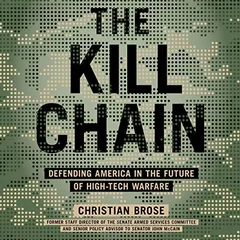 The Kill Chain: Defending America in the Future of High-Tech WarfareExplains how connected sensors, communications and weapons shorten targeting cycles, and why military procurement struggles to adapt.
Recommended videos
 5:39US intelligence says Chinese satellite imagery of Middle East bases is helping Iran | ABC NEWSReport on US intelligence that Chinese commercial imagery helped Iran target US bases, the article’s opening case.
 28:30The Increasing Reality of War in SpaceHow militaries depend on satellites for sensing and communication, and why space is now contested.
 9:34Why is Elon Musk’s Starlink internet so important on the battlefield in Ukraine? | BBC NewsWhy Starlink became critical on Ukraine’s battlefield and the leverage a private operator holds.
Cite this article
Ulfur Atli. “How satellites changed the economics of war without firing a single shot.” Eikleaf, 18 May 2026, updated 2 November 2026. https://www.eikleaf.com/how-satellites-changed-the-economics-of-war-without-firing-a-single-shot/
Gen AI Disclaimer
Some contents of this page were generated and/or edited with the help of a Generative AI.
Media
Key Sources and References
US Department of State. “Disrupting Iran’s Overseas Military Procurement Networks.” May 8, 2026. https://www.state.gov/releases/office-of-the-spokesperson/2026/05/disrupting-irans-overseas-military-procurement-networks/
China in Space. “U.S. Sanctions Three Chinese Space Firms Over Alleged Iran Ties.” May 2026. https://www.china-in-space.com/p/us-sanctions-three-chinese-space
Anadolu Agency. “Access to satellite imagery restricted amid Iran war.” March 16, 2026. https://aa.com.tr/en/world/access-to-satellite-imagery-restricted-amid-iran-war-report/3866406
Al Jazeera (AFP/Reuters). “US satellite firm Planet Labs announces blackout on war on Iran images.” April 5, 2026. https://www.aljazeera.com/news/2026/4/5/us-satellite-firm-planet-labs-announces-blackout-on-war-on-iran-images
ABC News (Australia). “Chinese satellite imagery of Middle East bases is helping Iran, US intelligence says.” April 6, 2026. https://www.abc.net.au/news/2026-04-06/us-intelligence-chinese-satellite-imagery-middle-east/106508322
Defence Industry Europe. “MizarVision publishes AI-processed satellite imagery of U.S. military assets, raising intelligence and security concerns.” 2026. https://defence-industry.eu/mizarvision-publishes-ai-processed-satellite-imagery-of-u-s-military-assets-raising-intelligence-and-security-concerns/
The Defense Post. “AI, China and the Middle East.” March 12, 2026. https://www.thedefensepost.com/2026/03/12/ai-china-middle-east/
The Wall Street Journal (via To Vima). “Chinese Satellites Over Mideast Battlefield Put U.S. on Edge.” 2026. https://www.tovima.com/wsj/chinese-satellites-over-mideast-battlefield-put-u-s-on-edge/
House Select Committee on the CCP. “Airbus Space likely provided satellite imagery of US military assets to China before Operation Epic Fury.” April 2026. https://chinaselectcommittee.house.gov/media/press-releases/airbus-space-likely-provided-satellite-imagery-of-us-military-assets-to-china-before-operation-epic-fury
The Washington Post. “Chinese firms market Iran war intelligence ‘exposing’ U.S. forces.” April 4, 2026 (subscription required).
National Reconnaissance Office. “Dr. Darrell Zimbelman Receives 2014 Charyk Award.” Press release 02-14, 2014 (archived). https://web.archive.org/web/20170119004229/http://nro.gov/news/press/2014/02-14.pdf
Planet Labs. “Planet imagery and archive.” https://www.planet.com/products/planet-imagery/
Planet Labs PBC. Fiscal fourth quarter 2026 earnings update presentation (FY26 revenue by sector: defence and intelligence 59 percent). March 2026. https://s29.q4cdn.com/903184914/files/doc_earnings/2026/q4/presentation/Planet-Fiscal-4Q-26-Update-Presentation.pdf
Vantor (formerly Maxar Intelligence). WorldView imagery. https://www.vantor.com/
CSIS. “Moscow’s Continuing Ukrainian Buildup.” November 17, 2021. https://www.csis.org/analysis/moscows-continuing-ukrainian-buildup
Radio Free Europe / Radio Liberty. “Boots On The Ground: Satellite Images Reveal Russian Troop Buildup Near Ukrainian Border And In Crimea.” (Maxar imagery, October–December 2021; gallery updated January 14, 2022.) https://www.rferl.org/a/russia-ukraine-troop-buildup-satellite-imagery/31598141.html
Army Times. “Satellite images show more Russian troops, equipment near Ukraine.” January 20, 2022. https://www.armytimes.com/flashpoints/2022/01/20/satellite-images-show-more-russian-troops-equipment-near-ukraine
NATO. “NATO’s approach to space” (including the Alliance Persistent Surveillance from Space programme and the 2021 Article 5 statement). https://www.nato.int/en/what-we-do/deterrence-and-defence/natos-approach-to-space
AIN.UA. “Maxar brings back access to satellite imagery for Ukrainians after a week-long pause.” March 12, 2025. https://en.ain.ua/2025/03/12/maxar-brings-back-access-for-ukraine
Space.com. “SpaceX and USAID deliver 5,000 Starlink internet terminals to Ukraine.” April 7, 2022. https://www.space.com/spacex-usaid-starlink-terminals-ukraine
Secure World Foundation. “Global Counterspace Capabilities: An Open Source Assessment.” April 2025. https://swfound.org/publications-and-reports/2025-global-counterspace-capabilities-report
Ukrainska Pravda. “First surface vessel attack on Crimea failed as Musk turned off connection.” January 1, 2024. https://www.pravda.com.ua/eng/news/2024/01/01/7435389/
SpacePolicyOnline. “GAO Details Cost Growth in DOD Space Programs” (AEHF cost estimates from GAO). April 2013. https://spacepolicyonline.com/news/gao-details-cost-growth-in-dod-space-programs/
GPS.gov. “Selective Availability.” https://www.gps.gov/selective-availability
Designation-Systems.net. “Boeing (McDonnell Douglas) JDAM.” https://www.designation-systems.net/dusrm/app5/jdam.html
US Air Force. “Joint Direct Attack Munition GBU-31/32/38” (fact sheet). https://www.af.mil/About-Us/Fact-Sheets/Display/Article/104572/joint-direct-attack-munition-gbu-313238/
The Defense Post. “US Air Force Orders Boeing JDAM Precision Kits for $7.5 Billion.” May 29, 2024. https://www.thedefensepost.com/2024/05/29/us-air-force-jdam/
Boeing. “Boeing Reaches 250,000 Kit Milestone for JDAM Weapon Program.” August 20, 2013. https://boeing.mediaroom.com/Boeing-Reaches-250-000-Kit-Milestone-for-JDAM-Weapon-Program
Hudson Institute. “Building Weapons that Adapt and Scale” (event transcript; Boeing’s Eric Nelson on JDAM production). May 13, 2025. https://www.hudson.org/events/building-weapons-adapt-scale
Maksymilian Dura, Defence24. “Excalibur – najlepszy środek na rosyjskie czołgi” (Excalibur unit price in fiscal years 2021–2022). November 4, 2022. https://defence24.pl/sily-zbrojne/excalibur-najlepszy-srodek-na-rosyjskie-czolgi
Kyiv Post. “Off Target – Are Kyiv’s GPS-Aided Weapons Susceptible to Kremlin EW Jamming?” May 29, 2024. https://www.kyivpost.com/analysis/33448
The Washington Post (via Anchorage Daily News). “Russian jamming leaves some high-tech U.S. weapons ineffective in Ukraine.” May 24, 2024. https://www.adn.com/nation-world/2024/05/24/russian-jamming-leaves-some-high-tech-us-weapons-ineffective-in-ukraine/
SiliconANGLE. “Satellite navigation startup Xona Space nabs $170M investment.” March 26, 2026; Xona Space Systems, “Pulsar.” https://siliconangle.com/2026/03/26/satellite-navigation-startup-xona-space-nabs-170m-investment/ · https://www.xonaspace.com/pulsar
Xona Space Systems. AFRL STAR-FISH contract announcement (resilient commercial PNT for Department of Defense missions). February 25, 2025. https://www.xonaspace.com/news/starfish
Joint Chiefs of Staff. Joint Publication 3-0, Joint Campaigns and Operations. June 18, 2022. https://www.jcs.mil/Doctrine/Joint-Doctrine-Pubs/3-0-Operations-Series/
NATO Standardization Office. AJP-3.3, Allied Joint Doctrine for Air and Space Operations, Edition C. February 2026. https://assets.publishing.service.gov.uk/media/698ef9fb7da91680ad7f4389/AJP_3_3_EdC_V1.pdf
Congressional Research Service. “FY2026 Defense Budget: Funding for Selected Weapon Systems” (R48860). Updated July 2, 2026. https://www.everycrsreport.com/files/2026-07-02_R48860_1f51b31646b9ab07d254d30354f21a4bb1565e77.html
UN Office for Outer Space Affairs. Treaty on Principles Governing the Activities of States in the Exploration and Use of Outer Space (Outer Space Treaty), 1967. https://www.unoosa.org/oosa/en/ourwork/spacelaw/treaties/outerspacetreaty.html
International Committee of the Red Cross. “ICRC Observations on the Consultants’ Report: Protecting Essential Civilian Services on Earth from Disruption by Military Space Operations.” June 2024. https://www.icrc.org/sites/default/files/media_file/2024-06/4781.02_002_icrc_observations_web.pdf