Last updated: · 17 min read
In brief
On 10 October 2026 a Houthi strike killed 13 people at Riyadh’s King Khalid International Airport, which has no military facilities. Officials describing an initial Saudi probe said drones went first, paving the way for missiles that got through. The usual story is a price ratio: a cheap drone against a $2 million missile. On its own, that ratio misleads. What wears a defence down is stock: US Patriot interceptors fell from 2,330 to an estimated 759 to 827, and replacements take years. Until stocks recover, commanders may fire two interceptors instead of three.
Contents
King Khalid International Airport in Riyadh has no military facilities. On Saturday 10 October 2026 a Houthi strike hit it anyway. The Saudi statement on the attack listed 12 dead and 309 injured: four Saudis, two Bangladeshis, an American, an Egyptian, a Jordanian, a Palestinian, a Syrian and a Sudanese among the dead. The next day the Indian embassy said an Indian national wounded in the attack had died, bringing the toll to 13. It was the deadliest strike on a Gulf Arab state since the war on Iran began in February, and by 12 October the airport had been hit four times in five days.
Two days after the attack, two regional officials, speaking on condition of anonymity, described what an initial Saudi probe had found. The Houthis, they said, first sent several drones to pave the way for a mix of cruise and ballistic missiles, and the missiles reached the airport. Saudi Arabia’s investigators want to know why the air defences failed to intercept the barrage, and why they gave no earlier warning of weapons that had flown more than 1,000 kilometres to reach the capital.
No answer has been made public. The Houthis do have ballistic missiles fitted with warheads that can change direction in flight, a known difficulty for the Patriot interceptors the Saudis use, but nobody has said that this is what happened over Riyadh.
The investigators’ questions line up with the jobs every air defence has to do: see a threat early enough to act, decide what to fire at, hit it, and still have the right weapon in the right place when the next raid comes. A raid that mixes cheap drones with missiles presses on all of them at once. More objects appear on the radar, more decisions have to be made in the same few minutes, more interceptors leave the launchers, and fewer remain for the next night.
The stakes run from airports to household energy bills. Riyadh’s airport closed after the strike, and by 21 October only a limited number of domestic flights were using it. On 20 October Britain announced that RAF Typhoon fighters would fly defensive missions to help protect Saudi cities and infrastructure, adding to British air defence equipment already deployed in the kingdom. The Ministry of Defence explained the decision in household terms: escalating violence in the Gulf, it said, can drive up “the cost of living” in Britain and disrupt its energy supplies.
The economics of drone warfare usually get told as a price ratio, a cheap drone against a costly missile. The ratio is real, and on its own it misleads. What wears a defence down over weeks and months is harder to see: how many interceptors exist, where they are, and how many years it takes to build more.
The ratio everyone quotes
Over about 15 months to January 2025, US Navy warships in the Red Sea fought 380 separate engagements against the Houthis and fired 220 missiles and 160 five-inch shells. The targets were a mix of drones, anti-ship missiles and ballistic missiles. The Navy’s workhorse interceptor in those fights, the SM-2, costs around $2 million.
Headlines liked to set that $2 million against a Houthi drone said to cost $2,000. The comparison misleads, and the drone’s price is the first reason. In June 2025 General Michael Kurilla, then commanding US Central Command, told Congress that the Iranian-supplied drones flown by the Houthis cost roughly $50,000 to $100,000 each. Against an SM-2 that makes the gap something like twenty or forty to one. That is still lopsided, and the White House said as much. Jake Sullivan, President Biden’s national security adviser, called missiles against cheap drones “just a terrible equation for us, obviously,” while adding that the “equation is more realistic” against the Houthis’ more advanced missiles.
The bigger flaw in the ratio is that it leaves out what the missile protects. In one Red Sea engagement an anti-ship cruise missile got “within a mile of the roughly $2 billion ship and all of the sailors on it”, the destroyer USS Gravely, before the ship’s Phalanx close-in gun shot it down. The warships were guarding a route that carried about 10% of the world’s seaborne trade in 2023. And Saudi Arabia already knows what a strike that gets through can cost. On 14 September 2019 missiles and drones hit its oil facilities at Abqaiq and Khurais and briefly knocked out 5.7 million barrels a day, more than half the kingdom’s output and about 5% of global supply.
Ships also fire expensive missiles at cheap drones for a mundane reason. A warship sails with whatever was loaded in port, and those loads are built to defeat the most dangerous threats. If the only thing coming is a drone, the crew may have nothing cheaper that can reach it. Given a choice, operators pick the cheapest weapon that will work, but the cheaper, shorter-range options can protect only a small circle around the ship. By January 2025 Vice Admiral Brendan McLane, then commander of the Navy’s surface forces, said simpler threats such as one-way attack drones were being taken on with ships’ guns and aircraft.
So, shot by shot, firing an expensive interceptor can be the right call. The price tag leaves out where the missile came from and how long it will take to replace.
Stock, place and time
The war on Iran that began on 28 February 2026 shows the drain at scale. Iran and its proxies launched thousands of missiles and one-way drones at states across the region, at commercial shipping and at US bases and ships. By the end of June, the integrated defence network that the United States and its partners run across the region had intercepted more than 6,000 one-way drones and more than 1,500 ballistic missiles. Those totals count threats stopped. They do not say how many interceptors were fired, or which kinds.
Every interception draws down a national stock. By late July, analysts at the Center for Strategic and International Studies (CSIS), a Washington think tank, estimated from budget documents and other public information that American Patriot interceptors had fallen from 2,330 before the war to 1,030 at the April ceasefire, and to between 759 and 827 after fighting resumed. Interceptors for THAAD, the system built to hit ballistic missiles higher up, had gone from 452 to between 234 and 278. In early August, unnamed sources put the losses higher still: nearly 80% of the prewar THAAD stock and roughly half the Patriots. The defence secretary, Pete Hegseth, denied that account, and the Pentagon has confirmed none of these numbers. Its chief spokesman, Sean Parnell, said in July that the military “has everything it needs”, and in October he was blunter: “Claims of U.S. munitions shortages are false.” In mid-October, though, US officials familiar with the matter said that two months before the war the Army’s then chief of staff, General Randy George, had warned that Patriot and THAAD stocks would stay strategically low until 2030. One official said that restoring them even to their December 2025 level would take until 2030.
Those stocks also have to be in the right place. A missile in a depot at home does nothing for Riyadh, and the same Patriot batteries are wanted in several places at once. The commander of US forces in Europe may want them in Poland while Central Command wants them in Kuwait and Indo-Pacific Command may need them for a contingency involving China. In April 2025 the US commander in the Pacific told senators that a Patriot battalion had been moved from his region to the Middle East. Warships with Standard Missiles can intercept ballistic missiles too, but CSIS notes they are generally too far away to stand in for Patriot and THAAD. In early March, two regional officials told reporters that Gulf Arab states were “running dangerously low on interceptors”, and their governments asked Washington to speed up deliveries. General Dan Caine, chairman of the Joint Chiefs, answered that there were sufficient “precision munitions for the task at hand, both on the offense and defense.”
At sea, place has a harder edge. A destroyer that empties its launch cells has to leave the fight to refill them. “We simply cannot afford to give up two weeks for destroyers and cruisers and future frigates to be able to reload,” Carlos Del Toro, then the Navy secretary, said in January 2025. A year earlier James Holmes, director of maritime strategy at the Naval War College, had pointed to the wider cost: “weapons expended in the Red Sea are weapons not available in the primary theater, East Asia, and are not quickly replaced.”
Why a destroyer returns to port to reload

American destroyers carry their missiles in the Mk 41 vertical launching system, a grid of cells set into the deck, each holding a missile in its canister. Refilling a cell with an SM-2 is a pier-side job: the missile cannot be reloaded while the ship is under way. Smaller weapons are more forgiving. Four Evolved Sea Sparrow Missiles fit into one cell, and the short-range RAM launcher can be reloaded at sea. For the Pacific fleet, the reload sites are in Japan, Guam, Hawaii and California. The Navy's answer is TRAM, a crane that lifts a 25-foot canister, rotates it upright and lowers it into the launcher. On 11 October 2024 the cruiser USS Chosin used it off San Diego to load an empty canister, the first such demonstration at sea. After the October 2024 test Del Toro said TRAM was two to three years from fielding. Even then, ships would probably rearm some distance from the fighting. No public report of it entering service had appeared by late October 2026.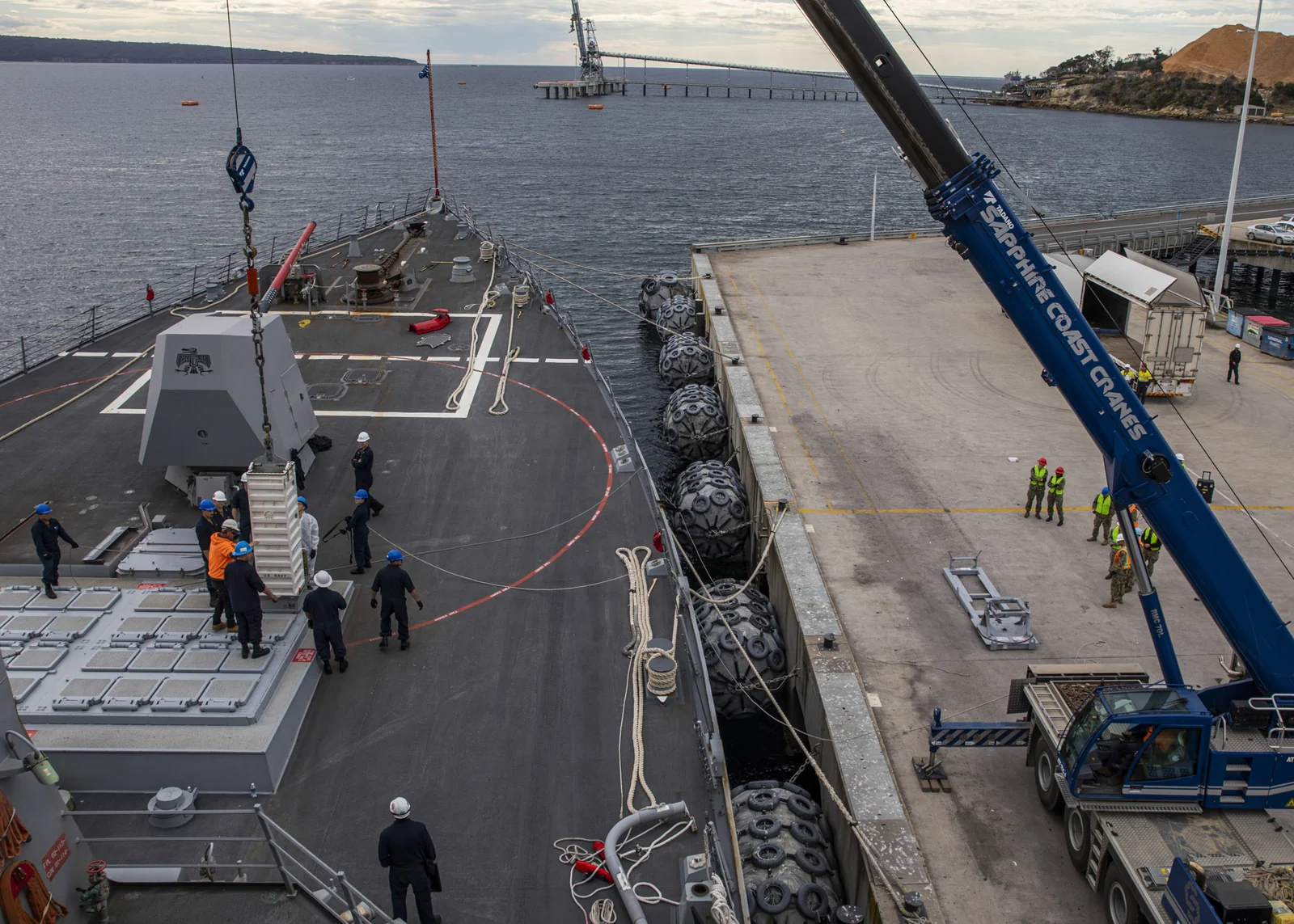
And replacing an interceptor takes years. Lockheed Martin delivered 620 PAC-3 MSE interceptors for the Patriot system in 2025, for American forces and foreign customers together. In January it announced a seven-year framework to raise capacity from about 600 a year to about 2,000, and in late July the Army awarded it a multiyear contract worth up to $58.6 billion, running to fiscal 2032. The Pentagon’s acquisition office has said the war’s munitions use left “strategic inventory shortfalls” and exposed bottlenecks in the industry, the most persistent being solid rocket motors, high-grade explosives and propellants, and skilled workers. An April CSIS estimate put the average delivery time for a PAC-3 order at three and a half years. Mark Cancian, a retired Marine colonel and senior adviser at CSIS, described the lag in July: “If you put money into the system today, you wouldn’t get a missile for three or four years. Sometimes even five.” And the other side of it: “What we’re getting now are missiles that were funded in 2023.”
Ukraine and the defence built in layers
If the Gulf shows what interceptors cost to replace, Ukraine shows what it takes to need fewer of them. In 2025 Ukraine reported 54,538 Shahed-type drones launched against it, counting decoys, and in May 2026 a monthly record of 8,161. In September the Ukrainian air force’s published reports added up to 6,732. The Institute for Science and International Security, which tracks the campaign month by month, uses that figure as a reporting baseline, because the air force no longer publishes a full 24-hour count every day, and estimates the full month at about 7,400 to 7,700.
Not every aircraft in a Russian package is a bomb. Alongside the strike Shaheds fly Gerberas, a multi-role type that can serve as a decoy, a loitering munition or a reconnaissance drone, and Parodies, decoys with no warhead at all. CSIS analysts described what the mix does to the defender: the Shaheds are used “as much to saturate air defenses as they are to attack targets, cluttering radar screens and forcing command centers to make decisions about where to fire their more capable surface-to-air missiles like the Patriot.”
The same analysts tried to price the campaign from Russia’s side. Using Ukrainian air force reports from September 2022 to December 2024 and a deliberately high assumed price of $35,000 a drone, they calculated in early 2025 that Shahed strikes cost Russia roughly $350,000 per target struck, against about $1 million for its most cost-effective missile. That made the Shahed, on their model, the most cost-effective weapon in Russia’s long-range arsenal, even though around 90% of the drones in that period were intercepted or failed to reach their targets.
In September 2026 Ukraine reported 5,520 drones shot down or suppressed, an official tally that lumps drones destroyed outright together with those knocked off course by electronic warfare. The Institute reconstructs 824 hits, about 12% of the reported total. That is its own estimate, not an official figure, and because decoys sit in the denominator it estimates the share of the reported package that hit something rather than the accuracy of a Shahed.
A good part of what stops the rest is cheap. Ukraine links acoustic sensors, mobile air defence teams and electronic warfare through a shared digital map that can run on a tablet. Sensors listen for the drones, the map sends mobile teams toward their path, and jammers can steer a drone off course by spoofing its satellite navigation. Heavy machine guns count among the low-cost tools too.
Cheap does not mean easy. In August 2025 a mobile fire group near Izium described its work to a Ukrainian reporter. Its weapon was a Soviet-era ZU-23 cannon mounted on an old truck. The cannon can reach 2,500 metres out but only about 1,500 metres up. The Shaheds this crew hunted flew at 1,500 to 2,800 metres, and sometimes up to 3,000. “God willing, every hundredth shot hits,” said one of the crew, identified only as Korsa. Every month, he said, the drones fly “higher and higher, faster and faster.”
How Britain learned to stop the V-1

At 4:18 a.m. on 13 June 1944 the first V-1 flying bomb fell on Swanscombe in Kent. It had a noisy pulsejet and pre-set guidance, and it was very inaccurate. Britain's first defence worked badly. Guns near London hit V-1s that crashed into the city anyway, and fighters chasing the fast, low missiles strayed into the gun belt. On 13 July Roderic Hill, the air defence commander, decided to move the guns to the coast. By 17 July the heavy guns and radar were in place, a move of 23,000 people and about 60,000 tons of supplies. The guns also got American SCR-584 radar, predictors and proximity fuzes, which burst at a preset distance from the target and proved about five times as effective as older fuzes. Gunners downed 17% of their targets in the first week after the move and 74% in the last four days of action. On the night of 27 to 28 August defenders destroyed 90 of 97 V-1s reported; four reached London. In all, they observed 7,488 and downed 3,957. The V-1s killed 6,184 people in the London area.
The newest cheap layer is the interceptor drone, a small drone flown to catch and destroy another one. Mykhailo Fedorov, then Ukraine’s defence minister, said that in March 2026 interceptor drones shot down more than 33,000 enemy drones of various types, twice February’s number. That is an official claim, and it covers everything from Shaheds to small reconnaissance drones. The US Army has taken note. In the eight days after the Iran war began it bought 13,000 Merops interceptors, made by the American firm Perennial Autonomy, at roughly $15,000 each, Dan Driscoll, then the Army secretary, told Congress in April. “We will make that trade all day long,” he said. The Army does not own the Merops design and “cannot produce them at will”. In June it opened a programme to buy low-cost interceptors whose designs the government would own and could hand to any manufacturer.
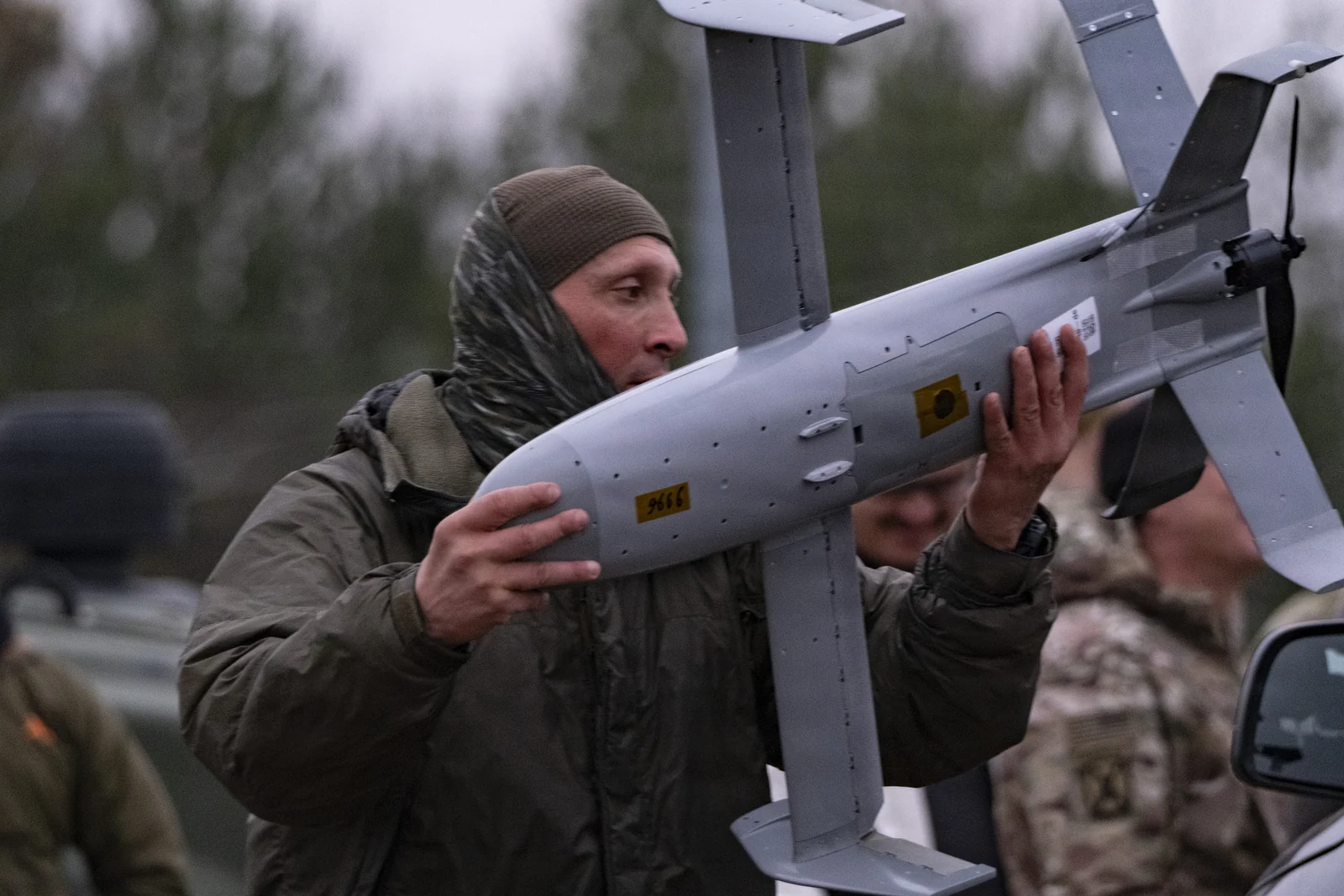
The official totals do not say how the kills divide among guns, jammers, interceptor drones, aircraft and missiles. Taken together, the pieces describe a defence that copes with thousands of drones a month by spreading the work across many cheap tools, held together by sensors, a shared picture and crews who know where to be.
The attacker adapts
A layer that works invites a reply. The standard Shahed flies at about 185 km/h. Its jet-powered successors reach roughly 500 km/h, which shrinks the time a mobile gun team has to engage and, in the Institute’s assessment, “may force Ukraine to use more capable interceptors or missile systems”. Speed can push the defender back toward the expensive weapons the cheap layers were meant to save, unless those layers keep up. Some are trying: by early October automated gun turrets on duty in Kyiv had shot down jet-powered drones.
The numbers moved quickly through September. By 26 September, President Zelensky said, Russia had launched more than 2,730 jet-powered Shaheds that month, and Ukraine was neutralising about 55% of them, against more than 90% of the older propeller-driven kind. Yuriy Ihnat of the Ukrainian air force estimated the month’s total at about 3,500 jet drones, up from about 2,800 in August. He described automated gun turrets as only one piece of the defence, alongside interceptor drones, aviation and electronic warfare. And he warned that the jet drones were approaching cruise missiles in some of their flight characteristics, which makes several of the cheaper anti-Shahed solutions less effective.
The raids continued through October. On the night of 21 to 22 October Russia sent 210 drones, 110 of them jet-powered, along with Iskander-M, Zircon and other missiles, with Kyiv the main target. By 9 a.m. the air force’s preliminary figures showed 181 drones destroyed or jammed and 10 still in the air. The next night it launched 176 drones, 92 of them jet-powered Shaheds; by 8 a.m. on 23 October the preliminary count was 140 brought down and 10 still airborne.
The attacker has a second lever besides speed: sequence. Send cheap aircraft first and the defence spends attention and ammunition on them before the expensive weapons arrive. The account the two regional officials gave of Riyadh, drones first to clear a path for missiles, describes that pattern. Whether it explains why the missiles got through is for the Saudi investigation to establish.
New layers and their limits
Defenders are adding layers, each limited by range, weather and the targets it can engage. In the Red Sea, aircraft became one. Kurilla told Congress that since Operation Rough Rider, the American campaign against the Houthis, about 40% of the drones shot down had been hit by APKWS, a laser-guided 2.75-inch rocket fired from F-16s and F-15s: “a $25,000 munition going against a, roughly, $50,000 or $100,000 drone.” The rocket is cheap. The fighter that carries it has to be in the air, in the right place, when the drone comes.
Lasers promise a very low cost per shot. Israel took delivery of its first Iron Beam laser on 28 December 2025, as a complement to the Iron Dome missile system, and officials put its running cost at a few shekels per interception. Defence estimates give it a range of about 10 kilometres. At the handover the director general of Israel’s defence ministry said the delivered system was the first of many in production. By August it was still the only one handed over, and it had yet to enter full operational use. Britain puts the running cost of its DragonFire laser at about £10 a shot, and in trials it has brought down drones capable of 650 km/h. It is not yet in service either: a £316 million contract is meant to put it on a Royal Navy Type 45 destroyer by 2027.
The price per shot leaves out the price of the laser itself, its power supply and the sensors that cue it. The physics sets a harder limit. A high-energy laser attacks one target at a time, needs several seconds to disable it and several more to swing to the next, so a single laser can stop only so many weapons arriving together, which is exactly what a saturation raid is designed to exploit. Lasers may also work poorly, or not at all, in rain or fog.
And the hardest threat stays where it was. “There are no good alternatives to Patriot and THAAD for ballistic missile defense,” the CSIS analysts wrote in July. What the cheap layers can do is take drones off the Patriot’s hands, so that each missile saved is there for a ballistic missile the cheaper weapons cannot stop.
Choosing which shots to take
When the stock runs short, the defender starts rationing. The CSIS analysts warned in July that “diminished stockpiles may force the United States and its coalition partners to take more risks with interceptions.” Cancian gave two concrete examples. A battery could fire two interceptors at an incoming missile instead of three. “It reduces the chances of interception, but you save a missile,” he said. Or it could hold fire at a missile predicted to land where there are no people or infrastructure. “They may just let it go and accept the fact that there might be some small amount of damage.”
Cheaper choices shift the danger elsewhere. Letting drones fly closer, so that guns and short-range weapons can take them, puts the ship and its crew at greater risk, Holmes warned in 2024. Even a shot that works can do harm. In the United Arab Emirates on 8 April 2026, debris from a successful interception set fires at the Habshan gas complex, injuring three people and halting operations there. In the first six weeks of the war the UAE alone reported intercepting 537 ballistic missiles, 26 cruise missiles and 2,256 drones. At that pace, falling debris becomes a hazard in its own right. On 21 October debris from a drone intercepted over Saudi Arabia’s Shaybah oilfield killed two workers.
The value test that justified the expensive shot in the first place still governs these choices. The difference is that the defender now has to apply it to every incoming track, with fewer missiles in the launcher and years of factory time between an order and its delivery.
An order book and a launcher
Late on 21 October an attack on King Fahd International Airport in Dammam, in the east of the kingdom, killed two people, a Saudi citizen and an Indian resident, and injured eight. Shortly after 4 a.m. on 23 October Saudi-led coalition air defences shot down a ballistic missile aimed at Riyadh, three hours after intercepting two drones heading for the south. By then the Houthis had fired at least 14 ballistic missiles and more than 60 armed drones at the kingdom in October.
On 22 October Lockheed Martin reported a record order backlog of $292 billion, including $52.5 billion tied to the multiyear award to build PAC-3 MSE interceptors, and higher sales from ramping up Patriot and THAAD production. Those missiles will arrive over years.
Until stocks recover, commanders may face the choice Cancian described: two interceptors at an incoming missile instead of three.
Related articles
- Finland destroyed a million landmines. Why does it want them back?
- Dark flares: the countermeasure that saves aircraft without giving them away
- How satellites changed the economics of war without firing a single shot
Further reading
As an Amazon Associate, Eikleaf earns from qualifying purchases. The book links below are affiliate links: if you buy through them, we may earn a small commission at no extra cost to you.
 The Kill Chain: Defending America in the Future of High-Tech WarfareArgues that few expensive weapons lose to many cheap ones, the cost problem at the heart of air defence.
 Army of None: Autonomous Weapons and the Future of WarA clear guide to drones, swarms and automated air defences by a former Pentagon official.The Drone Age: How Drone Technology Will Change War and PeaceThe Drone Age: How Drone Technology Will Change War and PeaceA scholarly overview of how cheap drones spread and how states adapt to them.
Recommended videos
 6:17Inside the race to build Patriot missiles as stocks run lowPBS NewsHour inside the race to build more Patriot interceptors as stocks run low.
 8:01Iranian drones: Cheap to produce, costly to defend againstCNN on why cheap Iranian-designed drones are so costly to defend against.
 3:10Ukrainian anti-drone ‘Bullet’ that could help defend Gulf | BBC NewsBBC on Ukraine’s cheap interceptor drones, the kind of low-cost layer defenders are adding.
Cite this article
Ulfur Atli. “Cheap drones, scarce missiles: what it takes to keep an air defence going.” Eikleaf, 24 October 2026, updated 25 October 2026. https://www.eikleaf.com/cheap-drones-scarce-missiles-what-it-takes-to-keep-an-air-defence-going/
Gen AI Disclaimer
Some contents of this page were generated and/or edited with the help of a Generative AI.
Media
USS Carney engages Houthi missiles and drones – U.S. Navy, Wikimedia Commons
SM-2 reload aboard USS Rafael Peralta, Port Eden – U.S. Navy, Wikimedia Commons
Interceptor drone at a counter-drone course near Lipa, Poland – U.S. Army, Wikimedia Commons
Key Sources and References
Samy Magdy. “Saudis probe how defense systems failed to stop deadly Houthi attack on Riyadh airport.” Associated Press via PBS NewsHour, 12 October 2026. https://www.pbs.org/newshour/world/saudis-probe-how-defense-systems-failed-to-stop-deadly-houthi-attack-on-riyadh-airport
CBS News. “Saudi Arabia’s main airport hit again, a day after strike killed 13 at Riyadh’s King Khalid International.” CBS News, 12 October 2026. https://www.cbsnews.com/news/houthis-threat-saudi-airspace-attack-riyadh-airport/
Sara El Deeb and Kareem Chehayeb. “Saudi capital’s airport reopens to limited traffic, and other Mideast news.” Associated Press via WDIV ClickOnDetroit, 21 October 2026. https://www.clickondetroit.com/news/world/2026/10/21/saudi-capitals-airport-opens-to-limited-traffic-and-other-mideast-news/
Arab News. “Dammam’s King Fahd airport resumes operations after attack kills 2.” Arab News, 22 October 2026. https://www.arabnews.com/saudi-arabia/dammams-king-fahd-airport-resumes-operations-after-attack-kills-2-3007672
Arab News. “Coalition air defenses down missiles bound for Riyadh, Khamis Mushait amid ongoing Houthi attacks.” Arab News, 23 October 2026. https://www.arabnews.com/saudi-arabia/coalition-air-defenses-down-missile-bound-for-riyadh-amid-ongoing-houthi-attacks-3007832
UK Ministry of Defence and Wes Streeting. “Operational update 20 October – UK military support to the Kingdom of Saudi Arabia.” GOV.UK, 20 October 2026. https://www.gov.uk/government/news/operational-update-20-october-uk-military-support-to-the-kingdom-of-saudi-arabia
Konstantin Toropin. “Navy’s Fight in Red Sea Used 220 Missiles, But Officials Say That’s Changing.” Military.com, 15 January 2025. https://www.military.com/daily-news/2025/01/15/navys-fight-red-sea-used-220-missiles-officials-say-thats-changing.html
US House Armed Services Committee. “U.S. Military Posture and National Security Challenges in the Greater Middle East and Africa.” H.A.S.C. No. 119–30, hearing of 10 June 2025. https://www.govinfo.gov/content/pkg/CHRG-119hhrg64360/pdf/CHRG-119hhrg64360.pdf
Wes Rumbaugh. “Cost and Value in Air and Missile Defense Intercepts.” Center for Strategic and International Studies, 13 February 2024. https://www.csis.org/analysis/cost-and-value-air-and-missile-defense-intercepts
Congressional Research Service. “Attacks on Saudi Oil Facilities: Effects and Responses.” IN11173, 27 September 2019, updated 1 October 2019. https://www.everycrsreport.com/reports/IN11173.html
Lead Inspector General. “Operation Epic Fury: Report to the United States Congress, April 1, 2026–June 30, 2026.” September 2026. https://oig.usaid.gov/sites/default/files/2026-09/Lead_IG_OEF_Q3_Final_Report.pdf
Mark Cancian and Chris H. Park. “Renewed Iran War Would Test Diminished Interceptor Inventories.” Center for Strategic and International Studies, 27 July 2026. https://www.csis.org/analysis/renewed-iran-war-would-test-diminished-interceptor-inventories
Ben Finley. “Recent fighting with Iran further draws down key US air defense stockpiles, analysis says.” Associated Press via KSAT, 28 July 2026. https://www.ksat.com/news/politics/2026/07/28/recent-fighting-with-iran-further-draws-down-key-us-air-defense-stockpiles-analysis-says/
Natalie Oliverio. “Iran war depleted US Patriot missile stockpiles, creating readiness challenges, experts say.” Military Times, 30 July 2026. https://www.militarytimes.com/news/your-military/2026/07/30/iran-war-depleted-us-patriot-missile-stockpiles-creating-readiness-challenges-experts-say/
James LaPorta. “Ousted general warned of years-long missile defense shortage before Iran war.” CBS News, 15 October 2026. https://www.cbsnews.com/news/randy-george-missile-defense-shortage-iran-china/
Margaret Brennan. “Arab states running dangerously low on interceptors to take down Iranian-fired missiles, officials say.” CBS News, 5 March 2026. https://www.cbsnews.com/news/arab-states-running-low-interceptors-iranian-fired-missiles/
Geoff Ziezulewicz. “What the Navy is learning from its fight in the Red Sea.” Defense News, 18 January 2024. https://www.defensenews.com/news/your-navy/2024/01/18/what-the-navy-is-learning-from-its-fight-in-the-red-sea/
Geoff Ziezulewicz. “Navy Warships Have To Leave Red Sea Fight For Weeks To Reload Their Missiles.” The War Zone, 16 January 2025. https://www.twz.com/news-features/navy-warships-have-to-leave-the-red-sea-fight-for-weeks-to-reload-their-missiles-navy-secretary-says
Caitlyn Burchett. “Navy is on track to rearm warships at sea in 2-3 years.” Stars and Stripes, 26 July 2024. https://stripes.com/branches/navy/2024-07-26/navy-rearm-ships-missiles-china-houthis-14606297.html
US Navy (republished by DSIAC). “Navy demonstrates first at-sea reloading of vertical launching system.” 15 October 2024. https://dsiac.dtic.mil/articles/navy-demonstrates-first-at-sea-reloading-of-vertical-launching-system
Jim Sciutto. “The Brief.” CNN transcript, 4 August 2026. https://transcripts.cnn.com/show/tbwjs/date/2026-08-04/segment/01
Lockheed Martin. “Lockheed Martin and Department of War Advance Landmark Acquisition Transformation to Accelerate PAC-3 MSE Production.” 6 January 2026. https://news.lockheedmartin.com/2026-01-06-Lockheed-Martin-and-Department-of-War-Advance-Landmark-Acquisition-Transformation-to-Accelerate-PAC-3-R-MSE-Production
Lockheed Martin. “Lockheed Martin Reports Third Quarter 2026 Financial Results.” SEC Form 8-K, Exhibit 99.1, 22 October 2026. https://www.sec.gov/Archives/edgar/data/936468/000162828026066780/ex991q32026.htm
Igor Anokhin. “June 2026 Updated Analysis of Russian Shahed-type UAVs Deployment Against Ukraine.” Institute for Science and International Security, 6 July 2026. https://isis-online.org/uploads/isis-reports/documents/June-2026-Updated-Analysis-of-Russian-Shahed-type-UAVs-Deployment-Against-Ukraine-up-to-July-6.pdf
Igor Anokhin. “Monthly Analysis of Russian Shahed 136 Deployment Against Ukraine – Updated.” Institute for Science and International Security, 13 October 2026. https://isis-online.org/isis-reports/monthly-analysis-of-russian-shahed-136-deployment-against-ukraine-updated
Neil Hollenbeck, Muhammed Hamza Altaf, Faith Avila, Javier Ramirez, Anurag Sharma and Benjamin Jensen. “Calculating the Cost-Effectiveness of Russia’s Drone Strikes.” Center for Strategic and International Studies, 19 February 2025. https://www.csis.org/analysis/calculating-cost-effectiveness-russias-drone-strikes
Polina Kulish. “Ukrainian mobile firing groups hunt for Russian Shaheds with guns unfit to efficiently down them.” Gwara Media, 30 September 2025. https://gwaramedia.com/en/ukrainian-mobile-firing-groups-hunt-for-russian-shaheds-with-guns-unfit-to-efficiently-down-them/
Arcus. “23 x 152 mm Round with HEI-T Projectile for ZU-23-2 and ZSU-23-4 Gun Mounts.” Technical specification. https://arcus.bg/wp-content/uploads/2020/04/23x152mm-HEI-T-Tech-Specs.pdf
Iryna Levytska. “Interceptor drones destroyed record 33,000 Russian UAVs in March, says Ukraine’s defence minister.” Ukrainska Pravda, 9 April 2026. https://www.pravda.com.ua/eng/news/2026/04/09/8029447/
Katie Livingstone. “Video purportedly shows Ukrainian unit running down Russian Shahed. The US is paying attention.” Defense News, 1 July 2026. https://www.defensenews.com/industry/techwatch/2026/07/01/video-shows-a-ukrainian-unit-running-down-a-russian-shahed-the-kind-of-kill-the-us-is-racing-to-reproduce/
Matthew Loh. “A $2,500 interceptor drone built to destroy Iranian Shaheds was recorded flying at the speed of a bullet train.” Business Insider via Yahoo News, 12 August 2025. https://www.yahoo.com/news/articles/2-500-interceptor-drone-built-034112755.html
United24 Media. “Ukraine Now Neutralizes 55% of Russia’s Jet-Powered Shahed Drones, Zelenskyy Says.” 27 September 2026. https://united24media.com/war-in-ukraine/ukraine-now-neutralizes-55-of-russias-jet-powered-shahed-drones-zelenskyy-says-22891
United24 Media. “Ukraine’s New AI-Powered Turret—Sky Sentinel—Is Already Shooting Down Russia’s Fastest Drones.” 23 October 2026. https://united24media.com/war-in-ukraine/ukraines-new-ai-powered-turret-sky-sentinel-is-already-shooting-down-russias-fastest-drones-23750
Ukrainska Pravda. “Russia attacks with Iskander, S-400, Zircon and Oniks missiles and 210 drones: air defences down 181 UAVs.” 22 October 2026. https://www.pravda.com.ua/eng/news/2026/10/22/8059193/
Ukrinform. “Ukraine’s air defenses down 140 out of 176 Russian drones overnight.” 23 October 2026. https://www.ukrinform.net/rubric-ato/4177331-ukraines-air-defenses-down-140-out-of-176-russian-drones-overnight.html
Yuval Azulay. “Israel deploys Iron Beam laser system as new layer of air defense.” Calcalist, 28 December 2025. https://www.calcalistech.com/ctechnews/article/bjanfpcq11x
The Defense Post. “Israel’s Iron Beam Still Not Fully Operational Eight Months After Delivery.” 11 August 2026. https://thedefensepost.com/2026/08/11/israel-iron-beam-operational-delay/
UK Ministry of Defence. “Boost for armed forces as new laser weapon takes down high-speed drones.” GOV.UK, 20 November 2025. https://www.gov.uk/government/news/boost-for-armed-forces-as-new-laser-weapon-takes-down-high-speed-drones
Congressional Research Service. “Department of Defense Directed Energy Weapons: Background and Issues for Congress.” R46925, updated 11 July 2024. https://www.everycrsreport.com/reports/R46925.html
The National. “UAE intercepts 17 ballistic missiles and 35 drones, says Defence Ministry.” The National, 8 April 2026. https://www.thenationalnews.com/news/uae/2026/04/08/uae-intercepts-17-ballistic-missiles-and-35-drones-in-wednesdays-figures/
Smithsonian National Air and Space Museum. “V-1 Cruise Missile.” https://airandspace.si.edu/collection-objects/missile-cruise-v-1-fi-103-fzg-76/nasm_A19600341000
Kenneth P. Werrell. “Archie, Flak, AAA, and SAM: A Short Operational History of Ground-Based Air Defense.” Air University Press, December 1988. https://www.govinfo.gov/content/pkg/GOVPUB-D301-PURL-LPS47085/pdf/GOVPUB-D301-PURL-LPS47085.pdf