Last updated: · 17 min read
In brief
A Finnish conscript strings a tripwire between two pine trees, practising a skill his country gave up by law. Finland destroyed 1,013,571 anti-personnel mines by 2015, and now its army wants a million new ones for about €100 million. It is one of five states on the EU’s eastern edge to leave the ban. Officers point to Ukraine as proof mines still matter. The evidence is contested. Reviews by senior officers found unwatched minefields fail, and clearing eastern and southern Ukraine may take decades.
Contents
On 3 February 2026, at the Kainuu Brigade’s garrison in Kajaani, in eastern Finland, a young conscript trudged through snow and drew a thin blue wire between two pine trees. The other end of the wire was attached to a mine hidden about 20 metres away. Someone had put up a warning sign reading “Miinoja, mines”, with a skull inside a red triangle pointing downwards, the international symbol for a mined area. The army had invited journalists to watch it teach a skill Finland had given up by law.
The mine at the end of the wire was a Claymore, a directional charge that throws fragments forward. Finland’s army had no operational stock of anti-personnel mines that winter, so it trained with the Claymore set to fire when someone walks into the wire. The device is permitted under the 1997 treaty banning anti-personnel mines when a soldier fires it, and forbidden when a tripwire does.
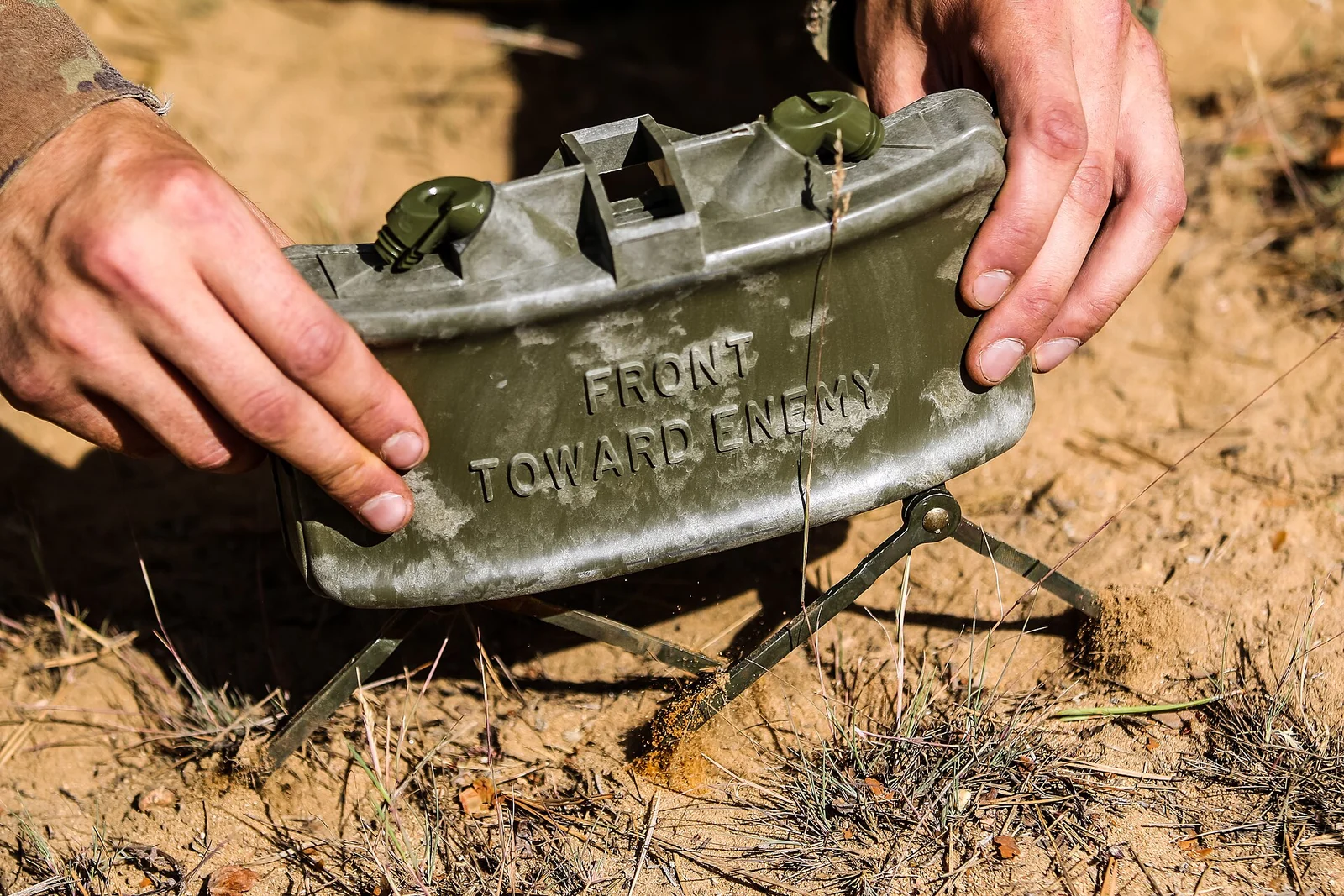
Lieutenant Joona Ratto, an officer at the brigade, explained what the wire was for. “We can use them to either stop the enemy or maybe alarm our own troops in the defensive positions,” he said, either way giving the defenders time to get ready for “the firefight”. His brigade is responsible for 700 kilometres of the 1,340-kilometre border Finland shares with Russia.
In reports published on 19 October 2026, the Finnish Defence Forces said they want to buy one million anti-personnel mines from Finnish manufacturers, at a cost of about €100 million. No contract had been signed by 20 October. The number has a history. Before it joined the treaty, Finland held about a million anti-personnel mines. Between 2012 and 2015 it destroyed 1,013,571 of them, the last on 15 August 2015, almost a year before its deadline.
Finland is one of five. Estonia, Latvia and Lithuania left the treaty with effect from 27 December 2025, Finland from 10 January 2026 and Poland from 20 February 2026. Five governments on the European Union’s eastern edge have decided that a weapon they once gave up may be worth having again. Their officers argue that mines buy time against an attacker on foot, and they point to Ukraine as proof that the weapon still matters. Finland and Poland add a promise: the mines will stay in storage until a real emergency.
What a mine is supposed to buy
The treaty’s definition is short. An anti-personnel mine is a munition designed to be set off by the presence, proximity or contact of a person. The victim pulls the trigger, by treading on a pressure plate, catching a wire, or simply walking close enough to shake the ground.
When is a mine not a mine?

The trigger rule reaches well beyond the Claymore. Soviet-type MON and OZM-72 mines can also be fired by a soldier at a switch, or left to be set off by a pull, tension-release or seismic fuze, and only the second way makes them banned weapons. Lithuania used that line long before it left. In 2004 it told the United Nations that its stocks of MON-100 and OZM-72 mines had been "changed to remotely controlled" instead of being destroyed. Mines built to stop vehicles fall outside the treaty, and so do anti-handling devices fitted to them. The ICRC adds a caveat that several states reject: a vehicle mine that a person can set off, through a tripwire or a tilt rod, counts as banned. A timer does not rescue a victim-activated mine either. The mines the United States sent Ukraine in late 2024 were reportedly designed to expire within two weeks, and a West Point law-of-war scholar judged that their use by Ukraine likely does not comply with the treaty.
Armies do not lay such mines mainly to kill. Their main military job is to slow an enemy and steer him, what doctrine calls countermobility. A soldier who runs into a minefield usually has to stop, look for a way through, wait for engineers or go round, and the defender decides in advance where “round” leads. Doctrine also says a minefield should be watched by direct or indirect fire. The mine holds the attacker in place; the guns and the reserves do the rest. Ratto’s alarm is a third use: a wire that goes off tells the defenders where the enemy is.
The governments that left the treaty make their case in these terms. Finland’s announcement in April 2025 said anti-personnel mines “make it possible to slow the advance of the attacker and minimise the defender’s casualties”, that they are simple enough for a conscript army, and that Finland can make them “quickly and in large quantities”. Lithuania’s defence ministry called them “an effective and relatively low-price means to disrupt pedestrian movement of infantry forces”.
Geography explains the appeal. Finland’s border with Russia is long, and a mine guards its patch of ground without needing to be fed or relieved. The border is also NATO’s border. Finland joined the alliance on 4 April 2023, and under Article 5 of the North Atlantic Treaty an armed attack on one member in Europe or North America counts as an attack on all. Minefields would not be expected to hold such a border on their own. Their job would be to slow an attacker while Finnish and allied forces arrive.
That is where the arithmetic gets harder. A mine can block the ground between defended positions, but someone still has to watch the field and guns still have to cover it. In January 2024 Latvia’s armed forces commander, Lieutenant General Leonīds Kalniņš, said that monitoring minefields around the clock would itself need large numbers of people in peacetime. A group of serving and retired officers who reviewed the evidence for the International Committee of the Red Cross (ICRC) in 2004 went further. Without continuous observation and direct fire, they wrote, barrier minefields are ineffective, and unmanned mined areas “may often be the preferred routes of infiltration”. An earlier ICRC study found that minefields built against infiltration had been expensive to guard and repair, and that covering long borders with aimed fire had often proved impossible. An unwatched minefield may still delay whoever walks into it, but nobody is on hand to use the time it buys.
What Ukraine shows, and what it doesn’t
Finnish officers point to Ukraine. In Ukraine’s summer offensive of 2023, Russian minefields stood in the way. Russian doctrine set them 120 metres deep. After the first clashes, Russia sought to deepen some of them to as much as 500 metres, beyond any rapid breaching capability. Russia did not have enough mines to fill them at doctrinal density and improvised, with homemade devices, a wider range of mine types and anti-tank mines laid in pairs. Even so, the fields significantly complicated Ukrainian planning. The analysts at London’s Royal United Services Institute who studied those defences did not say what part, if any, anti-personnel mines played.
The war has changed shape since then. In March 2025 Sean Watts, a law-of-war scholar at West Point, described Russia’s willingness to throw “unrelenting and costly, massed infantry attacks” at Ukrainian lines for small gains. By July 2026 a band more than 20 kilometres wide around the front was so saturated with mines, fortifications, shelling and drones that massing troops in it had become extremely dangerous. Accounts from the front put small groups first: Russian infantry moving forward in handfuls and trying to slip between Ukrainian positions. By some estimates drones caused the great majority of Russian casualties. In reporting published on 22 October 2026, Ukraine’s 1st Army Corps “Azov” described the same pattern: small groups of infantry sent on foot into open fields to work their way into Ukrainian lines and dig in. The commander of another corps said drones watching the fields and treelines had at times cut such units to pieces.
Colonel Riku Mikkonen of the Finnish Army Command drew his lesson from the same war. In February 2026 he said that while the war had cemented the role of drones, the trench fighting showed that mines “are still effective and they have an important role on the battlefield”.
The soldiers’ record against mines is older and more specific than the governments’ case. In 1996 the ICRC published a study written by a retired brigadier, Patrick Blagden, whose conclusions were unanimously endorsed by a meeting of active and retired senior commanders from several countries. It did not look only at tank wars. It noted that armies facing infantry attack, in Korea and in the Iran–Iraq war, had laid anti-personnel mines in larger numbers. And it found that an enemy willing to accept casualties simply crosses the minefields and takes the losses. In Korea, Chinese mass infantry attacks frequently passed through the extensive minefields around United Nations positions. In Rhodesia, infiltrators dug through border minefields with shovels, and kept breaching them after the belts were widened many times over. The study found no case in which anti-personnel mines had played a major role in deciding a conflict. Its review group of 2004, which included two Ukrainian officers, granted the weapons only a “marginal and limited military value”, and only “in limited situations”.
On one point the 1996 study has aged. It named Finland and Sweden, whose defence ministries then maintained that anti-personnel mines were an essential bulwark against invasion, and replied that the only credible attack on either would come from the East and would be “predominantly armoured”. An attack of the kind Ukraine now faces, by small groups of infantry moving on foot under drones, was not the one the study’s authors expected Finland to meet.
That leaves the evidence pointing two ways at once. Dispersed infiltrators are the case in which a tripwire that warns the defenders, as Ratto described, or disrupts infantry on foot, as Lithuania’s ministry put it, looks most useful. They are also the case in which the officers’ reviews said unwatched fields fail. Legal alternatives exist. Before Finland left the treaty, the Finnish company Insta developed Steel Burst, a munition a soldier detonates on command, which can be delivered by a small drone. In 2024 Ukrainian legal reviews concluded that remotely controlled “anti-infantry explosive devices” are not banned by the treaty at all. The difference lies in who decides. A command-detonated charge needs a soldier who sees the attacker and chooses when to fire. A victim-activated mine needs nobody, and it cannot tell a soldier from a civilian. Whether that saving in people is worth leaving the ban is a judgement the five governments have made, and the public evidence for it is contested.
How five states left the ban
The treaty was agreed in Oslo in September 1997 and opened for signature in Ottawa that December, when 122 states signed it. It entered into force on 1 March 1999. Its members promise “never under any circumstances” to use, develop, produce, stockpile or transfer anti-personnel mines, or to help anyone else do so, and to destroy their stocks within four years of the treaty taking effect for them. By late 2025, 94 states had declared their stockpiles destroyed, tens of millions of mines in all. Greece and Ukraine still held stocks past their deadlines.
Finland came late. It attended the 1997 signing only as an observer and aimed to join by 2006. In 2004 it moved the date to 2012 and set aside money for a large programme to replace its mines with close-combat weapons and sensors. It acceded on 9 January 2012, and the treaty bound it from 1 July that year. Poland had signed in 1997, ratified in 2012 and finished destroying its own stockpile in 2016.
How Finland got rid of its mines

Finland's stockpile consisted of blast mines and stake mines it had made itself, and the two were to go in different ways. The stake mines were to be destroyed by open detonation, which began at a site in Lapland in August 2012 and continued at the Ähtäri army depot in central Finland and at Kittilä. The blast mines were to be taken apart, with the fuze removed and the metal parts sent for recycling. In 2011 the foreign ministry estimated the cost of the whole operation at about €220,000. Finland never quite reached zero. It first kept back 16,500 mines for training and research, and its report of May 2025 counted 15,509 still in hand at the end of 2024. It says it needs them to develop and practise techniques for destroying mines. That is how an army with no mines to fight with in 2026 still held anti-personnel mines.
The road out began on 18 March 2025, when the defence ministers of Estonia, Latvia, Lithuania and Poland said they “unanimously recommend withdrawing”. In the current security environment, they wrote, their forces needed “flexibility and freedom of choice” of weapons. On 1 April Finland’s prime minister, Petteri Orpo, announced that Finland would follow. “Finland is not currently facing an immediate military threat,” he said; leaving would let it prepare for changes in its security environment “in a more versatile way”. When Estonia’s parliament voted in June, its foreign minister, Margus Tsahkna, said the decision sent a “clear signal” to Russia. The Finnish Defence Forces’ analysis behind the decision was not made public.
Some of their own commanders had argued otherwise. In December 2024 Estonia’s Defence Forces commander, Major General Andrus Merilo, told a parliamentary committee that an assessment made with experts concluded “there is currently no need for us to withdraw”. In January 2024 Latvia’s commander, Kalniņš, said “far more efficient and modern weapon systems than landmines” exist. Both countries left anyway.
The exit clause asks little. Article 20 asks only for “a full explanation of the reasons”, a test that was softened during drafting, and the exit takes effect six months after notice, provided the state is not then fighting a war. Watts points out that when Poland and the Baltic states joined, none seemed to face a serious threat of invasion. In May 2026, ten weeks after Poland’s exit took effect, Lebanon joined the treaty.
Ukraine’s position is the most tangled of all. On 18 July 2025 it told the UN that it would “suspend the operation” of the treaty “in accordance with the Vienna Convention on the Law of Treaties”. The International Campaign to Ban Landmines (ICBL), Human Rights Watch and Harvard Law School reply that the treaty permits no suspension, and that a war cannot count as a “fundamental change of circumstances” its members never foresaw. The treaty’s members agreed: in December 2025 their annual meeting affirmed that the convention allows no suspension and that Ukraine remains a party. Ukraine last reported a stockpile of millions of anti-personnel mines. There is credible evidence that its forces fired rocket-delivered mines in and around Izium in 2022; Human Rights Watch counted at least 11 civilian casualties. In 2024 Ukraine said it had opened an investigation, and it has given no update at the treaty’s meetings since. Several sources, including combatants on both sides, point to Ukrainian use of mines dropped by drones or fired by artillery between 2024 and 2026, though where they fell cannot be verified. The United States, which had banned exports of these weapons since 1992, announced transfers of anti-personnel mines to Ukraine on 20 November and 2 December 2024.
What is actually being bought
Finland wants two weapons: a modern tube mine fired by a tripwire, and a step mine set off by pressure. In October 2026 Mikkonen described the project as being in a “preparatory and market review phase”, with the technical specifications still being drawn up and tenders to follow. The first new mines and training equipment are expected during 2027, production in Finland is meant to begin in 2028, and the last deliveries are due in the 2030s. In the end every conscript will be trained to use them. Buying abroad has not been ruled out.
Poland’s position is easy to overstate. Its big mine contract, signed on 29 April 2026, is with the state-owned maker Belma for tens of thousands of combat and training cassettes of anti-tank mines for scatterable mining systems, delivered from 2027 to 2029. For anti-personnel mines Poland had, by October, only a market consultation, opened on 2 March 2026, for 14.7 million of them. The ICBL says that if the plan is carried out, Poland could become one of the world’s largest stockpilers. In May the private group Niewiadów signed a partnership with a military engineering institute to develop and produce two anti-personnel types, one pulled by a wire and one pressed by a foot; no order for them had been announced by October. The deputy defence minister, Paweł Zalewski, said in February that “a lot” of mines would be needed for Poland’s long eastern borders. Prime Minister Donald Tusk said on 19 February that Poland would “soon” be able to mine those borders within 48 hours of a threat; he spoke after watching a demonstration of Bluszcz, an unmanned vehicle built to lay anti-tank mines.
The Baltic states have said less. In July 2025 Lithuania’s deputy defence minister, Karolis Aleksa, said the country would spend “hundreds of millions of euros” on anti-tank mines “but also on anti-personnel mines”, and Estonia’s defence minister, Hanno Pevkur, called them “an option in the back pocket”. Latvia plans a mine purchase under SAFE, the European Union’s defence-loan scheme, without saying what kind of mines it means to buy.
That puts the money question inside the EU. An Irish parliamentary committee recorded in a December 2025 report, circulated to EU governments in January 2026, that Commission officials had confirmed that a member state may spend SAFE loans on cluster munitions and landmines if that matches its national policy. The committee saw a legal risk for Ireland in standing behind such loans through the EU budget guarantee. Twenty-two EU members remain bound by the treaty, including its promise never to “assist, encourage, or induce” anyone to do what it bans. On 12 October 2026 the ICBL wrote to the UN Secretary-General and to foreign ministers, in letters co-signed by Jody Williams, the campaign’s founding coordinator and a Nobel laureate. Poland and Finland, said its director, Tamar Gabelnick, “have not yet crossed every line”.
What mines leave behind
The ICRC’s case against the weapon was that mines are “far easier to lay than to remove”. Ukraine shows what that means once a war is running.
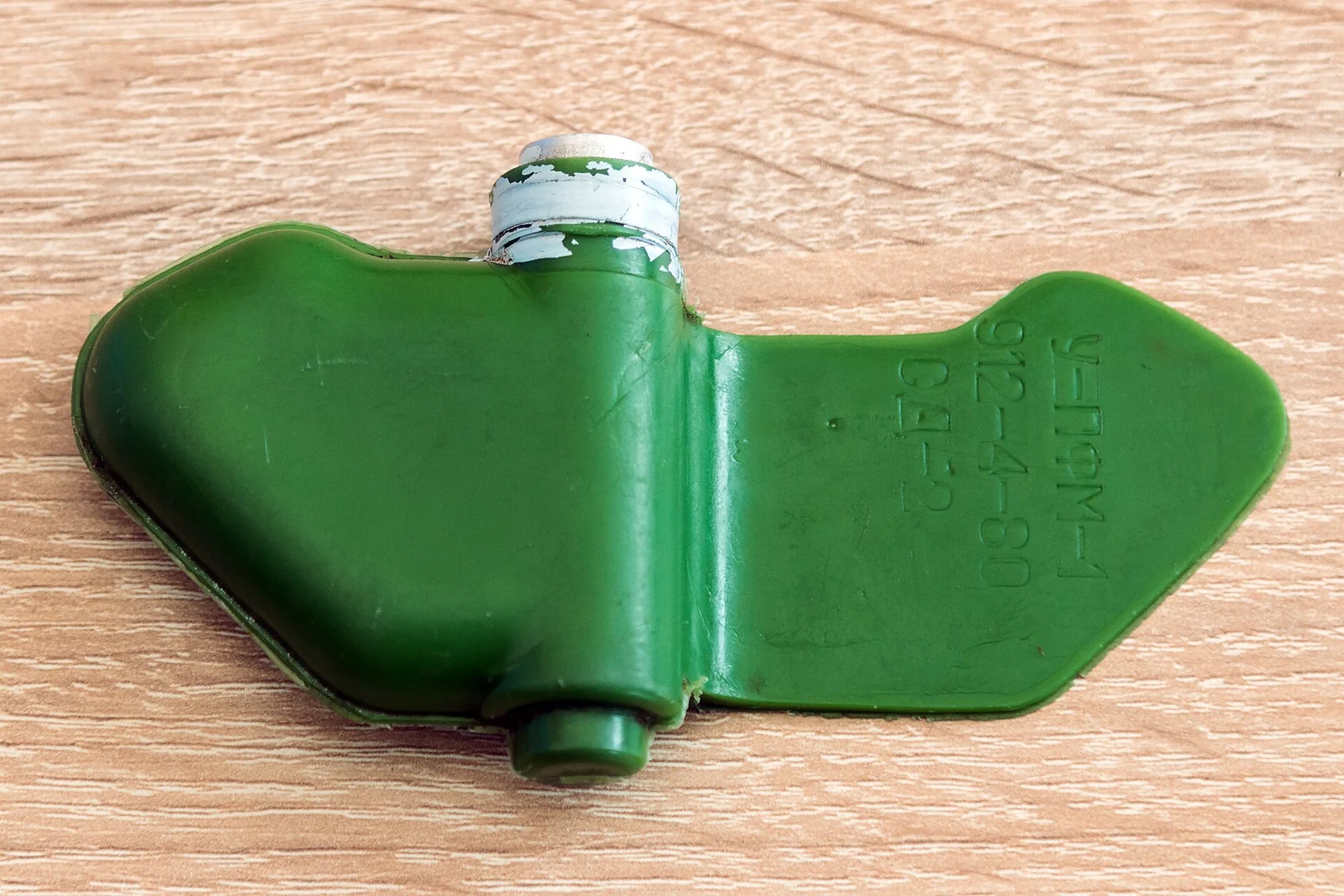
Russian soldiers have posted the evidence themselves. Posts on social media from late 2023 into 2026 show Russian drones dropping PFM-1, POM-2 and PMN-4 anti-personnel mines along with anti-vehicle mines. Human Rights Watch verified footage of drones dropping PFM-1 mines in residential areas of Kherson. Between February and July 2026 Ukrainian authorities warned residents of Kherson, Mykolaiv and the Nikopol area that Russian drones had begun scattering a new pressure mine nicknamed “Pryanik”. Russia’s POM-3 goes off at the ground vibration of approaching footsteps. Russia has used more than a dozen types of anti-personnel mine in Ukraine. The practice is not one-sided: in May 2026 Ukraine was reported to be dropping its own DP-02 anti-personnel mines from drones onto Russian supply routes in occupied territory.
In late October 2026 Ukraine’s published figures classed 132,076 square kilometres of the country as at risk. Of the 41,924 square kilometres returned to use by then, 171 had been cleared by deminers working the ground. The rest was released through non-technical survey, which gathers evidence about where explosives are and are not without searching the ground. Not all of the land at risk holds explosives: Paul Heslop, the senior UN mine action adviser in Ukraine, argues that the authorities classify land too broadly.
Ukraine’s own mine action directorate counts the casualties. Its data put the number of civilians killed or injured by mines and explosive remnants of war since 2022 at 1,739, including 178 children, as of 1 October 2026. In October Heslop warned that drones used by both sides could turn a very intense battle area into a much wider zone of contamination, on a scale unseen since American aircraft dropped cluster munitions on the Ho Chi Minh trail. Ukraine’s government and its international partners put the cost of explosive-hazard management and debris clearance over the coming decade at almost $28 billion, as of the end of 2025. Anne Héry of the charity Humanity & Inclusion has said clearing eastern and southern Ukraine “may take decades”.
Cambodia recorded 65,086 casualties from mines and explosive remnants of war between 1979 and 2024. In 1996 alone more than 4,000 people were killed or injured. In January to September 2026 its mine action authority recorded 32.
Worldwide, mines and explosive remnants of war killed or injured at least 6,279 people in 2024, the highest annual total since 2020. Nine in ten of those whose status was known were civilians, and children made up 46 percent of the civilian casualties whose age was recorded. International donors gave less to mine action in 2024 than the year before, and their money for helping victims fell by almost a quarter. Early in 2025 the United States, the largest donor, froze foreign aid.
Whether the promises hold
The governments that left the treaty answer all this with promises about restraint. Finland says its Defence Forces “will not lay landmines in normal conditions; all mines will be stockpiled”. “We will use mines only in emergency conditions,” Mikkonen said in January 2026. Poland’s Zalewski said his country would deploy them only “when there is a realistic threat of Russian aggression”. Heikki Autto, chair of the Finnish parliament’s defence committee, put the logic most simply in July 2025: “When we have them in storage, that is the best guarantee that they will never have to be used.”
Mikkonen has described what an emergency would look like. He hoped the decision to lay mines would come months before any fighting, ideally six, and said detailed minefield plans would be recorded on paper and in a smartphone app being developed for the purpose. Leaving Ottawa also does not leave Finland unregulated. It remains a party to Amended Protocol II of the Convention on Certain Conventional Weapons, which governs rather than bans mines and sets rules on marking, removal, deactivation and delivery from the air. Finland’s government says it remains committed to the treaty’s humanitarian aims and will keep supporting humanitarian mine action.
Most of those safeguards are decisions taken before a war: when to lay mines, where, and how to record them. The minefields described in the previous section show what mining looks like after more than four and a half years of full-scale war: mines scattered from drones, by both sides, over towns and supply roads. That is an observation about Ukraine and not a prediction about Finland. It is also the war Finland’s own officers cite.
Self-destruction is the safeguard meant to keep working after the shooting starts. A mine built to destroy or disarm itself after a set time shrinks the danger it leaves behind, but it does not end it: some fail to go off, and a mine that has disarmed itself still holds its explosive and has to be cleared like any other. Such mines are still banned under Ottawa, and Finland, now outside it, is free to choose them. In October 2026 its specifications were still being written. In February Mikkonen had said which way he leaned. He would rather not have self-destructing mines, he said, “because the war can last for a long time while the self-destruction happens after three to four months. It makes sense of the humanitarian side, not on the military side.”
Related articles
- The buffer zone doctrine: how temporary military occupations become permanent
- What Saudi Arabia’s military spending cannot guarantee
- The ceasefire economy: what actually causes wars to end — and why so many peace agreements collapse
Further reading
As an Amazon Associate, Eikleaf earns from qualifying purchases. The book links below are affiliate links: if you buy through them, we may earn a small commission at no extra cost to you.
- A Frozen Hell: The Russo-Finnish Winter War of 1939-1940 — William R. Trotter (1991). The standard English-language history of the war that shaped Finland’s defence thinking.
- To Walk Without Fear: The Global Movement to Ban Landmines — Maxwell A. Cameron, Robert J. Lawson, Brian W. Tomlin (eds.) (1998). Essays on how the Ottawa Treaty was negotiated and why it was hailed as a model.
- My Name Is Jody Williams: A Vermont Girl’s Winding Path to the Nobel Peace Prize — Jody Williams (2013). A memoir by the Nobel laureate who led the campaign to ban landmines.
Recommended videos
 29:11Banned weapons – Why Europe is bringing back landmines | DW DocumentaryDW documentary on why Finland and other European states are bringing back anti-personnel mines.
 2:03Finland, Lithuania set to produce anti-personnel mines, officials say | REUTERSReuters on Finland and Lithuania planning to produce anti-personnel mines.
 1:32Antipersonnel Landmines | ExplainerHuman Rights Watch explainer on the humanitarian case for the mine ban.
Cite this article
Johan Karlsson. “Finland destroyed a million landmines. Why does it want them back?.” Eikleaf, 24 October 2026, updated 25 October 2026. https://www.eikleaf.com/finland-destroyed-a-million-landmines-why-does-it-want-them-back/
Gen AI Disclaimer
Some contents of this page were generated and/or edited with the help of a Generative AI.
Media
Karelian Sword 26 – U.S. Army National Guard, DVIDS
NATO Claymore Exercise at Battle Group Poland – U.S. Army
PFM-1 mine – Wikimedia Commons (Photo: Mike1979 Russia, CC BY-SA 4.0)
Key Sources and References
AFP. “In Finland’s forests, soldiers re-learn how to lay anti-personnel mines as Russia threat grows.” Malay Mail, 6 February 2026. https://www.malaymail.com/news/world/2026/02/06/in-finlands-forests-soldiers-re-learn-how-to-lay-anti-personnel-mines-as-russia-threat-grows/208276
Yle News. “Finland buying a million landmines.” 19 October 2026. https://yle.fi/a/74-20252139
Al Jazeera Staff and AFP. “Finland seeking one million land mines as it eyes Russian threat.” Al Jazeera, 19 October 2026. https://www.aljazeera.com/news/2026/10/19/finland-seeking-one-million-land-mines-as-it-eyes-russian-threat
Thomas Newdick. “Finland To Build A Million Landmines As Russian Threat Looms.” The War Zone, 20 October 2026. https://www.twz.com/news-features/finland-plans-to-build-a-million-landmines-as-russian-threat-looms
Anne Kauranen. “Finland to acquire anti-personnel landmines and start training staff.” Reuters via Internazionale, 14 January 2026. https://www.internazionale.it/ultime-notizie-reuters/2026/01/14/finland-to-acquire-anti-personnel-landmines-and-start-training-staff
Reuters. “Finland and Lithuania set to produce anti-personnel mines, officials say.” Radio Canada International, 9 July 2025. https://www.rcinet.ca/eye-on-the-arctic/2025/07/09/finland-and-lithuania-set-to-produce-anti-personnel-mines-officials-say/
United Nations Treaty Collection. “Convention on the Prohibition of the Use, Stockpiling, Production and Transfer of Anti-Personnel Mines and on their Destruction: Status.” Accessed 23 October 2026. https://treaties.un.org/Pages/ViewDetails.aspx?src=TREATY&mtdsg_no=XXVI-5&chapter=26&clang=_en
International Committee of the Red Cross. “1997 Convention on the Prohibition of Anti-Personnel Mines and on their Destruction.” ICRC Advisory Service on International Humanitarian Law. https://www.icrc.org/sites/default/files/external/doc/en/assets/files/other/1997_ap_mines.pdf
International Committee of the Red Cross. Weapon Contamination Manual, Book I. Geneva, August 2007. https://www.icrc.org/sites/default/files/external/doc/en/assets/files/other/mine_action_i_web.pdf
Human Rights Watch. “Q&A: US Antipersonnel Landmine Transfers.” 13 December 2024. https://www.hrw.org/news/2024/12/13/qa-us-antipersonnel-landmine-transfers
Arms Control Association. “122 States Sign Ottawa Landmine Treaty.” Arms Control Today, November/December 1997. https://www.armscontrol.org/node/272
Implementation Support Unit, Anti-Personnel Mine Ban Convention. “Finland destroys over one million stockpiled landmines.” 2 December 2015. https://www.apminebanconvention.org/fileadmin/_APMBC_SITE/News/PressRelease-14MSP-Finland-2Dec2015.pdf
Landmine and Cluster Munition Monitor. “Finland: Mine Ban Policy.” 2026. https://the-monitor.org/country-profile/finland/mine-ban-policy
Landmine and Cluster Munition Monitor. “Poland: Mine Ban Policy.” 2026. https://the-monitor.org/country-profile/poland/mine-ban-policy
Landmine and Cluster Munition Monitor. “Lithuania: Mine Ban Policy.” 2026. https://the-monitor.org/country-profile/lithuania/mine-ban-policy
Landmine and Cluster Munition Monitor. “Latvia: Mine Ban Policy.” 2025. https://the-monitor.org/country-profile/latvia/mine-ban-policy
Landmine and Cluster Munition Monitor. “Estonia: Mine Ban Policy.” 2025. https://the-monitor.org/country-profile/estonia/mine-ban-policy
Landmine and Cluster Munition Monitor. “Ukraine: Mine Ban Policy.” 2026. https://the-monitor.org/country-profile/ukraine/mine-ban-policy
Landmine and Cluster Munition Monitor. “Cambodia: Casualties & Victim Assistance.” 28 January 2026. https://the-monitor.org/country-profile/cambodia/casualties-victim-assistance
Royal Government of Cambodia. “Presentation on Mine Action Achievements and the Way Ahead.” Standing Committee on Mine Clearance, Mine Risk Education and Mine Action New Technologies, Geneva, 14 June 2005. https://www.apminebanconvention.org/fileadmin/_APMBC-DOCUMENTS/Meetings/2005/Cambodia_14June05.pdf
Landmine and Cluster Munition Monitor. Landmine Monitor 2025. December 2025. https://the-monitor.org/online-reader/landmine-monitor-2025
International Campaign to Ban Landmines. “Landmine Monitor 2025: Civilian landmine casualties escalate while five countries take dangerous step away from humanitarian mine ban.” 1 December 2025. https://icblcmc.org/our-impact/landmine-monitor-2025-civilian-landmine-casualties-escalate-while-five-countries-take-dangerous-step-away-from-humanitarian-mine-ban
International Campaign to Ban Landmines. “ICBL Calls on Global Leaders to Prevent Renewed Production of Antipersonnel Mines by Poland and Finland.” 12 October 2026. https://icblcmc.org/our-impact/icbl-calls-on-global-leaders-to-prevent-renewed-production-of-antipersonnel-mines-by-poland-and-finland
International Committee of the Red Cross. Anti-personnel Landmines: Friend or Foe? A study of the military use and effectiveness of anti-personnel mines. Geneva, 1996. https://www.icrc.org/sites/default/files/external/doc/en/assets/files/other/icrc_002_0654.pdf
International Committee of the Red Cross. “Report on observations and conclusions from a review of the ICRC study ‘Anti-personnel landmines, Friend or Foe?'” Nairobi, 30 November–1 December 2004. https://www.icrc.org/sites/default/files/external/doc/en/assets/files/other/friendfoereportobservations30nov1dec2004.pdf
Sean Watts. “Assessing the Ottawa Anti-Personnel Mine Convention Withdrawals.” Articles of War, Lieber Institute, West Point, 27 March 2025. https://lieber.westpoint.edu/assessing-ottawa-anti-personnel-mine-convention-withdrawals/
Jack Watling and Nick Reynolds. Stormbreak: Fighting Through Russian Defences in Ukraine’s 2023 Offensive. Royal United Services Institute, September 2023. https://static.rusi.org/Stormbreak-Special-Report-web-final_0.pdf
Seth G. Jones and Riley McCabe. “Russian Blood and Treasure: The Ballooning Costs of Putin’s War.” Center for Strategic and International Studies, 1 July 2026. https://www.csis.org/analysis/russian-blood-and-treasure-ballooning-costs-putins-war
Stefan Korshak. “Ukraine Reports Record Russian War Losses in a Day.” Kyiv Post, 22 October 2026. https://www.kyivpost.com/post/87872
ERR News. “Estonia votes to leave Ottawa anti-personnel landmine ban convention.” 4 June 2025. https://news.err.ee/1609713534/estonia-votes-to-leave-ottawa-anti-personnel-landmine-ban-convention
The Associated Press. “Poland formally withdraws from Ottawa Convention on landmines, citing Russian threat.” CBC News, 20 February 2026. https://www.cbc.ca/news/world/poland-ottawa-convention-landmines-9.7098794
Ministry of National Defence of Poland. “Zwiększenie potencjału wojsk inżynieryjnych – tysiące nowoczesnych min dla Wojska Polskiego.” 29 April 2026. https://www.gov.pl/web/obrona-narodowa/zwiekszenie-potencjalu-wojsk-inzynieryjnych–tysiace-nowoczesnych-min-dla-wojska-polskiego
Houses of the Oireachtas, Joint Committee on Finance, Public Expenditure, Public Services Reform and Digitalisation, and Taoiseach. Report on the Prioritisation of Defence Funding in the EU. December 2025. Council of the European Union document 5096/26, 7 January 2026. https://data.consilium.europa.eu/doc/document/ST-5096-2026-INIT/EN/pdf
NATO. “Finland joins NATO as 31st Ally.” 4 April 2023. https://www.nato.int/cps/en/natohq/news_213448.htm
NATO. “The North Atlantic Treaty.” 4 April 1949. https://www.nato.int/cps/en/natohq/official_texts_17120.htm
Humanity & Inclusion. “Factsheet 2026: Landmines: use, contamination and civilian harm in Ukraine.” 2026. https://www.hi.org/sn_uploads/document/HI-Factsheet-Landmine-use-in-Ukraine-2026-final-ENG-V2_1.pdf
Giulia Bernacchi. “Drone Warfare Could Leave Ukraine With Vietnam-Scale Explosive Hazards.” The Defense Post, 15 October 2026. https://thedefensepost.com/2026/10/15/drone-warfare-ukraine-explosive-hazards/
Ministry of Economy of Ukraine. National Mine Action Platform (dashboard). Accessed 23 October 2026. https://demine.gov.ua/
United Nations Mine Action Service. International Mine Action Standards 08.10: Non-technical survey. Edition 1, Amendment 4, February 2019. https://www.mineactionstandards.org/standards/08-10/
Roman Kohanets. “Russia’s Retreat Leaves a Hidden Battlefield: 1,739 Ukrainian Civilians Killed or Injured.” UNITED24 Media, 12 October 2026. https://united24media.com/war-in-ukraine/russias-retreat-leaves-a-hidden-battlefield-1739-ukrainian-civilians-killed-or-injured-23350
Amy Hawkins. “Ukraine is littered with landmines on a scale last seen in Vietnam. How can they be removed?” The Guardian, 14 October 2026. https://www.theguardian.com/world/2026/oct/14/landmines-ukraine-demining-drones-ai
World Bank. “Updated Ukraine Recovery and Reconstruction Needs Assessment Released.” 23 February 2026. https://www.worldbank.org/en/news/press-release/2026/02/23/updated-ukraine-recovery-and-reconstruction-needs-assessment-released
Xinhua. “Cambodia landmine, ERW casualties fall to 32 during Jan.-Sept. period.” NAMPA, 19 October 2026. https://www.nampa.org/text/23043457