Last updated: · 18 min read
In brief
Brazil’s Amazon lost an estimated 3,335 square kilometres of forest in the year to July 2026, the lowest figure since records began in 1988. That same week, hundreds of fires burned inside protected forest. Satellites spot the clearing, but what counts is Ibama’s response: remote embargoes that cut illegally cleared farms off from meatpackers and credit. Under Jair Bolsonaro the alerts kept coming, yet the agency acted on just 1.3% of them. Embargoes cannot put out fires. A presidential runoff and a pending bill requiring notice before any remote embargo will shape whether the record holds.
Contents
On Sunday 11 October 2026, Brazil’s environment minister, João Paulo Capobianco, flew with enforcement officials over the burning parts of the Amazon and saw hundreds of fires in the middle of protected forest. He went up again on Wednesday. Afterwards he told the Associated Press: “The indications are that there has been a premeditated effort.” On 21 October the Federal Police opened nine inquiries into the origin of the fires in Amazonas.
Two days after the second flight, on Friday 16 October, Capobianco stood in front of the press in Brasília with the year’s figures from INPE, Brazil’s national space research institute. By INPE’s estimate, the Brazilian Amazon lost 3,335 square kilometres of forest in the twelve months to July 2026, the lowest figure in a series that began in 1988. “It’s an absolutely stratospheric drop… it’s like a dream,” the minister said. At 6:30 the next morning, fine-particle pollution in Manaus, the largest city in the Brazilian Amazon, reached 401.4 micrograms per cubic metre, a level the city’s civil defence rates “péssimo”, or terrible.
The previous low, 4,571 km², dated from 2011–12. The new figure is still an estimate, built from 271 priority satellite images out of the 516 that cover the region, and INPE will revise it once the rest are read. Last year the first estimate, 5,796 km², came down to 5,731 when it was consolidated, a change of 65 km². The new figure sits more than 1,200 km² below the old record.
The number matters beyond Brazil. Deforestation and other changes in land use are the country’s largest source of greenhouse gases, about 40% of its gross emissions. And it lands in the middle of an election. A presidential runoff between President Luiz Inácio Lula da Silva and Senator Flávio Bolsonaro, son of the former president Jair Bolsonaro, was set for 25 October, and a Datafolha poll taken on 20–22 October found them statistically tied. The winner takes office on 5 January 2027.
In a single week, a monitoring system built to catch chainsaws had produced its best result while the forest burned from fires that monitoring and embargoes alone could not put out. Brazil’s annual satellite record of Amazon deforestation stretches back nearly four decades. What turned that record into fewer felled trees, and how much of it would survive a change of hands?
From a pixel to a frozen farm
INPE runs two satellite systems over the Amazon. PRODES produces the official annual deforestation rate, the number Capobianco announced. DETER sends near-real-time alerts to Ibama, the federal environment agency, so that inspectors can act while the clearing is still under way.
Two satellites, two clocks

PRODES began in 1988, and its year runs from August to July because the middle of the year is the least cloudy; the useful window for looking at the Amazon runs from May to October, and outside it, one INPE researcher explained, everything is clouded over. It counts only clearings larger than 6.25 hectares, a square 250 metres on a side. That threshold was set when analysts still interpreted paper satellite prints, and INPE kept it so that every year stays comparable with the first. Gilberto Câmara, who ran INPE from 2005 to 2012, described PRODES this way: "O Prodes faz uma espécie de contagem de mortes no cemitério", a kind of body count in the cemetery. The count, he added in 2019, announced in December what had happened up to a year and a half earlier. DETER, started in 2004, was the answer to that slowness. It first spotted clearings larger than 25 hectares; the current version maps them down to about one hectare and reports to Ibama daily. It is an alarm system, and it cannot see through cloud.
Enforcement can do so much in the Amazon because so little of the clearing there would survive a check of the paperwork. When the MapBiomas monitoring network checked the area cleared in the Amazon in 2025 against official records, only 2.7% of it showed no sign of irregularity. A sign could be a missing permit to remove vegetation, an overlap with a strictly protected area or Indigenous land, an overlap with the parts of a farm that the law requires to stay forested, or an overlap with land already under embargo. A sign is not a court verdict. Still, it means that nearly every clearing in the Amazon carries at least one mark an inspector could act on, and the open question is whether anyone does. Capobianco has offered one reason the region differs from the Cerrado savanna to its south: much of the Amazon is public land, while in the Cerrado private farms predominate, and on those the law permits clearing under certain conditions.
The procedure that turns an alert into a cost goes roughly like this. Ibama takes alerts from DETER and other remote-sensing systems and checks whether the property had authorization to remove the vegetation. If it did not, inspectors impose a preventive embargo. The embargo can come before the administrative proceedings in which the owner contests the charge and any fine. For years that check needed people on the ground: inspectors had to go to each farm in person to verify the destruction. Ibama first used remote embargoes in 2016, but the practice was only properly structured from April 2023 and reached volume in 2025. The scale of the job explains why. In March 2026 Ascema, the association of federal environmental staff, counted 752 enforcement agents at Ibama, while DETER had sent more than 100,000 deforestation alerts in the region over the previous 24 months.
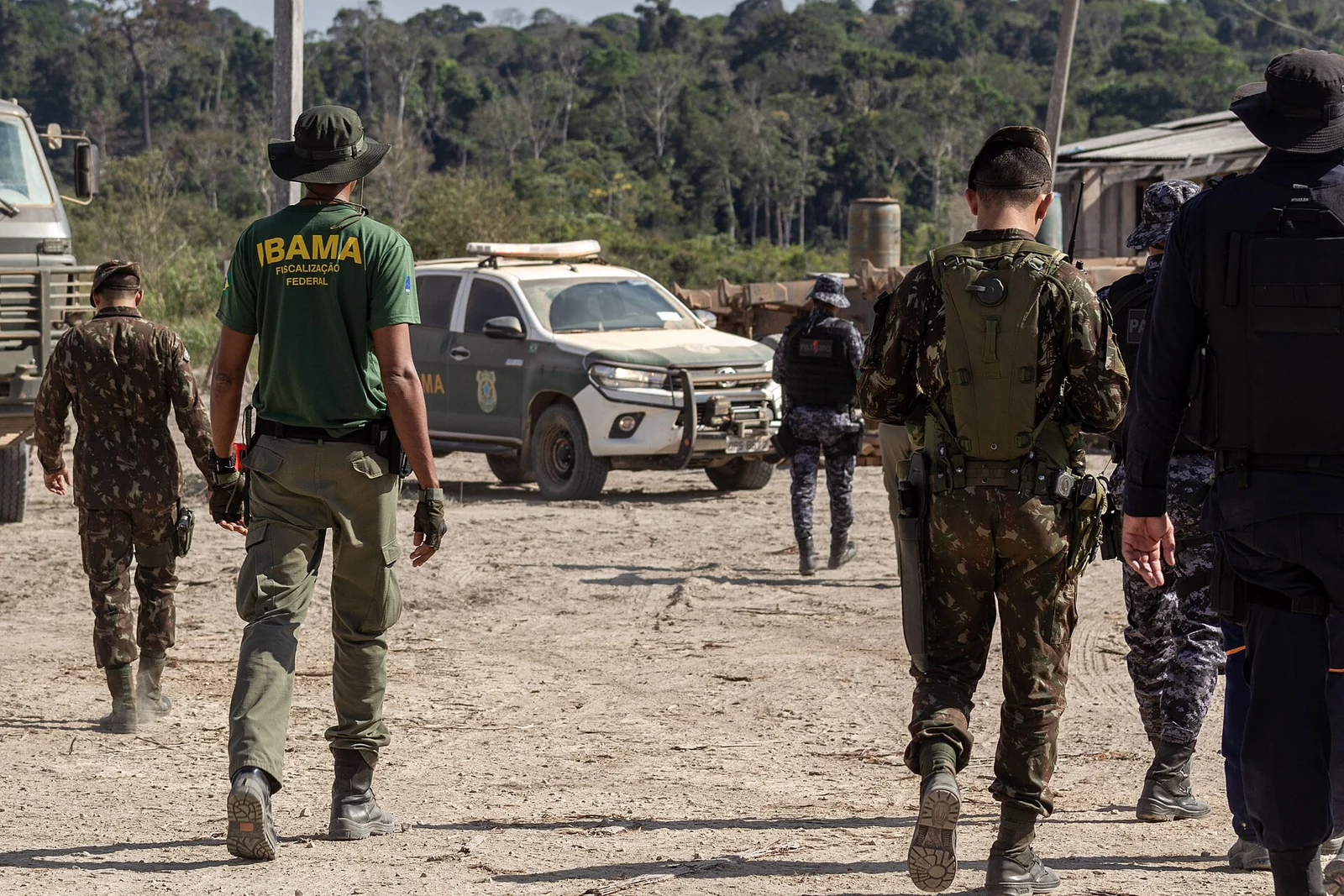
An embargo doesn’t fence anything off. It is an entry in government systems that blocks production on the area, and it does its work through the businesses that deal with the land. Meatpackers may not buy cattle from embargoed areas. Since January 2025 the rural-credit rules have barred rural credit for a farm business on a property with an environmental embargo for economic use of illegally cleared land, as long as the embargo is registered on Ibama’s public list. There are exceptions: loans used only to restore native vegetation on the embargoed area and, until 30 June 2027, other loans to borrowers who have paid their fines, fenced off the embargoed area and filed a plan to restore it. Nobody physically stops a tractor. The restriction works through the buyers and lenders who are required to check the list.
Remote embargoes made that list long very quickly. In May 2025, six months before Brazil hosted the COP30 climate summit in Belém, Ibama carried out what became known as the “embargão”, the big embargo: about 70,000 hectares on 5,000 farms in Acre, Amazonas, Mato Grosso, Rondônia and Pará, embargoed remotely in a single operation. It drew resistance from politicians, including some of Lula’s own allies. Pará’s governor, Helder Barbalho, travelled to Brasília with a delegation of politicians and ranchers and met the government’s leadership to try to rein the actions in.
Landowners also went to court, and some federal judges sided with them, ruling that Ibama’s method fell short of the guarantees of due process. In October 2025 Flávio Dino, a Supreme Court justice, acting alone in a precautionary decision, suspended 23 of those cases. The decree that created the preventive embargo faces its own challenge at the court. Because no decision had been taken in that case, Dino held, the decree’s constitutionality had to be presumed.
How anyone knows it works
Before DETER, finding threatened areas in time to act depended on voluntary and anonymous reports. In 2004 clearing reached about 27,700 km², and INPE built DETER at the environment ministry’s request. Lula’s first government launched an action plan for preventing and controlling Amazon deforestation, known as PPCDAm, in the same year.
A group of economists at PUC-Rio, a university in Rio de Janeiro, and the Climate Policy Initiative has spent more than a decade asking which part of that policy did the work. Clearing fell from 27,000 km² in 2004 to 7,000 km² in 2009, a period when falling crop prices may also have discouraged farmers from opening land. Their analysis found that conservation policies were effective in their own right. In 2008 the government put the municipalities with the most clearing on a blacklist, and the economists found that the listing cut deforestation, mainly through monitoring and law enforcement, with no effect on farm output or on lending. From the same year, the National Monetary Council made rural credit in the Amazon biome depend on proof of compliance with environmental rules. The economists’ central finding concerns DETER itself: monitoring and enforcement guided by its alerts effectively curb deforestation.
Using clouds to measure a policeman

Proving that enforcement cuts clearing is harder than it sounds. Ibama sends inspectors where clearing is worst, so a simple comparison could even suggest that inspectors cause deforestation. The economists needed something that moved enforcement around for reasons unrelated to how much anyone wanted to clear. They found it in the sky. DETER can't detect clearing under cloud, so it issues no alerts there, and in years when a municipality was cloudier, Ibama turned up there less. Those municipalities then showed more clearing the following year. Cloud cover is an accident of weather. The authors treated it as what economists call exogenous variation in the presence of the authorities, a source of change that comes from outside the system being studied. The method rests on one assumption: that clouds affect the next year's clearing only through their effect on enforcement. If that holds, the extra clearing in the cloudy places is the price of the inspectors' absence.
Those studies end in 2016 at the latest. The fall since 2022 is a separate question, and the evidence for it is thinner. After taking office for a third term in January 2023, Lula revived PPCDAm and restored sanctions for illegal clearing detected by satellite, which had been halted under Bolsonaro, alongside credit restrictions and extra money for priority municipalities that cut their forest loss. Clearing has fallen every year since 2022, by 71.2% over four years. In March 2026 Jair Schmitt, then Ibama’s director of environmental protection and now its president, said the remote embargo had turned back the rebound in clearing that DETER alerts began to signal between late 2024 and early 2025. “A gente reverteu a alta,” he said: we reversed the rise. That was his assessment as the official in charge. No study has yet measured how much of the 2023–26 fall the embargoes caused, and too many policies changed at once to hand them all the credit.
One cross-check shows both the reach and the gaps. Looking back over the seven years from 2019 to 2025, MapBiomas found that 65% of all the area cleared in Brazil, and 67.6% in the Amazon biome, overlaps either a permit to clear or a record of enforcement. That is a cumulative overlap with permits as well as enforcement actions, not a rate of punishment. Counted by number of deforestation alerts instead of by area, the national overlap drops to 27.5%, which MapBiomas puts down to enforcement prioritising larger clearings. MapBiomas also warns that the federal and state records it could obtain may not include every permit and enforcement action, and that some state agencies publish incomplete data.
Where the chain leaks
The first leak is in the cattle trade, where an animal can pass through several farms before slaughter. A Human Rights Watch investigation found that cattle raised on illegally deforested land were moved through a “laundering” system that concealed their origins before they reached the meatpacker JBS. An illegal farm in Pará can sell to intermediaries in Mato Grosso, which in turn supply a JBS slaughterhouse in São Paulo. JBS first pledged to track these indirect suppliers by 2011; in November 2025 Human Rights Watch said it still generally could not identify them. JBS says its Transparent Livestock Platform is extending its checks to indirect suppliers. The embargo list catches the farm that is on it. An animal that spent its early life there and then moved to a clean neighbour’s pasture reaches the slaughterhouse from the clean farm.
Credit leaks too. The credit bar applies only to embargoes registered on Ibama’s list, so a farm cleared illegally but never embargoed is not caught by it. A second, broader check was meant to close that gap: banks would have to consult a government list built from PRODES data and confirm whether native vegetation was cleared on the financed property after 31 July 2019, and if it was, see an authorization or a document regularizing it. That check had applied since April 2026 to properties larger than four fiscal modules, Brazil’s unit of rural property size. In May 2026 the National Monetary Council postponed it. It now starts on 4 January 2027 for the largest properties, in July 2027 for mid-sized ones and in January 2028 for the smallest. The first of those dates falls one day before the next president takes office. Agribusiness representatives had already asked the Supreme Court, on 15 April, to suspend the rules.
The third leak is fire on public land. Invaded public land without settled land titles is common in the Amazon. Ibama can embargo such an area even when it cannot identify who is responsible, by publishing the embargo in the official gazette and listing the area on its website, and the Observatório do Clima, a Brazilian climate network, says the remote embargo has been the central tool there against land-grabbing, speculation and the illegal opening of new areas. Fire is harder to pin on anyone. Around Manaus, public land of a similar kind is where much of 2026’s fire has been detected. The Amazon Environmental Research Institute, Ipam, found that undesignated public forests, frequent targets of land-grabbers, held 39% of the fire hotspots recorded in the Manaus region from January to 14 October. Ane Alencar, a scientist at Ipam, explained the logic: “É mais fácil degradar a área com fogo sem ser pego, do que contratar pessoas para desmatar, usando trator e motosserra.” It is easier to degrade an area with fire without being caught than to hire people to clear it with a tractor and chainsaw.
The strongest objection to the whole system concerns due process. An embargo hits first and listens later: a farm can lose its buyers and its credit before its owner has contested the evidence. The federal judges who lifted embargoes ruled on that basis that Ibama’s method did not meet due-process guarantees. A bill in Congress, PL 2.564/2025, turns the objection into law. Its official summary says it regulates precautionary administrative measures and provides for “a garantia à ampla defesa e ao contraditório”, the guarantee of a full defence and of the right to be heard. As tabled, it banned embargoes based solely on remote detection. The version the Chamber of Deputies passed in May 2026 dropped that outright ban, but it requires prior notification of the accused before any embargo or other precautionary measure based on remote detection.
The defenders of the current system answer on the same ground. The embargo is preventive, and an administrative process with a defence follows it. The Supreme Court justice who reviewed the federal cases presumed the decree constitutional while its challenge was pending. And the Observatório do Clima’s technical note on the bill sets out the cost of reversing the order: prior notice prevents the state from responding immediately and removes one of the main gains of remote enforcement, the speed with which it interrupts the damage. The note adds that the approved text opens the way to legal challenges against credit restrictions, traceability rules and sector agreements tied to embargoes. A farmer’s right to be heard before a sanction and the value of stopping a clearing before the next hectare falls pull against each other. The Chamber’s text settles that conflict in the farmer’s favour.
When the agencies stopped
The record low has been set before, and lost. After the 4,571 km² of 2011–12, clearing rose 29% to 5,891 km² in 2012–13, ending a continuous decline that had run since 2008. The rise came the year after Congress revised the Forest Code in 2012, a revision that researchers estimated cut by 58% the area landowners would have had to restore for forest cleared illegally before 2008. That timing alone does not show that the revised law caused the increase.
The second reversal is better documented. PRODES went from about 7,500 km² in the year from August 2017 to July 2018 to 10,129 km² in the year to July 2019, a monitoring year whose last seven months fell under Jair Bolsonaro, who took office in January 2019. In mid-2019 DETER showed an 88% rise in clearing in June compared with the same month a year earlier, and INPE’s director, Ricardo Galvão, was dismissed. Fines issued by Ibama across Brazil fell 29.4% in the first seven months of the year. The environment minister, Ricardo Salles, said the alert system “não se presta a medir volume de desmatamento, não é preciso e não faz comparações”: it was unfit to measure the volume of deforestation, imprecise and unable to make comparisons.
The satellites kept working through all of this, and the alerts kept coming. What changed was what Ibama did with them. When researchers crossed the deforestation alerts for 2019 and 2020 with Ibama’s records, they found that the agency had issued infraction notices or embargoes on 1.3% of them. “It’s not a lack of information that’s causing inaction,” said the lead author, Marcondes Coelho-Junior. In the year to July 2021, clearing reached a 15-year high of 13,038 km². Over the four PRODES years from 2019 to 2022, the first of which ended seven months into Bolsonaro’s term, the Amazon lost about 11,400 km² a year on average, almost 60% more than in the previous four years. For scale, the worst years, in the mid-1990s, came close to 30,000 km².
What an embargo can’t stop
PRODES counts forest lost to repeated degradation once the canopy is completely gone. In the preliminary estimate for 2025, about two-fifths of the loss came that way, mostly through fire, and was counted inside the official rate. Degradation that stops short of full canopy loss stays outside it, however badly the forest has been damaged.
Fire calls for three separate jobs: stopping people from lighting it, punishing illegal burning afterwards, and putting out a fire that is already running. Douglas Morton, an Earth system scientist at NASA, says the large fires near Santarém and Manaus in October 2026 began as management fires, set to clear shrubs from pasture or crops from fields, that escaped and burned freely through the parched understorey of the rainforest. Lightning, he notes, ignites less than 1% of fires there. Enforcement does reach fire. In September and October Ibama ran 49 enforcement actions in south-western Pará that ended in fines, embargoes and suspended activities. But an embargo cannot put out a fire already burning. That job fell to the 522 firefighters and agents that Ibama and ICMBio, the agency that runs federal protected areas, had deployed in Pará by 22 October. By then federal teams had put out 184 forest fires in the state.
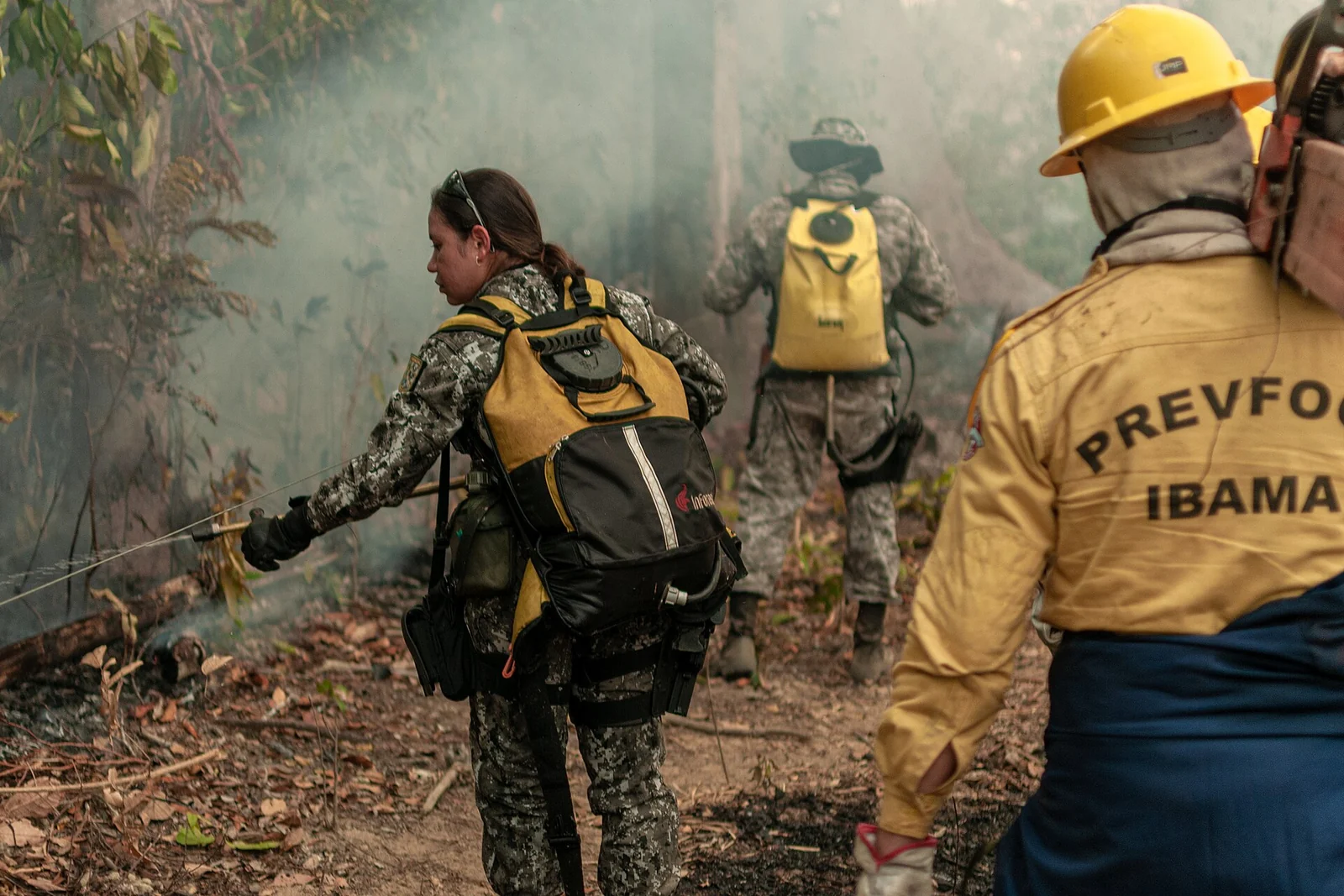
The October figures each come with their own map. In Manaus and 18 municipalities around it, Ipam counted 5,598 hotspots between 4 and 14 October, 321% more than in the previous 11 days. A hotspot is a satellite’s detection of heat, not a count of fires or of burned area. The window opened on the day of the first round of the election, and Alencar was careful about what that meant. She had not gone to the area to check for a political motive, she said, “mas os dados mostram uma coincidência”: but the data show a coincidence. In Pará, INPE detected 2,991 hotspots from 14 to 20 October, 610 more than the week before. Coiab, the coordinating body of Indigenous organisations in the Brazilian Amazon, reported that between July and 20 October fires reached 12 Indigenous territories in Amazonas. In the Brazilian Amazon, less than 2% of Indigenous land has been cleared, against more than 27% of the land outside it.
At the scale of the whole basin, fire now rivals the chainsaw. In 2024, across all the Amazon countries, burned forests released an estimated 791 million tonnes of carbon dioxide, give or take 86 million, more than the estimated 625 million (give or take 38 million) from deforestation. Morton expects drought and fire risk in the southern Amazon to peak around August and September 2027. The two problems are linked: less clearing leaves less fuel for runaway fires, and forest already charred by earlier fires burns more easily the next time. Modelling published in May 2026 found that, leaving deforestation aside, up to a third of the Amazon forest risks losing stability beyond 3.7–4.0 °C of global warming. With deforestation of 22–28%, warming of 1.5–1.9 °C above preindustrial levels could set 62–77% of the forest area on course for a shift to a degraded state, a change that could take decades to a few centuries to play out. About 17–18% of the Amazon has already been cleared.
The vote and the bill
The newest signal is early and needs care. INPE’s raw DETER records show 898 km² of deforestation alerts between 1 August and 16 October 2026, against 770 km² in the same window of 2025. These are alerts in the first months of a new monitoring year, not the rate. The last time Brazil went to the polls, in 2022, alerts surged from August. Giovana Girardi, a columnist at Agência Pública, read that surge as lawbreakers acting freely in the expectation that a less permissive government might win. That is her reading of 2022, and nothing in the records through 16 October showed the same thing happening in 2026.
The runoff is the first decision. Flávio Bolsonaro’s manifesto pledges to strengthen environmental oversight in the Amazon, to focus enforcement on organised crime instead of extractive workers and small farmers, and to end “illegal deforestation” by 2029. At a campaign event in Marabá, Pará, on 19 October, he promised: “Esses entraves ambientais que existem, principalmente por razões ideológicas, a gente vai acabar”, meaning he would end environmental obstacles that exist mainly for ideological reasons. He did not say which. To landholders he said “você vai poder plantar, criar gado, vai fazer o que quiser na sua terra”, that they would be able to plant, raise cattle and do whatever they wanted on their land. What counts as illegal is not fixed: laws set how much clearing is allowed, and Bolsonaro’s allies in Congress have pushed to legalize clearing in more cases. His party, the PL, won 121 of the 513 seats in the Chamber of Deputies on 4 October, the largest delegation.
Lula’s stated goal is “zero illegal deforestation by 2030.” His own government has also pushed the BR-319, a highway through preserved forest in Amazonas. On 13 April 2026 it issued bids for works on the road, using a loophole in the new licensing law that Lula had vetoed and Congress restored. A federal judge suspended the bids on 28 April; the president of the regional federal court reinstated them the same night, and by 24 October the merits had not been judged. The new term begins partway through a PRODES year that runs until July.
The second decision sits in the Senate. As of 24 October 2026, PL 2.564/2025 was with its rapporteur, Senator Jaques Wagner, in the justice committee, where it was assigned on 18 August. It was then due to go to the environment committee, and no vote had been recorded. The Observatório do Clima warns that the prior notice required by the Chamber’s text would do the most harm on invaded public land without settled titles, the kind of land where much of the Manaus region’s fire has burned this year.
Related articles
- Why the world’s best agricultural land is increasingly owned by foreign governments
- Why the global food system is more fragile than anyone admits
- The European Green Deal was never just about the climate
Further reading
As an Amazon Associate, Eikleaf earns from qualifying purchases. The book links below are affiliate links: if you buy through them, we may earn a small commission at no extra cost to you.
Recommended videos
 1:44Brazil: Amazon deforestation at 40-year low • FRANCE 24 EnglishFRANCE 24 on Brazil’s announcement that Amazon deforestation hit a roughly 40-year low.
 2:55How Brazil’s election could impact the Amazon rainforest | DW NewsDW on how Brazil’s election could change the enforcement behind the drop.
 1:36Amazon deforestation hits record low in Brazil, but El Niño and a tight election threaten progressEuronews on the record low and the El Niño and political risks that could reverse it.
Cite this article
Johan Karlsson. “How Brazil cut Amazon deforestation to a record low, and what could undo it.” Eikleaf, 24 October 2026, updated 25 October 2026. https://www.eikleaf.com/how-brazil-cut-amazon-deforestation-to-a-record-low-and-what-could-undo-it/
Gen AI Disclaimer
Some contents of this page were generated and/or edited with the help of a Generative AI.
Media
Amazon rainforest from the ISS – Wikimedia Commons (Photo: Alexander Gerst, CC BY 2.0)
Espigão do Oeste, Rondônia – Wikimedia Commons (Photo: Fernando Augusto/Ibama, CC BY-SA 2.0)
Operação Verde Brasil, Rondônia – Wikimedia Commons (Photo: Ibama, CC BY-SA 2.0)
Key Sources and References
INPE and Ministério do Meio Ambiente. “Taxas de desmatamento Prodes 2026” (press-conference slides). 16 October 2026. https://www.gov.br/mma/pt-br/noticias-defeso-eleitoral/apresentacao-coletiva-prodes-2026_inpe.pdf
INPE. “Brasil alcança menores taxas de desmatamento da série histórica na Amazônia e no Cerrado.” 16 October 2026 (updated 20 October). https://www.gov.br/inpe/pt-br/assuntos/ultimas-noticias/brasil-alcanca-menores-taxas-de-desmatamento-da-serie-historica-na-amazonia-e-no-cerrado
Paraguassu, L. and Romani, A. “Deforestation in Brazil’s Amazon falls to record low.” Reuters, syndicated in Newcastle Herald, 17 October 2026. https://www.newcastleherald.com.au/story/9370233/deforestation-in-brazils-amazon-falls-to-record-low/ ; Associated Press. “Amazon deforestation hits lowest level since 1988.” Jamaica Gleaner, 17 October 2026. https://jamaica-gleaner.com/article/world-news/20261017/amazon-deforestation-hits-lowest-level-1988 ; Al Jazeera. “Brazil’s Amazon deforestation hits lowest level on record.” 17 October 2026. https://www.aljazeera.com/news/2026/10/17/brazils-amazon-deforestation-hits-lowest-level-on-record
Associated Press. “Brazil investigates Amazon wildfires that disrupt daily life.” ABC News, 15 October 2026. https://abcnews.com/International/wireStory/brazil-investigates-amazon-wildfires-disrupt-daily-life-fueled-137285901 ; AFP. “Brazil probing ‘criminal’ origin of forest fires: minister to AFP.” eNCA, 14 October 2026. https://www.enca.com/lifestyle/brazil-probing-criminal-origin-forest-fires-minister-afp ; TV Brasil. “PF vai investigar origem de incêndios no Amazonas.” 21 October 2026. https://tvbrasil.ebc.com.br/reporter-brasil/2026/10/pf-vai-investigar-origem-de-incendios-no-amazonas
Times Brasil / CNBC. “Amazonas registra salto de focos de calor e qualidade do ar em Manaus chega a nível péssimo.” 17 October 2026. https://timesbrasil.com.br/brasil/amazonas-registra-salto-de-focos-de-calor-e-qualidade-do-ar-em-manaus-chega-a-nivel-pessimo-veja/
Poder360. “Desmatamento cai na Amazônia e no Cerrado em 2026.” 16 October 2026. https://www.poder360.com.br/poder-sustentavel/desmatamento-cai-na-amazonia-e-no-cerrado-em-2026/
INPE. “Estimativa de desmatamento na Amazônia Legal para 2025 é de 5.796 km2” (technical note). October 2025. https://www.gov.br/inpe/pt-br/assuntos/ultimas-noticias/20251015Nota_tcnica_EstimativaPRODES_2025.pdf
Bloomberg Línea. “Segundo turno opõe propostas sobre desmatamento, terras indígenas e energia no Brasil.” 9 October 2026. https://www.bloomberglinea.com.br/brasil/segundo-turno-opoe-visoes-sobre-desmatamento-terras-indigenas-e-energia-no-brasil/
Brazil. Constitutional Amendment 111/2021. https://static.poder360.com.br/2025/05/Emenda-Constitucional-no-111.pdf
Butler, R. A. “Amazon deforestation alerts fall to lowest level since 2013, Brazilian data show.” Mongabay, 9 August 2026. https://news.mongabay.com/2026/08/amazon-deforestation-alerts-fall-to-lowest-level-since-2013-brazilian-data-show/
Pesquisa FAPESP. “Desmatamento na encruzilhada.” September 2019. https://revistapesquisa.fapesp.br/desmatamento-na-encruzilhada/ ; Câmara, G. “About.” https://gilbertocamara.org/about/
Izique, C. “A arte de varrer nuvens.” Pesquisa FAPESP, 2008. https://revistapesquisa.fapesp.br/a-arte-de-varrer-nuvens/
MapBiomas. RAD 2025: Relatório Anual do Desmatamento, chapter 4 and Tables 65 and 69. May 2026. https://rad.ia.mapbiomas.org/rad2025/publication-web-resources/html/publication-134.html ; https://rad.ia.mapbiomas.org/rad2025/publication-web-resources/html/publication-151.html ; https://rad.ia.mapbiomas.org/rad2025/publication-web-resources/html/publication-152.html
Girardi, G. and Escardovelli, M. “Projeto na Câmara dos Deputados pode atrapalhar até 70% das ações do Ibama na Amazônia.” Agência Pública, 20 March 2026. https://apublica.org/2026/03/pl-sobre-crimes-ambientais-pode-barrar-ate-70-das-acoes-do-ibama/ ; Ministério do Meio Ambiente. “Dados do Deter indicam redução de 18,9% nos alertas de desmatamento no Cerrado em agosto.” 11 September 2026. https://www.gov.br/mma/pt-br/noticias-defeso-eleitoral/dados-do-deter-indicam-reducao-de-18-9-nos-alertas-de-desmatamento-no-cerrado-em-agosto
Folhapress. “Câmara aprova urgência de projeto para barrar operações do Ibama após recorde de ações contra desmatamento.” Acessa, 16 March 2026. https://www.acessa.com/noticias/2026/03/315428-camara-aprova-urgencia-de-projeto-para-barrar-operacoes-do-ibama-apos-recorde-de-acoes-contra-desmatamento.html
Observatório do Clima. “Alertas de desmatamento em 2026 são os menores da história.” 7 August 2026. https://oc.eco.br/alertas-de-desmatamento-em-2026-sao-os-menores-da-historia/
Conselho Monetário Nacional. Resolução CMN nº 5.193, 19 December 2024. https://www.bcb.gov.br/estabilidadefinanceira/exibenormativo?tipo=Resolu%C3%A7%C3%A3o%20CMN&numero=5193 ; Conselho Monetário Nacional. Resolução CMN nº 5.303, 12 May 2026. https://www.bcb.gov.br/estabilidadefinanceira/exibenormativo?tipo=Resolu%C3%A7%C3%A3o%20CMN&numero=5303 ; Conselho Monetário Nacional. Voto 82/2025–CMN, 18 December 2025 (summarises Resolution 5.193 and amends the rural-credit manual). https://normativos.bcb.gov.br/Votos/CMN/202582/Voto_do_CMN_82_2025.pdf
Greenpeace Brasil. “Greenpeace Brasil vê retrocesso em adiamento de regras ambientais para crédito rural.” 14 May 2026. https://www.greenpeace.org/brasil/imprensa/greenpeace-brasil-ve-retrocesso-em-adiamento-de-regras-ambientais-para-credito-rural/
Supremo Tribunal Federal. “Supremo suspende decisões que impediam bloqueios de terras para prevenir desmatamento.” 14 October 2025. https://noticias.stf.jus.br/postsnoticias/stf-suspende-decisoes-que-impediam-bloqueios-de-terras-para-prevenir-desmatamento/ ; Ibama. Instrução Normativa nº 19/2023 (administrative process for environmental infractions). 2023. https://supremoambiental.com.br/wp-content/uploads/2023/06/instruo-normativa-n-19-ibama-2023-regulamenta-o-processo-administrativo.pdf
Assunção, J., Gandour, C. and Rocha, Romero. “DETERring Deforestation in the Brazilian Amazon: Environmental Monitoring and Law Enforcement” (executive summary). Climate Policy Initiative, May 2013. https://www.climatepolicyinitiative.org/wp-content/uploads/2013/05/DETERring-Deforestation-in-the-Brazilian-Amazon-Environmental-Monitoring-and-Law-Enforcement-Executive-Summary.pdf
Assunção, J., Gandour, C. and Rocha, Romero. “DETER-ing Deforestation in the Amazon: Environmental Monitoring and Law Enforcement.” American Economic Journal: Applied Economics 15(2): 125–56, 2023. https://www.aeaweb.org/articles?id=10.1257/app.20200196
Assunção, J., Gandour, C. and Rocha, Rudi. “Deforestation slowdown in the Brazilian Amazon: prices or policies?” Environment and Development Economics 20(6): 697–722, 2015. Executive summary: https://www.climatepolicyinitiative.org/wp-content/uploads/2012/03/Deforestation-Slowdown-in-the-Brazilian-Amazon-Prices-or-Policies-Executive-Summary.pdf
Assunção, J. and Rocha, Romero. “Getting greener by going black: the effect of blacklisting municipalities on Amazon deforestation.” Environment and Development Economics 24(2): 115–137, 2019. https://www.cambridge.org/core/journals/environment-and-development-economics/article/getting-greener-by-going-black-the-effect-of-blacklisting-municipalities-on-amazon-deforestation/360C7CAB41129B18FEE2D37C66317914
Conselho Monetário Nacional. Resolução nº 3.545, 29 February 2008. https://www.bcb.gov.br/estabilidadefinanceira/exibenormativo?tipo=Resolu%C3%A7%C3%A3o&numero=3545
Climate Policy Initiative. “Change in Brazil Credit Legislation Reduced Amazon Deforestation by 15%” (press release). 2013. https://www.climatepolicyinitiative.org/press-release/change-in-brazil-credit-legislation-reduced-amazon-deforestation-by-15/
Human Rights Watch. “JBS Still Can’t Root Out Illegal Ranches from Its Supply Chain.” 21 November 2025. https://www.hrw.org/news/2025/11/21/jbs-still-cant-root-out-illegal-ranches-from-its-supply-chain ; Al Jazeera. “Is your beef linked to Amazon deforestation? A report highlights loopholes.” 15 October 2025. https://www.aljazeera.com/news/2025/10/15/is-your-beef-linked-to-amazon-deforestation-a-report-highlights-loopholes ; JBS N.V. Form 6-K exhibit 99.1 (annual report), US Securities and Exchange Commission. 2026. https://www.sec.gov/Archives/edgar/data/0001791942/000121390026044089/ea028640101ex99-1.htm
Observatório do Clima. “Nota Técnica sobre os PLs nº 364/2019, nº 2.564/2025, nº 2.486/2026 e nº 5.900/2025.” May 2026. https://oeco.org.br/wp-content/uploads/2026/05/OC-NT-PLs-Semana-do-Agro_.pdf
Cosme, J. and Maes, J. “Focos de fogo em Manaus e cidades vizinhas disparam após o primeiro turno das eleições.” Folhapress, via ES Hoje, 23 October 2026. https://eshoje.com.br/meio-ambiente/2026/10/focos-de-fogo-em-manaus/
Senado Federal. PL 2564/2025, legislative record, retrieved 23–24 October 2026. https://www25.senado.leg.br/web/atividade/materias/-/materia/174479
Instituto Socioambiental. “Inpe confirma aumento de 29% no desmatamento da Amazônia entre 2012 e 2013.” 10 September 2014. https://site-antigo.socioambiental.org/en/print/3769
Soares-Filho, B. et al. “Cracking Brazil’s Forest Code.” Science 344(6182): 363, 25 April 2014. doi:10.1126/science.1246663. https://www.agroicone.com.br/wp-content/uploads/2019/11/Cracking-Brazil-Forest-Code.pdf
IHU-Unisinos (reproducing an INPE note). “A taxa consolidada de desmatamento por corte raso para os nove estados da Amazônia Legal em 2019 é de 10.129 km2.” June 2020. https://ihu.unisinos.br/599865-a-taxa-consolidada-de-desmatamento-por-corte-raso-para-os-nove-estados-da-amazonia-legal-em-2019-e-de-10-129-km2 ; Associated Press. “Brazil’s Amazon deforestation surges to worst in 15 years.” OPB, 18 November 2021. https://www.opb.org/article/2021/11/18/brazil-s-amazon-deforestation-surges-to-worst-in-15-years/
Coelho-Junior, M. G. et al. “Unmasking the impunity of illegal deforestation in the Brazilian Amazon: a call for enforcement and accountability.” Environmental Research Letters 17: 041001, 2022. https://iopscience.iop.org/article/10.1088/1748-9326/ac5193 ; Mongabay. “Government inaction sees 98% of deforestation alerts go unpunished in Brazil.” May 2022. https://news.mongabay.com/2022/05/governmet-inaction-sees-98-of-deforestation-alerts-go-unpunished-in-brazil/
Ministério do Meio Ambiente and INPE. “PRODES 2024/2025” (presentation slides). October–November 2025. https://static.poder360.com.br/2025/11/PRODES-20242025.pdf
Girardi, G. “O sonho de Marina: alcançar em 2026 a menor taxa de desmatamento da história.” Agência Pública, February 2026. https://apublica.org/2026/02/o-sonho-de-marina-alcancar-em-2026-a-menor-taxa-de-desmatamento-da-historia/
NASA Earth Observatory. “Fires Arrive in the Amazon Rainforest.” October 2026. https://science.nasa.gov/earth/earth-observatory/fires-arrive-in-the-amazon-rainforest/
Ministério do Meio Ambiente. “Governo Federal apresenta ações de resposta a incêndios florestais no Pará.” 22 October 2026. https://www.gov.br/mma/pt-br/noticias-defeso-eleitoral/governo-federal-apresenta-acoes-de-resposta-a-incendios-florestais-no-para/
Radler, J. and Almeida, R. “Com Super El Niño e ações criminosas, incêndios atingem 12 Terras Indígenas no Amazonas.” Instituto Socioambiental, 23 October 2026. https://www.socioambiental.org/noticias-socioambientais/com-super-el-nino-e-acoes-criminosas-incendios-atingem-12-terras-indigenas ; Câmara dos Deputados, Comissão da Amazônia e dos Povos Originários e Tradicionais. Parecer da relatora on PL 4.903/2024. 26 May 2026. https://www.camara.leg.br/proposicoesWeb/prop_mostrarintegra?codteor=3136517&filename=Parecer-CPOVOS-2026-05-26
Bourgoin, C. et al. “Extensive fire-driven degradation in 2024 marks worst Amazon forest disturbance in over 2 decades.” Biogeosciences 22: 5247–5256, 2025. https://bg.copernicus.org/articles/22/5247/2025/
Wunderling, N. et al. “Deforestation-induced drying lowers Amazon climate threshold.” Nature, 6 May 2026. https://www.nature.com/articles/s41586-026-10456-0 ; Mongabay. “Deforestation and warming could push Amazon to tipping point by 2040s: study.” 7 May 2026. https://news.mongabay.com/2026/05/deforestation-and-warming-could-push-amazon-to-tipping-point-by-2040s-study/
INPE TerraBrasilis. DETER-Amazônia raw alert records (deter-amz layer), queried 24 October 2026; sum of areamunkm for classes DESMATAMENTO_CR, DESMATAMENTO_VEG and MINERACAO, view_date 1 August to 16 October of each year. https://terrabrasilis.dpi.inpe.br/geoserver/deter-amz/ows?service=WFS&version=2.0.0&request=GetFeature&typeName=deter-amz:deter_amz&outputFormat=csv&propertyName=classname,view_date,areamunkm&CQL_FILTER=view_date%3E%3D%272026-08-01%27%20AND%20view_date%3C%3D%272026-10-16%27
SBT News. “Flávio promete acabar com entraves ambientais ‘ideológicos’.” 19–20 October 2026. https://sbtnews.sbt.com.br/noticia/eleicoes/flavio-promete-acabar-com-entraves-ambientais-ideologicos
Aldern, C. “Brazil’s election could determine the fate of the Amazon.” Grist (co-published with Agência Pública), 15 October 2026. https://grist.org/international/brazil-election-runoff-amazon-deforestation-lula-bolsonaro/
Agência Senado. “Câmara: PL obtém a maior bancada; federação PT-PCdoB-PV é a segunda força.” 5 October 2026. https://www12.senado.leg.br/noticias/materias/2026/10/05/camara-pl-obtem-a-maior-bancada-federacao-pt-pcdob-pv-e-a-segunda-forca ; Datafolha. “Flávio Bolsonaro (PL) tem 47% e tem empate técnico com Lula (PT), que aparece com 46%.” 23 October 2026. https://datafolha.folha.uol.com.br/eleicoes/2026/10/flavio-bolsonaro-pl-tem-47-e-tem-empate-tecnico-com-lula-pt-que-aparece-com-46.shtml
CNN Brasil. “Justiça suspende licitação de obras do ‘trecho do meio’ da BR-319.” 28 April 2026. https://www.cnnbrasil.com.br/infra/justica-suspende-licitacao-de-obras-do-trecho-do-meio-da-br-319/ ; Agência Infra. TRF-1 lifts injunction on BR-319 “trecho do meio” bids. 29 April 2026. https://agenciainfra.com/blog/?p=40325 ; Mongabay. “Brazil taps legal loophole to issue bids for Amazon tipping-point road.” April 2026. https://news.mongabay.com/2026/04/brazil-taps-legal-loophole-to-issue-bids-for-amazon-tipping-point-road/