Last updated: · 18 min read
In brief
Four Swedish prisoners landed in Estonia to serve time in a prison that had been half empty, where Sweden now rents places. Weeks later, England and Wales began releasing most eligible prisoners at a third of their sentence. How full a prison system gets depends on who is sent in, how long they stay and how many places exist. Crime is only one input. England and Wales nearly doubled its prison population from 1993 to 2012 while crime fell, through more custody and longer sentences. Release people early, and the pressure moves onto a probation service its union calls overwhelmed.
Contents
Four men and a half-empty prison
On Tuesday 18 August 2026, a charter flight from Sweden landed at Ämari air base in Estonia with four prisoners on board. An armed escort unit of the Estonian Prison Service took them from the airport to Tartu Prison. They were the first inmates sent abroad under a rental treaty the two governments had signed in June 2025, and whose day-to-day arrangements they had settled less than two weeks before the flight.
Estonia had room to spare. In September 2026 it held around 1,600 people behind bars, fewer than at any time since it regained independence in 1991, and Tartu Prison was half empty when the government agreed to take up to 600 Swedish inmates. Sweden had the opposite problem. Its prison population doubled in the ten years to 2025, to more than 11,200, driven mainly by gang violence and harsher sentences. The men on the flight were adult long-term prisoners, and the deal says none of them will be released in Estonia. All of them go back to Sweden before their sentences end.

About six weeks later, England and Wales began letting prisoners out in batches. New rules moved the release point for most eligible prisoners to a third of their sentence, because without them the prisons were expected to run out of space entirely by November.
One government sent prisoners abroad and the other let them out early, but both were working on the same sum. How full a prison system is depends on three decisions taken by different people on different timetables. Someone decides who is sent in, someone decides how long they stay, and someone else decides how many usable places exist. Crime reaches the first of these only through police, prosecutors and courts, and the kinds of crime that come to court also shape how long people stay. When the three decisions drift apart, a country can run out of cells in a decade when crime is falling, and the cause of the shortage can lie years upstream of the crisis.
Most systems, though not all
Overcrowding is common without being universal. In roughly two thirds of the countries that report figures, prison systems hold more people than they were planned for. That estimate uses each country’s latest figure from somewhere between 2015 and 2024, and every country counts once, so a small island state weighs as much as a country with hundreds of thousands of prisoners. It describes how many systems are overcrowded, not how many prisoners live in crowded conditions.
Europe looks calmer. On 31 January 2025, 16 of the 50 prison administrations in the Council of Europe’s annual survey held more people than their stated capacity, about a third of them. England and Wales, which had begun releasing prisoners early a few months before that count, was not among them.
Part of the explanation lies in the denominator. Every country decides for itself what counts as its capacity, and one of the common measures, operational capacity, is an administrative figure that can be adjusted upward, which also reduces the appearance of overcrowding. A system can report spare room on paper while its staff are already putting two people in cells built for one.
What counts as full

A prison has more than one capacity. Design capacity is the number of people the architect or planner built it for. Operational capacity is the number it can hold given its staff and services. England and Wales adds a third measure, Certified Normal Accommodation, which the Prison Service calls the good, decent standard it aspires to give every prisoner: an uncrowded prison. At the end of September 2026 the estate in England and Wales had 81,361 such places in use and held 87,499 people. Its useable operational capacity was 89,055, a figure from which 1,640 places had already been subtracted as an operating margin, because prisoners have to be separated by sex, age, security category and conviction status, some cannot safely share a cell, and a free bed in the wrong part of the country is no use. Where a prison's operational capacity is higher than its uncrowded figure, the service classes it as potentially crowded. The American state of Alabama shows how far the measures can drift apart. At the end of 2023 it held 21,046 people: 173.7% of design capacity, and 95.6% of operational capacity.
The arithmetic of a full prison
A prison population changes each day by the number of people who come in minus the number who leave. If admissions and the average length of stay hold steady for long enough, the population settles at roughly the number admitted each year multiplied by the average time each person spends inside. Real systems rarely sit still that long, so the formula is a sketch, but it explains most of what follows.
American local jails show both halves of the product. In the year to June 2024 they recorded 7.9 million admissions, yet on an average day they held 667,700. People admitted stayed an average of about a month before release. That is an average across very different cases, but it shows how an enormous flow of admissions can coexist with a modest population when stays are short.
Now take a hypothetical system with round numbers. It admits 1,000 people a year and keeps each of them for two years, so once it settles it holds about 2,000. Lawmakers then require everyone newly admitted to stay two and a half years, while people already inside keep their old release dates, and nothing changes in crime, arrests or convictions. The system now needs about 2,500 places. The extra 500 do not arrive on the day the law passes. For the first two years nothing visible happens, because nobody sentenced under the new rule would have left before then anyway. Only after that do departures fall short of admissions, and the population climbs for another six months until it settles at its new level. In a real system, with sentences of every length, the rise is smeared across many years. Either way, the bill for a sentencing change arrives long after the vote, and can land on a different government.
The same pattern shows up across Europe. Countries with high imprisonment rates tend to keep people inside for longer, and the average length of imprisonment is the central factor in how many prisoners a country holds.
Each decision has its own levers. Admissions depend on what police pursue, what prosecutors charge, whether courts choose custody, whether people are held before trial and whether people already released are sent back. Length of stay depends on the terms lawmakers write, the sentences judges pass and the point at which the law lets a prisoner out. The number of places depends on what gets built, what gets repaired and what the Treasury pays for. England and Wales shows how all three can pile up.
How England and Wales filled their prisons while crime fell
Between 1993 and 2012, the prison population of England and Wales nearly doubled, from around 44,000 to almost 87,000. Rising crime did not drive it. The Crime Survey for England and Wales shows theft, criminal damage and violence falling since the mid-1990s, even though in the year to March 2016 most adults still believed crime across the country was rising. The survey’s broader headline measure, which adds fraud and computer misuse, was still below its 2017 level in the year to June 2026, though it showed no significant change over the latest year. The Independent Sentencing Review, set up by the government and reporting in 2025, concluded that the growth in prisoners could not be explained by rising crime.
Part of the growth came through the front door. In 1993, 16% of people sentenced for indictable offences, the more serious crimes that can go before a jury, received immediate custody. By 2024 that rate was more than 16 percentage points higher, which means it had more than doubled. Over the same years the alternative shrank: the number of community orders, sentences served outside prison under supervision and conditions, fell by 61% between 2010 and 2024. Short prison terms also compare badly with what they replaced. When the Ministry of Justice matched adult offenders from 2016 on their characteristics and records, those given custodial sentences of less than a year had a rate of proven reoffending over the following year about 4 percentage points higher than those given community or suspended sentences. The matched groups were a small subset with relatively entrenched problems, and matching is not a randomised trial, so this is an association, but it points the opposite way from the hope that a short spell inside straightens people out.
The other part came through length of stay. The average custodial sentence for indictable offences rose from 16 months in 1993 to 22.5 months by June 2024. For murder, the average minimum term rose from 13 years in 2000 to 21 years in 2021. Looking at 2010 to 2023, the Review found that the main driver was harsher sentencing for the same categories of crime. Changes in the mix of cases coming to court were a comparatively minor contributor, though they have mattered more since 2020, possibly because courts gave priority to serious cases while working through the backlogs left by the pandemic.
Lawyers who gave evidence to the Review described how a change at the top of the scale travels down it. The Criminal Bar Association said that raising maximum and minimum terms lengthens sentences “across the board”, in less serious cases as well as the most serious ones. The Review itself concluded that the “tough on crime” political narrative had harmed sentencing policy. An extra few months per sentence, multiplied across every sentence of that kind, builds up in the cells slowly, as each new group of prisoners stays past the date on which it would once have left.
Sweden reached the same squeeze partly through the front door. Swedish courts handed down prison sentences totalling just under 200,000 months in 2023, double the total for 2014. Part of the reason was police success against the gangs. By early 2025 there had been fewer deadly shootings and more convictions over the previous two years, and the prison service was struggling to absorb the people it was sent. Solving more crimes adds to admissions just as longer sentences add to length of stay, and a full prison can be a sign of either.
Who comes back, and who waits
Two groups add to a prison population without anyone receiving a new sentence for a new crime.
The first is people sent back. In England and Wales, leaving prison does not end a sentence. The rest is served in the community “on licence”, under conditions set by probation, and a breach of those conditions can mean recall to prison. In 1993 the number of people in prison on recall on any given day was estimated at fewer than 100. By 2025 it was about 13,500.
The government has started to pull this lever. Recall used to come in three forms: a fixed 14 days, a fixed 28 days, or an open-ended “standard” recall that could keep someone inside until the Secretary of State or the Parole Board re-released them or the sentence ran out. From June 2025 standard recall was restricted for most offenders, and from late March 2026 the two short fixed terms were replaced by a single 56-day recall, with people who had already spent more than 56 days on recall released in batches. At the same time, courts were told to presume that sentences of 12 months or less should be suspended. Together these changes seem to have contributed to a drop of about 1,600 in the prison population between March and April 2026. The fall did not last. By September the population was close to its record again.
The second group is people waiting for a court. Around the world, about 3.6 million prisoners were held in pre-trial detention in 2024, and the share of prisoners who have not been sentenced has stayed at around 30% for a decade. The UN’s drugs and crime agency calls disproportionate use of pre-trial detention a major contributor to overcrowding in many countries. Here the length-of-stay arithmetic applies to the speed of the courts: every month a case waits is a month a remand prisoner spends in a cell.
In England and Wales the lever has moved in the right direction. The remand population had been rising since early 2020, then fell 13% in the year to 30 June 2026. The Institute for Government, a London think tank that tracks public services, credits the courts hearing cases more quickly with the biggest single contribution to the recent fall in the prison population. France’s remand numbers have moved the other way. Leaving out its overseas collectivities, the number of French “prévenus” on 1 October 2026 was 10.8% higher than a year earlier. The category covers people not yet tried and people convicted whose conviction is not yet final, for example because they have appealed.
Why new places haven’t kept up
The third decision, how many places exist, is made by different people working to a different budget and a much slower clock. The National Audit Office, the UK parliament’s spending watchdog, said so directly in December 2024. It found that the prison crisis was a consequence of previous governments’ “failure to align criminal justice policies with funding for the prison estate”. Tougher sentences and more police officers raised the expected demand for places, while years of under-investment in maintenance left the Ministry of Justice and the prison service poorly placed to respond. It called their expansion plan unrealistic and said the government had not made it a priority.
The prison service in England and Wales has been building and barely gaining ground. Around 3,200 new places have been added since 2024, but the Institute for Government reckons the net gain is “a few hundred spaces at most”, because a similar number of old cells have been taken out of use through dilapidation, safety concerns or other problems. In December 2024 the backlog of prison maintenance stood at £1.8bn. Delivering a new prison takes at least seven years, and the Ministry of Justice says it has acquired no new land in over a decade, so it owns no suitable sites beyond those already planned. Four separate failures sit behind the shortage: building is slow, old cells are withdrawn almost as fast as new ones open, the ministry has run out of land of its own, and the money was never matched to the sentencing laws in the first place.
France is caught in the same trap. A national plan launched in 2018 promised 15,000 additional prison places, and by mid-October 2026 just over 8,000 had been delivered. Dominique Simonnot, France’s prison inspector until her term ended in October, calculated that absorbing the current growth in prisoners would require opening a new prison every six weeks.
The Netherlands shows that the cycle can swing both ways within a decade. In the three years to 2017 the government shut 19 of its nearly 60 prisons. About a third of Dutch cells sat empty, and the country rented prisons to Belgium and Norway. Criminologists put the surplus down to falling crime, a building spree in the 1990s and the spread of electronic tagging. One union official, Frans Carbo, warned at the time: “If you close prisons now, you will only have to open them in a few years.”
Eight years later, in March 2025, the Dutch government said its prison system was in what it called “code black”: occupancy above 99.5%, with arrested people routinely left in police cells because there was nowhere to send them. Staff shortages had caused the first problems, the government said, but the shortage was now mainly of cells, driven by longer detentions and by more young adults and more people under psychiatric hospital orders. By June 2026 people serving sentences of up to a year were being released up to two weeks early, and leaked ministry plans had the cabinet weighing whether to extend early release to sentences of up to two years. Sanne Struijk, a professor of penal law at Erasmus University Rotterdam, put the shortage down to prison closures, harsher sentences and tighter rules on conditional release, not to more crime. “In the prison system, it always moves in waves,” she said.
What a rented cell buys

Sweden pays Estonia a fixed €22.95m for a twelve-month transition while Tartu's places are phased in. After that it pays €30.6m a year to keep 300 places ready, whether or not they are filled, plus €8,500 a month for each prisoner beyond them, with both rates rising by 3.5% a year from January 2027. What it buys is a cell run by another country's staff. Estonia consents to each prisoner separately, and for the first group it accepted fewer than half the candidates Sweden put forward. On 27 August 2026, advisers to Estonia's chancellor of justice made an unannounced inspection, when Tartu held 15 Swedish inmates. They found the men had not been told enough about conditions and rules before the move, that language barriers made information hard to follow and that video calls were not yet available, and they questioned how carefully family ties and children's interests had been weighed. Most inmates they spoke to said they had opposed the transfer. The prison's director, Merle Ulst, said most of them had arrived two days before the visit, and that most of the issues were already being handled. Norway once leased the Dutch high-security prison at Norgerhaven, for about €25m a year.
The case for enough prison places
Some people have to be held, and a state that cannot hold them safely has failed at one of its basic jobs. Prison protects the public by incapacitation, sharply limiting what offenders can do outside while they are held. Much crime is committed by a small group of persistent offenders, so locking up the right people could prevent a great deal of harm. Sweden’s fuller prisons followed real success in convicting gang members. On this view, the answer to crowding is a country with enough decent places for the sentences it hands down, and supervision that the public can trust for those it releases.
The difficulty lies in the details, because incapacitation, deterrence and reoffending are separate effects and each has to be weighed on its own. On incapacitation, research cannot reliably identify in advance the small group responsible for so much crime. Offending also falls steeply from about the mid-thirties, so a long sentence for someone ageing out of crime still incapacitates them, but it is a costly way to prevent crimes they were already less likely to commit. On deterrence, adding years to already long sentences produces at most a very modest effect. And on reoffending, the ministry’s comparison of short prison terms with community sentences points against the short terms.
El Salvador is the obvious test of the opposite view. In 2015 it recorded more than 100 homicides per 100,000 people. Official figures put the rate at 20 in 2020, and the government reports 1.3 for 2025. The emergency regime, which allows arrests without a warrant, began only in March 2022, so most of the fall in the official series happened before it. The series itself has been challenged. In 2024, Jeremy Giles reported in Foreign Policy that the government had stopped counting bodies found in clandestine graves from 2021, and people killed in clashes with the police or army from 2022. By October 2026 more than 92,000 people had been detained under the regime. For prison numbers, the most recent estimate comes from Idhuca, a human-rights institute at the Central American University, which puts El Salvador’s prison population at 118,369 at the end of 2025. That works out at about 2.6 prisoners per place, in a calculation that counts the mega-prison CECOT only by the places actually occupied. Counting CECOT at its full nominal capacity instead, the same prisoners would still come to about 1.67 per place. By October 2026, human-rights groups had documented more than 500 deaths in state custody under the regime.
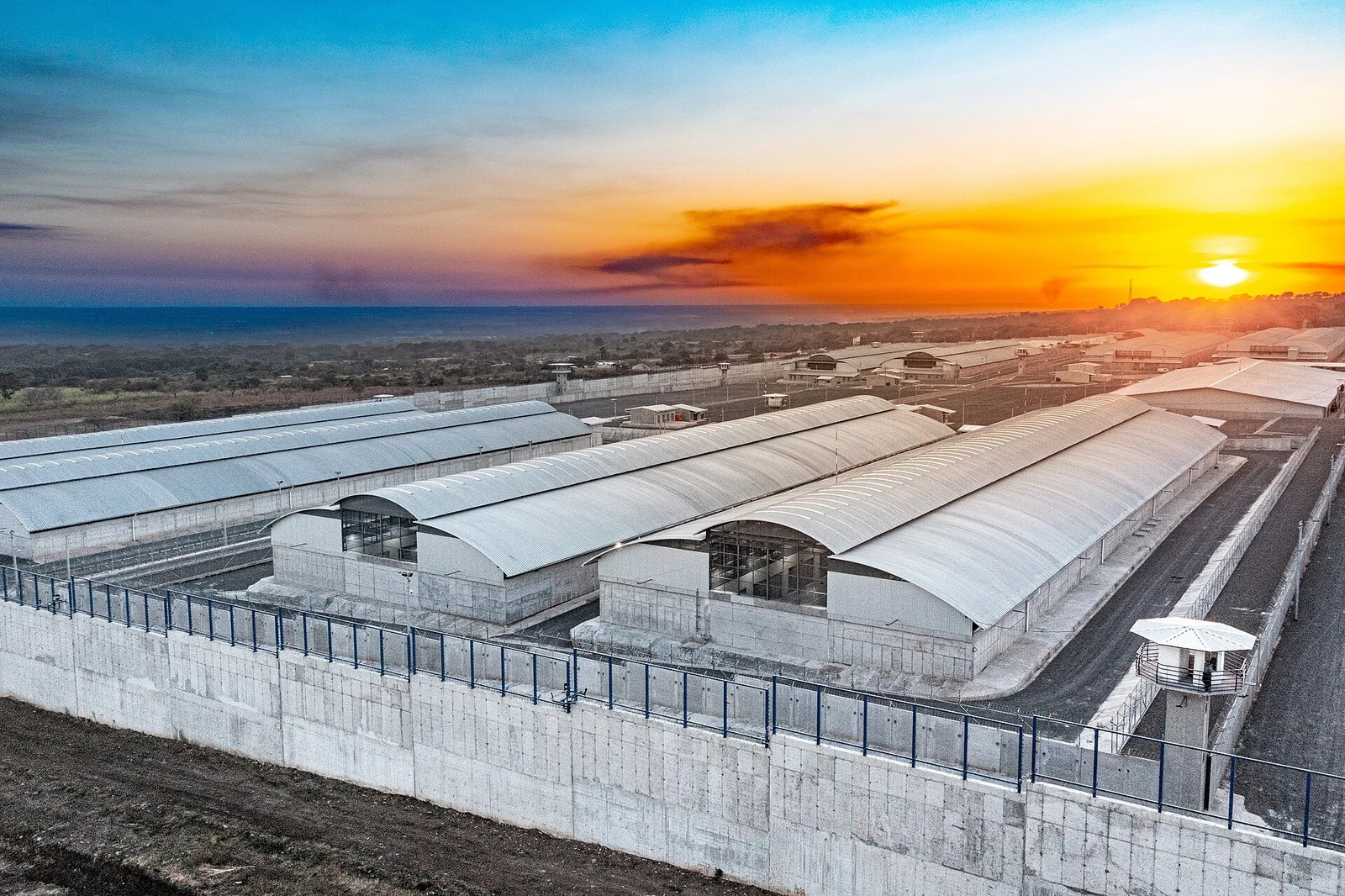
Even there, the conversation has turned to release. On 13 October 2026, President Nayib Bukele said his government was evaluating early conditional release for roughly half of the prisoners who had collaborated with gangs, without saying when or on what criteria. Three days later he narrowed it: the review covered 10,629 people accused of occasional collaboration with gangs, about half of whom might qualify for a work programme leading to earlier release, and no gang member, he said, would ever go free. Neither statement announced a decision.
Courts can also force the issue. In 2011, in Brown v. Plata, the US Supreme Court upheld an order requiring California to cut its prison population to 137.5% of design capacity within two years, because overcrowding was preventing constitutionally adequate medical and mental-health care. A country that sentences beyond its capacity can end up with judges setting the limit instead.
The case for enough safe capacity is strong. Taken seriously, it is an argument for paying to build, maintain and run the places that a country’s sentencing laws require. In England and Wales in 2024–25, holding a prisoner cost an average of £56,618 a year. That is an average across the estate, which is different from the cost of one extra prisoner, but it gives the scale. The National Audit Office found that governments passed the sentences without funding the places.
The release valve
When the three decisions collided in England and Wales, the lever that moved fastest was the one that sets the release date. The prison population hit a record 88,521 on 6 September 2024. Four days later the government moved the automatic release point for some standard sentences from half to 40%. It took about six months for the population to climb back to its previous peak.
The stakes of running out are specific. The National Audit Office warned that if prisons reached full capacity, courts would be unable to try cases where a suspect might receive a prison sentence. So the government reached for the same lever again.
Under the Sentencing Act 2026, from 1 October 2026 most adults on standard sentences who would have served 40% or half of their term leave after a third, and a second group who would have served two thirds leave at half. Andy Burnham, shortly after becoming prime minister, paused the scheme and then narrowed it, excluding rape and serious child sexual and grooming offences, and later anyone serving time for unlawful killing, after a backlash over the possible release of the killers of PC Andrew Harper. In August he wrote that “it is simply not possible to prevent all offenders from being released early without the prison system collapsing.” Some 700 people left on 1 October and about 650 on 13 October, and batches of prisoners on progressively longer sentences are due to continue until June 2027.
None of this shortens a sentence in law. It moves part of it out of the building. On a standard six-year sentence released at a third, the person spends two years in prison, two years under probation supervision and two more on licence, without routine supervision but still liable to recall. On Monday 19 October 2026 the adult men’s estate had 1,984 spare places, a figure already net of the operating margin. Prisons that had been expected to run out of space in November had some room again, made by moving time out of thousands of sentences.
The time that no longer fits inside the prisons is served under probation instead. Probation officers are “absolutely overwhelmed with work,” in the words of Ian Lawrence, general secretary of their union, Napo. During an earlier round of early releases, between February and August 2024, 14% of all the prisoners released were sleeping rough. Electronic tags are among the tools meant to carry the part of the punishment the prison no longer has room for. In the 180 cases that inspectors examined for a report in September, only 55% of GPS and radio-frequency tags had been fitted promptly, and some people still had no equipment assigned up to five months after it was required.
Related articles
- The hidden arithmetic of immigration: what the research actually shows
- The invisible market that prices human life
- The economics of trust: what happens to a society when the thing that makes markets work starts to disappear
Further reading
As an Amazon Associate, Eikleaf earns from qualifying purchases. The book links below are affiliate links: if you buy through them, we may earn a small commission at no extra cost to you.
 Locked In: The True Causes of Mass Incarceration and How to Achieve Real ReformShows that prison numbers depend on prosecutors’ and sentencing choices rather than crime alone, explaining why falling crime need not empty cells.
 The Culture of Control: Crime and Social Order in Contemporary SocietyClassic account of how politics and public anxiety drove longer sentences in Britain and America, independent of crime trends.Crime Control as Industry: Towards Gulags, Western StyleCrime Control as Industry: Towards Gulags, Western StyleA Norwegian criminologist’s classic argument that prison capacity grows by its own institutional logic, with a Nordic perspective close to the Sweden-Estonia case.
Recommended videos
 19:39Britain is releasing prisoners early. Here’s how other countries avoided it | BBC NewsBBC on Britain’s early-release schemes and how other countries kept prison numbers down.
 18:58On the front line: Inside Britain’s prison crisis | BBC DocumentaryBBC documentary inside overcrowded prisons in England and Wales.
 5:46Why have hundreds of prisoners been released in England and Wales? | BBC NewsShort explainer on the latest early releases and the pressure moving to probation.
Cite this article
Ingrid Dahl. “Why falling crime doesn’t always empty prisons.” Eikleaf, 24 October 2026, updated 25 October 2026. https://www.eikleaf.com/why-falling-crime-doesn-t-always-empty-prisons/
Gen AI Disclaimer
Some contents of this page were generated and/or edited with the help of a Generative AI.
Media
Pentonville Prison – Wikimedia Commons (Photo: Reading Tom, CC BY 2.0)
Tartu Prison from the Emajõgi – Wikimedia Commons (Photo: Oop, CC BY-SA 3.0)
Aerial view of CECOT – Casa Presidencial, El Salvador
Key Sources and References
Republic of Estonia and Kingdom of Sweden. “Agreement on the Enforcement in Estonia of Swedish Sentences of Imprisonment.” Stockholm, 18 June 2025. https://api.riigikogu.ee/api/files/7b06efa7-d92d-4165-9fcb-8785eb9ddb07/download
ERR News. “Photos: First Swedish prisoners arrive at Tartu under prison-rental deal.” 18 August 2026. https://news.err.ee/1610113024/photos-first-swedish-prisoners-arrive-at-tartu-under-prison-rental-deal
ERR News. “Estonia and Sweden sign ‘historic’ prison rental space agreement.” 5 August 2026. https://news.err.ee/1610103226/estonia-and-sweden-sign-prison-rental-space-agreement
ERR News. “Swedish prisoners in Estonia: No motivation to strive for a more law-abiding life.” 14 October 2026. https://news.err.ee/1610166235/swedish-prisoners-in-estonia-no-motivation-to-strive-for-a-more-law-abiding-life
ERR News. “Tartu prison director: Dissatisfaction with prison life hardly out of the ordinary.” 15 October 2026. https://news.err.ee/1610167075/tartu-prison-director-dissatisfaction-with-prison-life-hardly-out-of-the-ordinary
EUobserver. “Sweden begins shipping off prisoners to rented Estonian cells.” 18 September 2026. https://euobserver.com/237669/sweden-begins-shipping-off-prisoners-to-rented-estonian-cells/
Reuters (via Yahoo News). “Sweden eyes sending inmates abroad as prisons full due to gang crime wave.” 29 January 2025. https://www.yahoo.com/news/sweden-eyes-sending-inmates-abroad-115805693.html
La Corte, M. L. and Rowland, C. “How will the new prison early release scheme work?” Institute for Government, 6 August 2026. https://www.instituteforgovernment.org.uk/explainer/prison-early-release-scheme
Institute for Government. “Performance Tracker 2026: Prisons and probation.” 12 October 2026. https://www.instituteforgovernment.org.uk/publication/performance-tracker-2026/criminal-justice/prisons
UNODC. “Prison Matters 2026: Global prison population and trends.” United Nations Office on Drugs and Crime, July 2026. https://www.unodc.org/documents/data-and-analysis/prison/Prison_Matters_2026.pdf
Aebi, M. F. and Cocco, E. “Prisons and Prisoners in Europe 2025: Key Findings of the SPACE I report.” Council of Europe and University of Lausanne, 2026. https://wp.unil.ch/space/files/2026/10/261013_key-findings-space-i_prisons-europe-2025.pdf
Ministry of Justice. “Prison population: Monthly Bulletin September 2026.” 2026. https://assets.publishing.service.gov.uk/media/6accb1f8b8542d3693fd42c9/Monthly_Bulletin_September_2026_web.ods
Ministry of Justice. “Population and Capacity Briefing for Monday 19 October 2026.” Prison population weekly estate figures 2026, 19 October 2026. https://assets.publishing.service.gov.uk/media/6ad5f05d67af5c09d04797ac/prison-pop-19-oct-2026.ods
Bureau of Justice Statistics. “Prisoners in 2023 – Statistical Tables.” US Department of Justice, September 2025. https://bjs.ojp.gov/document/p23st.pdf
Bureau of Justice Statistics. “Jail Inmates in 2024 – Statistical Tables.” US Department of Justice, 8 September 2026. https://bjs.ojp.gov/library/publications/jail-inmates-2024-statistical-tables
Office for National Statistics. “Public perceptions of crime in England and Wales: year ending March 2016.” 7 September 2017. https://www.ons.gov.uk/peoplepopulationandcommunity/crimeandjustice/articles/publicperceptionsofcrimeinenglandandwales/yearendingmarch2016
Office for National Statistics. “Crime in England and Wales: year ending June 2026.” 22 October 2026. https://www.ons.gov.uk/peoplepopulationandcommunity/crimeandjustice/bulletins/crimeinenglandandwales/latest
Independent Sentencing Review. “History and Trends in Sentencing” (Part 1). Ministry of Justice, February 2025. https://assets.publishing.service.gov.uk/media/67c583a868a61757838d2196/independent-sentencing-review-part-1-report.pdf
Independent Sentencing Review. “Final report and proposals for reform” (Part 2). Ministry of Justice, May 2025. https://assets.publishing.service.gov.uk/media/682d8d995ba51be7c0f45371/independent-sentencing-review-report-part_2.pdf
Eaton, G. and Mews, A. “The impact of short custodial sentences, community orders and suspended sentence orders on reoffending.” Ministry of Justice, 2019. https://www.gov.uk/government/publications/impact-of-short-custodial-sentences-community-orders-and-suspended-sentence-orders-on-reoffending
Ministry of Justice. “Offender Management Statistics Bulletin, England and Wales: January to March 2026.” 30 July 2026. https://assets.publishing.service.gov.uk/media/6a69fdd61bcde42205705ff9/OMSQ_Q1_2026.pdf
Ministère de la Justice (SSER). “Au 1er octobre 2026, + 7 % de personnes détenues sur un an.” Infos Rapides Justice n° 45, October 2026. https://www.justice.gouv.fr/sites/default/files/2026-10/Infos_Rapides_Justice_n45.pdf
National Audit Office. “Increasing the capacity of the prison estate to meet demand.” 4 December 2024. https://www.nao.org.uk/reports/increasing-the-capacity-of-the-prison-estate-to-meet-demand/
Ministry of Justice. “Annual Statement on Prison Capacity: 2025” (CP 1494). January 2026. https://assets.publishing.service.gov.uk/media/6978d0421c24881f40a4d6b0/moj_annual_statement_prison_capacity_2025.pdf
AFP (via Le Progrès). “Un ex-dirigeant du groupe Vinci comme « contrôleur des prisons », annonce Emmanuel Macron.” 14 October 2026. https://www.leprogres.fr/faits-divers-justice/2026/10/14/un-ex-dirigeant-du-groupe-vinci-comme-controleur-des-prisons-annonce-emmanuel-macron
AFP (via Sud Radio). “Surpopulation carcérale en France : un nouveau record à 90.020 détenus.” 3 October 2026. https://www.sudradio.fr/societe/prisons-90-020-detenus-en-france-au-1er-septembre-un-nouveau-record
The New York Times (via Malay Mail). “Dutch get creative to solve prison problem: too many empty cells.” 10 February 2017. https://www.malaymail.com/news/life/2017/02/10/dutch-get-creative-to-solve-prison-problem-too-many-empty-cells/1311821
Government of the Netherlands. “New approach to relieve overcrowded prisons.” 7 March 2025. https://www.government.nl/latest/news/2025/03/07/new-approach-to-relieve-overcrowded-prisons
DutchNews. “More day releases to help prisons bursting at the seams: NOS.” 25 June 2026. https://www.dutchnews.nl/2026/06/more-day-releases-to-help-prisons-bursting-at-the-seams-nos/
Erasmus University Rotterdam. “Early release for prisoners, yet still a shortage: the cell capacity problem in the Netherlands.” 2025. https://www.eur.nl/en/news/early-release-prisoners-yet-still-shortage-cell-capacity-problem-netherlands
National Institute of Justice. “Five Things About Deterrence.” 5 June 2016. https://nij.ojp.gov/topics/articles/five-things-about-deterrence
AFP (via New Straits Times). “Govt: El Salvador’s homicide rate dips as war on gangs intensifies.” 6 January 2026. https://www.nst.com.my/amp/world/world/2026/01/1351292/govt-el-salvadors-homicide-rate-dips-war-gangs-intensifies
AFP (via Voz de América). “El Salvador cerró 2020 con un importante descenso de homicidios.” 3 January 2021. https://www.vozdeamerica.com/a/centroamerica_elsalvador-cerro-2020-decenso-homicidios/6070466.html
Diario El Mundo. “Gobierno evalúa posible liberación anticipada a un 50% de presos por colaboración con pandillas.” 14 October 2026. https://diario.elmundo.sv/nacionales/gobierno-evalua-posible-liberacion-anticipada-a-un-50-de-presos-por-colaboracion-con-pandillas
Giles, J. “The Problem With El Salvador’s Crime Numbers.” Foreign Policy, 8 August 2024. https://foreignpolicy.com/2024/08/08/el-salvador-bukele-crime-homicide-prison-gangs/
El País. “Bukele evalúa la liberación condicional de la mitad de los 92.000 presos de su estado de excepción.” 14 October 2026. https://elpais.com/america/2026-10-14/bukele-evalua-la-liberacion-condicional-de-la-mitad-de-los-92000-presos-de-su-estado-de-excepcion.html
EFE (via Emol). “Bukele estudia la ‘liberación anticipada’ de presos de la guerra contra las pandillas en El Salvador.” 14 October 2026. https://www.emol.com/noticias/Internacional/2026/10/14/1214122/bukele-liberacion-anticipada-presos-elsalvador.html
Diario El Mundo. “Bukele aclara que beneficios carcelarios sería solo para unos 5,000 colaboradores de pandillas.” 17 October 2026. https://diario.elmundo.sv/nacionales/bukele-aclara-que-beneficios-carcelarios-seria-solo-para-unos-5000-colaboradores-de-pandillas
EFE (via ABC Color). “El Salvador registra hacinamiento del 261% en sus cárceles, según ente de Derechos Humanos.” 8 June 2026. https://www.abc.com.py/internacionales/2026/06/08/el-salvador-registra-hacinamiento-del-261-en-sus-carceles-segun-ente-de-derechos-humanos/
Supreme Court of the United States. “Brown v. Plata, 563 U.S. 493.” 23 May 2011. https://www.law.cornell.edu/supremecourt/text/09-1233
HM Prison and Probation Service. “Costs per place and costs per prisoner 2024 to 2025.” 2026. https://assets.publishing.service.gov.uk/media/69bbeea2f7b1c24d8e23ce44/costs-per-place-costs-per-prisoner-2024-2025-summary.pdf
HM Inspectorate of Probation and HMICFRS. “Electronic monitoring in practice: Early Report Briefing.” Criminal Justice Joint Inspectorates, 29 September 2026. https://cjji.justiceinspectorates.gov.uk/inspection-report/electronic-monitoring-in-practice-early-report-briefing-from-hm-inspectorate-of-probation-and-hm-inspectorate-of-constabulary-and-fire-rescue-services/
Ministry of Justice. “10-Year Prison Capacity Strategy” (CP 1219). December 2024. https://assets.publishing.service.gov.uk/media/67586f828a1ef8f66413b9c2/24.231_MOJ_10-Year_Capacity_Strat_Pub_v10.1_WEB.pdf
PA (via Nation.Cymru). “Hundreds of prisoners to walk free as expanded early release scheme begins.” 30 September 2026. https://nation.cymru/news/hundreds-of-prisoners-to-walk-free-as-expanded-early-release-scheme-begins/
Al Jazeera. “Why the UK faces a prisons crisis amid row over release of cop killers.” 12 August 2026. https://www.aljazeera.com/news/2026/8/12/why-the-uk-faces-a-prisons-crisis-amid-row-over-release-of-cop-killers
BBC News (via Yahoo News). “Hundreds more prisoners being freed in second phase of early release scheme.” 13 October 2026. https://www.yahoo.com/news/politics/articles/hundreds-more-prisoners-freed-second-011338337.html