Last updated: · 18 min read
In brief
In September 2026 a UN report said the world will pass 1.5°C within a few years and must approach it from above. A planet has no dial. Net zero for carbon dioxide more or less stops the warming; the temperature holds but does not fall. Each tenth of a degree of cooling by removal costs about 220 billion tonnes of carbon dioxide, beyond what is still emitted. Direct air capture removed about 1,500 tonnes in 2025. The height the world must climb down from is being set this decade.
Contents
From above
On 2 September 2026, Inger Andersen, executive director of the UN Environment Programme (UNEP), told journalists that the 1.5°C target “is still the goal. But now, we need to approach it differently: from above.” The report she was presenting, Limiting Overshoot, was the first assessment by a UN agency to state without qualification that the world would pass 1.5°C of warming, and that it would happen “in the next few years”. Tuvalu’s climate minister, Maina Talia, said the blunt message “really struck those who live in low-lying atolls”.
“From above” is an instruction a thermostat can follow. Turn the dial down, the heating stops and the room cools. A planet has no dial. Its temperature is set by the carbon dioxide that has already built up in the air, by the heat the oceans have already absorbed, and by whatever is still being emitted. None of those answers quickly to a decision taken at a press conference. For the temperature to fall, the stock of carbon dioxide in the air has to shrink, and some of what the heat has already done will outlast it.
The word “overshoot” needs pinning down first. The world is in overshoot when the long-term average temperature, measured over decades, sits above a given level. A single hot year above the line doesn’t count, and neither does a single hot month. September 2026 was 1.63°C warmer than the 1850–1900 average that serves as the pre-industrial baseline. That is a fact about one month’s weather, and the overshoot UNEP is talking about is something slower.
On 21 October, UNEP’s annual Emissions Gap Report set out the best case still available. With deep cuts starting immediately, warming would peak around mid-century at 1.7–1.8°C. Bringing it back to 1.5°C by 2100 is a further step with only about even odds, and it needs those cuts combined with a large and sustained scale-up of carbon dioxide removal. Richard Betts, part of the core team that steered the September report, expects the world to stay in overshoot for “many, many decades”.
A hot month and a warm decade
In August 2026 the global average surface air temperature was 1.65°C above pre-industrial, tied with July 2023 as the warmest month ever measured. September came close behind, the second-warmest September on record. An El Niño, the periodic warming of the tropical Pacific surface, is firmly established and strengthening. The World Meteorological Organization (WMO) said on 8 October that it is close to certain to last through February 2027 and may become one of the strongest since at least 1950, and on 22 October that it could be unprecedented in strength. Copernicus, the EU’s climate monitoring service, expects the run of months above 1.5°C to continue into 2027. An El Niño adds no new heat to the planet. It brings heat that the ocean had already stored up to the surface, where the thermometers are.
The long-term level sits lower and moves more slowly. In January 2026 Copernicus put long-term warming at about 1.4°C and said 1.5°C on that measure could arrive by the end of this decade, more than ten years earlier than had been predicted when the Paris Agreement was signed. Human-caused warming was estimated at 1.37°C in 2025, rising by 0.27°C per decade over 2016–2025. At that level and that pace, it reaches 1.5°C around 2030. The number would already be higher if the air were cleaner. Greenhouse gases on their own would have warmed the world by more than 1.6°C by 2025, and cooling from aerosols, the fine particles that burning and industry also release, hides part of that.
The Paris Agreement sets out the aim of holding warming “well below 2°C” and pursuing efforts to limit it to 1.5°C, but the treaty text never says over what period the temperature should be averaged. The IPCC and the WMO fill that gap with a working convention: a warming level is crossed when the 20-year average passes it. Twenty years is long enough for an El Niño or two to wash out and leave the underlying trend visible, which is why one year above 1.5°C does not, by itself, mean the Paris goal has gone.
Dating an average before it ends

A 20-year average has an awkward property: nobody can know its value until the twenty years are over. Climate scientists date a warming level to the middle of its window, ten years after the window opens, and the moment the world "reached" 1.5°C will only be fixed with confidence in hindsight. A single hot year can still carry information. In model runs, without very stringent emission cuts, the first year above 1.5°C falls inside the first 20-year period that averages 1.5°C, with a probability of about 99% on average. The reason is that the warming trend is strong compared with the year-to-year wobble. Under stringent near-term cuts the probability falls to around 75%, and in the lowest-emission scenario one hot year does not make it very likely that 1.5°C will ever be reached on average. UNEP's September report takes the first reading. In its view, 2024, the first calendar year above 1.5°C, put the world inside a 20-year period whose mean warming will be 1.5°C.
What net zero does to the thermometer
The physics of coming down starts with how the world went up. Long-term warming tracks the running total of carbon dioxide ever emitted, close to a straight line: about 0.45°C for every 1,000 billion tonnes of CO2. The thermometer responds less to what the world emits in any one year than to the size of that total. Cutting annual emissions makes the total grow more slowly. It keeps growing, though, until emissions and removals balance at global net-zero CO2, and the IPCC treats reaching net zero as the condition for stabilising human-caused warming at any level.
What happens on the day net zero arrives? The best evidence is that the warming caused by CO2 more or less stops. Holding overall warming steady also needs deep cuts in methane and the other greenhouse gases. Even then, the temperature holds but does not fall on its own. At net-zero CO2 the running total stops growing, and only sustained net-negative emissions, removing more CO2 than is emitted year after year for decades, make it shrink. There is a second route on paper: net zero across all greenhouse gases, kept up over time, would bring a gradual decline after the peak. Some emissions of other gases would remain, though, and balancing them means taking extra CO2 out of the air, so net-zero greenhouse gases implies net-negative CO2 anyway.
Why warming stops when emissions stop

Older model experiments suggested another 0.4–0.5°C of warming was "in the pipeline", due over the following centuries even if nothing changed. Those runs held the amount of CO2 in the air constant. Keeping it constant, though, requires continued emissions to replace what land and ocean soak up, so the experiments never described a world of zero emissions. When emissions really stop, two effects pull against each other. The ocean, which has absorbed more than 90% of the extra heat, draws heat down from the surface more slowly as its depths catch up, and that nudges the surface warmer. Meanwhile land and ocean, which take up about half of the CO2 humans emit each year, keep drawing it out of the air, which cools. In an idealised experiment run on 18 models, CO2 emissions were cut off abruptly once 1,000 billion tonnes of carbon had been emitted. Fifty years later, temperatures ranged from 0.36°C cooler to 0.29°C warmer, averaging 0.07°C cooler. The most likely value is close to zero, though some models kept warming for decades to millennia and others cooled substantially.
If net zero holds the line, the line it holds is wherever the world has got to by then. That makes the remaining carbon budget, the CO2 that can still be emitted with an even chance of keeping warming to 1.5°C, the figure that decides how high the plateau sits. Two dated estimates disagree. The Indicators of Global Climate Change team put it, in June 2026, at about 130 billion tonnes from the start of 2026, gone in a little over three years at 2025’s rate of emissions; UNEP’s September report uses that figure. The Global Carbon Project, in November 2025, put it at 170 billion tonnes, which it said “will be gone before 2030 at current emission rate”. Both rest on assumptions: depending on how far methane and other non-CO2 emissions are cut, the IGCC budget can move up or down by around 200 billion tonnes. Neither estimate gives the date of crossing 1.5°C. How much warming past emissions still hold in store is uncertain, and so is what other gases add or subtract, so running out of budget and reaching 1.5°C need not coincide.
The plateau matters because it is the starting point for any descent. UNEP’s October report puts the cost of delay in a single conversion: every five years of CO2 emissions at current levels raises peak warming by about 0.1°C. The height from which the world will have to come down is being set during this decade.
The arithmetic of coming down
The rate of exchange is steep. UNEP’s September report estimates that about 220 billion tonnes of cumulative net-negative CO2 emissions are needed to lower global temperature by around 0.1°C. Net-negative CO2 means removals exceed the CO2 still being emitted, so these are tonnes taken out after the world’s own CO2 emissions have been balanced. Even if net removals reached 10 billion tonnes a year, around a quarter of today’s CO2 emissions, warming might reverse by only about 0.05°C per decade. At the current rate of warming, roughly 0.25°C per decade, ten years of heating could take about fifty years to undo, and that assumes optimistic removal.
The exchange is not one-for-one either. When CO2 is taken out of the air, the land and ocean, which had been absorbing it, respond by giving some back. The IPCC judges, with medium confidence, that a removal could lower atmospheric CO2 by up to 10% less than an equal emission raises it, depending on the total amount removed. Treating emissions and removals as mirror images is probably fine for small overruns of the budget, and in some models it holds less well when large amounts have to be reversed.
So the descent cannot rest on removal alone. UNEP lists three levers, and says none is likely to be enough by itself. The first is cutting the residual CO2, the emissions still left after mid-century. The second is the other residual emissions that warm the planet, above all methane, which contributes around 0.5°C of current warming. A sustained further cut of 60–70 million tonnes a year in residual methane emissions after 2050 could lower temperatures by about 0.1°C over the following 50–100 years, the same effect as 220 billion tonnes of extra net-negative CO2. The third is removing more CO2. Even with optimistic growth in removal, UNEP considers a reversal of more than a few tenths of a degree this century unlikely, and even that depends heavily on cutting residual CO2 at the same time. A decline of 0.2–0.3°C within a few decades would need globally coordinated policy that goes far beyond the net-zero targets governments and companies set themselves today. Beyond a peak of around 1.8°C, getting back to 1.5°C within the century becomes increasingly hard.
Those calculations use central estimates of how the climate responds, and the response has a heavy tail. The overshoot sizes attached to the IPCC’s scenario categories are medians, so a given pathway could overshoot more. In model runs by Carl-Friedrich Schleussner and colleagues, the net-negative emissions needed to bring warming back to 1.5°C by 2100 ranged, across the middle half of outcomes, from nothing to 400 billion tonnes of CO2. To guard against warming that turns out higher than expected, they argued, the world needs removal capacity of several hundred billion tonnes held in reserve, and they concluded: “we cannot be confident that temperature decline after overshoot is achievable within the timescales expected today.”
Models do not even agree on whether the temperature comes back. Two Earth system models driven by emissions and run out to 2300 behaved in opposite ways. In one, large residual warming persisted into the 22nd century despite negative CO2 emissions, linked to heat released from the Southern Ocean. In the other, temperature largely came back down, while sea-level rise and the loss of oxygen from the ocean essentially did not reverse.
What counts as a removed tonne
Carbon dioxide removal has three jobs, and only the last is the descent. In the near term it lowers net emissions. Around mid-century it cancels the residual emissions that cannot be eliminated, which is how net zero is reached. Only after that can it push the world into net-negative territory. Every tonne used for the first two jobs is a tonne not yet available for cooling.
Almost all carbon removal is conventional. New and regrown forests alone took up an average of about 2,200 million tonnes of CO2 a year over 2014–2023. The rest is grouped as novel methods. These include biochar, charcoal made from plant matter and worked into soil; bioenergy with carbon capture and storage (BECCS), where plants absorb CO2, are burned for power and the CO2 from the chimney is buried; enhanced weathering, which spreads crushed rock that reacts with CO2; and direct air capture (DAC), machines that pull CO2 out of the open air and store it underground.
Novel removal is small and the accounting needs care. Activity from novel methods came to an estimated 2.04 million tonnes of CO2 in 2025, about a thousandth of the conventional total, and grew by an average of 36% a year between 2020 and 2025. Biochar made up 1.46 million tonnes of that, but carbon equivalent to 0.97 million tonnes of CO2 came from wood: carbon that trees had already taken from the air, moved into a more durable store. The researchers who compile these numbers count such cases as carbon moving between stores, separate from CO2 removed from the air that year. Biochar and BECCS account for almost all novel removals. Direct air capture removed about 1,500 tonnes in 2025, on the registry data available, which leaves out projects whose removals have not yet been verified.
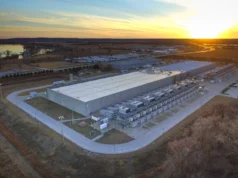
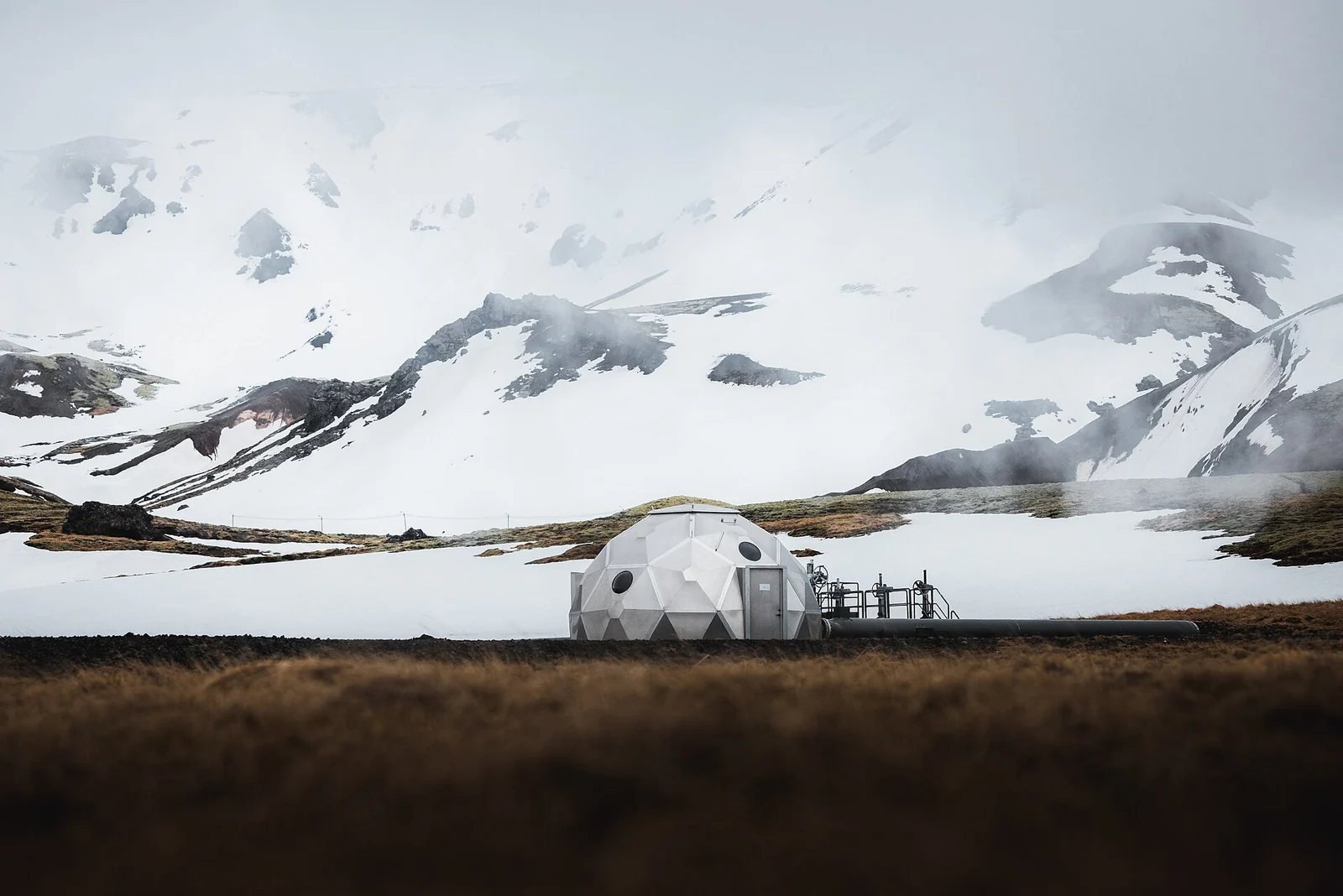
The largest DAC plant shows how hard the scaling is. Climeworks says its Mammoth plant in Iceland produced 675 tonnes of net removal in the first half of 2026, against 119 tonnes in the same period a year earlier. Net, in the company’s definition, means CO2 permanently stored underground after allowing for maintenance, weather, availability and the emissions from building and running the plant. The plant’s stated capacity is up to 36,000 tonnes a year. Climeworks says its two upgraded collector containers now turn around 40–50% of their design output into actual net removal, and it plans to upgrade all twelve containers in one plant module by the end of 2026. Its co-chief executive, Jan Wurzbacher, has said that in building Mammoth the company and its investors wanted volume in the field fast, at almost any cost: “It was really a volume game.”
Price and potential set further limits. Estimated costs for forestry removal run from $5 to $53 per tonne of CO2, and direct air capture is among the most expensive methods. Expected costs across all methods run from under $10 to over $1,000 a tonne, with most methods’ upper estimates above $200. The more reliable lower estimates of potential are about 1 billion tonnes a year for most methods. Those potentials cannot simply be added up, because methods compete for the same resources: BECCS, biochar and biomass burial all draw on the same supply of plant matter.
Then there is the planet’s own removal system. Climate change has been weakening the land and ocean sinks that absorb CO2, and that weakening accounts for 8% of the rise in atmospheric CO2 since 1960. Climate change and deforestation together have turned the tropical forests of South-East Asia and large parts of South America from sinks into sources. The land sink is not on a one-way slide: in 2025, after the 2023–24 El Niño ended, it recovered to its pre-El Niño level. Warming also reduces how much CO2 some nature-based methods take up and how long they hold it. UNEP calculates that even with fossil CO2 emissions at zero and deforestation stopped, a century of afforestation and forest management at the current scale would lower the global temperature by 0.1°C.
What the way down requires
The descent depends first on how much is still being emitted. UNEP’s lowest-overshoot pathway needs greenhouse gas emissions to fall 18% by 2030, 45% by 2035 and 69% by 2040, compared with 2025, with global net-zero CO2 around 2050. Fully implementing the national climate plans countries have submitted under Paris would cut emissions by only 5–8% by 2030. Global emissions in 2025 are estimated at 58.4 billion tonnes of CO2 equivalent, very slightly below 2024, and UNEP says it is too soon to tell whether they have peaked. With current policies, UNEP gives warming a 66% chance of staying below 2.8°C this century. Carrying out all national plans brings that line down to 2.6°C, and adding every net-zero pledge brings it to 2.1°C. The pledge-based projections are worse than in UNEP’s 2025 report, because of revised estimates of past emissions and the withdrawal of the United States, the world’s second-largest emitter, from the Paris Agreement.
The second requirement is durable removal and somewhere to put it. The lowest-overshoot pathway needs about 320 billion tonnes of CO2 removed and permanently stored over the century, about eight years of 2024’s CO2 emissions. On an annual basis, the median of the most ambitious 1.5°C scenarios needs 8.8 billion tonnes of removal a year by 2050, while the most ambitious long-term national pledges add up to 3.6 billion. Scenarios that delay deep cuts must remove over 150 billion tonnes more by 2100 than those that act early. UNEP itself warns that removal at this scale is uncertain, for technological as well as social and economic reasons.
The third requirement is someone to pay. The market for novel removal depends on very few buyers. One of them, Microsoft, dominates purchases, and contracts covering about 40 million tonnes of removal were signed in the voluntary carbon market in 2025. Governments have begun to build rules. In 2025, Norway and Switzerland made the first transfer of durable removal under Article 6.2 of the Paris Agreement, which lets countries trade emission reductions, and from 2025 Switzerland allows captured and permanently stored CO2 to count towards compliance in its emissions trading system.
What a cooler planet gets back
Suppose the descent is paid for. The thermometer is the fastest part of the climate to respond, and some things follow it within a human lifetime. Arctic sea ice is expected to come back as warming reverses, lagging global temperature by years to decades.
Sea level runs on a slower clock. The oceans are committed to rising for centuries to millennia whatever happens now, and even with temperatures falling, the rise is irreversible over many centuries. Cooling still pays, because it slows the rise and lowers the long-term commitment. Bringing temperature down in the long run, compared with letting it settle at a higher level, may mean almost half a metre less sea-level rise in 2300. Time spent above the line counts as well as height. In one set of modelled pathways, each century above 1.5°C added around 40 centimetres to the sea-level commitment by 2300, on a central estimate, on top of roughly 80 centimetres without any overshoot, a ratio that holds for those pathways rather than as a general rule.
Some of the damage does not come back on any timescale that matters to policy. When permafrost thaws, the carbon it releases stays released, even if the frozen ground partly recovers as temperatures fall, because rebuilding that soil carbon and refreezing it would take millennia. One intermediate-complexity Earth system model puts numbers on what a temporary overshoot leaves behind. It was run on 42 pairs of scenarios: in each, one overshoots, peaking between about 1.5°C and 2°C, while its partner reaches the same end-of-century emissions total without overshooting. By the year the overshooting run had cooled back to its partner’s temperature, the median recovery from the extra effects of overshoot was close to 0% for permafrost carbon and for the strength of the Atlantic overturning circulation, the ocean current system that carries heat north. It was only 20–25% for ocean temperature, ocean oxygen and the sea-level rise caused by the water’s expansion. The lasting damage tracked what the authors call degree-years, each year’s excess temperature over the partner scenario added up across the overshoot, and depended little on the peak itself. It is one model, and recovery was measured over decades, shorter than many of these systems need to settle.
For warm-water coral reefs, UNEP’s report puts the warming threshold at 1.2°C, within a range of 0.7–1.5°C, and says that at about 1.4°C of warming the reefs are already crossing their thermal tipping point, the threshold beyond which a system reorganises, often abruptly and irreversibly. It sees little chance of corals surviving this century whether warming stabilises at 2°C or overshoots and comes back to 1.5°C. On 22 October 2026 the International Union for Conservation of Nature (IUCN) published the first global Red List assessment of shallow-water coral reef ecosystems. It classed 122 of the 127 reef ecosystems it assessed, 96%, as Critically Endangered, at extremely high risk of collapse by 2075, using projected heat stress under a middle-of-the-road emissions scenario with about 2.7°C of warming by 2100. On observed change over the past 50 years alone, 24% would be in that category. The IUCN is careful about what the label means: “Critically Endangered does not mean collapsed.” Most reefs still have living coral. The IPCC’s 2018 projection was that reefs would decline by a further 70–90% at 1.5°C of warming. The risk of crossing tipping points in major ice sheets, the Amazon and the Atlantic overturning circulation rises with both the size and the duration of an overshoot.

A licence to delay?
The September report drew sharp criticism from people who want the same outcome. Bill Hare of Climate Analytics said it “does a poor job of showing us that there is a way out” and risked becoming “a call to apathy”. Lili Fuhr of the Center for International Environmental Law (CIEL) argued that “the only way to minimise harm is to cut emissions now… not to delay action with speculative techno-fixes.” Their worry is that a plan with a descent built in gives governments licence to keep emitting today against removals promised for later.
Two other doubts are separate from that one. The first is physical: Schleussner’s group concluded that a decline after overshoot cannot be counted on within the expected timescales. The second is political. Rob Jackson of Stanford University put his view of the overshoot scenarios in two questions: “Is it our best hope? Absolutely. Is it likely? Absolutely not.”
On the first worry the critics and UNEP’s arithmetic point the same way. The report itself says removal “cannot deliver a high temperature decline”. Keywan Riahi, a contributor to the October report, said the aim is to keep the overshoot “as low as possible, so that we do not need to rely on these technologies to take CO₂ out of the atmosphere later on”. Building removal now is not purely a bet on the future, since the same capacity also cuts net emissions today and later balances residual emissions on the way to net zero.
Forecasts have been wrong in the hopeful direction before. Since the Paris Agreement, renewable electricity capacity has grown about three times as much as projections made in 2015, under the policies of the time, had expected, and energy-related CO2 has risen 40% less than expected. Carlo Buontempo, who heads the Copernicus climate service, said in October: “How far we overshoot, and for how long, is still up to us.”
Removed carbon also has to end up somewhere. Every tonne taken out for the descent has to be stored, and so does every tonne captured to cancel the emissions the world keeps producing at net zero. One cautious assessment, which sets aside storage exposed to geological, environmental, human and policy risks, puts usable storage in sedimentary basins at about 1,460 billion tonnes of CO2, around an eighth of their physical capacity. On that estimate, if residual emissions stayed at 10 billion tonnes a year from 2050 and were balanced by removals stored underground, the space could be used up by 2200 just keeping the world at net zero, with nothing left over for cooling. Halve the residuals to 5 billion tonnes, and the same removal would bring the temperature down by about 0.1°C over 50 years.
Related articles
- How a wet country runs short of water
- Why nuclear fusion has been 20 years away for 70 years — and whether that’s finally changing
- Why is the sky blue?
Further reading
As an Amazon Associate, Eikleaf earns from qualifying purchases. The book links below are affiliate links: if you buy through them, we may earn a small commission at no extra cost to you.
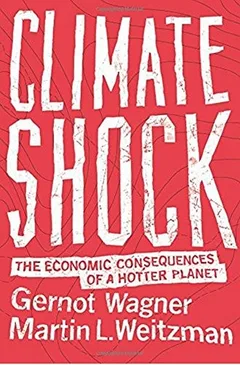 Climate Shock: The Economic Consequences of a Hotter PlanetTwo economists explain why the risk of overshooting warming targets matters most, and why carbon removal and geoengineering enter the debate.
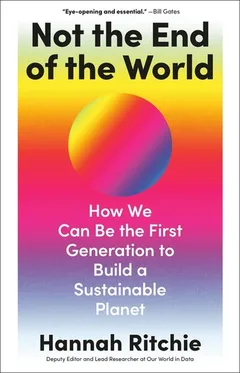 Not the End of the World: How We Can Be the First Generation to Build a Sustainable PlanetA data scientist at Our World in Data sets out where emissions are falling and what it would take to stabilise and then reverse warming.
Recommended videos
 3:46What is overshoot? #climateUN Environment Programme explainer on what overshooting 1.5°C means, the scenario the article starts from.
 21:01Climate overshoot – when we go past 1.5 degrees there is no going back | New Scientist Weekly 271New Scientist on climate overshoot and which impacts would not reverse even if temperatures fell.
 6:27The tricky plan to pull CO2 out of the airExplains direct air capture and the scale problem facing carbon dioxide removal.
Cite this article
Ingrid Dahl. “Can the world cool back down after 1.5°C?.” Eikleaf, 24 October 2026, updated 25 October 2026. https://www.eikleaf.com/can-the-world-cool-back-down-after-1-5c/
Gen AI Disclaimer
Some contents of this page were generated and/or edited with the help of a Generative AI.
Media
Ponds on the Ocean, ICESCAPE – NASA
Carbfix well, Hellisheiði – Wikimedia Commons (Photo: Siljaye, CC BY-SA 4.0)
Coral bleaching at Cheeca Rocks, Florida Keys – NOAA
Key Sources and References
UN Environment Programme. “Limiting Overshoot: Navigating exceedance of 1.5°C and pathways towards return.” UNEP, 2 September 2026. https://doi.org/10.59117/20.500.11822/49857
UN Environment Programme. “Emissions Gap Report 2026: The Point of Return.” UNEP, 21 October 2026. https://www.unep.org/en/publications/report/emissions-gap-report-2026
Dunne, D., Viglione, G., McSweeney, R. “UNEP: Opportunity has ‘been lost’ to meet 1.5C warming limit without ‘overshoot’.” Carbon Brief, 21 October 2026. https://www.carbonbrief.org/unep-opportunity-has-been-lost-to-meet-1-5c-warming-limit-without-overshoot
PBL Netherlands Environmental Assessment Agency. “New UNEP report lays out emission cuts needed for return to 1.5°C.” PBL, 21 October 2026. https://www.pbl.nl/en/latest/news/new-unep-report-lays-out-emission-cuts-needed-for-return-to-15degc
Chime, V. “UN sets steep emission cuts to reverse 1.5C overshoot by end of century.” Climate Home News, 21 October 2026. https://www.climatechangenews.com/2026/10/21/un-sets-steep-emission-cuts-to-reverse-1-5c-overshoot-by-end-of-century/
Agence France-Presse. “UN says world must navigate ‘reality’ of 1.5C overshoot.” AFP via Macau Business, 2 September 2026. https://macaubusiness.com/un-says-world-must-navigate-reality-of-1-5c-overshoot/
Borenstein, S. “Global warming will exceed limit, UN says in a report that maps path to get back below danger zone.” Associated Press via Anchorage Daily News, 2 September 2026. https://adn.com/nation-world/2026/09/02/global-warming-will-exceed-limit-un-says-in-a-report-that-maps-path-to-get-back-below-danger-zone
Copernicus Climate Change Service. “Copernicus: Second warmest September as global temperatures stay above 1.5°C.” Copernicus, 9 October 2026. https://climate.copernicus.eu/copernicus-second-warmest-september-global-temperatures-stay-above-15degc
Copernicus Climate Change Service. “Copernicus: August was the world’s joint hottest month on record, pushing global temperatures back above 1.5°C above pre-industrial levels.” Copernicus, 10 September 2026. https://climate.copernicus.eu/copernicus-august-was-worlds-joint-hottest-month-record-pushing-global-temperatures-back-above
ECMWF. “2025 was the third-warmest year on record, Copernicus data show.” ECMWF, 14 January 2026. https://www.ecmwf.int/en/about/media-centre/news/2025/2025-third-warmest-year
World Meteorological Organization. “Sea-surface temperatures reflect strengthening El Niño.” WMO, 8 October 2026. https://wmo.int/node/39068
World Meteorological Organization. “El Niño puts humanitarian weather services in the spotlight.” WMO, 22 October 2026. https://public.wmo.int/media/update/el-nino-puts-humanitarian-weather-services-spotlight
World Meteorological Organization. “New report suggests more global temperature records ahead.” WMO, 28 May 2026. https://wmo.int/news/media-centre/new-report-suggests-more-global-temperature-records-ahead
Forster, P. M., et al. “Indicators of Global Climate Change 2025.” Earth System Science Data 18, 3889–3933, 11 June 2026. https://doi.org/10.5194/essd-18-3889-2026
UNFCCC. “Paris Agreement.” United Nations, 2015. https://unfccc.int/files/essential_background/convention/application/pdf/english_paris_agreement.pdf
IPCC. “Climate Change 2021: The Physical Science Basis. Summary for Policymakers.” Intergovernmental Panel on Climate Change, 2021. https://www.ipcc.ch/report/ar6/wg1/downloads/report/IPCC_AR6_WGI_SPM.pdf
IPCC. “AR6 Synthesis Report: Summary for Policymakers.” Intergovernmental Panel on Climate Change, 2023. https://www.ipcc.ch/report/ar6/syr/downloads/report/IPCC_AR6_SYR_SPM.pdf
IPCC. “Global Warming of 1.5°C: Summary for Policymakers.” Intergovernmental Panel on Climate Change, 2018. https://www.ipcc.ch/sr15/
Bevacqua, E., Schleussner, C.-F., Zscheischler, J. “A year above 1.5 °C signals that Earth is most probably within the 20-year period that will reach the Paris Agreement limit.” Nature Climate Change 15, 262–265, 10 February 2025. https://doi.org/10.1038/s41558-025-02246-9
MacDougall, A. H., et al. “Is there warming in the pipeline? A multi-model analysis of the Zero Emissions Commitment from CO2.” Biogeosciences 17, 2987–3016, 15 June 2020. https://bg.copernicus.org/articles/17/2987/2020/
Hausfather, Z. “Explainer: Will global warming ‘stop’ as soon as net-zero emissions are reached?” Carbon Brief, 29 April 2021. https://www.carbonbrief.org/explainer-will-global-warming-stop-as-soon-as-net-zero-emissions-are-reached/
Global Carbon Project. “Fossil fuel CO2 emissions hit record high in 2025.” Global Carbon Project, 13 November 2025. https://globalcarbonbudget.org/fossil-fuel-co2-emissions-hit-record-high-in-2025/
Schleussner, C.-F., et al. “Overconfidence in climate overshoot.” Nature 634, 366–373, 9 October 2024. https://doi.org/10.1038/s41586-024-08020-9
Smith, C., et al. “Overshoot and (ir)reversibility to 2300 in two CO2-emissions driven Earth System models.” Earth System Dynamics 17, 893–911, 29 June 2026. https://doi.org/10.5194/esd-17-893-2026
Dickau, M., Zickfeld, K., Matthews, H. D., et al. “Irreversible climate changes driven by degree-years of temperature overshoot.” Communications Earth & Environment, 16 June 2026. https://www.nature.com/articles/s43247-026-03761-z
Gidden, M. J., et al. “A prudent planetary limit for geologic carbon storage.” Nature 645, 124–132, 3 September 2025. https://www.nature.com/articles/s41586-025-09423-y
Edwards, M. R., Geden, O., Gidden, M. J., et al. (eds). “The State of Carbon Dioxide Removal, 3rd Edition.” June 2026. https://www.stateofcdr.org/asset/State-of-Carbon-Dioxide-Removal-Edition-3_June2026.pdf
Dunne, D., Viglione, G., Gabbatiss, J. “Q&A: The current state of ‘carbon dioxide removal’ around the world.” Carbon Brief, 2 June 2026. https://www.carbonbrief.org/qa-the-current-state-of-carbon-dioxide-removal-around-the-world/
Wurzbacher, J. “How Mammoth is unlocking a step change in performance & reducing costs.” Climeworks, 2026. https://climeworks.com/blog/mammoth-direct-air-capture-performance-update
Rathi, A., Marsh, A. “Carbon removal pioneer Climeworks increases CO2 capture sixfold.” Bloomberg via Energy Connects, 10 September 2026. https://www.energyconnects.com/news/renewables/2026/september/carbon-removal-pioneer-climeworks-increases-co2-capture-sixfold/
IUCN. “Virtually all coral reef ecosystems face high risk of collapse in 50 years – IUCN Red List of Ecosystems.” IUCN, 22 October 2026. https://iucn.org/press-release/202610/virtually-all-coral-reef-ecosystems-face-high-risk-collapse-50-years-iucn-red
IUCN. “Red List of Coral Reef Ecosystems.” IUCN, 22 October 2026. https://iucn.org/story/202610/red-list-coral-reef-ecosystems