Last updated: · 15 min read
In brief
The Dutch accepted English rule over the future New York in 1667, and England dropped its claim to Run, a small Banda island. By that day’s logic, the Dutch won. Nutmeg grew in one place on earth, the Banda Islands, and they wanted to own the source. So they removed the sellers: of perhaps 15,000 Bandanese, only about 1,000 remained after the 1621 campaign. Smuggled seedlings later broke the monopoly. China refined 92% of the world’s magnet rare earths in 2023, and rival seedlings may already be growing somewhere.
Contents
In 1667, the Dutch Republic and England concluded a treaty in which the Dutch accepted English possession of a colonial settlement on the eastern seaboard of North America, the one that would become New York City, while England gave up its claim to a volcanic island in the Banda Sea. The island is called Pulau Run. The Dutch had long since deported its few hundred inhabitants and cut down every nutmeg tree on it. By the arithmetic of 1667, the Dutch had the better of the deal.
What spices were for
Spices were valuable because food tasted better with them. That’s the version of events most people carry. It is true as far as it goes, and it explains little about what drove the spice trade as an economic system.
The medieval European economy ran on spices for three distinct reasons, only one of which had anything to do with flavor. The first was medicine. From roughly the 5th century through the 17th, European physicians worked within Galenic humoral theory, which held that health depended on the balance of four humors: blood, phlegm, yellow bile, black bile. Foods were classified by quality: hot, cold, wet, dry. Pepper and cinnamon were hot and dry; nutmeg was warm and dry. These were therapeutic categories. The physician who prescribed powdered cloves for digestive complaints and the cook who added them to a sauce were reaching into the same jar (often literally the same jar, bought from the same merchant), and within that system both uses made sense. In many cities apothecary and spice merchant were the same trade. A ship loaded with pepper carried pharmaceutical stock and seasoning at once, because those categories didn’t separate out.
The body as chemistry set

In the humoral scheme, blood was hot and wet, phlegm cold and wet, yellow bile hot and dry, black bile cold and dry. Illness was imbalance; treatment was dietary or medicinal correction. Pepper, cloves, nutmeg, and cinnamon, all hot and dry, were the correctives for cold and wet conditions: sluggish digestion, respiratory phlegm, fevers in their cool phase. Medieval physicians and cooks disagreed about little regarding spices except who was charging for the consultation.
The second reason was status: a demonstration of purchasing power performed at the table. Heavily spiced sauces at a noble feast, such as cameline sauce or sauce poivrade, showed that the host could reach into the global supply chain and extract from it at will. Paul Freedman, a historian of medieval spice use, reads medieval feasting the same way: the spice served as display more than as condiment. You ate spiced food in the same spirit you wore expensive cloth, and the content was almost beside the point.
The third reason was scarcity, so structural it amounted to a geological and botanical given. In London in 1438–39, a pound of pepper cost a master mason or carpenter more than two days’ wages, and a pound of cloves more than four days’. A pound of saffron cost about 23 days’ wages, nearly four working weeks. With that much value packed into so little weight, spices worked as portable wealth.
Then there is the myth that medieval Europeans spiced their meat heavily to disguise decomposition. This explanation has had a long, comfortable life in popular history. It answers a question cleanly and requires no further thought. It’s also wrong on the economics. The argument fails its own internal logic: the people who could afford imported spices costing several days’ wages per pound were the same people who could afford fresh meat. The theory requires the same wealthy household to simultaneously have the purchasing power to import the most expensive condiments in the known world and the domestic failure to keep their larder from rotting. The rich ate heavily spiced fresh food. The poor ate unseasoned food they couldn’t afford to season.
The intermediary machine
The geographic facts were established before anyone built a trade route around them. Nutmeg and mace grew in one place on earth: the Banda Islands, ten small volcanic islands in the Banda Sea in eastern Indonesia, with a combined land area of only about 44 square kilometers. Cloves grew primarily in the northern Maluku islands — Ternate and Tidore. Black pepper came mainly from the Malabar Coast of southwestern India, a narrow strip between the Western Ghats and the sea. Cinnamon came mainly from Ceylon. Any European consumer wanting these goods had one supply chain available and no leverage within it.
The chain ran from Bandanese growers to Javanese maritime traders, to Arab merchants at Malacca, Aden, and Alexandria, to Venetian wholesale agents, to European distribution. Every node took its cut in freight charges, port tariffs, bribes and merchant margins, with no competitive pressure on any of it, because there was no alternative route. In reconstructed fifteenth-century prices, a kilogram of pepper that cost about 2 grams of silver where it grew sold for 14–18 grams in Venice and 20–30 grams in the markets of northern Europe. That is a ten- to fifteenfold markup over the full chain, with each toll station operating as a de facto monopoly on its section of the route.
The chain also operated through deliberate information suppression. Arab merchants propagated exotic and dangerous-sounding origin myths: cinnamon gathered from the nests of giant birds, cassia sourced from lakes guarded by winged creatures. Herodotus recorded an early version of the cinnamon bird story in the 5th century BCE, so it had been in circulation for at least a thousand years before the medieval spice trade reached its peak. The myths did commercial work. They kept buyers from knowing where to look, which is what trade secrecy does in any supply chain where the supplier’s advantage depends on that ignorance.
Venice held the western end of this system, and through most of the 15th century it was the most advantaged commercial position in Europe. Its state-run galley convoys loaded pepper and other spices at Alexandria and Beirut, the outlets of the Mamluk Sultanate. In 1496 alone, four galleys from Alexandria landed some 2 million kilograms of spices in Venice, about two-thirds of it pepper. Venice was a political intermediary whose commercial architecture depended on remaining the mandatory western bottleneck. The position made the city rich, and its political existence rested on it.
Venice as economic civilization

The financial instruments that Venice and its Italian rivals refined became the template for modern commercial finance: bills of exchange allowing credit to move without physical money, marine insurance spreading catastrophic voyage risk across underwriters, partnership contracts and careful double-entry accounts making large-scale commercial finance tractable. The spice trade was among their most demanding users: the volumes were large, the distances great, the timescales long. When Portugal broke Venice's position and redirected the trade route, it threatened a financial civilization built to service that route. Venice fought back, and its Levant spice trade staged a strong recovery after about 1550, but it never again held the monopoly.
The first supply-chain takeover
Vasco da Gama reached Calicut (today’s Kozhikode, on the Malabar Coast of Kerala) in May 1498. Four ships and roughly 170 men had left Lisbon ten months earlier. The voyage is remembered as a feat of navigation; what made it matter was the disruption it brought to the supply chain.
The Portuguese crown had spent decades and substantial capital on the project of reaching Asian spice markets directly by sea. The underlying calculation was not complicated: if the markup chain between source and European consumer runs at ten to fifteen times, and you can eliminate every intermediary node by sailing around Africa and buying at source, the projected return justifies almost any investment in getting there. Portugal’s ships were a capital expenditure.
The economics followed quickly. Cape-route spice deliveries to Lisbon rose from about 1,500 quintals a year in 1501–02 to almost 17,000 a year by 1503–06, an elevenfold jump in a few years. Venice’s own ambassador in Cairo called the Portuguese breakthrough a “causa de grande ruina del Stato Veneto”, a cause of great ruin for the Venetian state. When a rival is landing your core commodity in bulk at the other end of Europe, the trade your city was built on is under threat.
Girolamo Priuli, a Venetian banker whose private diary runs from 1494 to 1512, recorded the news from Lisbon as it arrived. The formal institutional response came on January 15, 1507 (still 1506 in the Venetian calendar). The Senate created the Cinque Savi alla Mercanzia, five “sages” charged with reviving the city’s declining overseas trade. The board outlived the crisis: it became a permanent magistracy and lasted until the Republic itself fell in 1797.
The Cartaz System

Portugal's mechanism for inserting itself as the new mandatory intermediary was a pass system backed by warships. The Estado da India issued cartazes, passes that Asian merchants were required to carry on the routes Portugal claimed, usually with an obligation to call at a Portuguese fort and pay customs there. Ships caught without one risked seizure or sinking. Enforcement was never complete: nearly half the Malabar pepper shipped west between 1504 and 1549 still slipped through to the Red Sea and the Levant. But wherever Portuguese warships patrolled, merchants who had sailed freely for generations now paid Portugal for the privilege. The cartaz system is the structural ancestor of the oil company concession agreement that would follow it by four centuries: a dominant actor converting geographic access (in this case, sea-lane control asserted by right of discovery and maintained by force) into a licensing fee, backed by sufficient violence to make the license non-optional.
Portugal ended up capturing the markup chain instead of eliminating it. It profited handsomely, and it was in no hurry to pass the savings on: by 1527 it was getting 66 percent more for its pepper in Antwerp than in 1509. Real spice prices in Europe drifted down only gradually over the century that followed. Arab and Venetian intermediaries lost their monopoly, but the mechanism of geographically concentrated supply, a mandatory chokepoint and intermediary extraction survived the disruption intact.
Monopoly carried to its end
The Dutch identified Portugal’s structural vulnerability. Portugal controlled the distribution chain, but the spice trees remained in local hands, tended by people who could sell to whoever offered better terms. The Portuguese position was contingent on that fact. The Dutch aimed past the intermediary layer: they wanted to own the source.
The Vereenigde Oost-Indische Compagnie, chartered by the Dutch States-General in 1602, is routinely called the world’s first publicly traded company: its share offering was open to the public, and 1,143 investors subscribed to its first share issue in the Amsterdam chamber alone. The label leaves out most of what it was: the VOC’s charter granted it legal authority to make war, conclude treaties, build fortifications, and administer territory, and its shareholders collected dividends from all of it.
Dutch traders reached the Banda Islands in 1599. What they found was a functioning open market: Bandanese growers selling simultaneously to Portuguese, English, Arab, and Javanese traders, as the islands had operated for generations. This arrangement suited the Bandanese: multiple buyers meant price leverage, which meant better terms in every transaction. For the VOC, it was intolerable for the same reason: the Dutch monopoly model required taking that leverage away.
The VOC pressed exclusivity contracts on Bandanese communities. The Bandanese refused. Their refusal made obvious economic sense: accepting a single-buyer arrangement meant surrendering the structural advantage that made the open market work in their favor. Jan Pieterszoon Coen, the VOC’s Governor-General in Batavia, resolved the impasse the way the VOC’s charter had made possible. Instead of offering better prices or negotiating, he removed the sellers.
The Banda Islands held perhaps 15,000 people before the Dutch campaign of 1621. Coen’s forces, Dutch soldiers and Japanese mercenaries, carried out mass killings, forced marches into the interior, destruction of food supplies and fresh water sources, and deportations of survivors to Batavia. The historian Vincent Loth counts only about 1,000 of the estimated 15,000 Bandanese left on the islands by the end of the campaign, a few hundred of them on Run, spared the fighting only because of the English presence there. Frank Dhont, another historian, calls the outcome the destruction of Bandanese civilization in the archipelago.
The islands were then divided into perken: plantation plots handed out to Dutch settler-planters, the perkeniers, who were bound to sell their entire harvest of nutmeg and mace to the VOC at fixed prices. Enslaved people imported from across the archipelago, India, and coastal China worked the plots. Replacing the Bandanese with enslaved workers moved pricing power as well as labor: the Bandanese population had held independent price-setting power over the world’s sole nutmeg supply, and the enslaved workforce that replaced them held none.
The category of “colonial violence” tends to absorb what happened in Banda and thereby obscure it. The Banda genocide was the business model itself, the rational endpoint of monopoly logic when the sole independent claimants on a resource’s pricing are a population that can be destroyed. Coen returned to the Netherlands in 1623 as a celebrated figure. The Rijksmuseum holds his official portrait. His statue has stood in the main square of his hometown, Hoorn, since 1893. In 2012 a text was added to its plinth stating that his successes were achieved in a very violent manner, and after years of postponed decisions the town council handed the statue’s fate to a new coalition in 2026. It still stands.
Why the Dutch bet was rational, and why it failed
By 1667, the VOC plantation system in the Banda Islands was producing exactly what it had been designed to produce. The nutmeg monopoly was as complete as it had ever been. The one remaining gap was Pulau Run, the last island in the archipelago where English traders had held a contested foothold. Nathaniel Courthope defended that foothold for years until his death.
New Amsterdam had been occupied by England in 1664 and renamed New York. The whole colony of New Netherland, of which it had been the capital, held fewer than 9,000 settlers, and the town lived on trade with a frontier market. It produced nothing irreplaceable and held no monopoly position on anything.
The Treaty of Breda formalized mutual recognition of occupied positions: England kept New York; the Dutch secured English recognition of their claim to Run.
The Dutch were not trading Manhattan for an island, since they had already lost it. They were accepting that loss in exchange for closing the last gap in a monopoly they had purchased at considerable cost, and by the economic logic of 1667 Run was the better prize.
What the Dutch could not model was Pierre Poivre. A French naturalist and royal administrator of Île de France (today’s Mauritius), Poivre had been trying to smuggle living nutmeg out of the Dutch-held Moluccas since the early 1750s, with little success at first. In 1769–70, ships he sent into the eastern archipelago finally came home with a rich haul of nutmeg and clove plants. On Île de France, colonists and enslaved gardeners learned by trial and error to make them grow, and the plants were passed on to other French colonies. The British finished what Poivre started: during the Napoleonic Wars they seized the Banda Islands and carried nutmeg seedlings off to plantations elsewhere in their empire, and the tree eventually became a mainstay of Caribbean Grenada. Warships took the islands, and the seedlings made the loss permanent.
Over the 19th century, nutmeg turned into an ordinary kitchen spice. Run Island’s strategic value went with it. Manhattan’s, meanwhile, had only begun to grow. Both parties to the 1667 treaty had chosen sensibly within what they could know, and the Dutch bet failed anyway.
The same template, running now
Nutmeg became cheap, but the mechanism that had made it precious still operates on other resources.
The five big Persian Gulf producers (Saudi Arabia, Iraq, Iran, the United Arab Emirates and Kuwait) hold approximately 53% of the world’s proven oil reserves. The mechanism is structurally equivalent to the Banda Islands’: geographic concentration of a resource produces a mandatory chokepoint for global consumption. The difference is that the Gulf states are sovereign governments with military capacity and full legal standing rather than a stateless island population that could be physically removed. For most of the 20th century, the intermediary layer between that source and consumers was the Seven Sisters, the consortium of Western oil majors: Standard Oil of New Jersey, Royal Dutch Shell, Anglo-Persian, Mobil, Chevron, Texaco, Gulf. These companies dominated global production, refining, and distribution, capturing the spread between production cost and market price at every stage. The architecture was Portuguese in its basic logic: control the distribution chain, extract at every node, and back the arrangement with sufficient force to make it stick.
The VOC and its heirs

Modern extraction multinationals are structurally similar to the VOC to the degree that current international law permits: they maintain private security forces, negotiate directly with sovereign governments over extraction terms, and have historically benefited from military support from their home states when contracts required it. The 1953 CIA-backed coup in Iran restored oil company concessions after Mohammad Mosaddegh's nationalization. The 1954 Anglo-Iranian settlement that followed divided Iranian production among the major Western oil companies. The institutional form changed between the VOC's era and the Seven Sisters'. The structural logic did not: state-backed private entities controlling resource extraction at scale, with state violence behind them when commercial pressure was insufficient.
The OPEC nationalizations and the 1973 embargo were another instance of a recurring structural pattern: geographically concentrated resource producers refusing prices dictated by an intermediary extraction cartel. The Bandanese had attempted that move and been destroyed, because they had no state apparatus, no military capacity, and no legal standing that could protect them. Saudi Arabia, Iran, Libya, and Venezuela had all three. Over 350 years the power position of the producers had inverted, and the same structure produced the opposite outcome.
In normal years the Strait of Hormuz carries about 20 million barrels of oil a day, roughly a fifth of global petroleum liquids consumption. It is the closest modern equivalent of the old Red Sea and Gulf spice routes: Saudi and Emirati pipelines can carry some oil around it, but the spare bypass capacity is only about 2.6 million barrels a day. 2026 showed what that means: after war broke out in Iran, flows through the strait fell from 21.6 million barrels a day in late 2025 to about 4.9 million in the second quarter of 2026. For most of that oil, ships pass through or the supply doesn’t move.
American shale was the closest thing to a Pierre Poivre move: new supply developed outside the existing chokepoint, using extraction technology rather than botany. It did not end OPEC’s influence; as 2026 showed, the Gulf can still move world prices. But it loosened the cartel’s grip without anyone seizing the Gulf.
Rare earths are the resource now in its 1667 phase. China accounts for roughly 69% of global rare earth mining, and in 2023 it refined 92% of the world’s magnet rare earths. In 2025 Beijing showed it was willing to use that position, tightening export controls on rare earths. Advanced semiconductor fabrication is concentrated in Taiwan and South Korea in ways that anyone who had studied the spice trade would recognize at once. If the trade is any guide, the seedlings are already in a greenhouse somewhere.
The monopoly ended with seedlings in a ship’s hold. British warships seized the islands, but a navy only changes who holds a chokepoint; the seedlings produced supply where the chokepoint couldn’t reach.
Pulau Run today grows nutmeg in quantities and at prices that carry no strategic significance. Some 1,600 people live there, fishing and tending nutmeg trees on an island that once outranked Manhattan.
Related articles
- Why certain cities became financial capitals — and others, equally positioned, did not
- How refrigeration changed the geopolitical map more than any 20th century war
- How ancient Rome’s road network still shapes European trade routes
Further reading
As an Amazon Associate, Eikleaf earns from qualifying purchases. The book links below are affiliate links: if you buy through them, we may earn a small commission at no extra cost to you.
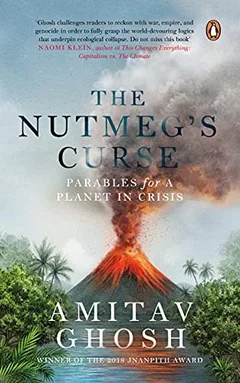 The Nutmeg’s Curse: Parables for a Planet in CrisisUses the Banda massacre and nutmeg monopoly to connect colonial resource extraction with present environmental and geopolitical crises.
 Nathaniel’s Nutmeg: Or, the True and Incredible Adventures of the Spice Trader Who Changed the Course of HistoryExpands the article’s opening episode into an account of rival spice companies, dangerous voyages and the struggle over Run.
 Spice: The History of a TemptationExplains why buyers valued spices so highly, supplying the cultural and medicinal demand behind the article’s prices and monopolies.
Recommended videos
 5:04How one of the most profitable companies in history rose to power – Adam ClulowTED-Ed on how the Dutch East India Company rose to power through the spice trade.
 58:28How Did Nutmeg Cause Wars In Indonesia? | The Spice Trail | Absolute HistoryThe Spice Trail episode on nutmeg, the Banda Islands and the wars fought over them.
 18:35The Economics of the Dutch East India CompanyEconomics Explained on the VOC’s business model, monopoly and eventual decline.
Cite this article
Owen Parker. “The economic history of spices: how flavor changed the world’s power structure.” Eikleaf, 11 May 2026, updated 2 November 2026. https://www.eikleaf.com/the-economic-history-of-spices-how-flavor-changed-the-worlds-power-structure/
Gen AI Disclaimer
Some contents of this page were generated and/or edited with the help of a Generative AI.
Media
Usman AbdulrasheedGambo – Pexels
Key Sources and References
Paul Freedman, Out of the East: Spices and the Medieval Imagination, Yale University Press, 2008.
Paul Freedman, “Spices in the Middle Ages,” History Compass, vol. 2, no. 1, 2004. https://doi.org/10.1111/j.1478-0542.2004.00115.x
John H. Munro, “The Consumption of Spices and Their Costs in Late-Medieval and Early-Modern Europe: Luxuries or Necessities?” Department of Economics, University of Toronto. https://www.economics.utoronto.ca/munro5/SPICES1.htm
Herodotus, Histories, Book III, section 111, 5th century BCE (trans. A. D. Godley), Perseus Digital Library. https://www.perseus.tufts.edu/hopper/text?doc=Perseus:text:1999.01.0126:book=3:chapter=111
Kevin H. O’Rourke and Jeffrey G. Williamson, “Did Vasco da Gama Matter for European Markets? Testing Frederick Lane’s Hypotheses Fifty Years Later,” NBER Working Paper 11884, 2005; published in Economic History Review 62, no. 3 (2009). https://www.nber.org/papers/w11884
Tamsin Prideaux, Negotiation and Mobility in Early Modern Venice: Armenian, Jewish, and Ottoman Turkish Merchants and the Cinque Savii alla Mercanzia, c.1541–1700, PhD thesis, University of Edinburgh, 2022. https://era.ed.ac.uk/items/f2f0a275-e984-4312-98f6-ec07ac3486bc/full
Vincent C. Loth, “Pioneers and Perkeniers: The Banda Islands in the 17th Century,” Cakalele 6 (1995): 13–35. https://scholarspace.manoa.hawaii.edu/items/6a3d3403-9724-4d6c-a9bc-bd9154842479/full
Frank Dhont, “Genocide in the Spice Islands,” in The Cambridge World History of Genocide, Volume II, Cambridge University Press, 2023, pp. 186–214. https://doi.org/10.1017/9781108765480.009
“Nieuwe tekst op sokkel JP Coen,” NOS, March 14, 2012. https://nos.nl/artikel/351256-nieuwe-tekst-op-sokkel-jp-coen
“Vijf jaar discussie over standbeeld Coen,” NH Nieuws, March 18, 2026. https://www.nhnieuws.nl/nieuws/358059/vijf-jaar-discussie-over-standbeeld-coen-waarom-schuift-hoornse-politiek-dat-steeds-voor-zich-uit
U.S. National Park Service, “The Rise and Fall of New Netherland.” https://www.nps.gov/mava/learn/historyculture/new-netherland.htm
Giles Milton, Nathaniel’s Nutmeg: How One Man’s Courage Changed the Course of History, Hodder and Stoughton, 1999.
Dorit Brixius, “A hard nut to crack: nutmeg cultivation and the application of natural history between the Maluku islands and Isle de France (1750s–1780s),” British Journal for the History of Science 51, no. 4 (2018): 585–606. https://doi.org/10.1017/s0007087418000754
“Provost, Sieur,” Flora Malesiana Cyclopaedia of Collectors, Naturalis Biodiversity Center. https://www.nationaalherbarium.nl/FMCollectors/P/ProvostS.htm
“Transplanting Nutmeg,” JSTOR Daily, 2025. https://daily.jstor.org/transplanting-nutmeg/
“The Spice Trade’s Forgotten Island,” National Geographic, 2015. https://www.nationalgeographic.com/photography/article/the-spice-trades-forgotten-island
BPS-Statistics Indonesia, Maluku Tengah Regency, Kecamatan Banda Dalam Angka 2025 (Banda District in Figures 2025), 2025. https://malukutengahkab.bps.go.id/id/publication/2025/09/26/273bf711c065ccf523a9f7e0/kecamatan-banda-dalam-angka-2025.html
Anthony Sampson, The Seven Sisters: The Great Oil Companies and the World They Shaped, Hodder and Stoughton, 1975.
OPEC Annual Statistical Bulletin 2025, Organization of the Petroleum Exporting Countries, Vienna, 2025. https://www.opec.org/assets/assetdb/asb-2025.pdf
U.S. Energy Information Administration, “Amid regional conflict, the Strait of Hormuz remains critical oil chokepoint,” Today in Energy, June 16, 2025. https://www.eia.gov/todayinenergy/detail.php?id=65504
U.S. Energy Information Administration, Short-Term Energy Outlook: Global Energy Security Data, Table 4 (Strait of Hormuz), 2026. https://www.eia.gov/outlooks/steo/report/energysecurity/article.php
Shelby N. Johnston, Mineral Commodity Summaries 2026: Rare Earths, U.S. Geological Survey, 2026. https://pubs.usgs.gov/periodicals/mcs2026/mcs2026-rare-earths.pdf
International Energy Agency, Global Critical Minerals Outlook 2024, IEA, Paris, 2024. https://iea.blob.core.windows.net/assets/ee01701d-1d5c-4ba8-9df6-abeeac9de99a/GlobalCriticalMineralsOutlook2024.pdf