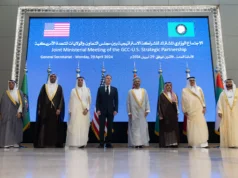
On September 2, 2025, US forces in the southern Caribbean destroyed a small boat. Eleven people died. The administration called them Tren de Aragua narco-terrorists. Venezuela called the killings extrajudicial murders, and Colombia’s president would soon denounce the campaign as murder. That dispute remains unresolved. Underneath it sits an earlier question: what legal category those eleven people occupied in the instant before the strike.
No court or other juridical institution decided that, and no judge reviewed a warrant. The decision was made in Washington, through an executive order signed on inauguration day, State Department designations published in February, a still-secret presidential directive in the summer, and legal advice drafted inside the Justice Department. Only a month after the strike did the administration tell Congress that it considered the United States to be in a “non-international armed conflict” with drug-trafficking organizations designated as foreign terrorist organizations.
Centuries of American doctrine govern what the state must prove before it may punish a person: due process, the right to be charged, confronted with evidence, and tried by a court that can evaluate the specific claim against the specific person. Outside that process, police may kill only to stop a serious threat of death or grave injury. None of that framework applied in the Caribbean on September 2, and nobody had suspended it. The administration’s legal theory holds that it never applied: that the people on that boat were not criminal suspects eligible for arrest and trial but enemy combatants subject to military targeting rules, and that the executive branch alone had set this categorization in motion before anyone was shot, without judicial participation.
The question is how that became the legal position of the United States government, and what it means that no federal court has yet ruled on whether it can be.
The campaign
By early October 2026, thirteen months after that first strike, the US military had carried out at least 71 strikes on boats in the Caribbean Sea and Eastern Pacific Ocean, killing at least 238 people, 23 of them listed as missing and presumed dead. Defense Secretary Pete Hegseth named the campaign Operation Southern Spear in November 2025; it was led by Joint Task Force Southern Spear under US Southern Command, with the stated purpose of defending the homeland, removing “narco-terrorists from our Hemisphere,” and securing the homeland “from the drugs that are killing our people.” Since August 2026, Southern Command has attributed new strikes to Joint Task Force Western Hemisphere. One US servicemember has died: Lance Corporal Chukwuemeka E. Oforah, who fell overboard from the USS Iwo Jima in February 2026 while supporting the operation.
Not a single person killed has been charged with a crime. No court has reviewed any targeting decision, and no independent body has verified any allegation against any specific person killed. The Defense Department has not publicly identified any of the dead.
The anonymity follows from how the system is designed. Military targeting asks whether a person belongs to an enemy force, a question of status; a criminal court asks whether that person is guilty. The categories that placed those people in the target set were drawn by administrative decision in Washington. What any person on any specific boat had done, or knew, or intended counted, in the administration’s framing, only as evidence of membership, and whatever checks the military ran on that evidence happen under classified procedures that no court or independent body has examined. The government’s targeting procedure does not require it to know who it has killed, and no external mechanism compels it to find out.
In May 2026, a five-month investigation led by the Latin American Center for Investigative Journalism (CLIP) named 13 previously unidentified victims and brought the number of publicly identified dead to 16. Several were fishermen with no indication of any involvement in the drug trade; others appear to have been hired to carry illicit cargo, poor men doing dangerous work rather than cartel bosses. These networks are real, and they employ people with varying degrees of knowledge and participation. Nor, eight months into the strikes, had the US government offered evidence that any of the 194 people killed by then were involved in drug trafficking; nothing in the targeting procedure required it to.
In October 2025, Senators Adam Schiff and Tim Kaine forced a vote on a resolution to bar further strikes without congressional authorization; the Senate rejected it 51-48. A resolution aimed at hostilities against Venezuela failed in November, and in December the House narrowly rejected two war powers resolutions. The administration did not request and did not receive any formal congressional authorization. It characterized authorization as unnecessary. Throughout the operation, its language has been consistent: “narco-terrorists,” “unlawful combatants,” strikes that Hegseth has called “approved by the best military and civilian lawyers, up and down the chain of command.” That approval rests on the administration’s word: the legal sign-off comes from lawyers inside the same executive branch that conducts the strikes, while independent assessments, from UN experts to Human Rights Watch, have reached the opposite conclusion.
The dairy farm

Beginning March 3, 2026, Ecuadorian forces, operating with US support under the Operation Southern Spear banner, raided a property near the village of San Martín in Ecuador's Sucumbíos province, close to the Colombian border. Ecuador described the target as a camp of Comandos de la Frontera, an armed group rooted in the FARC dissident movement and accused of drug trafficking; Washington spoke only of narco-terrorists tied to an unnamed designated terrorist organization. Workers told the New York Times that Ecuadorian soldiers interrogated and beat them and burned the property's shelters with gasoline; soldiers also burned two nearby abandoned homes. On March 6, helicopters returned and dropped explosives on the remains, and Hegseth shared the video, declaring that the United States was "bombing Narco Terrorists on land as well."

On March 24 the Times, after interviewing the owner, workers and residents, reported that the target was a cattle and dairy farm. Ecuador's Defense Ministry rejected the report, saying troops had found a semiautomatic rifle and ammunition and that the site had no cattle or dairy activity, claims it has not backed with public evidence. A coalition of Ecuadorian human rights groups filed a complaint with Ecuadorian authorities and the United Nations. Neither government has announced an investigation, and neither has acknowledged any error. In July, Human Rights Watch published its own inquiry: soldiers had burned three properties, bombed two of them and detained and tortured four farm workers, and the group found no credible evidence that any of the properties had a connection with criminal armed groups.
The architecture: how the killing was declared legal
The legal chain behind the claim that the strikes are lawful has four discrete links, each individually defensible under some legal interpretation, and the chain as a whole has never been adjudicated by any court.
On January 20, 2025, Trump signed an executive order titled “Designating Cartels and Other Organizations as Foreign Terrorist Organizations and Specially Designated Global Terrorists.” The order gave the Secretary of State 14 days to recommend which cartels and other organizations should be designated as foreign terrorist organizations under Immigration and Nationality Act Section 219.
On February 20, 2025, Secretary of State Rubio published eight designations in the Federal Register: the Sinaloa Cartel, Cártel de Jalisco Nueva Generación, Cártel del Noreste (formerly Los Zetas), Gulf Cartel, La Nueva Familia Michoacana, Carteles Unidos, Tren de Aragua, and MS-13. Under INA §219, the Secretary must find that an organization is foreign, engages in terrorist activity or terrorism or retains the capability and intent to do so, and threatens US nationals or national security. The designation requires no judicial approval. Congress gets seven days’ notice; it can block or revoke a designation, but only by passing a law. The designated organization itself may challenge the decision in the D.C. Circuit within 30 days, but the court looks only at the administrative record, with classified evidence shown to the judges alone, and can set the designation aside if it is arbitrary, unconstitutional, beyond the statute, procedurally flawed or lacking substantial support in the record. In practice, the executive branch designates, and a court tests that decision only if the designated group itself sues, and then with heavy deference to the executive.
The first strike on a vessel came on September 2, 2025. Two days later, Trump sent Congress the 48-hour report the War Powers Resolution requires, describing a strike on a vessel “affiliated with a designated terrorist organization” without claiming any armed conflict. That claim arrived a month later. In a notice to congressional committees in early October 2025, filed under a separate reporting statute (50 U.S.C. §1543a), the administration said the president had “determined” that the United States was in a “non-international armed conflict” with the FTO-designated drug trafficking organizations, whose members it called “unlawful combatants.” Under international humanitarian law, a genuine NIAC brings the laws of armed conflict into play, permitting attacks on members of an organized armed group that peacetime law enforcement rules would forbid. In the administration’s framing, this made the people on those boats members of an organized armed group in armed conflict with the United States, and so lawful military targets. Marty Lederman, a former OLC official, set out at the time why the notice failed to establish any armed conflict under international law.
The administration sought neither a new Authorization for Use of Military Force nor a declaration of war. In a closed briefing on October 30, 2025, the head of the Justice Department’s Office of Legal Counsel told lawmakers that the strikes needed no congressional authorization and did not amount to “hostilities” under the War Powers Resolution, so in the administration’s view the resolution’s 60-day clock did not apply. The classified OLC memorandum behind that position, reportedly finalized on September 5, 2025, three days after the first strike, has never been publicly released. In late September 2026, a federal judge in New York, hearing a freedom-of-information suit by the ACLU and the Center for Constitutional Rights, ordered the government to hand it over for the court’s private review.
Put together, the executive designates the target class, subject only to narrow, deferential judicial review; declares the conflict, with no judicial approval required; authorizes the force under Article II; and assesses its own legality through OLC, whose conclusions remain classified. All four steps sit within the same branch, and no one outside it approves the targeting itself. No federal court has ruled on whether individuals operating in service of FTO-designated organizations in international waters are lawful military targets under the laws of armed conflict. The structural reason is that courts need a plaintiff with standing, and the targets are dead. Their families face sovereign-immunity and justiciability barriers that earlier drone-strike litigation showed to be formidable. The first test case is now in court: in January 2026, relatives of two Trinidadian men killed in an October 2025 strike sued the United States for wrongful death in federal court in Massachusetts. The government has moved to dismiss, and the case has been on hold since July 2026.
The OLC memo tradition

The Office of Legal Counsel produces formal opinions on the legality of executive actions. In practice, OLC opinions function as authorization: if OLC says the executive branch can do something, it proceeds. No public review occurs unless litigation eventually forces disclosure.

The specific precedent is the memo that authorized the killing of Anwar al-Awlaki, a US citizen and alleged Al Qaeda operational leader. Produced around 2010-2011, it remained classified until June 2014, when it was released under court order after FOIA litigation by the ACLU. The memo itself became public almost three years after the killing. The same structure governs the cartel strikes today: a classified OLC opinion, no public review, and disclosure only through litigation that may take years and may never reach the merits. For Operation Southern Spear, that process has barely begun: a year after the first strike, a court has only now ordered the memo shown to a judge in private.
The law being bypassed
The administration’s legal theory works by substitution. It does not claim that the Law of the Sea, human rights law, or ordinary US criminal law permit what is being done. It claims that a different legal regime, the laws of armed conflict (also called international humanitarian law), has been activated, and that this regime, together with the president’s constitutional authority as commander in chief, permits the strikes. Declaring an armed conflict does not make the other frameworks disappear: human rights law keeps applying in war, too.
UNCLOS governs maritime jurisdiction. Under Article 110, unless a treaty grants further powers, warships may board foreign vessels on the high seas only in specific enumerated cases: suspected piracy, the slave trade, unauthorized broadcasting, vessels without nationality, and ships that fly a foreign flag, or refuse to show one, but in reality share the warship’s own nationality. Drug trafficking is not on the list. Instead, drug interdiction at sea runs through exactly that treaty route: consent from the flag state. The United States has never ratified UNCLOS, but it accepts these high-seas rules as binding customary international law. Article 108 exhorts states to cooperate in suppressing narcotics trafficking on the high seas but creates no unilateral boarding right and no authority to use lethal force. The 1988 Vienna Convention against Illicit Traffic in Narcotic Drugs established the bilateral consent system for boarding drug-suspected vessels, under which the flag state must give permission.
Maritime drug interdiction normally runs through boarding, arrest and prosecution in a national court. UNCLOS contains no provision for destroying a vessel and killing its occupants. The administration has not argued that UNCLOS permits the strikes. It has argued that UNCLOS does not govern, because the armed conflict declaration replaces the maritime law enforcement regime with a different ruleset entirely. On that theory, the administration never has to meet the UNCLOS framework on its own terms; a declaration sets it aside.
Stateless vessels

The administration has described at least one target, the boat struck on September 15, 2025, as an "unflagged vessel." It has said nothing about the registration of most of the others. Suppose none carried a flag. UNCLOS Article 110 permits warships to board vessels without nationality. That authority is real, and the United States, like some other states, goes further and treats a stateless vessel as open to its own arrest and prosecution. Even if drug trafficking is confirmed, nothing in the Convention authorizes destroying the vessel or killing the occupants. There is no provision in UNCLOS for lethal force against stateless vessels, or against any vessel regardless of flag status. Even if every targeted vessel in Operation Southern Spear was stateless, UNCLOS would still provide no basis for killing rather than arresting their occupants, and the administration has never argued otherwise.
International humanitarian law applies only to armed conflicts. The administration’s entire theory rests on the claim that an armed conflict exists. The International Criminal Tribunal for the former Yugoslavia, in its 1995 Tadić decision, defined a non-international armed conflict as “protracted armed violence between governmental authorities and organized armed groups.” The test that grew out of that definition and later ICTY case law requires two independent criteria: an organized armed group and sustained armed violence of sufficient intensity. An FTO designation satisfies neither.
The intensity criterion requires that violence exceed sporadic or isolated acts of criminality. Drug trafficking violence kills tens of thousands of people annually. Most of it is directed at rival criminal organizations, at police and soldiers in the countries where the groups operate, and at civilians caught between competing networks. The conflict the administration claims, though, is with the United States, and between these groups and US forces there has been no sustained, two-sided fighting, only US strikes on boats.
The organization criterion asks whether a group has a command structure able to plan and carry out sustained military operations. Motive does not enter into it: a group fighting for profit can qualify as readily as one fighting to overthrow a government, and international lawyers have argued that some Mexican cartels, in certain regions and periods, met both tests in their fighting with Mexican forces. Cartels are sophisticated, durable and operationally complex, but whether any designated group is organized for war, and fighting one with the United States, is a question of fact. The ICRC classifies armed conflicts “solely on the basis of facts and legal criteria,” so a domestic terrorist designation cannot settle it. Those facts have to be established independently of administrative determination, and the administration has not shown them in public.
UN human rights experts, who are independent Special Procedures mandate holders appointed by, but not speaking for, the Human Rights Council, condemned the first strike as an extrajudicial execution within two weeks, repeated the charge on October 21, 2025, and, marking a year of strikes in September 2026, declared that “calling it war does not make it one.”
Human Rights Watch concluded that the strikes violate international human rights law, and Mary Ellen O’Connell of Notre Dame Law argued that the very first strike violated the right to life. Others go further. Luis Moreno Ocampo, the ICC’s founding chief prosecutor, said that the strikes “could be clearly crimes, war crimes and crimes against humanity,” and Charlie Trumbull of the University of South Carolina School of Law has called them crimes against humanity, grounding the charge chiefly in their systematic character.
If the laws of armed conflict don’t apply, as these assessments conclude, then international human rights law governs on its own. Under IHRL and the 1990 UN Basic Principles on the Use of Force and Firearms by Law Enforcement Officials, lethal force is permissible “only when strictly unavoidable in order to protect life.” A strike that destroys a vessel with no attempt at boarding or arrest does not meet that standard. A second strike fired at survivors clinging to wreckage falls further short still.
The second-strike allegation shows what the operation’s claimed legal vetting looks like in practice, whatever it says about individual culpability. The Washington Post reported in late November 2025 that Hegseth had given a spoken directive before the September 2 strike to “kill everybody,” and that a follow-up strike killed two survivors clinging to the wreckage. Hegseth dismissed the report and defended the strikes as lawful. Senator Tom Cotton said that Adm. Frank “Mitch” Bradley, who commanded the operation and ordered the follow-up strike, told lawmakers in a closed briefing on December 4 that he had been given no order to “kill them all”; Hegseth has said he “didn’t stick around” for the second strike but that Bradley “made the right call.” The specific facts remain in dispute, but the administration has characterized no aspect of the strikes as a deviation from proper procedure; it calls all of them legally vetted.
Under US domestic law, the Fifth Amendment prohibits depriving any person of life without due process. The administration’s answer is the drone program’s answer: persons killed as military targets in armed conflict are not deprived of life through a law enforcement action; they are killed in armed conflict, where the Fifth Amendment applies differently, if at all, to non-citizens abroad. The cartel strikes target non-citizens abroad, which makes the Fifth Amendment claim structurally weaker still and judicial review even less accessible, because standing barriers are higher, though the legal problem is no smaller. And the 2001 AUMF provided, however tenuously, a congressional imprimatur for the drone program. No equivalent exists for the cartel strikes: Congress did not authorize them, and the administration did not ask.
The architecture’s prior tenant: drone strikes
Precedent gives little reason to expect the courts to step in. The targeted killing program under Bush and Obama, which used drone strikes against Al Qaeda members and affiliated forces and rested on classified OLC opinions and the 2001 AUMF, established the judicial doctrine that governs the current situation. On September 30, 2011, Anwar al-Awlaki, a US citizen and alleged operational leader of Al Qaeda in the Arabian Peninsula, was killed by drone strike in Yemen without charge or trial. His father had attempted to challenge the targeting in federal court before the killing occurred. Courts declined to rule on the merits.
In Al-Aulaqi v. Obama, Judge John Bates of the US District Court for the District of Columbia found the case non-justiciable in 2010, invoking the political question doctrine and standing barriers. Bates acknowledged explicitly that the ruling had “unsettling” implications: some executive decisions to kill American citizens may be judicially unreviewable by design. Courts declined to say whether the drone program was lawful or unlawful, and declined to engage with the merits at all.
The cartel strikes inherit that refusal to decide whether targeted killing is lawful, along with the habit of criteria the executive writes for itself. The drone program’s version appeared in the DOJ white paper on targeted killing, leaked in February 2013, which addressed a US citizen who was a senior al-Qaeda leader and set out three conditions: imminent threat, capture infeasible, law-of-war compliance. The executive certified its own compliance with those criteria, and no court reviewed whether they were met in any individual case.
Operation Southern Spear carries that structure further. The drone program killed US citizens (Anwar al-Awlaki, Samir Khan and al-Awlaki’s 16-year-old son), which made the Fifth Amendment claim live and the political controversy sharp. The cartel strikes have killed at least 238 people in thirteen months, but because they target non-citizens abroad, the constitutional objection that drove the al-Awlaki litigation barely reaches them.
The legislative gap is new. The 2001 AUMF, however broadly interpreted and however expansively applied to groups beyond Al Qaeda, was an authorization Congress voted for. A failed vote to constrain an operation authorizes nothing, and the executive is operating under cover of that inaction. Without a vote of its own, one branch has designated the target class, declared the conflict, authorized the force and reviewed its own legality, something the drone program, resting on the AUMF, never did alone.
What law enforcement produced
Conventional maritime drug interdiction, from Campaign Martillo back through the operations of earlier administrations, produced large seizure volumes over decades without lastingly raising US street prices or cutting drug availability. For any program whose stated purpose is reducing drug supply to American consumers, seizure totals count for less than their effect on the supply reaching US streets. The purity-adjusted price of cocaine on US streets fell for decades, and enforcement surges produced only temporary spikes. The one sharp contraction, when US cocaine use roughly halved between 2006 and 2010 while prices rose, has never been convincingly traced to interdiction. And a year into the strikes, public reporting indicates that cocaine’s availability, purity and price in the United States have largely returned to pre-operation levels.
The fentanyl crisis, which the administration invokes constantly as justification, is largely unaffected by maritime strikes in the Caribbean and Eastern Pacific. Fentanyl enters the United States primarily through land ports of entry on the southwest border, in vehicles, carried by people, and through commercial shipments. In 2024, synthetic opioids, mostly illicitly manufactured fentanyl, accounted for about 60 percent of the roughly 80,000 US drug overdose deaths. Strikes in the Caribbean Sea and Eastern Pacific do not touch fentanyl’s main supply route, and they have not been shown to prevent any of those deaths.
The structural failure of criminal prosecution is real, though. Cartel-affiliated witnesses are killed. Prosecutors in affected countries operate under threat and amid corruption. Evidence gathered at sea is legally fragile, with chain-of-custody problems, jurisdictional complications, and the practical difficulty of preserving admissible evidence in maritime conditions. Cartel leadership is distributed and replaceable: El Chapo’s conviction reorganized cartel activity without reducing it. The administration is right that decades of law enforcement produced durable cartels.
But the argument from failure is about effectiveness, and it says nothing about rights. “The law enforcement approach didn’t work” establishes only that the law enforcement approach produced limited results; it does not establish that killing without trial is legal. The right to counsel and the requirement to prove guilt beyond a reasonable doubt are inefficient too, and the Constitution requires them anyway.
And the dairy farm rebuts the effectiveness argument’s internal logic. The case for military targeting over criminal procedure rests partly on the implicit claim that military intelligence is reliable enough to justify bypassing the evidentiary safeguards of criminal law. In Sucumbíos in March 2026, military intelligence identified what the New York Times found to be a dairy farm as an armed group’s camp, and explosives were dropped on it. The evidentiary standards embedded in criminal procedure exist partly because identifying the correct target is difficult, and because errors need mechanisms to be caught and corrected. Removing those standards leaves targeting no more accurate and takes away the mechanism by which inaccuracy would be caught.
The effectiveness argument is real, and the administration has benefited from keeping this debate centered on it. Whether military strikes reduce American overdose rates is a question about outcomes, and the geography suggests they don’t. What was built to pursue the drug war raises a different kind of question, about how far its authority reaches.
The architecture doesn’t name drug cartels
Immigration and Nationality Act Section 219, stripped to its operative elements: the Secretary of State may designate any foreign organization as an FTO on finding that it is foreign, engages in terrorist activity or terrorism or retains the capability and intent to do so, and threatens US nationals or national security. The statute’s definition of “terrorist activity” includes the use of any explosive, firearm or other weapon, “other than for mere personal monetary gain,” with intent to endanger people or cause substantial damage to property. The criteria do not mention drug trafficking, maritime operations, or cartel structure. The designation is an executive determination, open only to narrow, deferential review at the designated group’s own request.
Operation Southern Spear has already moved beyond maritime drug trafficking. The Sucumbíos strike in March 2026 took the campaign onto land, inside a partner country and with its consent, against what Ecuador called a camp of Comandos de la Frontera, an armed group born of the FARC dissident movement, rather than against drug couriers on boats. The White House’s report to Congress described the target only as “narco-terrorists affiliated with a designated terrorist organization,” without naming the organization.
Armed dissident factions and maritime drug couriers are different categories of person. The targeting framework does not require that distinction to be drawn. Both can be described, under the administration’s architecture, as affiliated with an FTO-designated organization in a declared armed conflict, and therefore, in that architecture, targetable. In that architecture, the individual characteristics that decide a criminal case (intent, role, knowledge, specific acts) count only as evidence that someone belongs to the enemy group. The laws of armed conflict ask more: mere affiliation with a group does not make a person a target, which requires a continuous combat role in an organized armed group or a direct part in hostilities.
MS-13 was designated in the same February 2025 wave as the drug cartels. MS-13 is a street gang with no maritime drug-trafficking profile. Its designation places it in the same legal category as the Sinaloa Cartel: it meets the same statutory criteria and is, on the administration’s theory, equally available as a predicate for the armed conflict targeting framework. The administration has articulated no legal distinction between FTO-designated organizations subject to the cartel targeting architecture and FTO-designated organizations not subject to it, because INA §219 makes no such distinction.
The FTO list has expanded continuously since February 2025. Los Choneros and Los Lobos, Ecuadorian organizations, were designated in September 2025, Cartel de los Soles in November and Clan del Golfo in December. The Brazilian groups Comando Vermelho and Primeiro Comando da Capital were named Specially Designated Global Terrorists in late May 2026, with their FTO designations taking effect on June 5. The pace of expansion is consistent with an administration that understands the designation as the load-bearing mechanism: its claimed armed conflict is with designated organizations, so each addition to the list widens the pool of groups its theory could reach. And the public list may not even be the outer boundary: the classified OLC opinion reportedly names 24 cartels, more than the administration has publicly designated.
Congress has declined to step in. Courts have not reviewed targeting decisions, and the doctrine built in drone-strike litigation creates substantial barriers to any future judicial challenge. OLC assesses the legality of the executive’s own operations. Future administrations inherit this architecture regardless of their stated goals: no court has held it unlawful, and Congress has passed nothing to rein it in.
The legal authority assembled through Operation Southern Spear rests on an FTO designation and a declared armed conflict; Tren de Aragua, the group named when the first boat was destroyed, was only its first application. The criteria that define who can be added to that category (foreign, terrorist activity, threat to US nationals) are broad, are executive determinations, and face only narrow judicial review.
The eleven people killed in the Caribbean on September 2 were placed in a legal category by executive decisions that no court approved and no court has since reviewed. An executive order and a State Department designation came before the strike; the classified OLC memo, reportedly finalized three days later, and the notice to Congress declaring an armed conflict came after the strike, and the Senate declined to object. By October 2026, that chain had produced at least 238 dead, none of them charged, not one identified by the government that killed them, and none given access to any process in which the government’s claim against them could be tested.
Drug cartels make the most defensible first application of this process. Building political support for killing drug traffickers is straightforward. Building support for a largely unchecked executive authority to designate any foreign organization a terrorist group, declare an armed conflict with it, and subject its members to lethal force without congressional authorization, without any court reviewing the targeting, and without any mechanism for an individual to contest their categorization would be considerably harder, and the architecture was not introduced in that form.
What those eleven people were, whether drug traffickers, fishermen or something in between, remains unknown. The government never established it, and nothing in the system it built required it to.
Gen AI Disclaimer
Some contents of this page were generated and/or edited with the help of a Generative AI.
Media
Key Sources and References
The campaign and its toll
Just Security, “Timeline of Boat Strikes and Related Actions” (continually updated; overview as of October 4, 2026). https://www.justsecurity.org/124002/timeline-vessel-strikes-related-actions/
AFP via Malay Mail, “Venezuela accuses US of killing 11 in strike on alleged gang boat,” September 4, 2025. https://malaymail.com/news/world/2025/09/04/venezuela-accuses-us-of-killing-11-in-strike-on-alleged-gang-boat/189966
The Guardian, “13 men killed by US military boat strikes identified” (investigation led by the Latin American Center for Investigative Journalism, CLIP), May 15, 2026. https://www.theguardian.com/us-news/2026/may/15/us-military-airstrikes-caribbean-pacific-victim-identities
Al Jazeera, “A year into Trump’s boat strike campaign, families search for answers,” September 2, 2026. https://www.aljazeera.com/news/2026/9/2/a-year-into-trumps-boat-strike-campaign-families-search-for-answers
Newsweek, “Hegseth defends strikes on alleged drug boats in Caribbean as ‘lawful,'” November 28, 2025. https://www.newsweek.com/hegseth-defends-strikes-on-alleged-drug-boats-in-caribbean-as-lawful-11128336
Associated Press, “Admiral tells lawmakers there was no ‘kill them all’ order in attack that killed alleged drug boat survivors,” December 4, 2025 (following the Washington Post’s report of November 28, 2025). https://spectrumlocalnews.com/us/snplus/politics/2025/12/04/admiral-bradley-boat-strike-congress-briefing
The dairy farm
New York Times, “The U.S. Said It Helped Bomb a Drug Camp. It Was a Dairy Farm,” March 24, 2026. https://www.nytimes.com/2026/03/24/world/americas/us-ecuador-drug-camp-bombing-dairy-farm.html
Vistazo, “Ministerio de Defensa rechaza versión de The New York Times sobre bombardeo en Sucumbíos,” March 25, 2026. https://www.vistazo.com/actualidad/nacional/2026-03-25-ministerio-defensa-rechaza-version-the-new-york-times-bombardeo-sucumbios-CJ10806455
Brian Finucane, “Did the United States Just Bomb Ecuador?,” Just Security, March 13, 2026. https://www.justsecurity.org/133744/did-united-states-bomb-ecuador/
Human Rights Watch, “US/Ecuador: Abuses Proliferate as Security Cooperation Deepens” (report “A Dangerous Partnership”), July 21, 2026. https://www.hrw.org/news/2026/07/21/us/ecuador-abuses-proliferate-as-security-cooperation-deepens
Designations, notices and the OLC opinion
White House, “Designating Cartels and Other Organizations as Foreign Terrorist Organizations and Specially Designated Global Terrorists,” Executive Order 14157, January 20, 2025. https://www.whitehouse.gov/presidential-actions/2025/01/designating-cartels-and-other-organizations-as-foreign-terrorist-organizations-and-specially-designated-global-terrorists/
US State Department, “Designation of International Cartels,” Foreign Terrorist Organization designations effective February 20, 2025. https://www.state.gov/designation-of-international-cartels
US State Department, “Terrorist Designations of Los Choneros and Los Lobos,” September 2025. https://www.state.gov/releases/office-of-the-spokesperson/2025/09/terrorist-designations-of-los-choneros-and-los-lobos
US State Department, “Terrorist Designations of Cartel de los Soles,” November 24, 2025. https://www.state.gov/releases/office-of-the-spokesperson/2025/11/terrorist-designations-of-cartel-de-los-soles
US State Department, “Terrorist Designations of Clan del Golfo,” December 16, 2025. https://www.state.gov/releases/office-of-the-spokesperson/2025/12/terrorist-designations-of-clan-del-golfo
US State Department, “Terrorist Designation of Comando Vermelho and Primeiro Comando da Capital,” May 28, 2026. https://www.state.gov/releases/office-of-the-spokesperson/2026/05/terrorist-designation-of-comando-vermelho-and-primeiro-comando-da-capital
8 U.S.C. §1189 (designation of foreign terrorist organizations; judicial review), Cornell Legal Information Institute. https://www.law.cornell.edu/uscode/text/8/1189
8 U.S.C. §1182(a)(3)(B) (definition of “terrorist activity”), Cornell Legal Information Institute. https://www.law.cornell.edu/uscode/text/8/1182
NBC News, “Trump has ‘determined’ the U.S. is in ‘armed conflict’ with cartels, administration tells Congress,” October 2, 2025. https://www.nbcnews.com/politics/national-security/trump-determined-us-armed-conflict-cartels-congress-notice-rcna235294
Department of War, notice to Congress under 50 U.S.C. §1543a on the non-international armed conflict with designated cartels, early October 2025 (as published by Just Security). https://www.justsecurity.org/wp-content/uploads/2025/10/50-usc-1543-notice-to-congress-drug-cartels.pdf
Marty Lederman, “Legal Flaws in the Trump Administration’s Notice to Congress on ‘Armed Conflict’ with Drug Cartels,” Just Security, October 3, 2025. https://www.justsecurity.org/121844/trump-notice-drug-cartels/
CNN, “Justice Department tells Congress Trump doesn’t need its approval for military strikes on alleged drug boats,” November 2, 2025. https://www.cnn.com/2025/11/02/politics/justice-department-tells-congress-trump-doesnt-need-its-approval-for-military-strikes-on-alleged-drug-boats
Litigation
Burnley v. United States, No. 1:26-cv-10364 (D. Mass., filed January 27, 2026), docket via CourtListener. https://www.courtlistener.com/docket/72191479/burnley-v-united-states/
Edward Swaine, “Can the U.S. Government Be Sued for Wrongful Death in a Caribbean Boat Strike?,” Just Security, January 29, 2026. https://www.justsecurity.org/130038/can-the-u-s-government-be-sued-for-wrongful-death-in-a-caribbean-boat-strike/
Al-Aulaqi v. Obama, 727 F. Supp. 2d 1 (D.D.C. 2010), via CourtListener; ACLU, “Court Dismisses Targeted Killing Case on Procedural Grounds Without Addressing Merits,” December 7, 2010. https://www.courtlistener.com/opinion/2477002/al-aulaqi-v-obama/ · https://www.aclu.org/press-releases/court-dismisses-targeted-killing-case-procedural-grounds-without-addressing-merits
ACLU v. DOJ, No. 12 Civ. 794 (S.D.N.Y.), FOIA case for records relating to the killing of three US citizens. https://www.aclu.org/cases/aclu-v-doj-foia-case-records-relating-killing-three-us-citizens
New York Times Co. v. US Department of Justice, 752 F.3d 123 (2d Cir. April 21, 2014), ordering disclosure of the OLC targeted-killing memo; amended opinion of June 23, 2014, with the redacted OLC memorandum (David Barron, “Applicability of Federal Criminal Laws and the Constitution to Contemplated Lethal Operations Against Shaykh Anwar al-Aulaqi,” July 16, 2010) appended. https://www.courtlistener.com/opinion/2670614/new-york-times-co-v-united-states-department-of-justice/ · https://www.courtlistener.com/opinion/2679837/new-york-times-co-v-united-states-deparment-of-justice/ · https://www.aclu.org/sites/default/files/assets/2014-06-23_barron-memorandum.pdf
Department of Justice, “Lawfulness of a Lethal Operation Directed Against a U.S. Citizen Who is a Senior Operational Leader of Al-Qa’ida or An Associated Force” (white paper, draft dated November 8, 2011; published by NBC News, February 4, 2013). https://www.justice.gov/sites/default/files/oip/legacy/2014/07/23/dept-white-paper.pdf
International law and expert assessments
United Nations Convention on the Law of the Sea, 1982, Articles 108 and 110. https://www.un.org/depts/los/convention_agreements/texts/unclos/unclos_e.pdf
United Nations Convention against Illicit Traffic in Narcotic Drugs and Psychotropic Substances, 1988, Article 17. https://www.unodc.org/pdf/convention_1988_en.pdf
Elizabeth Hutton, “Maritime Law Enforcement on the High Seas: Authority, Jurisdiction, and the Seizure of The Skipper,” Just Security, December 22, 2025. https://www.justsecurity.org/127791/maritime-law-high-seas-seizure-skipper
International Criminal Tribunal for the former Yugoslavia, Prosecutor v. Tadić, Case No. IT-94-1, Decision on the Defence Motion for Interlocutory Appeal on Jurisdiction, Appeals Chamber, October 2, 1995. https://www.icty.org/x/cases/tadic/acdec/en/51002.htm
ICRC, “How is the Term ‘Armed Conflict’ Defined in International Humanitarian Law?,” Opinion Paper, April 2024. https://www.icrc.org/en/document/icrc-opinion-paper-how-term-armed-conflict-defined-international-humanitarian-law
Chiara Redaelli, “The War on Drugs is not a War (Part II): Classification Challenges,” Opinio Juris, December 18, 2025. https://opiniojuris.org/2025/12/18/the-war-on-drugs-is-not-a-war-part-ii-classification-challenges/
ICRC, “Direct participation in hostilities: Questions & answers,” February 6, 2009. https://www.icrc.org/en/article/direct-participation-hostilities-questions-answers
ICRC, “The interplay between IHL and IHRL: An introduction to recent developments.” https://www.icrc.org/en/document/recent-developments-interplay-between-ihl-and-ihrl
United Nations, Basic Principles on the Use of Force and Firearms by Law Enforcement Officials, adopted by the Eighth United Nations Congress on the Prevention of Crime and the Treatment of Offenders, 1990 (Principle 9).
Tennessee v. Garner, 471 U.S. 1 (1985), US Supreme Court. https://www.govinfo.gov/content/pkg/USREPORTS-471/pdf/USREPORTS-471-1.pdf
UN Special Procedures, “US war on ‘narco-terrorists’ violates the right to life, warn UN experts after deadly strike,” September 2025. https://www.ohchr.org/en/press-releases/2025/09/us-war-narco-terrorists-violates-right-life-warn-un-experts-after-deadly
UN Special Procedures, “UN experts condemn coercive intervention in Venezuela by the United States,” October 21, 2025. https://www.ohchr.org/en/press-releases/2025/10/un-experts-condemn-coercive-intervention-venezuela-united-states
UN Special Procedures, “United States: UN experts demand end to unlawful killings at sea, as one-year death toll hits 223,” September 1, 2026. https://www.ohchr.org/en/press-releases/2026/09/united-states-un-experts-demand-end-unlawful-killings-sea-one-year-death
Human Rights Watch, “Q&A: US Military Operations in the Caribbean, Pacific,” December 16, 2025. https://www.hrw.org/news/2025/12/16/qa-us-military-operations-in-the-caribbean-pacific
Human Rights Watch, “US: Other Countries Should Push Back on Lawless Executions at Sea,” December 9, 2025. https://www.hrw.org/news/2025/12/09/us-other-countries-should-push-back-on-lawless-executions-at-sea
Mary Ellen O’Connell, “US obliteration of Caribbean boat was a clear violation of international ‘right to life’ laws — no matter who was on board,” The Conversation, September 5, 2025. https://theconversation.com/us-obliteration-of-caribbean-boat-was-a-clear-violation-of-international-right-to-life-laws-no-matter-who-was-on-board-264568
Luis Moreno Ocampo, interview with Eyder Peralta, “Luis Moreno Ocampo, founding chief prosecutor of the ICC, examines war crimes,” NPR, December 6, 2025. https://www.npr.org/2025/12/06/nx-s1-5632610/luis-moreno-ocampo-founding-chief-prosecutor-of-the-icc-examines-war-crimes
Charlie Trumbull, “The Administration’s Drug Boat Strikes Are Crimes Against Humanity,” Lawfare, December 16, 2025. https://www.lawfaremedia.org/article/the-administration-s-drug-boat-strikes-are-crimes-against-humanity
Drug supply and overdoses
Beau Kilmer, “Uncle Sam’s Cocaine Nosedive,” RAND, 2016. https://www.rand.org/pubs/external_publications/EP66463.html
Washington Office on Latin America (WOLA), “Connecting the Dots,” 2007. https://www.wola.org/sites/default/files/downloadable/Drug%20Policy/past/Connecting%20the%20Dots%204-23-2007.pdf
Chamberlin, Lusk and McNamara, “America’s War on Drug Smugglers at Sea Is Unlawful—and It Is Failing,” Just Security, September 2, 2026. https://www.justsecurity.org/155570/americas-war-drug-smugglers-sea-unlawful-failing/
Centers for Disease Control and Prevention, National Center for Health Statistics, “Drug Overdose Deaths in the United States, 2023-2024,” NCHS Data Brief No. 549, January 2026. https://www.cdc.gov/nchs/products/databriefs/db549.htm
Drug Enforcement Administration, “2024 National Drug Threat Assessment,” May 2024. https://www.dea.gov/sites/default/files/2024-05/NDTA_2024.pdf