In 1989, the Taif Agreement laid down the terms that ended Lebanon’s fifteen-year civil war; the last fighting stopped in October 1990. Tucked into the constitutional preamble was a provision designating as “a basic national goal” the abolition of political confessionalism: the system of distributing every significant government position by religious sect. Article 95 of the amended constitution mandated the formation of a National Committee, chaired by the president, including the speaker of parliament and the prime minister, tasked with studying and proposing the means to dismantle the sectarian allocation of power and with overseeing a phased plan to do it.
In the thirty-six years since those amendments, that committee has never been formed. When Speaker Nabih Berri announced in 2010 that he would finally set it up, the backlash from across the confessional spectrum buried the idea. No president has convened it, no prime minister has treated its absence as a constitutional violation, and no one has challenged the omission in court. The provision sits in the constitution unrepealed and ignored: a written commitment to transformation, left in the hands of the people whose power depends on the transformation never happening.
The usual explanation for Lebanon’s failure is a list of burdens: too many sects and foreign armies, too much history packed into too small a country. Article 95 points to a sharper question. Why did a political system that formally committed to its own eventual abolition spend three and a half decades making certain the abolition never came?
The machine
The story starts with a bargain struck in the summer of 1943, when two men negotiated the terms of a new country.
President Bechara el-Khoury, a Maronite Christian, and Prime Minister Riad el-Solh, a Sunni Muslim, reached what became known as the National Pact, an unwritten agreement distributing political power along confessional lines. The presidency would go to a Maronite, the prime ministership to a Sunni, the speakership of parliament to a Shia Muslim. Parliamentary seats were allocated on a 6:5 Christian-to-Muslim ratio. In practice the allocation ran beneath the headline offices too: ministries, senior civil service posts, military commands and judicial appointments were distributed by sect.
The bargain was mutual and explicit. Muslims would accept Lebanon’s borders and abandon the push for union with Syria or a wider Arab state. Christians would stop relying on France for protection. Both sides agreed, in effect, to be Lebanese, on the condition that being Lebanese meant never having to share power on any basis other than communal identity.
The entire structure was proportioned to a census conducted in 1932 under the French Mandate. It remains the last official national census Lebanon has held. Among residents it found Christians and Muslims at near parity. The Christian majority came from somewhere else: the count also registered some 250,000 emigrants living in the Americas, West Africa and elsewhere, a diaspora roughly 85 percent Christian, which lifted the Christian share of registered Lebanese to well over half.
The Taif Agreement of 1989 restructured the formula. Parliament moved to a 50:50 Christian-Muslim split, with 108 seats under the 1990 amendments, enlarged to today’s 128 by the 1992 electoral law. The Maronite president’s executive authority was substantially reduced in favor of the Council of Ministers. The Sunni prime minister gained executive power in his own right. The Shia speaker’s term was extended from one to four years, strengthening the position. But Taif kept the confessional foundation and went further: it wrote Christian-Muslim parity into the constitution itself, for parliament and for the top grade of the civil service, while the sect-by-sect allocation of the three top offices stayed what it had been since 1943, an unwritten rule no one dares break. And Article 95, the provision meant to eventually abolish the whole arrangement, was placed in the hands of the very political actors whose positions depended on its continuation.
Confessionalism wasn’t a purely Lebanese invention. The principle of managing divided societies through proportional power-sharing had European precedents, and Arend Lijphart named it consociational democracy in 1969 and developed the idea in later work, where Lebanon stands among his key cases outside Europe. The idea was elegant in the seminar room: give every group a guaranteed share of power, remove the incentive for violence, manage division without resolving it.
Outside Europe, Lebanon was the oldest and most complete running instance of the template, which was later exported, with modifications, to other post-conflict settings as a standard institutional mechanism.
The census that runs the country
The power formula runs on the 1932 census, a ninety-four-year-old count conducted by a colonial administration for a country that didn’t yet exist in its current political form. Its data describes no community in its current proportions.
Current estimates carry no official basis, because no official survey has ever replaced the 1932 count. They suggest that Shia Muslims are now the largest single community in Lebanon, with Sunni Muslims and Christians roughly comparable in size, each a little under a third of citizens, and Maronites, still the largest Christian church, down to about one Lebanese in six. These figures stay estimates because firm data would require a census, and the system cannot allow a census.
The whole system rests on murky population counts that hard data could upend. Every sectarian leader in the country understands what a count would reveal: that some communities have grown and others have shrunk, and that updating the formula would mean transferring political power from the shrinking to the growing. Religious leaders across the confessional spectrum, who agree on little else, have agreed for nearly a century that there should be no count.
Reform in Lebanon runs on consensus among the political actors, and consensus means that no major group loses. A census creates losers, and the losers are strong enough to block it, so there is no census. Without one, there’s no legitimate demographic basis for arguing that the allocation should change. Without a changed allocation, the 1943 arrangement, adjusted at the margins by Taif but structurally intact, continues to determine who governs and who profits.
Article 95’s National Committee sits where it has sat since 1990, required by the constitution and never formed. It has never met, because convening it would require the very agreement the system was built to prevent.
The patronage engine
The route from a constitutional arrangement to a country where the lights don’t work runs through patronage. Every significant ministry in Lebanon is allocated by sect, which means every minister answers to the sectarian patron who secured the appointment rather than to the ministry’s stated function.
State services such as employment, contracts, permits, utility connections and benefits are mediated through wasta, the informal currency of communal access. Often you get a government job because your za’im, your communal leader, arranged it, whatever your qualifications. And the za’im arranged it because your gratitude is his political capital.
Électricité du Liban is the clearest expression of what this looks like as infrastructure. Run by boards appointed on partisan affiliation rather than merit, and used by politicians as a jobs machine for their clienteles, EDL has bled power for decades through technical faults, billing failures and outright theft; by 1985, non-technical losses from theft and unpaid bills were already estimated at 36 percent of consumption. In August 2024, EDL ran out of fuel entirely and the whole country went dark. By 2025, state electricity had clawed back to several hours a day, up from the one to three hours EDL had struggled to supply since the summer of 2021. The 2026 war with Israel set even that partial recovery back.
Ministers have had little incentive to rationalize EDL, because rationalization means firing political appointees from several communities at once and spreading the political cost across their sectarian constituencies, so the system has found it rational to let the grid rot. The electricity regulator that a 2002 law called for was only named in September 2025.
Tax collection follows the same logic. Lebanon’s tax-to-GDP ratio collapsed from roughly 15 percent before the crisis to about 6 percent by 2021, and had climbed back only to about 11 percent by 2024. Gross public debt reached an estimated 183 percent of GDP in 2021, among the highest ratios in the world. The revenue apparatus behind those figures was staffed through patronage networks that had no interest in effective collection, because effective collection would fund a state capable of providing services independently and dissolve the dependency relationships their political power runs on.
Put together, the pieces form a loop: confessionalism produces patronage, patronage produces service failure, and service failure produces dependency on sectarian providers.
Those providers include Hezbollah’s hospitals, schools, and welfare networks in Shia areas; Christian parties’ parallel services; the Future Movement’s Sunni social programs. Dependency on them reinforces confessional electoral loyalty, and that loyalty keeps the patronage system in place.
The Beirut port explosion

On August 4, 2020, ammonium nitrate from a 2,750-tonne cargo stored in Beirut's port detonated; how much of the cargo was still there to explode remains disputed. The blast killed at least 218 people, wounded 7,000, and destroyed large sections of the city. The ammonium nitrate had been confiscated from the cargo vessel MV Rhosus in 2014 and stored unsecured ever since. Customs, the military, the judicial authorities and successive ministers all knew it was there. Letters and court requests went back and forth for six years, and no one secured or removed it. The likeliest reason is the system itself: the file ran across institutions controlled by different sectarian patrons, none of whom had an incentive to absorb the political cost of dealing with hazardous material stored under another sect's jurisdictional authority. The criminal investigation that followed was blocked repeatedly: investigating judges recused or replaced, political figures using their institutional positions to challenge proceedings, Lebanon's chief public prosecutor eventually halting the inquiry after the lead judge charged him.

Judge Tarek Bitar revived the probe in 2025. More than 70 people have been charged in the case, politicians and security chiefs among them; as of October 2026 his indictment was still pending, and no senior official has been tried, let alone convicted. The explosion is the most concentrated illustration of what confessional patronage produces when its failures become physical: mass death without judicial accountability.
Who gains from a weak state
The standard prescription for Lebanon is to find the right reformers and push them hard from outside.
The prescription keeps failing because every actor inside the Lebanese system has rational incentives to keep the state weak: centralized capacity would shift the power balance between sectarian patrons.
A capable Lebanese state, one that taxes effectively, delivers services independent of sect, commands a military monopoly on violence and enforces law through an independent judiciary, would redistribute power between sectarian communities. If the state delivered electricity reliably, Hezbollah’s parallel power infrastructure would lose its value as a patronage asset. If the civil service were staffed on merit, sectarian patrons would lose their primary vehicle for distributing community benefits. If the judiciary were independent, the patronage apparatus would become prosecutable.
Every reform that builds state capacity threatens the power base of every actor controlling a piece of the state. The IMF talks show how this plays out.
After Lebanon defaulted on its sovereign debt in March 2020, the first default in the country’s history, the Fund conditioned any rescue program on specific structural reforms: banking sector restructuring, loss allocation legislation, capital controls, an independent audit of the Banque du Liban. A staff-level agreement was reached in April 2022. Parliament has since passed pieces of the package: bank-secrecy amendments in April 2025 and a bank-restructuring law that July. But as of mid-2026 the law deciding who absorbs the banking losses was still stuck, and no IMF program had been signed. Lebanese officials understood the conditions, which were specific, public, and repeated at every IMF mission. The obstacle was that each reform distributed losses in ways that would devastate a specific sectarian patron’s financial or political base, and every actor capable of blocking that particular reform had both the incentive and the institutional leverage to do it.
In this framework, Hezbollah’s parallel state is the extreme expression of a logic every sectarian actor follows. Hezbollah built what the state wouldn’t provide, to build the dependency relationships its political power runs on. Every other major sectarian actor has done the same, at smaller scale. What sets Hezbollah apart from its rivals is that scale, and the military capacity that protects it.
The Nawaf Salam government, formed in February 2025 with explicit reform ambitions, operates inside this same system. Reform has scored gains before: after the 1958 crisis, Fuad Chehab’s Civil Service Board brought merit-based recruitment to the ministries, until the civil war stripped it of its mandate. No reform has yet dislodged the sectarian allocation itself.
The 2019 thawra and why it couldn't win

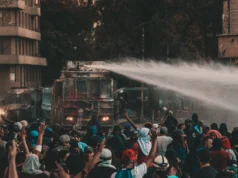
On October 17, 2019, the broadest cross-sectarian civic mobilization in Lebanese history erupted. The slogan was "kullun yaani kullun": all of them means all of them. The protests targeted every political party regardless of sect, constructing a national grievance in a system designed to recognize only communal ones. Hundreds of thousands participated across the sectarian map, and the movement sustained itself for months. Within two weeks it forced Saad Hariri's government to resign, but it could not turn that into systemic change. Every institution the thawra needed to move was held by sectarian patrons whose power depended on the sectarian loyalty the protests were attacking. Then the financial collapse deepened, COVID arrived and the port exploded, and each crisis drained the movement and redirected attention.
The outside patrons
The dysfunction sustains itself from within, yet what Iran, Saudi Arabia and France do still matters, because each has found its own use for a Lebanese state too weak to govern itself.
Iran filled the gap. Where the state was absent, it used Hezbollah to build a parallel army and social-services network, turning the vacuum into a political asset.
Before the 2024 war, Hezbollah outgunned the Lebanese Armed Forces, a larger army with far less firepower: it had an estimated 40,000 to 50,000 fighters and an arsenal of 120,000 to 200,000 rockets and missiles, depending on the source. The 2024 war degraded Hezbollah substantially. Hassan Nasrallah was killed in September 2024, and the organization suffered prolonged leadership disruption and significant command losses at every level. But by early 2026, Israel was saying Hezbollah was rearming faster than it was being disarmed, and a Lebanese source described the group rebuilding in parallel with Israel’s campaign to destroy it. On the eve of the 2026 war, an Israeli research group put its arsenal at about 25,000 rockets and missiles. A functioning Lebanese state with real sovereignty would close the vacuum Hezbollah fills. Iran’s four-decade investment, dating to Hezbollah’s founding in the early 1980s, was a bet on the permanence of that vacuum.
Saudi Arabia worked through money and a client family. Rafik Hariri built his fortune through Saudi Oger, a construction company he built up in Saudi Arabia that grew into one of the largest in the Middle East through extensive royal patronage contracts. He became Lebanon’s most powerful Sunni politician, serving twice as prime minister between 1992 and 2004, channeling Gulf investment into postwar reconstruction while leaving the confessional system untouched. His assassination in 2005 disrupted the patronage chain but didn’t sever it: his son Saad inherited both the political franchise and the Saudi relationship, and served twice as prime minister himself. The nature of the dependency showed in November 2017, when Saad Hariri, on a visit to Riyadh, announced his resignation as Lebanon’s prime minister on Saudi television. Lebanese and Western officials cited by The New York Times said he had been held by Saudi security, stripped of his phone and handed a pre-written resignation speech; Hariri has denied being held against his will. The client’s political existence depended on the patron rather than on any Lebanese state institution. He left the kingdom only after Emmanuel Macron intervened, and rescinded the resignation once home. Saudi Oger, the Saudi-based firm behind the family fortune, had by then already shut down. Saad Hariri suspended political activity in January 2022. His Future Movement relaunched in February 2025 and Riyadh has since courted Sunni figures again, but it has not handed the old franchise back to the Hariri family. While the channel lasted, its influence depended on state weakness.
France’s role has been crisis diplomacy. Protector of Levantine Christians since the sixteenth century, administrator of Greater Lebanon under the Mandate from 1920 and architect of the constitutional framework from which confessionalism grew, France co-sponsored the November 2024 ceasefire, sent Macron to Beirut after the 2020 explosion and backed the 2025 political transition. Each intervention addressed a symptom and left the system alone. Whatever Paris intends, its standing in Beirut has rested on being the outside power called in when the system breaks.
A Lebanon able to govern itself would close the vacuum Iran uses, end the dependency Saudi Arabia cultivated and leave France fewer crises to manage. Each patron has drawn on a specific kind of weakness that serves its interests, though external interference isn’t the cause of the institutional weakness itself.
The Banque du Liban and who protected it

From roughly 2016 onward, the Banque du Liban under Governor Riad Salameh conducted a series of "financial engineering" operations: borrowing dollars from commercial banks at above-market rates to defend the pound's peg to the dollar, creating a circular system that required constant new dollar inflows and generated outsized returns for Lebanon's politically connected banking sector. When the arrangement collapsed in October 2019, ordinary depositors lost access to their savings. The pound lost over 98 percent of its value. No comprehensive depositor-protection legislation has been enacted. No politician intervened while it was happening. The banking sector was the primary vehicle through which sectarian elites stored and managed their wealth, so threatening the peg meant threatening the financial base of each leader's own patron network. The central bank went on protecting those networks until the depositors' dollars ran out.
Three rival explanations
Three counterarguments each name something real, and each, traced far enough, leads back to the confessional system.
The Palestinian presence. Jordan and Syria also hosted large Palestinian refugee populations in the same period. Jordan faced Black September in 1970; the Hashemite monarchy survived because the state could mount a unified security response. Syria absorbed refugees without civil war because the Assad regime exercised centralized authority. Lebanon couldn’t formulate a unified response because the confessional system split the state along the same lines as the conflict. Christian militias opposed the Palestinian armed presence as a threat to Maronite demographic standing. Sunni leaders accommodated it on pan-Arab solidarity grounds. Shia communities organized against it through the Amal movement as Palestinian factions competed for the same southern terrain. The Palestinian armed presence was one of the war’s main causes, but it did its damage by adding pressure the confessional system couldn’t contain.
The civil war itself, 1975 to 1990, is sometimes treated as the event that broke the country. But the war was triggered by confessional dynamics already fully operational. And Taif, which set the terms for ending it, reproduced those dynamics instead of resolving them, entrenching wartime militia leaders as postwar political actors and codifying their sectarian constituencies in the settlement. The war deepened a dysfunction that already existed and had made the war possible.
The Syrian tutelage, 1990 to 2005 — the last fifteen years of a military presence that began in 1976. Damascus, under Hafez al-Assad until his death in 2000 and then under his son Bashar, managed Lebanese politics for those fifteen years by working through the confessional system, using sectarian patronage networks as leverage points. When Syria withdrew after the Cedar Revolution following Rafik Hariri’s assassination, the confessional architecture was entirely intact. Syria had found the dysfunction already in place, made use of it, and left the infrastructure undamaged when it pulled out.
All three are events the confessional system processed, and each time it absorbed and survived one, the system came out more entrenched. Each crisis that made sectarian actors the primary providers of security or services deepened the dependency relationships that keep the system self-perpetuating.
Bosnia runs the same design
If the confessional architecture survived a civil war, a foreign occupation, an assassination that triggered a revolution, a financial collapse, a mass-casualty explosion, and repeated Israeli military campaigns with its logic intact every time, then the logic matters beyond Lebanon, and it has been exported.
The 1995 Dayton Agreement created a governance structure for Bosnia-Herzegovina built on the same post-conflict power-sharing template: a three-member rotating presidency with one Bosniak, one Croat and one Serb, ethnically allocated positions at every level of government, and two semi-autonomous entities with separate administrations and laws. The result is five presidents (the three-member state presidency plus one for each entity), thirteen prime ministers, fourteen parliaments, and more than seven hundred members of parliament, serving a population of about 3.1 million.
The governance formula came out of the wartime settlement, ethnic quotas and an entity split negotiated to end the fighting, the same design logic as the 1943 National Pact and the 1989 Taif Agreement. The reform mechanism seals itself the same way. In 2009, the European Court of Human Rights ruled in Sejdic and Finci v. Bosnia that the ethnic allocation of the presidency and the upper house violated the European Convention on Human Rights by excluding minorities from the highest offices. Seventeen years later the ruling remains unimplemented, because implementation requires the consent of the actors whose positions depend on the allocation continuing. Sejdic-Finci is Bosnia’s Article 95: an authoritative finding that the system’s ethnic rules for its top offices break European human-rights law, sitting unexecuted because the people those rules protect can block the change. Bosnia’s system has struggled to produce order on its own, which is why outside management has been a constant, and why things degrade when that management weakens or turns adversarial.
Bosnia does have what Lebanon never had: a European legal framework wrapping the dysfunction, in the form of ECHR jurisdiction, EU accession conditionality and a NATO security presence. Because that scaffolding is heavier and better resourced, Bosnia’s dysfunction has advanced more slowly, and under outside pressure its leaders did agree to move defence, indirect taxation and judicial reform to the state level. The lock on the core allocation has held all the same: the ECHR ruling sits unimplemented in Sarajevo for the same reason Article 95’s committee has never been formed in Beirut.
Government formation in Bosnia routinely takes months as no ethnic group accepts an outcome that reduces its share. EU accession, conditioned on reforms that would redistribute ethnic power, has crawled for two decades: EU leaders gave the green light to open talks in March 2024, and two years later Bosnia had still not formally started negotiating. Republika Srpska, still steered by Milorad Dodik even after a 2025 conviction removed him from its presidency, operates separatist politics structurally analogous to Hezbollah’s relationship with the Lebanese state: building parallel institutions, leveraging central-state weakness as a political base, backed by external patrons. In Lebanon, the Syrian withdrawal of 2005 and the later Saudi retreat left the system with fewer outside props in the years before its 2019 collapse. If the mechanism is the same, Lebanon suggests where Bosnia’s road leads.
Israel’s 2026 war in Lebanon began in early March, when Hezbollah opened fire on Israel after the US-Israeli killing of Iran’s supreme leader. By late May it had carried Israeli troops across the Litani River, with more than 3,300 killed and over a million displaced by Lebanese official counts. The crossing came despite a ceasefire agreed in April. In June, Lebanon and Israel signed a US-brokered framework in Washington that ties a phased Israeli pullback to the verified disarmament of non-state armed groups, meaning Hezbollah; the group, which was not at the table, rejected it.
Israel is in Lebanon in 2026 as it was in 1978, 1982, 2006 and 2024. The Lebanese state has now promised, on paper, a monopoly on force. Keeping that promise runs through the same sectarian vetoes that have kept Article 95’s committee from ever meeting.
Gen AI Disclaimer
Some contents of this page were generated and/or edited with the help of a Generative AI.
Media
Key Sources and References
Article 95, Lebanese Constitution, as amended by Constitutional Law of September 21, 1990, implementing the Taif Agreement. English text: Constitute Project. https://www.constituteproject.org/constitution/Lebanon_2004
The Taif Agreement (National Reconciliation Accord), 1989; implementation record: Peace Accords Matrix, University of Notre Dame. https://peaceaccords.nd.edu/accord/taif-accord · https://peaceaccords.nd.edu/provision/legislative-branch-reform-taif-accord
Asharq Al-Awsat, “The final days of sectarianism?”, January 23, 2010. https://en-archive.aawsat.com/2010/01/23/the-final-days-of-sectarianism/
Joseph Bahout, “The Unraveling of Lebanon’s Taif Agreement: Limits of Sect-Based Power Sharing,” Carnegie Endowment for International Peace, May 2016. https://carnegieendowment.org/research/2016/05/the-unraveling-of-lebanons-taif-agreement-limits-of-sect-based-power-sharing
Arend Lijphart, “Consociational Democracy,” World Politics, Vol. 21, No. 2, 1969. https://doi.org/10.2307/2009820
Arend Lijphart, Democracy in Plural Societies: A Comparative Exploration, Yale University Press, 1977. https://yalebooks.yale.edu/book/9780300024944/democracy-in-plural-societies/
Rania Maktabi, “The Lebanese Census of 1932 Revisited: Who Are the Lebanese?”, British Journal of Middle Eastern Studies, Vol. 26, No. 2, 1999, pp. 219–241. https://doi.org/10.1080/13530199908705684
The Monthly (Information International), “The Lebanese and Their Sects,” 2013 (1932 census tables). https://monthlymagazine.com/en/article/772/the-lebanese-and-their-sects
US Department of State, 2023 Report on International Religious Freedom: Lebanon. https://www.state.gov/reports/2023-report-on-international-religious-freedom/lebanon/
Amos Barshad, “In Lebanon, a Census Is Too Dangerous to Implement,” The Nation, October 17, 2019. https://www.thenation.com/article/archive/lebanon-census/
Human Rights Watch, “Cut Off From Life Itself: Lebanon’s Failure on the Right to Electricity,” March 2023. https://www.hrw.org/report/2023/03/09/cut-life-itself/lebanons-failure-right-electricity
Naharnet, “Cabinet names regulatory authorities for electricity and telecom sectors,” September 12, 2025. https://www.naharnet.com/stories/en/315227-cabinet-names-regulatory-authorities-for-electricity-and-telecom-sectors
World Bank, Lebanon Economic Monitor, Fall 2021: “The Great Denial.” Published January 2022. Estimates gross public debt at 183 percent of GDP in 2021. https://www.worldbank.org/en/news/press-release/2022/01/24/lebanon-s-crisis-great-denial-in-the-deliberate-depression
World Bank, Tax Revenue (% of GDP) — Lebanon, World Development Indicators. https://api.worldbank.org/v2/country/LBN/indicator/GC.TAX.TOTL.GD.ZS?format=json
International Monetary Fund, “IMF Reaches Staff-Level Agreement on Economic Policies with Lebanon for a Four-Year Extended Fund Facility,” Press Release No. 22/108, April 7, 2022 (archived copy). https://web.archive.org/web/2023/https://www.imf.org/en/News/Articles/2022/04/07/pr22108-imf-reaches-agreement-on-economic-policies-with-lebanon-for-a-four-year-fund-facility
Enterprise, “Who pays for Lebanon’s banking collapse?”, May 13, 2026. https://enterpriseam.com/menaplus/2026/05/13/who-pays-for-lebanons-banking-collapse/
Arab News, “Lebanon approves financial gap draft law despite opposition from Hezbollah and Lebanese Forces,” December 2025. https://www.arabnews.com/middle-east/lebanon-approves-financial-gap-draft-law-despite-opposition-from-hezbollah-and-lebanese-forces-2627533
Issam Kayssi, “Nawaf Salam’s Text Messages,” Carnegie Endowment for International Peace, February 20, 2025. https://carnegieendowment.org/middle-east/diwan/2025/02/nawaf-salams-text-messages
Sabine Hatem, Lamia Moubayed Bissat and Carl Rihan, “Lebanon’s Experiment with Installing Competitive Recruitment,” Institut des Finances Basil Fuleihan (on the 1959 Civil Service Board). https://institutdesfinances.gov.lb/sites/default/files/2024-06/15-Lebanons-Experiment-with-Installing-Competitive-Recruitment-Lamia-Moubayed-Bissat-Sabine-Hatem-Carl-Rihan.pdf
Human Rights Watch, “They Killed Us from the Inside: An Investigation into the August 4 Beirut Blast,” August 2021. https://www.hrw.org/report/2021/08/03/they-killed-us-inside/investigation-august-4-beirut-blast
Anadolu Agency, “Beirut port blast case nears indictment, trial after 6 years,” September 21, 2026. https://aa.com.tr/en/middle-east/beirut-port-blast-case-nears-indictment-trial-after-6-years/4062929
Lina Khatib, “Lebanon is experiencing a social revolution,” Al Jazeera, October 20, 2019. https://www.aljazeera.com/opinions/2019/10/20/lebanon-is-experiencing-a-social-revolution/
Euronews, “Lebanon’s Hariri resigns after days of nationwide protests,” October 29, 2019. https://www.euronews.com/2019/10/29/lebanese-prime-minister-set-to-give-speech-from-official-residence-amid-resignation-rumour
Council on Foreign Relations, “What Is Hezbollah?” Backgrounder, updated April 2026. https://www.cfr.org/backgrounders/what-hezbollah
Reuters, “Hezbollah saw new war with Israel as inevitable and rearmed for months, sources say,” March 5, 2026 (citing ALMA Research and Education Center’s arsenal estimate). https://www.yahoo.com/news/articles/hezbollah-saw-war-israel-inevitable-190240037.html
Al Jazeera, “Profile: Rafik Hariri,” March 1, 2009. https://www.aljazeera.com/news/2009/3/1/profile-rafik-hariri
Al Jazeera, “Lebanese PM Hariri ‘pressured to resign’ by the Saudis,” December 25, 2017. https://www.aljazeera.com/news/2017/12/25/lebanese-pm-hariri-pressured-to-resign-by-the-saudis/
Gulf News, “Lebanon ex-PM Hariri says he is withdrawing from political life,” January 24, 2022. https://gulfnews.com/world/mena/lebanon-ex-pm-hariri-says-he-is-withdrawing-from-political-life-1.1643034675565
Dario Sabaghi, “A political revival? Saad Hariri and the Future Movement,” The New Arab, February 23, 2026. https://www.newarab.com/analysis/political-revival-saad-hariri-and-future-movement
Anne Kirstine Rønn, “Still an irreplaceable piece? Reflecting on the limits of Saudi reengagement in Lebanon,” POMEPS, 2026. https://pomeps.org/still-an-irreplaceable-piece-reflecting-on-the-limits-of-saudi-reengagement-in-lebanon
Argaam, “Here’s a list of projects Saudi Oger was working on before its closure,” July 31, 2017. https://www.argaam.com/en/article/articledetail/id/498219
BBC News, “Death of Assad” (in-depth), June 2000. http://news.bbc.co.uk/2/hi/in_depth/middle_east/2000/death_of_assad/default.stm
Sejdic and Finci v. Bosnia and Herzegovina, Applications nos. 27996/06 and 34836/06, European Court of Human Rights, Grand Chamber, December 22, 2009. https://hudoc.echr.coe.int/eng?i=001-96491
RFE/RL, “It’s Complicated: Bosnia’s Byzantine System Of Government,” October 11, 2018. https://www.rferl.org/a/its-complicated/29538308.html
General Framework Agreement for Peace in Bosnia and Herzegovina (Dayton), Annex 4: Constitution of Bosnia and Herzegovina, Articles IV–V, 1995. Office of the High Representative. https://www.ohr.int/dayton-peace-agreement/annex-4/
Office of the High Representative, “Transfer of Competency Agreement Withdrawal Legally Questionable,” 2007 (defence, indirect taxation and judicial reform transfers). https://www.ohr.int/ohr-transfer-of-competency-agreement-withdrawal-legally-questionable/
World Bank, Population, total — Bosnia and Herzegovina, World Development Indicators. https://api.worldbank.org/v2/country/BIH/indicator/SP.POP.TOTL?format=json
EEAS, “Two years on from the green light for accession negotiations – is there still political will in Bosnia and Herzegovina to move forward on the EU path?”, March 21, 2026. https://www.eeas.europa.eu/delegations/bosnia-and-herzegovina/two-years-green-light-accession-negotiations-%E2%80%93-there-still-political-will-bosnia-and-herzegovina_en
OSW, “Snap presidential election in Republika Srpska: Dodik’s candidate wins,” November 26, 2025. https://www.osw.waw.pl/en/publikacje/analyses/2025-11-26/snap-presidential-election-republika-srpska-dodiks-candidate-wins
ACLED, “Israel prepares ground invasion of Lebanon as Hezbollah formally joins war,” March 5, 2026. https://acleddata.com/report/israel-prepares-ground-invasion-lebanon-hezbollah-formally-joins-war
laRegione, “Israele amplia le operazioni in Libano dopo l’attraversamento del fiume Litani,” May 31, 2026. https://www.laregione.ch/estero/estero/1929366/libano-litani-israele-esercito-fiume-operazioni-aver-attraversamento
Al Jazeera, “Israel-Lebanon deal ties ceasefire to Hezbollah disarmament: Will it work?”, June 27, 2026. https://www.aljazeera.com/news/2026/6/27/israel-lebanon-deal-ties-ceasefire-to-hezbollah-disarmament-will-it-work
Farid el-Khazen, The Breakdown of the State in Lebanon, 1967–1976, Harvard University Press, 2000.