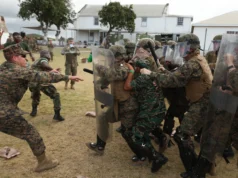
In June 2014, Islamic State fighters drove a bulldozer through the earthen berm that marks the Iraq-Syria border and circulated the pictures under the title “Smashing the Sykes-Picot border”, the machine lurching forward as dirt cascaded away in clouds. On 29 June the group’s English-language media wing followed with a video titled The End of Sykes-Picot, in which a Chilean-born fighter tours an abandoned Iraqi border post and narrates in accented English, explaining what they are doing and why: they are erasing a line drawn in 1916 by two European diplomats, and erasing it is, in the video’s logic, an act of liberation. The video had the production values of a recruitment advertisement and the argument of a history lecture.
A jihadist militia, at the height of its 2014 offensive, chose to frame its territorial expansion in diplomatic-historical terms as well as religious ones. As it seized territory, it named the specific agreement it was undoing, a 98-year-old Anglo-French memorandum, and summoned that agreement as the symbolic enemy of its project. Whatever else the Islamic State was, it was right that Sykes-Picot still mattered: nearly a century later, the agreement carried enough residual charge to serve as the identified oppressor of a self-declared caliphate.
The Agreement That Almost Wasn’t the Map
Sykes and Picot reached agreement in January 1916; with Russia’s assent, it was formalised in an exchange of letters between the French and British governments completed on 16 May 1916. Its formal name was the Asia Minor Agreement. Its negotiators were Sir Mark Sykes, a Conservative MP and seasoned traveller in Ottoman territory, and François Georges-Picot, a French diplomat and former consul-general in Beirut.
What they produced was a partition of spheres, not a map of states. France would take direct control of coastal Syria and Lebanon and a slice of south-eastern Anatolia, with indirect influence over an Arab state or confederation in the Syrian interior that reached east to Mosul. Britain would take direct control of lower Mesopotamia from Baghdad to Basra, plus the ports of Haifa and Acre, with indirect influence over the desert belt in between, roughly today’s Jordan and western Iraq. Palestine would fall under some form of international administration. Both powers also pledged not to acquire territory in the Arabian Peninsula itself. Its lines match today’s political map only in places: the coastal Levant it assigned to France did become Syria and Lebanon, and lower Mesopotamia did become the core of British Iraq, but most of the frontiers that matter today were drawn later, and Mosul, which it gave to France, ended up in Iraq.
Most of what passes for public knowledge about Sykes-Picot gets this wrong: the current borders of Iraq, Syria, Jordan, Lebanon and Israel were not drawn by Sykes and Picot. They emerged from later negotiations: the San Remo Conference of 1920, which allocated the League of Nations mandates; the Treaty of Lausanne of 1923, which settled most of the post-war Turkish question but left the Turkey-Iraq frontier to the League of Nations; and a series of Anglo-French boundary commissions that drew the lines in detail. Scholars who criticise the popular Sykes-Picot story, among them David Siddhartha Patel, Steven Cook and Amr T. Leheta, are right to point this out. The map that carved up the Middle East is not precisely the one those two men drew.
Mark Sykes himself is often presented as a man ignorant of what he was doing to whom, but he had travelled extensively through Ottoman territories, published Through Five Turkish Provinces in 1900 and The Caliph’s Last Heritage in 1915, and possessed a political intelligence about the region that was real, if filtered through the assumptions of his class and time. Georges-Picot had served as consul-general in Beirut.
Neither man was accountable to those who would live inside the resulting states. They were not designing countries they would have to govern or that their children would inhabit, and neither man’s diplomatic career depended on making those countries functional. They were dividing a collapsing empire between two colonial powers in the middle of a world war. The interests being balanced were French and British. Whether the populations inside those lines would experience the resulting states as legitimate, and so whether those states could be governed by consent, was not a variable in the calculation.
When the Bolsheviks published the text of the secret agreement in late 1917, the Arab world’s response was fury of a particular kind: the fury of a people who had been making a deal on one set of terms and discovered the other party had made a different deal on entirely different terms behind their back. That fury has not entirely dissipated. The agreement’s power as a symbol derives partly from this betrayal, and partly from something more structural: the principle it established survived the specific lines it drew. Every subsequent treaty that demarcated these borders inherited much the same logic: the region would be carved up to suit the great powers. Where consultation was promised, it was ignored or managed: the League Covenant said the wishes of the former Ottoman communities must be “a principal consideration” in choosing their mandatory power, yet the 1919 King-Crane Commission’s finding that most Syrians rejected a French mandate was shelved, and Faisal’s Iraqi throne was made subject to a plebiscite whose outcome Britain had already decided.
The treaty sequence

The popular account treats Sykes-Picot as the definitive partition of the Middle East. The actual sequence is more complicated. The Sykes-Picot Agreement (1916) established the principle of Anglo-French partition and sketched zones of influence. The Balfour Declaration (1917) introduced the Palestine question. The Treaty of Sèvres (1920) attempted to impose a post-Ottoman settlement including Kurdish autonomy provisions, and was never ratified by Turkey. The San Remo Conference (1920) formally allocated League of Nations mandates: France received Syria and Lebanon; Britain received Iraq and Palestine.

The Treaty of Lausanne (1923), negotiated after Turkish nationalist victory under Mustafa Kemal, superseded Sèvres entirely and settled all of Turkey's borders except the frontier with Iraq, without any provision for Kurdish autonomy. The League of Nations awarded that frontier along the "Brussels line" in December 1925, an award an Anglo-Turkish-Iraqi treaty confirmed in June 1926. The Anglo-French boundary commissions then drew specific lines. The resulting borders diverge from Sykes-Picot's original zoning in significant ways, but each subsequent document operated within the same broad framework of external partition. Most historians accept that continuity, even as they debate how much of it belongs to Sykes-Picot itself rather than to wartime occupation, the mandate system and the deals of 1918–26.
The People Who Were Promised a State
The mechanism works at its clearest in the case of the Kurds, who number between 25 and 45 million by the range of current estimates (no census counts them). They are plausibly the largest stateless ethnic group in the world, spread across Turkey, Iraq, Syria and Iran.
They share a language (or a cluster of closely related dialects), a culture, and a territory that has a historical name: Kurdistan. They have a national identity but no state, and the reason is traceable, with unusual documentary precision, to a series of specific diplomatic decisions made between 1920 and 1923.
The Treaty of Sèvres, signed in August 1920, gave the Kurds a promise. Articles 62 through 64 of that treaty provided for Kurdish autonomy in predominantly Kurdish territories of the former Ottoman Empire, with Article 64 specifying that if, within one year of the treaty’s coming into force, the Kurds showed the League of Nations Council that a majority in those areas desired independence, and the Council judged them capable of it and recommended it, Turkey would renounce its claims over them. “Kurdistan” appeared as the title of a section of a major multilateral peace treaty, and no later treaty settling the region would repeat it. The Allied powers had committed to it in a signed document, with specific articles and a timeline. Because the treaty never came into force, that timeline never began to run.
Three years later, the Treaty of Lausanne was signed. The word “Kurd” does not appear in it. Articles 62 through 64 of Sèvres, with their autonomy provisions and independence pathway, were dropped without replacement. The reversal was driven by power: Mustafa Kemal’s nationalist movement had defeated the Allied-backed Greek army and would accept no partition of Anatolia; Britain, intent on keeping the oil-bearing Mosul vilayet inside its Iraqi mandate, had no further use for an independent Kurdistan that might lay claim to it; and France had already made its own separate peace with Ankara in October 1921. The Kurds had no equivalent leverage. They had been promised a state as a by-product of Ottoman partition; when the calculus shifted, the promise was dropped.
The result was Kurdish territory distributed across four separate states: Turkey, the French Syrian mandate, the British Iraqi mandate and Iran. Each of them subsequently pursued policies of suppression, assimilation or denial of Kurdish political identity, with varying brutality. What followed was a set of parallel conflicts, all produced by the same structural condition: a population large enough and coherent enough to constitute a nation, divided across multiple states whose political systems were built around excluding that nationality from power.
In Turkey, the PKK (the Kurdistan Workers’ Party, founded in 1978 and designated a terrorist organisation by both the United States and the European Union) waged an insurgency from 1984 that killed at least 40,000 people over four decades. In 2025, at Öcalan’s call, the PKK announced its dissolution and began destroying its weapons. In August 2026 Turkey’s parliament passed a framework law offering conditional amnesty to its members; the amnesty measures apply only once Turkey’s National Security Council confirms that the group has disbanded and disarmed, a verification still pending in October 2026. The PKK’s founding ideology was Marxist separatism; its leader’s later turn away from statehood itself is discussed below.
In Iraq, the denial took its most extreme form in 1988. Saddam Hussein’s Anfal campaign, conducted between February and September of that year, was a systematic military operation against Iraqi Kurdish populations, using conventional forces, chemical weapons and mass displacement. The campaign’s most infamous single incident was the chemical attack on Halabja in March 1988, which killed an estimated 3,200 to 5,000 people in hours; it is widely regarded as the deadliest chemical weapons attack ever directed at a civilian population. The Anfal campaign’s total death toll is disputed; Human Rights Watch put it at 50,000 by the most conservative estimate, and possibly twice that number. What is not disputed is that it was genocidal in design and execution: a state attempting to resolve, by mass killing, a demographic problem its own borders had created.
In September 2017, the Kurdistan Regional Government in northern Iraq held an independence referendum, and more than 92 percent voted in favour. The Iraqi central government nullified the result. Iran and Turkey, both with Kurdish minorities of their own, supported Baghdad. The United States, which had spent years building a military alliance with Kurdish forces in the fight against ISIS, offered no support for the referendum outcome. Within weeks the KRG lost Kirkuk, its oil fields and almost all of the roughly 23,000 square kilometres of disputed territory it had taken since 2003.
The Kurdish case makes the mechanism visible. The Kurdish people did not lack the cohesion or the will to form a state. Their state was promised in one treaty and revoked in the next; their land was partitioned across four borders by powers who had no stake in the outcome; and whenever they pressed for a remedy, the states that held them answered with suppression, with poison gas in 1988, or, in 2017, with a nullified vote.
Öcalan's confederalism

Abdullah Öcalan, the PKK's imprisoned founding leader, developed his theory of "democratic confederalism" while serving a life sentence on İmralı Island. Drawing on American anarchist Murray Bookchin's concept of "libertarian municipalism," Öcalan argued that the nation-state was itself the problem, and that Kurdish liberation required a democratic, multi-ethnic, feminist governance model operating across existing borders rather than a Kurdish state. The theory is, in part, a response to permanent foreclosure: when the state-based solution has been made unavailable for long enough, the intellectual project redirects toward imagining liberation without it.

Rojava, the autonomous Kurdish-led administration in northern Syria established during the Syrian civil war, attempted to implement elements of this model while squeezed between Turkish military pressure and US strategic calculations. After a government offensive and a ceasefire in January 2026, its forces and institutions were folded into the new Syrian state; by August 2026 its leaders had declared that integration complete, with Kurdish self-rule surviving, if at all, at municipal level.
The State That Was Assembled to Fail
Kurdistan shows what happens when colonial cartography cuts across a coherent national group, denying it the state its population and territory would otherwise warrant. Iraq shows the other side of the same operation: groups that had never shared a state, fused into a single one that has struggled to hold together ever since.
Modern Iraq was created from three Ottoman vilayets. The vilayet of Mosul, in the north, was majority Kurdish, with large Arab, Turkmen, Christian and Yazidi communities. The vilayet of Baghdad, in the centre, mixed Sunni and Shia Arabs and contained the Shia shrine cities of Karbala and Najaf. The vilayet of Basra, in the south, was predominantly Shia Arab. Baghdad and Basra had long been treated as one region, “Arab Iraq”, and Baghdad often exercised authority over its neighbours, but Mosul looked north and west as much as south, and the three had never formed a state of their own. Historians still argue over how artificial that made Iraq; what is not in dispute is how the British assembled it. They fused the three into a single administrative entity because doing so was strategically convenient: Mosul for its oil, Basra for its Persian Gulf access, Baghdad as the administrative centre. There was little Iraqi national identity to appeal to, because Iraq had never before existed as an independent state.
The demographic arithmetic the British created was precarious from the first day. Iraq’s Muslim population is roughly three-fifths Shia and one-third Sunni; Kurds constitute between fifteen and twenty percent of the total. Into this arrangement the British installed a Sunni Arab monarchy under Faisal I, drawn from the Hashemite family of the Hejaz: a man who had no prior connection to Iraq and whose community, the Sunni Arabs, made up perhaps a fifth of the country’s population. The choice was deliberate. The British found the Sunni Arab administrative class, and Faisal himself, easier to work with than the Shia clergy who dominated the south. The Shia majority, whose political marginalisation was built into the state’s founding structure, did not factor heavily in the calculation.
The confessional arithmetic was not incidental to what followed. Every Iraqi government from the Hashemite monarchy through the 1958 republican coup and the Ba’athist takeover of 1968 to Saddam Hussein’s presidency was Sunni-dominated, governing over a Shia majority and a Kurdish minority that had both been shut out of the levers of state power. Holding this arrangement together required force, and force became the basic instrument of government. Iraq’s composition made consent-based governance nearly impossible, so the state converged on coercion as its default mode.
When the 2003 US invasion removed that coercive architecture, what emerged was the immediate assertion of forces that had been compressed for decades. The sectarian civil war of 2006 to 2008, in which some 66,000 civilian deaths were recorded across the three years, was not caused by the invasion alone. The invasion, and occupation decisions such as the dissolution of the army, exposed a fault line that had existed since 1920. Shia militias, Sunni insurgencies and Kurdish autonomy movements were all reactions by communities to a state whose founding design had excluded them from power. Ba’athism, the form that exclusion had taken, was gone; the arrangement that had made exclusion the price of holding the state together was not.
The Islamic State’s capture of Mosul in June 2014, and its rapid consolidation of control across the Sunni Arab heartland of western Iraq, followed the same logic. ISIS drew many of its military commanders from officers of the dissolved Iraqi army, an institution whose Sunni Arab-dominated officer corps had been moved from state authority to unemployment by a single administrative order in May 2003. A Sunni population that had held state power for eight decades found itself governed, after 2003, by a Shia-dominated Baghdad whose new democracy many experienced as confessional revenge. Into that political space ISIS moved with an offer: a Sunni state, for Sunnis, in territory that Sunnis had historically administered. Iraq’s own history explains why the offer appealed.
The Mosul question

The inclusion of the vilayet of Mosul within the British mandate, rather than in Turkey, in a separate Kurdish state or under French influence, was not an accident of geography. Mosul was contested: Turkey claimed it; the Kurds lived in it; Sykes-Picot had placed it in France's sphere. Britain resolved the contest in its own favour, primarily because British oil interests had identified the Mosul region's reserves as strategically significant. Clemenceau ceded Mosul at the end of the war in return for a share of its oil, fixed at 25 percent in 1920; the San Remo Conference that year confirmed it within the British mandate, and the League of Nations awarded it to Iraq in December 1925, a decision Turkey accepted by treaty in June 1926.

The Turkish Petroleum Company, renamed the Iraq Petroleum Company in 1929, was by then owned in equal shares of just under a quarter each by British, Anglo-Dutch, French and American groups, with 5 percent for the broker Calouste Gulbenkian. Those proportions reflected the geopolitical settlement rather than any local preference. The border that enclosed Mosul within Iraq was, among other things, an oil-field boundary.
Lebanon, or: What Happens When You Build Sectarianism into the State
Kurdistan is the case of partition; Iraq is the case of forced assembly. In Lebanon the mechanism worked a third way, by formalising sectarian division in the architecture of the state itself. The result is a political system permanently designed to reproduce the divisions it inherited, incapable of transcending them because its entire structure depends on their maintenance.
Greater Lebanon was proclaimed by France on 1 September 1920 through the enlargement of the old Ottoman province of Mount Lebanon, which was predominantly Maronite Christian, to absorb Beirut, Sidon, Tyre, Tripoli, and the Bekaa Valley, populations that were predominantly Muslim and that, in many cases, preferred union with Syria. France acted at Maronite request and against the explicit opposition of Muslim communities. The expansion created a state whose demographic balance was contested from the moment of its creation.
The governing arrangement that emerged from this was the National Pact of 1943, an unwritten pre-independence agreement between Christian and Muslim political leaders that allocated the state’s senior positions by religious confession: the president would be Maronite Christian, the prime minister Sunni Muslim, the speaker of parliament Shia Muslim. Parliamentary seats would be divided in a six-to-five Christian-to-Muslim ratio. This arithmetic was derived from a single source: the 1932 census conducted under the French mandate. That census showed Christians as a narrow majority, roughly half of residents, and nearer three-fifths once the largely Christian emigrants on its registers were counted. It remains the last official census Lebanon has conducted and has never been updated. In 2026, Lebanon’s confessional system rests on a demographic snapshot that is ninety-four years old.
The reason there has been no census since is political calculation, carried out by every political actor in Lebanon simultaneously. Every major religious community knows, with reasonable confidence, that a new census would show a Muslim majority, probably a substantial one, that would justify a redistribution of political power. No Christian bloc wants that redistribution, no Muslim bloc wants the instability of getting there, and so no one orders the census. The political system built on the 1932 numbers has generated the incentives needed to keep the 1932 numbers in place.
The Lebanese Civil War, which ran from 1975 to 1990 and killed an estimated 120,000 to 150,000 people, was not caused solely by the confessional system’s demographic miscalibration. Palestinian armed presence in Lebanon, Syrian and Israeli intervention, and the regional reshaping of Shia political identity under Iranian influence all contributed. But the confessional system could neither accommodate demographic change nor give legitimate political expression to communities whose power allocations were based on a census from 1932, and that structural incapacity was the condition the war’s multiple pressures exposed and exploited. A political system with a functional mechanism for redistributing power in response to demographic change would not have been invulnerable to civil conflict, but it would have had a release valve, which Lebanon lacked.
The Taif Agreement of 1989, which ended the civil war, modified the confessional ratios by equalising Christian and Muslim parliamentary seats, but did not abolish the system. The sectarian allocation of the three top posts survived intact. These conventions still hold in 2026: President Joseph Aoun is a Maronite, Prime Minister Nawaf Salam a Sunni, Speaker Nabih Berri a Shia. None of them is written in the constitution, which since Taif has declared the abolition of political sectarianism a “basic national objective”. Yet the unwritten bargain of 1943, struck in the last years of a French mandate that had favoured Maronite dominance, has outlived every attempt to retire it, in a country whose demographic composition has changed beyond recognition.
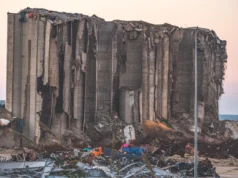
The August 2020 explosion at the Port of Beirut killed at least 218 people and displaced more than 300,000. It was caused by ammonium nitrate stored in unsafe conditions for six years, a failure that no single political actor has yet been made to answer for. The ammonium nitrate had been flagged by port officials, customs authorities, and government ministers. Nothing was done because the confessional system had distributed accountability across so many competing institutional fiefdoms that no single actor had sufficient authority to impose a safety decision on a facility that sat, nominally, within everyone’s jurisdiction and therefore, practically, within no one’s. Six years on, the investigating judge has charged more than 70 officials and employees, yet after years of political obstruction no indictment had been issued by October 2026. The explosion happened, in large part, because of the confessional system.
Hezbollah and the Shia gap

The Lebanese confessional system allocated the speakership of parliament, the third of the state's top three posts, to the Shia community, and Nabih Berri has made the office a power centre since 1992. Yet the Shia were historically the poorest and least politically organised of Lebanon's major communities. When the Iranian revolutionary project sought a Lebanese partner, it found a community that had been systematically under-resourced by the very political system theoretically designed to represent it. Hezbollah emerged in the 1980s not only as a resistance movement against Israeli occupation of southern Lebanon but as a social services provider, running schools, hospitals and welfare networks and filling the vacuum the Lebanese state had created by allocating political positions to Shia representation while failing to allocate the resources that might have made that representation meaningful.

Hezbollah is a product of the confessional system's structural failures as much as it is a product of Iranian strategic interest. In March 2026 that dual identity pulled Lebanon into war again: after the killing of Iran's supreme leader in US-Israeli strikes, Hezbollah attacked Israel, and by late June more than 4,000 people had been killed in Lebanon and over 1.2 million displaced.

Parliament postponed the May 2026 elections by two years, and a US-brokered framework signed in June ties Israel's gradual redeployment from the south to Hezbollah's verified disarmament. Hezbollah, which was not a party to the deal, rejected it, and its implementation was still being negotiated in October 2026.
The Revisionist Objection, and Why It Doesn’t Save Us
The most serious objection to this whole argument is the revisionist case, made most carefully by Patel, Cook, Leheta and Ali Murat Kurşun. It deserves an answer, and it runs roughly as follows.
First, the specific borders of the modern Middle East do not closely match what Sykes and Picot drew, so attributing those borders to the agreement is historically imprecise. Second, the Middle East’s conflicts are primarily a function of authoritarian governance and legitimacy crises, not of borders per se, and the cartographic explanation displaces political accountability from rulers onto maps. Third, assigning contemporary conflicts to a 1916 agreement is deterministic in a way that erases a century of regional agency: Arab states, Kurdish movements, and Iraqi political actors have had choices, and those choices have mattered.
All three points have force, though not in equal measure. The first has already been conceded here: the specific Sykes-Picot lines were superseded.
The argument concerns the principle those lines instantiated: that the region would be partitioned by outside powers, with local consent sought, if at all, only for form’s sake, and that every subsequent treaty operated within that principle’s framework.
The second point holds in part. Authoritarian governance is plainly the proximate cause of the region’s most acute suffering: Saddam Hussein’s decision to gas the Kurds, the Assad dynasty’s decision to bomb its own cities, the Lebanese political class’s six-year failure to remove impounded ammonium nitrate from a warehouse beside residential Beirut. These were choices, made by specific people who bear specific responsibility. The structural argument leaves room for that agency. It holds that state structures assembled without consent-based foundations tend, under pressure, toward authoritarian solutions, because coercion becomes the only way to hold them together. The Sunni-minority governance of Iraq was a predictable response to a state that could not be held by democratic means, and on the whole the region’s authoritarianism has grown out of those structural conditions.
The third point holds only in part, and it deserves the most resistance. The Kurdish case shows what regional agency can and cannot do against such a structure. Kurdish political actors have had a century of agency. That century has produced the Sheikh Said rebellion in Turkey (1925), Simko Shikak’s revolts in Iran (1918–22, briefly renewed in 1926), the Dersim massacre in Turkey (1937–38), the Mahabad Republic in Iran (1946), four decades of PKK insurgency in Turkey, the Anfal genocide, the 2005 Iraqi constitution’s Kurdish autonomy provisions, and a 2017 independence referendum that ninety-two percent of voters backed and that was nullified within weeks. The structure has proven more durable than the agency deployed against it, because it was built to contain the Kurds.
What the revisionist critique establishes is that the argument here must be about a class of action rather than a specific agreement. Colonial cartographic imposition, meaning borders drawn by outside powers for administrative convenience without accountability for governability or consent, creates structural conditions from which specific, predictable failure modes reliably emerge. Sykes-Picot names one instance of that class, and the Middle East is its most legible example, though not the only one.
Not Just the Middle East: The Pattern
One of the clearest non-Middle Eastern demonstrations of the mechanism is Kashmir, even though the dispute itself was triggered by the partition of 1947. The unit that partition tore at had been assembled a century earlier.
In March 1846, the British East India Company concluded the Treaty of Amritsar with Gulab Singh, a Dogra Hindu ruler of Jammu. Under the treaty, the British sold the Kashmir Valley and surrounding territories, a region with a majority Muslim population, to a Hindu ruler whose religion differed from that of most of his new subjects. The price was 7.5 million Nanakshahee rupees. The sale joined the Kashmir Valley, predominantly Muslim, to Gulab Singh’s religiously mixed Jammu territories; with Buddhist Ladakh and Muslim Gilgit, which came under Dogra rule outside the treaty, the result was a composite entity designed for administrative convenience and boundary clarity, not for the consent of the governed or the coherence of the governed’s political identity.
The mechanism here differs slightly from Iraq or Lebanon in its form: this was a colonial sale to a local ruler rather than direct mandate administration. But the structural result was identical in character. A boundary was drawn for financial and administrative reasons across populations with divergent religious identities, with no consent mechanism and no consideration of whether the resulting unit could sustain legitimate governance. When the British departed in 1947 and the partition of India was negotiated, the Hindu maharajah of a majority-Muslim state opted to accede to India, after initial hesitation and after Pakistani irregular forces had entered his territory. The resulting ambiguity has produced three wars over Kashmir between India and Pakistan (1947, 1965, 1999), a fourth war in 1971 over East Pakistan, and a Line of Control, fixed in 1972, that bisects the former princely state. In 2026 the dispute sits between two nuclear-armed states that exchanged strikes as recently as May 2025.
The other major instance of the pattern is harder to trace but broader in scale. The Berlin Conference of 1884 to 1885 set the rules for the European partition of Africa with no African representation at the table; the lines themselves were drawn mostly in bilateral treaties over the following decades. The process split more than 200 ethnic groups between states, divided kingdoms and trading networks, and forced historical rivals into single administrative units. King Leopold II’s Congo Free State, recognised at Berlin and later the Belgian Congo, enclosed that diversity within a single colonial framework; independence in 1960 was followed almost immediately by the Katanga secession crisis. The Second Congo War of 1998 to 2003 drew in states from across Africa and reflected ethnic and political fault lines traceable to the colonial carve-up. It also set off a humanitarian collapse that the International Rescue Committee estimates caused 5.4 million excess deaths between 1998 and 2007, though critics of its survey method put the figure far lower. The war is, on the IRC’s numbers, the deadliest conflict on earth since the Second World War. The argument over the number reflects how hard it is to count deaths across vast ungoverned territory, among populations who die not only directly from violence but from the disease and displacement it causes.
The comparison between these cases and the Middle East does not hold at every point. Not every post-colonial border produced sustained violent conflict. Where violence did come, the borders were rarely the whole story: Rwanda and Burundi, whose colonial boundaries enclosed Hutu and Tutsi populations in ways Belgian policy deliberately exacerbated, collapsed into mass violence through post-independence political choices that the borders alone did not predetermine. Singapore was separated from Malaysia in 1965 under conditions of communal tension and became one of the world’s most stable and prosperous states. The colonial cartographic act does not guarantee failure. It is a significant structural risk factor that forecloses certain options for consent-based governance and leaves a state dependent on the quality and honesty of the political institutions built within it.
When states are assembled by outside powers for administrative convenience, without consent and without accountability for whether they can be governed, the excluded are suppressed, the state rules by coercion, and the conflict returns because its cause is still there. The Middle East makes this pattern legible because the documentation is unusually complete: there are names, a date, a map, and a specific betrayal of a specific promise. Kashmir’s record has a date, a transaction and a sale price; the Congo’s begins with a conference at which no African had a voice.
The African states' choice

At its first Conference of African Heads of State and Government in Cairo in 1964, the Organisation of African Unity passed Resolution AHG/Res. 16(I), endorsing the principle of uti possidetis juris, the obligation to respect inherited colonial boundaries as the basis for post-independence sovereignty. The resolution was a deliberate choice by African states to keep borders they knew were arbitrary, because redrawing them along ethnic lines was judged more dangerous.

Yugoslavia's post-1991 experience of ethnically motivated border revision, with its multiple wars and some 140,000 deaths, shows what the alternative could cost. The OAU's resolution reflects the judgment that the borders are only part of the problem, and that the absence of political institutions capable of managing heterogeneity within them is another part.
Why It Doesn’t End
In June 2014 ISIS put a bulldozer through a berm and called it the end of a border. Within three years the breach had been sealed and the militants driven from the Iraqi side; by January 2025 Iraq had built 400 kilometres of concrete wall along the frontier.
The colonial cartographic act produces conflict, and it also produces a structural trap in which every available remedy also causes harm, and in which the incentives generated by the original imposition reliably work to maintain it. The ISIS caliphate correctly named what had been done to the Sunni populations of western Iraq and eastern Syria: they had been structurally excluded from power in states assembled without their consent. It then attempted to remedy this by establishing a Sunni state, which required seizing the territory of Kurds, Shia, Yazidis, and Christians who were also already living there. The original cartographic crime had produced a situation where every plausible correction was also a dispossession. Every group with a legitimate grievance about the borders also occupied the territory that any revision would take from someone else.
This is the main reason why colonial cartographic impositions are so durable. They create a structure in which the injustice cannot be corrected without committing new injustices, because the communities displaced and divided by the original borders have spent a century building lives, states, and identities within those borders’ terms.
Lebanon demonstrates what this looks like in its most formally embedded form. The confessional system cannot be reformed through democratic means, because any politician seeking to abolish it must first win power under it, and winning power under it requires defending it. The coalition required to dismantle the system can only be assembled by actors who depend on it for their power.
The international legal architecture has converged on the same conclusion through different reasoning. The UN Charter’s provisions on territorial integrity and the OAU’s uti possidetis resolution exist because allowing borders to be revised in response to legitimate grievances produces at least as much violence as maintaining unjust ones. The post-Yugoslav redrawing of Balkan borders was accomplished at a cost of approximately 140,000 lives and produced a set of states that are still, in 2026, unresolved in their mutual relationships.
The states that have achieved something resembling stability within these borders have done so by building governance institutions capable of managing the original structural problem rather than resolving it: power-sharing arrangements, federal structures, minority rights frameworks, economic incentives for cross-communal cooperation. The diplomats of 1916 never set themselves that task, because they never bore any accountability for whether the structures they designed could be made to work.
Coda
Return to the Lebanese census of 1932. It remains the country’s last official count, a document produced under French mandate authority, showing a narrow Christian majority in a country that no longer has one by any reasonable demographic estimate.
Every Lebanese government since independence has known this, and none has ordered a new census. The document is no secret, and its obsolescence is not concealed. Every party leaves it as it is, because updating it would require dismantling the system built on it, and no one inside that system has an interest in its dismantling.
A census has none of the drama of a bulldozer at a border berm or a propaganda video narrated in English for global consumption. The 1932 census persists because the political system designed around it has generated every incentive needed to keep it in place. Those incentives will hold until something external breaks the loop, and that may take a long time, because the external forces most likely to break it would be acting on interests of their own.
The video and the census are two faces of the same trap. The caliphate named a crime and answered it with another; the census names nothing, and it stays in force because every alternative looks worse to the people who run the system built on it, none of whom answer to the population the count no longer describes.
Gen AI Disclaimer
Some contents of this page were generated and/or edited with the help of a Generative AI.
Media
Key Sources and References
Al Jazeera. “Syrian government, Kurdish-led SDF agree on ceasefire.” 18 January 2026. https://www.aljazeera.com/news/2026/1/18/syrian-army-advances-on-sdf-stronghold-of-raqqa-whats-the-latest
Al Jazeera. “Israel-Lebanon deal ties ceasefire to Hezbollah disarmament: Will it work?” 27 June 2026. https://www.aljazeera.com/features/2026/6/27/israel-lebanon-deal-ties-ceasefire-to-hezbollah-disarmament-will-it-work
Al Jazeera. “Timeline: Lebanon.” 4 June 2009. https://www.aljazeera.com/news/2009/6/4/timeline-lebanon
Al-Monitor. “Turkey’s Kurdish peace process moves to implementation: What to know and what’s next.” August 2026. https://www.al-monitor.com/originals/2026/08/turkeys-kurdish-peace-process-moves-implementation-what-know-and-whats-next
Anadolu Agency. “Beirut port blast case nears indictment, trial after 6 years.” 21 September 2026. https://aa.com.tr/en/middle-east/beirut-port-blast-case-nears-indictment-trial-after-6-years/4062929
Coalition Provisional Authority. Order No. 2: Dissolution of Entities. 23 May 2003. https://www.esd.whs.mil/Portals/54/Documents/FOID/Reading%20Room/International_Security_Affairs/06-F-2692_CPA_Order_2_Dissolution_of_Entities.pdf
Constitute Project. Lebanon’s Constitution of 1926 with Amendments through 2004. https://www.constituteproject.org/constitution/Lebanon_2004
Cook, Steven A., and Amr T. Leheta. “Don’t Blame Sykes-Picot for the Middle East’s Mess.” Foreign Policy, 13 May 2016. Reposted by the Council on Foreign Relations. https://www.cfr.org/blog/dont-blame-sykes-picot-middle-easts-mess
Council on Foreign Relations. “Conflict Between India and Pakistan.” Global Conflict Tracker. https://www.cfr.org/global-conflict-tracker/conflict/conflict-between-india-and-pakistan
Council on Foreign Relations. “The Kurds’ Long Struggle With Statelessness.” Timeline. https://www.cfr.org/timeline/kurds-long-struggle-statelessness
Covenant of the League of Nations, Article 22. Yale Law School Avalon Project. https://avalon.law.yale.edu/20th_century/leagcov.asp
Dodge, Toby. “The Danger of Analogical Myths: Explaining the Power and Consequences of the Sykes-Picot Delusion.” AJIL Unbound 110 (2016). https://www.cambridge.org/core/journals/american-journal-of-international-law/article/danger-of-analogical-myths-explaining-the-power-and-consequences-of-the-sykespicot-delusion/86C60DA4127D96822D1B5D397CDEACBF
Human Rights Watch. Genocide in Iraq: The Anfal Campaign Against the Kurds. New York: Human Rights Watch, 1993. https://www.hrw.org/reports/1993/iraqanfal/
Human Rights Watch. “They Killed Us From the Inside”: An Investigation into the August 4 Beirut Blast. August 2021. https://www.hrw.org/report/2021/08/03/they-killed-us-inside/investigation-august-4-beirut-blast
International Center for Transitional Justice. “The Former Yugoslavia.” https://www.ictj.org/where-we-work/former-yugoslavia
International Center for Transitional Justice. “The PKK Kurdish Militant Group Will Disarm and Disband as Part of Peace Initiative with Turkey.” May 2025. https://www.ictj.org/latest-news/pkk-kurdish-militant-group-will-disarm-and-disband-part-peace-initiative-turkey
International Rescue Committee. Mortality in the Democratic Republic of Congo: An Ongoing Crisis. New York: IRC, 2008. https://www.rescue.org/report/mortality-democratic-republic-congo-ongoing-crisis
Institut kurde de Paris (AFP). “Iraqi army retakes almost all disputed areas from Kurds.” 18 October 2017. https://www.institutkurde.org/en/info/latest/iraqi-army-retakes-almost-all-disputed-areas-from-kurds-7418/
Iraq Body Count. Database of documented civilian deaths. https://www.iraqbodycount.org/database/
Iraq Oil Report. “Iraqi forces have taken back vital conduit from Islamic State.” 19 June 2017. https://www.iraqoilreport.com/daily-brief/iraqi-forces-taken-back-vital-conduit-islamic-state-questions-remain-23570/
Kurdistan Regional Government — United States. “Halabja: The Chemical Attack That Shook the World.” https://us.gov.krd/halabja-the-chemical-attack-that-shook-the-world/
Kurşun, Ali Murat. “Deconstructing the Sykes-Picot Myth: Frontiers, Boundaries, Borders and the Evolution of Ottoman Territoriality.” All Azimuth: A Journal of Foreign Policy and Peace 9, no. 1 (2020): 83–104. https://doi.org/10.20991/allazimuth.541258
Les clés du Moyen-Orient. “Mossoul.” https://www.lesclesdumoyenorient.com/Mossoul.html
Long War Journal. “ISIS announces formation of caliphate, rebrands as ‘Islamic State’.” 29 June 2014. https://www.longwarjournal.org/archives/2014/06/isis_announces_formation_of_ca.php
Michalopoulos, Stelios, and Elias Papaioannou. “The Long-Run Effects of the Scramble for Africa.” NBER Working Paper 17620. https://www.nber.org/system/files/working_papers/w17620/w17620.pdf
Miller, James. “Why Islamic State Militants Care So Much About Sykes-Picot.” Radio Free Europe / Radio Liberty, 16 May 2016. https://www.rferl.org/a/why-islamic-state-cares-so-much-about-sykes-picot/27738467.html
Oberlin College Library. “Restoring Lost Voices of Self-Determination: The King-Crane Commission.” https://www2.oberlin.edu/library/digital/king-crane/intro.html
OPCW. “Commemoration of the 1988 Halabja Chemical Weapons Attack.” OPCW News, March 2025. https://www.opcw.org/media-centre/news/2025/03/commemoration-1988-halabja-chemical-weapons-attack
Organisation of African Unity. Resolution AHG/Res. 16(I): Border Disputes among African States. First Conference of African Heads of State and Government, Cairo, 17–21 July 1964. https://archives.au.int/handle/123456789/1092
Patel, David Siddhartha. “Repartitioning the Sykes-Picot Middle East? Debunking Three Myths.” Crown Center for Middle East Studies, Brandeis University, Middle East Brief No. 103, November 2016. https://www.brandeis.edu/crown/publications/middle-east-briefs/pdfs/101-200/meb103.pdf
Ruthven, Malise. “The Map ISIS Hates.” New York Review of Books, 25 June 2014. https://www.nybooks.com/online/2014/06/25/map-isis-hates/
Sykes, Mark. The Caliph’s Last Heritage: A Short History of the Turkish Empire. London: Macmillan, 1915.
Sykes, Mark. Through Five Turkish Provinces. London: Bickers & Son, 1900. https://find.library.upenn.edu/catalog/995356513503681
The National. “PKK withdraws from Turkish border area in Iraqi Kurdistan.” 12 October 2026. https://www.thenationalnews.com/news/mena/2026/10/12/pkk-withdraws-from-turkish-border-area-in-iraqi-kurdistan/
The National. “SDF integration into Syrian state marks milestone but key tensions unresolved, experts say.” 21 August 2026. https://www.thenationalnews.com/news/mena/2026/08/21/sdf-integration-into-syrian-state-marks-milestone-but-key-tensions-unresolved-experts-say/
The Nation. “In Lebanon, a Census Is Too Dangerous to Implement.” 2019. https://www.thenation.com/article/archive/lebanon-census/
The New Arab. “Iraq completes 400 km security border wall with Syria.” 9 January 2025. https://www.newarab.com/news/iraq-completes-400-km-security-border-wall-syria
The New Arab. “Lebanon postpones parliamentary elections by two years.” 9 March 2026. https://www.newarab.com/news/lebanon-postpones-parliamentary-elections-two-years
The New Arab. “Lebanon-Israel talks to resume in Florida on 20 October: sources.” October 2026. https://www.newarab.com/news/lebanon-israel-talks-resume-florida-20-october-sources
Treaty of Amritsar, 16 March 1846. In C.U. Aitchison, A Collection of Treaties, Engagements and Sanads, vol. XI, p. 264. Calcutta: Superintendent Government Printing, 1909. Text: https://www.ikashmir.net/historicaldocuments/treatyofamritsar.html
Treaty of Lausanne, 24 July 1923. League of Nations Treaty Series, vol. 28. Text: WWI Document Archive. https://wwi.lib.byu.edu/index.php/Treaty_of_Lausanne
Treaty of Peace with Turkey, signed at Sèvres, 10 August 1920. Treaty Series No. 11 (1920). London: HMSO. https://ia800800.us.archive.org/16/items/TS00113/TS0011_text.pdf
United Nations Assistance Mission for Iraq. Human Rights Report: 1 November – 31 December 2006. UNAMI, 2007. Summarised in UN News, “Over 34,000 civilians killed in Iraq in 2006,” 16 January 2007. https://news.un.org/en/story/2007/01/205862
US Office of the Historian. “The 1928 Red Line Agreement.” https://history.state.gov/milestones/1921-1936/red-line
Yale Law School Avalon Project. “The Sykes-Picot Agreement: 1916.” https://avalon.law.yale.edu/20th_century/sykes.asp