Last updated: · 16 min read
In brief
Hungary’s Fidesz won 44.9 percent of the national-list vote in 2014, and 133 of 199 seats. That was two-thirds of parliament from under half the votes. Nothing about it was a coup. Today the typical path is elected leaders dismantling democracy step by step, capturing courts, media and electoral rules, each move defensible on its own. Legal challenges arrive too late: Hungary’s Constitutional Court struck down a judicial retirement change after most judges were already gone. In April 2026 voters finally ousted Orbán, but Poland suggests that winning an election is easier than repairing what was dismantled.
Contents
SA men lined the walls of the Kroll Opera House. The Reichstag building had burned on February 27. The 81 Communist deputies were absent, their mandates annulled, many of them arrested or in hiding. Another 26 Social Democrats were missing: most in custody or in flight, one in hospital after a beating by SA and SS men. Centre Party delegates had decided, after considerable internal deliberation, to vote yes. The count came to 444 in favor and 94 against, every no from the Social Democrats, the only party that held the line. The Enabling Act, formally the Law to Remedy the Distress of the People and the Reich, passed with the required two-thirds supermajority and transferred legislative authority to Hitler’s cabinet for four years.
On paper, the vote cleared every bar: the Weimar constitution’s two-thirds threshold was met. Beyond the empty Communist benches, though, the Reichstag had begun the session by rewriting its own rules of procedure so that deputies absent without excuse counted as present, a manoeuvre around the constitution’s quorum rule that guaranteed the attendance a boycott might otherwise have denied. The Act kept every outward form of procedural legitimacy, and it was the last significant legislation a functioning Reichstag would ever pass.
Moral judgment about fascism aside, a procedural puzzle remains: a parliament, voting in the outward forms of its own procedure, handed away its power to make law. It is tempting to file that afternoon away as the peculiarity of a singular moment. The decades since suggest it was the most compressed instance of a pattern that has since been slowed down, spread across years and made routine, until it barely looks like the same thing: governments using the rules to dismantle the rules while keeping up the appearance of obeying them.
The wrong mental model
When people imagine democratic collapse, they tend to picture a specific kind of event: tanks in the streets, a general on television, the declaration of martial law. The moment is recognizable and dramatic, with a before and an after and an unambiguous line between them.
This describes the twentieth century’s dominant mode of autocratization tolerably well. During the Cold War, coups d’état accounted for nearly three out of every four democratic breakdowns worldwide. The coup-as-rupture was the normal mechanism, its diagnostic simple: no military intervention, no end of democracy.
The problem is that this metric stopped tracking the thing it was designed to measure. Since roughly 1990, the dominant mode has shifted. Forty-four countries were in active processes of autocratization in 2025, up from 12 two decades earlier. The typical pattern is what political scientists call executive aggrandizement: elected leaders dismantling the institutions designed to constrain them, using the powers of office to do so, with freedom of expression and the media the most frequent target.
Elections, in this version of democratic collapse, keep happening, and that is partly the point. In Hungary, Turkey, and Venezuela, elections continued throughout the periods of deepest institutional erosion, and voter turnout remained substantial.
In Hungary, OSCE election observers reported in 2014 that the governing party enjoyed an undue advantage. But an undue advantage is not a coup, and anyone applying the coup model would conclude there was no moment of democratic failure, only the ongoing suspicion that something was happening that didn’t fit the category.
The coup model looks for a rupture, and these cases are built to avoid one. There is no decisive moment and no clear before-and-after. Each individual step is defensible, and the aggregate becomes undeniable only when it is already hard to reverse.
The model trains observers to ask the wrong question. The answer to “Are elections still happening?” is almost always yes. The question that matters is what elections mean when the institutions surrounding them have been reshaped.
Competitive authoritarianism

Political scientists Steven Levitsky and Lucan Way introduced the concept of competitive authoritarianism in 2002 to describe regimes that hold elections while systematically tilting the competition. The concept is related to, but distinct from, democratic backsliding. Competitive authoritarian regimes often begin from already-tilted competition, where the field was never level, while the cases examined in this article involve leaders who dismantled democratic institutions they themselves inherited. The endpoint is similar in both cases: elections that register popular preference through a system the government has structured to its own advantage.
The sequence
The playbook isn’t secret, and it doesn’t need to be, because each step stands up on its own terms. In practice the steps overlap, and governments take them in whatever order the opening allows.
Step one: win with sufficient margin. Specifically, win enough to govern without coalition partners who would constrain subsequent steps, and ideally win enough to amend the constitution unilaterally. In Hungary’s April 2010 parliamentary election, the Fidesz–KDNP alliance won 52.7 percent of the party-list vote and received 263 of 386 parliamentary seats, a two-thirds supermajority sufficient to amend, and soon to replace, the constitution without any other party’s cooperation. The seat share substantially overstated the vote share, a distortion built into the existing electoral rules that Fidesz would subsequently amplify.
Step two: capture the judiciary. Courts are the institution most capable of halting the other steps, which makes them an early target. In Hungary, the new constitutional order lowered the mandatory retirement age for judges from 70 to 62 from January 2012, pushing about 274 judges off the bench within a year, among them roughly a quarter of the Supreme Court and four of the five appeals court presidents. In Venezuela, a 2004 law expanded the Supreme Court from 20 to 32 members; that December, the governing coalition filled the new seats and five vacancies with allies in a single day. Human Rights Watch concluded that the packed court had largely abdicated its role as a check on the executive: it upheld rights in occasional, discrete cases but failed to stand up to the government in the most prominent, politically sensitive ones. Those occasional rulings kept up the appearance of independence.
Step three: capture the media. Regulatory capture comes first, because it is easier to justify than confiscation. One of the new government’s first major legislative packages, in 2010, rebuilt media regulation around a Media Council made up entirely of Fidesz nominees serving nine-year terms, with power to impose heavy fines. Friendly businessmen then bought up outlets, including every regional daily. In November 2018 their owners donated 476 media outlets, free of charge, to a single new body, the Central European Press and Media Foundation, and the government declared the merger “of national strategic importance,” exempting it from competition review. Counting public media, government-aligned outlets already took an estimated 78 percent of the revenue in Hungary’s news and public-affairs market in 2017, before the donation. In Turkey, an Istanbul court seized Zaman, at the time the country’s largest-circulation daily newspaper, in March 2016 and placed it under government administration.
Step four: use the protected legislative majority to change the electoral rules and make the next election harder to lose. Hungary’s new election law, adopted in December 2011, cut parliament from 386 to 199 seats and introduced a “winner compensation” mechanism, which recycles surplus votes for winning candidates in single-member constituencies as national list votes and so compounds the advantage of the largest party. In 2014 Fidesz won 44.9 percent of the national-list vote and 133 of 199 seats: two-thirds of parliament from under half the votes. Winner compensation alone was worth six seats to Fidesz in 2014, exactly the margin between 127 seats and a two-thirds majority.
Step five: win the next election again — and keep the supermajority even on fewer votes. On the tilted field, with a captured judiciary and reshaped media environment, the next election renews the mandate: in 2014 Fidesz’s list vote fell from 52.7 to 44.9 percent, yet it kept its two-thirds majority, and it won two-thirds again in 2018 and 2022. That majority retroactively legitimizes steps one through four. Each subsequent mandate is presented as evidence that the population endorses what happened, and in the technical sense that counts votes without examining the conditions under which they were cast, it does. The question the mechanism forecloses is what that vote meant, given what the information environment and the electoral architecture looked like when people cast it.
The Hungarian winner compensation system

Hungary’s mixed electoral system combines single-member constituency seats, won by plurality, with a national party list. Under the 2011 election law, surplus votes for winning candidates in single-member constituencies, meaning votes beyond what was needed to secure a win, are recycled as fractional credits on the national party list. This mechanism is called winner compensation, and it amplifies the electoral advantage of the party that wins the most constituency seats. In 2014, Fidesz won 96 of the 106 constituency seats, and the compensation votes added six more seats at the list level. Together they produced the gap between 44.9 percent of the list vote and two-thirds of the seats. The scheme was passed through ordinary parliamentary votes, rushed through with little public consultation but defensible as procedurally legitimate in each formal respect.
The legality trap
Courts noticed and suits were filed, but the mechanism continued, and it needed no conspiracy to do so. Levitsky and Ziblatt draw a distinction between the written rules of democratic systems and the unwritten norms that sustain them: what they call mutual toleration, accepting the legitimacy of political opponents as valid participants in democratic life, and institutional forbearance, the restraint political actors exercise in not doing everything the law technically permits.
Constitutions do not enforce themselves. They depend on political actors choosing not to use the full legal power they hold. When one actor stops observing forbearance while everyone else continues, the written rules cannot correct this, because they were designed on the assumption of universal restraint.
Beyond the failure of norms lies a timing problem. Legal challenges to any individual step arrive after that step has already produced its institutional effect. Hungary’s Constitutional Court struck down the judicial retirement change in July 2012, after most of the affected judges had already been sent home. The ruling put no one back on the bench: the Court itself said dismissed judges could not be reinstated on the strength of its decision alone. Only after the EU Court of Justice also condemned the measure, in November 2012, did a 2013 law let them choose between returning and compensation, and by then their leadership posts had been filled.
The steps run faster than the courts, and they run in parallel. By the time the Constitutional Court ruled on the judges, Hungary’s media package had been law for a year and a half and the new election law was already on the books.
Constitutional hardball, the use of the full legal power one holds, is only part of it. Democratic institutions derive their authority from procedural legitimacy, from being the body that observes correct procedure and reaches decisions through the right channels. An institution whose authority rests on observing procedure is exposed to anyone willing to treat procedure as a tool instead of a limit.
Opposition parties in Hungary, Turkey, and Venezuela made correct constitutional arguments against each step. The arguments were sound and lost anyway, because by the time they were adjudicated, the institution that would have enforced them was no longer the same institution. Saying “this is unconstitutional” while the Constitutional Court is being stacked is accurate, and it does not stop the stacking.
The population problem
Why political opposition failed as well as legal opposition is a harder question. Deception played its part: many people did not understand what was happening until it was too late. A fuller account looks at the conditions that made collective opposition difficult at every stage, conditions the governments’ own measures helped create.
The first is information. By the time the aggregate picture is undeniable, the media environment has already been reshaped to make it hard to circulate. A Hungarian voter relying on domestic television or regional newspapers in 2018 was operating in an information environment where, on the 2017 figures, government-aligned outlets, public media included, took about 78 percent of news-media revenue.
The information capture was step three, executed while material conditions were still good enough that institutional concerns felt remote. The information environment was degraded before the moment when information would matter most.
The second factor is material: conditions were, initially, good. Hungary under Orbán recorded consistent GDP growth through much of the 2010s. Venezuela under Chávez saw household poverty roughly halved between 2003 and 2008, as soaring oil revenues funded expanding social programs. The fall in poverty would reverse sharply, though not until the institutional restructuring was already well advanced. Under these conditions the population was weighing concrete and immediate gains (social spending, employment, visible economic growth) against abstract, deferred, institutionally complex goods: independent courts, editorial freedom, the procedural integrity of future elections. That trade-off needs no theory of civic failure to explain it, especially once the information environment has been shifted to frame institutional concerns as opposition propaganda.
The third factor is ideological, and the Argentine political scientist Guillermo O’Donnell identified it in 1994 as delegative democracy: a governing logic in which the election winner is understood to have received a mandate to govern without institutional constraint — “constrained only by the hard facts of existing power relations and by a constitutionally limited term of office,” in his own formulation. A population that has internalized the delegative premise has already conceded the autocrat’s core argument before he acts on it. In this frame, electoral victory is authorization to use available power, and the institutions that would constrain that use become obstruction. None of this requires populations that were uniquely credulous.
The limits of delegative democracy as a concept

O’Donnell developed his concept of delegative democracy in the specific context of Latin American post-authoritarian transitions of the late 1980s and early 1990s: societies with structurally weak horizontal accountability institutions inherited from preceding autocracies. Whether the concept applies cleanly to Hungary or Turkey, with their stronger institutional legacies, is disputed: the framework may need that prior institutional weakness, or the delegative premise may operate wherever leaders cultivate the idea that a mandate is a license for unconstrained power.Variations on the sequence
Hungary completed the sequence most precisely. From 2010 to 2014, Orbán’s government worked almost entirely through the constitutional rules it inherited, using the old constitution’s two-thirds amendment clause to write a new one. The judiciary was challenged; the Constitutional Court struck down the retirement age change, but the bench had already changed. The media consolidation, which ran on past 2014 and was completed in 2018, proceeded through purchases, a mass donation and a government decree. The electoral reform was voted through by the two-thirds majority parliament then contained. At no point was any individual step beyond legal contest.
Turkey’s version was slower, partly because Erdoğan’s AKP was working against two independent constraints, the military and the Kemalist judiciary, that took some fifteen years of careful sequencing to wear down. The 2010 referendum on constitutional amendments opened the door to court packing. The process compressed dramatically after the failed coup attempt of July 15, 2016, which gave the government emergency decree authority: 2,745 judges and prosecutors were suspended the day after the attempt, and more than 4,000 were eventually dismissed by emergency decree. The 2017 referendum, held under the state of emergency and won with 51.4 percent, then abolished the office of prime minister and replaced the parliamentary system of government with a strong executive presidency, which Erdoğan assumed in July 2018. Turkey’s method was more exposed than Hungary’s, especially after 2016, when the emergency powers made the compression visible, but the constitutional mechanisms granting those powers remained formally intact.
Venezuela shows what the mechanism looks like without its most important feature. Chávez followed the same logic with markedly less procedural discipline. The 1999 constitutional assembly bypassed the National Congress instead of working through it, and the new constitution broke with the old order outright, dropping the “technically legal at each step” constraint that makes the mechanism so difficult to oppose in its more refined form. In Hungary and Turkey, the discipline buys deniability. It lets a government operate in a legally contested environment behind a democratic façade that makes each individual step hard to oppose, and it produces the legitimate-looking mandate that step five requires.
The Weimar case is the extreme. The core sequence that took Orbán four years compressed into a single legislative session, because prior institutional collapse (economic catastrophe, street violence, normalized political terror, the Centre Party’s calculation that Hitler could be managed from within a coalition) had already done what ordinarily requires years of step-by-step capture. The March 23 vote observed the forms, but with SA and SS men filling the hall and the other parties’ assent won through deception, self-deception and blackmail, it was not a free vote.
These cases share a logic and differ in pace and starting conditions. A government beginning with weaker institutions, as in Venezuela, moves faster and less carefully. A government beginning with stronger ones, such as Hungary’s post-communist constitutional structure or Turkey’s Kemalist establishment, must be more deliberate, and what it builds lasts longer.
The Acerbo Law, 1923

The earliest clear modern European instance of step four, changing electoral rules to entrench the leading party, is Mussolini’s 1923 electoral reform, named after the deputy who proposed it and passed a year after Mussolini came to power with only 35 Fascist deputies in the chamber. The Acerbo Law guaranteed two-thirds of parliamentary seats to the party with the largest share of the vote, provided that share exceeded 25 percent. At the April 1924 general election, the Fascist-led lists, campaigning amid significant intimidation and political violence, received 64.9 percent of the vote. The law was used only once: in 1925 the regime replaced it, and in 1928 a new law abolished competitive elections altogether, leaving voters to approve or reject a single list chosen by the Fascist Grand Council. The Italian case is the mechanism stripped to its core: take office, change the electoral rules, win the next election decisively, then dispense with the machinery of plausible deniability. The progression from step four to electoral theater took five years.
What remains
Fully completed democratic capture, with judicial, media, electoral, and informational environments substantially reshaped, is built to resist electoral reversal: once the field is sufficiently tilted, an opposition victory is less likely, and when it occurs, the institutions the new government needs remain staffed with the previous government’s loyalists.
Hungary has now tested the first half of that claim. On April 12, 2026, after sixteen years in power, Orbán’s Fidesz lost: Péter Magyar’s Tisza party took about 53 percent of the list vote and a two-thirds majority on a record turnout, and Orbán conceded.
The majoritarian machinery Fidesz built, single-member seats and winner compensation, amplified its opponent’s landslide just as faithfully as it had once amplified Fidesz. A tilted field can be overturned by voters, but it takes a wave large enough to swamp the tilt.
Poland tests the second half. Donald Tusk’s coalition won decisively in October 2023, ending eight years of Law and Justice rule during which Poland’s courts, prosecution services, and public media were captured. The new government pledged institutional repair, and V-Dem now counts Poland among the countries turning autocratization around. But repair through legal means runs into the same timing asymmetry that made the damage possible: some reversals require decisive executive action that resembles the illiberal playbook itself; others require majorities the government doesn’t hold, and since 2025 a president aligned with Law and Justice has vetoed key judicial reforms. Nearly three years in, reform remains partial and contested: a change of government does not by itself restore democratic institutions. Hungary’s new supermajority now faces a version of the same gap.
But the mechanism contains a fragility its designers didn’t build in. The ongoing requirement to win elections, even on a tilted field, keeps the government accountable to popular performance in ways closed autocracies aren’t. Performing electoral legitimacy requires, at the margin, delivering something material to the population whose votes are being sought. When delivery collapses, because oil revenues dry up or growth stalls, the mechanism encounters pressure it was not designed to handle. Venezuela after Chávez shows both the pressure and its limit: when oil revenues collapsed, the opposition won control of the National Assembly in 2015, and the packed Supreme Court struck down almost every law it passed. Losing the votes did not mean losing power. Even the US military operation that removed Nicolás Maduro in January 2026 did not end the system: his vice-president, Delcy Rodríguez, took over as acting president, and in September 2026 UN investigators reported that the state’s repressive apparatus remained intact.
The delegative audience can stop cheering. Whether that’s sufficient to reverse the institutional damage, or only to replace the personnel within a permanently degraded institutional structure, is the question Poland and now Hungary are answering in real time. Poland suggests that reversing the damage is the harder task: the mechanism’s durability lies in the gap between winning an election and restoring what the previous government spent years methodically dismantling.
The Kroll Opera House vote came at the end of the sequence. The prior institutional degradation, the normalization of constitutional hardball, the parties’ calculations about available alternatives: all of that preceded March 23. What happened that afternoon was the endpoint of a process already largely done, which makes it the wrong place to look for the warning.
Locate the equivalent endpoint in Hungary, and it doesn’t look like one. It looks like a media regulatory restructuring, a constitutional amendment debated in parliament, or a judicial retirement provision that the Constitutional Court will later review. In Turkey, the endpoint looks like a referendum or an emergency decree, each with its own legal instrument and each in order on its own formal terms.
The 44 autocratizing countries are home to a record 41 percent of the world’s population. A few, such as Burkina Faso and Niger, got there by military coup. Many of the others are elected governments running versions of the same sequence at different speeds.
Knowing the sequence in advance does not settle what to do about it. Most of the time each step is still contested on its own, in courts and before voters that the earlier steps have already reshaped.
Related articles
- The countries that never needed a revolution — and what protects them
- The invention of the nation-state: why the world’s default political unit is only 200 years old and already cracking
- The economics of trust: what happens to a society when the thing that makes markets work starts to disappear
Further reading
As an Amazon Associate, Eikleaf earns from qualifying purchases. The book links below are affiliate links: if you buy through them, we may earn a small commission at no extra cost to you.
 How Democracies DieExplains how elected leaders subvert courts, electoral competition and democratic norms through institutions they inherited.
 Spin Dictators: The Changing Face of Tyranny in the 21st CenturyShows how leaders including Chávez and Orbán preserve electoral appearances while manipulating information and weakening opposition.
 Twilight of Democracy: The Seductive Lure of AuthoritarianismUses personal reporting from Poland, Hungary and other democracies to explain why influential insiders help authoritarian parties consolidate power.
 How to Lose a Country: The 7 Steps from Democracy to FascismDraws on Turkey’s authoritarian turn to trace the gradual destruction of political language, public resistance and judicial safeguards.
Recommended videos
 1:04:55Steven Levitsky & Daniel Ziblatt, “How Democracies Die”Levitsky and Ziblatt on how elected leaders dismantle democracies legally, the core framework behind the article.
 13:53Viktor Orban’s ‘illiberal democracy’ – BBC NewsnightNewsnight report on Orbán’s ‘illiberal democracy’ at its height, showing the step-by-step model in practice.
 13:57The end of Viktor Orbán in Hungary | On the GroundGuardian report from Hungary as Orbán’s rule ended at the ballot box, the ‘until they don’t’ outcome the article describes.
Cite this article
Johan Karlsson. “The countries that chose autocracy democratically.” Eikleaf, 8 May 2026, updated 2 November 2026. https://www.eikleaf.com/the-countries-that-chose-autocracy-democratically/
Gen AI Disclaimer
Some contents of this page were generated and/or edited with the help of a Generative AI.
Media
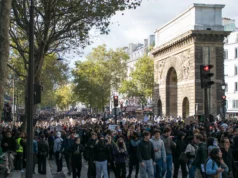
Beyazıt Meydanı önünde üniversite öğrencilerinin başlattığı prostestolar. – Wikipedia
Key Sources and References
Steven Levitsky and Daniel Ziblatt, How Democracies Die, Crown, 2018
V-Dem Institute, Democracy Report 2026: Unraveling the Democratic Era?, University of Gothenburg, 2026. Available at: https://www.v-dem.net/documents/75/V-Dem_Institute_Democracy_Report_2026_lowres.pdf
Deutscher Bundestag, “Kalenderblatt: Ermächtigungsgesetz,” 2023. Available at: https://www.bundestag.de/dokumente/textarchiv/2023/kw12-kalenderblatt-ermaechtigungsgesetz-938540
Deutscher Bundestag, “Heinrich August Winkler zum Ermächtigungsgesetz,” March 2013. Available at: https://www.bundestag.de/webarchiv/textarchiv/2013/winkler-343610
Deutsches Historisches Museum, LeMO, “Das Ermächtigungsgesetz.” Available at: https://www.dhm.de/lemo/kapitel/ns-regime/etablierung-der-ns-herrschaft/ermaechtigungsgesetz
Inter-Parliamentary Union, “Hungary: Elections held in 2010” and “Hungary: Elections held in 2014,” PARLINE database. Available at: http://archive.ipu.org/parline-e/reports/arc/2141_10.htm · http://archive.ipu.org/parline-e/reports/arc/2141_14.htm
National Election Office of Hungary, 2014 parliamentary election, national list results. Available at: https://www.valasztas.hu/dyn/pv14/szavossz/en/orszlist_e.html
OSCE/ODIHR, Hungary, Parliamentary Elections, 6 April 2014: Limited Election Observation Mission Final Report, 11 July 2014. Available at: https://www.osce.org/files/f/documents/c/0/121098.pdf
Court of Justice of the EU, Press Release No 139/12, Case C-286/12 Commission v Hungary, 6 November 2012. Available at: https://curia.europa.eu/jcms/upload/docs/application/pdf/2012-11/cp120139en.pdf
Kim Lane Scheppele, “How to Evade the Constitution: The Hungarian Constitutional Court’s Decision on Judicial Retirement Age, Part I,” Verfassungsblog, 9 August 2012. Available at: https://verfassungsblog.de/evade-constitution-case-hungarian-constitutional-courts-decision-judicial-retirement-age/
Hungarian Helsinki Committee, “Hungary Fact Sheet: Lowering of the Mandatory Retirement Age for Judges,” 2012. Available at: https://helsinki.hu/wp-content/uploads/Mandatory-retirement-of-judges.pdf
Human Rights Watch, “Venezuela: Chávez Allies Pack Supreme Court,” December 13, 2004. Available at: https://www.hrw.org/news/2004/12/13/venezuela-chavez-allies-pack-supreme-court
Human Rights Watch, “Rigging the Rule of Law: Judicial Independence Under Siege in Venezuela,” June 16, 2004. Available at: https://www.hrw.org/report/2004/06/16/rigging-rule-law/judicial-independence-under-siege-venezuela
Human Rights Watch, “A Decade Under Chávez: Political Intolerance and Lost Opportunities for Advancing Human Rights in Venezuela,” September 18, 2008. Available at: https://www.hrw.org/report/2008/09/18/decade-under-chavez/political-intolerance-and-lost-opportunities-advancing-human
Mark Weisbrot, Rebecca Ray and Luis Sandoval, “The Chávez Administration at 10 Years: The Economy and Social Indicators,” Center for Economic and Policy Research, February 2009. Available at: https://www.cepr.net/documents/publications/venezuela-2009-02.pdf
Human Rights Watch, “World Report 2017: Venezuela,” 2017. Available at: https://www.hrw.org/world-report/2017/country-chapters/venezuela
CBS News, “Venezuela’s military recognizes Vice President Delcy Rodriguez as acting leader after Maduro’s capture,” January 4, 2026. Available at: https://www.cbsnews.com/news/venezuela-military-delcy-rodriguez-acting-leader-nicolas-maduro/
UN Human Rights Council, 63rd session, 18th meeting: interactive dialogue with the Independent International Fact-Finding Mission on the Bolivarian Republic of Venezuela, September 18, 2026. Available at: https://transcripts.un.org/en/hrc/63/18
Guillermo O’Donnell, “Delegative Democracy,” Journal of Democracy, Vol. 5, No. 1, January 1994, pp. 55–69. Available at: https://www.journalofdemocracy.org/articles/delegative-democracy/
Steven Levitsky and Lucan A. Way, “Elections Without Democracy: The Rise of Competitive Authoritarianism,” Journal of Democracy, Vol. 13, No. 2, April 2002, pp. 51–65. Available at: https://www.journalofdemocracy.org/articles/elections-without-democracy-the-rise-of-competitive-authoritarianism/
Ágnes Urbán / Mérték Media Monitor, “Fidesz-friendly media dominate everywhere,” May 2, 2019. Available at: https://mertek.eu/en/2019/05/02/fidesz-friendly-media-dominate-everywhere/
Hungarian Civil Liberties Union, “Orbán’s Media Empire Unlawfully Given Green Light,” 2020. Available at: https://hclu.hu/en/articles/orbans-media-empire-unlawfully-given-green-light
Insight Hungary (444), “Court says pro-government media merger was unlawfully approved,” January 30, 2020. Available at: https://insighthungary.444.hu/2020/01/30/court-says-pro-government-media-merger-was-unlawfully-approved
Human Rights Watch, “Turkey: Court Orders Newspaper Takeover,” March 5, 2016. Available at: https://www.hrw.org/news/2016/03/05/turkey-court-orders-newspaper-takeover
Human Rights Watch, “Turkey: Judges, Prosecutors Unfairly Jailed,” August 5, 2016. Available at: https://www.hrw.org/news/2016/08/05/turkey-judges-prosecutors-unfairly-jailed
Stockholm Center for Freedom, “Only 95 of 4,156 Judges and Prosecutors Fired After Coup in Turkey Reinstated: Report.” Available at: https://stockholmcf.org/only-95-of-4156-judges-and-prosecutors-fired-after-coup-in-turkey-reinstated-report/
The Conversation, “Turkish referendum grants more power to Erdoğan – democracy no more?,” April 2017. Available at: https://theconversation.com/turkish-referendum-grants-more-power-to-erdogan-democracy-no-more-75824
Amberin Zaman, “Erdogan assumes office, vast new powers,” Al-Monitor, July 9, 2018. Available at: https://www.al-monitor.com/originals/2018/07/erdogan-sworn-in.html
Camera dei deputati, “Il periodo fascista,” Conoscere la Camera: il sistema elettorale. Available at: https://conoscere.camera.it/norme-essenziali/il-sistema-elettorale/precedente-legislazione-elettorale/il-periodo-fascista
Pagella Politica, “Civati e i difetti dell’Italicum” (fact-check on the Acerbo Law and the 1924 election). Available at: https://pagellapolitica.it/fact-checking/civati-e-i-difetti-dellitalicum
Fernando Venturini, “Elections after Mussolini’s speech of January 3rd, 1925?,” Le Carte e la Storia, No. 2/2020, Il Mulino. Available at: https://rivisteweb.it/doi/10.1411/99394
OSW Centre for Eastern Studies, “Elections in Hungary: triumph of Péter Magyar,” April 13, 2026. Available at: https://www.osw.waw.pl/en/publikacje/analyses/2026-04-13/elections-hungary-triumph-peter-magyar
BTA, “Tisza Party Wins Hungary Election with Constitutional Majority,” April 13, 2026. Available at: https://www.bta.bg/en/news/1104529-tisza-party-wins-hungary-election-with-constitutional-majority
International IDEA, “Is Poland’s Democratic Backsliding Over? History Shows It Takes More Than an Election,” December 13, 2023. Available at: https://www.idea.int/blog/polands-democratic-backsliding-over-history-shows-it-takes-more-election
Notes from Poland, “President vetoes bill reforming judicial body at heart of Poland’s rule of law crisis,” February 19, 2026. Available at: https://notesfrompoland.com/2026/02/19/president-vetoes-bill-reforming-judicial-body-at-heart-of-polands-rule-of-law-crisis/