NOT INVESTMENT ADVICE

Nothing in this article constitutes financial advice or a recommendation to buy, sell, or hold any asset. Bitcoin is a speculative asset. You can lose everything. The scenarios described are analytical frameworks, not predictions. Consult a qualified financial advisor before making any investment decisions.
Bitcoin hit a record of about $126,000 in October 2025, fell below $60,000 in mid-2026 and trades around $83,000 as of October 2026. In 2025, North Korea stole $1.5 billion from a single exchange. The world’s largest crypto exchange had already pleaded guilty in US federal court to anti-money-laundering and sanctions violations, and the US Treasury found it had failed to report transactions linked to groups including Al-Qaeda and Hamas. Crypto-industry PACs raised more than $245 million for the 2024 US elections, buying political protection that may not outlast the administration it helped elect. What comes next depends on the monetary thesis and on everything else Bitcoin is, including the forces arrayed for and against it.
Bybit, February 2025
On February 21, 2025, North Korea’s Lazarus Group drained some 401,000 ether plus other Ethereum-based tokens, worth roughly $1.5 billion in total, from a cold wallet at Bybit, a Dubai-based cryptocurrency exchange. The blockchain analytics firm Elliptic calls it almost certainly the largest known theft of any kind, bigger than the roughly $1 billion Saddam Hussein took from Iraq’s central bank in 2003. It was not a brute-force attack. The attackers had first compromised a computer belonging to a developer at Safe{Wallet}, the multi-signature wallet software Bybit used for cold storage, and planted malicious code in Safe’s web interface. During what looked like a routine transfer from cold to warm storage, Bybit’s authorised signers approved a transaction that, unknown to them, handed control of the wallet to the attackers. The CEO was the last to sign.
Within 48 hours, at least $160 million had been laundered through a cascade of blockchain bridges, decentralised exchanges and high-frequency wallet splits, a technique researchers call ‘flood the zone,’ designed to overwhelm compliance teams faster than they can coordinate. By March 20, Bybit’s CEO reported that about 86% of the stolen funds had been converted into roughly 12,800 bitcoin. The FBI attributed the attack to Lazarus Group. The UN Panel of Experts that had been tracking Lazarus’s cryptocurrency theft for years had been dissolved ten months earlier, after Russia vetoed its mandate renewal.
The ether was stolen and laundered into Bitcoin, because Bitcoin offers the deepest liquidity in crypto and is the hardest to freeze. The international body meant to track this had been removed by a state that benefits from crypto’s permissive environment.
As of October 2026, Bitcoin trades at about $83,000, roughly a third below its all-time high of about $126,000 set on October 6, 2025, and its market capitalisation is about $1.67 trillion. Strategy, the company formerly known as MicroStrategy, holds 848,000 bitcoin, roughly 4% of the 21 million coins that will ever exist, and BlackRock’s iShares Bitcoin Trust (IBIT) holds roughly 805,000 more. (Market figures as of October 4–13, 2026; check current values at the time of reading.) By these numbers Bitcoin has won the argument over mainstream legitimacy, but nothing in them shows that its future is secure.
The Monetary Case Is Real
Gold rose about two-thirds in 2025, its best calendar year since 1979. It peaked near $5,600 an ounce in late January 2026 before falling back to around $4,200 by October 2026. Safe-haven and diversification demand, alongside heavy central-bank buying, drove the rally; many analysts link it to eroding confidence in the long-run value of dollar-denominated government debt. The Congressional Budget Office projects that US federal debt held by the public will pass its post-war record around 2030 and reach 175% of GDP by 2056. That is the baseline under current law, not a crisis scenario, and it has worsened with each edition: a year earlier the same projection ended at 156% of GDP by 2055.
Bitcoin’s macro bull thesis is that it performs the same function as gold but better: a fixed supply of 21 million coins enforced by code rather than geology, digital transfer without custody costs, no counterparty risk if self-custodied. If institutional allocators moved $1 trillion into Bitcoin, less than 1% of the world’s professionally managed assets, that would be new demand equal to more than half of Bitcoin’s current market capitalisation. How much that would move the price is uncertain, but the direction is clear. Gold’s 2025 rally is consistent with the monetary debasement thesis. The question is whether Bitcoin survives the political environment long enough for it to play out.
The case is strongest where it is least discussed in Western financial media: ordinary people using Bitcoin to protect savings from governments actively destroying them. Argentina recorded official inflation of 211% in 2023, the highest in over three decades. Nigeria’s naira lost more than half its dollar value after the 2023–24 exchange-rate unification. Lebanon’s banking system, insolvent since the 2019 crash, has kept most depositors locked out of their dollar savings, while the Lebanese pound lost 98% of its value. Venezuela’s decade-long economic collapse included more than three years of hyperinflation, from late 2017 to early 2021. In each case, people who converted salaries to Bitcoin or USDT the day they received them were trying to protect their savings from monetary theft by their own governments. This use case, the one with the clearest moral claim, is absent from most Western analysis because engaging with it seriously requires acknowledging that democratic governments are not the only kind that exist, and that some governments steal from their own citizens as policy.
Bitcoin has survived four crashes of more than 75%, in 2011, 2013–15, 2017–18 and 2021–22, plus a roughly 50% collapse in March 2020, and it has recovered to new highs each time. Each crash produced confident declarations of terminal failure, and each was followed by a new cycle. That pattern may not continue. But the institutional infrastructure built across those cycles did not exist in any earlier cycle: a single BlackRock ETF and one public company’s balance sheet that each hold hundreds of thousands of bitcoin, regulated futures markets, institutional custodians, a US Strategic Bitcoin Reserve created by executive order in March 2025, and a political-action network that raised hundreds of millions of dollars in a single election cycle. The political cost of legislation that effectively confiscates or prohibits an asset held at this scale by regulated institutional participants is different from the political calculus of 2013 or 2017. That does not make prohibition impossible, but it raises its cost.
And the Monetary Case Is Not Enough
Bitcoin’s core value proposition, the one that makes the monetary thesis coherent, is censorship resistance. The government cannot freeze your Bitcoin if you hold your own keys. If you hold BlackRock’s iShares Bitcoin Trust, IBIT, you hold a claim on Bitcoin in custody at Coinbase, managed by BlackRock. That custody puts the coins, and the records of who owns them, within reach of US law. The International Emergency Economic Powers Act has been used to freeze foreign sovereign assets held in US institutions. National Security Letters let the FBI obtain financial records without prior court approval, usually under a gag order. The ETF infrastructure that has made Bitcoin’s price higher has at the same time made its foundational property more theoretical. The Bitcoin community has celebrated the first development while treating the second as a detail.
Insurance is a constraint less discussed than regulation. Crime and custody cover for digital assets is offered by a small specialist market, and insured limits are typically far smaller than the holdings of the largest custodians. For a sovereign wealth fund weighing a large direct allocation, the limits on insurance could matter as much as the limits imposed by regulators.
Much of the world’s Bitcoin trading, especially on large offshore exchanges, is quoted against Tether (USDT) rather than US dollars. Tether, which backs about $184 billion of USDT in circulation, relied for years on quarterly attestations: snapshots of reserves that are not equivalent to a full audit. In August 2026 it announced that KPMG had completed its first full financial-statement audit, for 2025, and issued a clean (“unqualified”) opinion on its main issuing entity, Tether International. Tether has not published the audited statements or their notes, so outside observers can verify only the headline figures it has chosen to release. The finance professors John Griffin and Amin Shams presented statistical evidence that Tether issuances correlated with Bitcoin price support during the 2017 bull run, in patterns consistent with coordinated price inflation. Their reading of the data is contested. Griffin and Kevin Mei later estimated that crypto flows linked to pig-butchering networks moved tens of billions of dollars a year into suspicious exchange accounts, mostly in Tether. Tether is therefore at once the instrument through which Bitcoin’s price is discovered, a primary settlement layer for large-scale organised crypto-enabled crime flows, and a financial entity that operated at enormous scale for more than a decade before obtaining its first full audit, the details of which remain unpublished. If Tether is fractionally reserved and confidence breaks, the liquidity withdrawal hits every cryptocurrency market at once, with no circuit breaker and no lender of last resort.
Crypto-related PACs and affiliated groups raised more than $245 million in the 2024 US election cycle. Fairshake, the largest, disbursed about $196 million over 2023–24, including transfers to its affiliated PACs. Fairshake and its affiliated committees, funded primarily by Coinbase, Ripple and Andreessen Horowitz, accounted for the majority of the money raised. By August 2024, Public Citizen estimated, the industry accounted for nearly half of all corporate money given to the election so far. The cycle ended with nearly 300 pro-crypto lawmakers in the House and Senate, by the industry’s own count, and an administration openly aligned with the industry. In January 2025, Trump pardoned Ross Ulbricht, founder of Silk Road, who was serving double life without parole. Silk Road was the darknet marketplace whose sales, mostly of drugs, totalled more than 9.5 million bitcoin by US prosecutors’ count, about $1.2 billion at the exchange rate when the FBI seized the site in October 2013. The pardon was framed as a matter of liberty. It also signalled how much tolerance the new administration would extend to crypto’s operational ecosystem. Fairshake and its affiliated PACs reported more than $193 million on hand for the 2026 midterms in January 2026.
Bitcoin’s advocates rarely mention Monero, which solves the privacy problem Bitcoin cannot solve without a protocol change. Transactions are confidential at the base layer by default: amounts, senders and recipients are all obscured. In 2020 the IRS awarded Chainalysis and Integra FEC contracts worth up to $1.25 million combined to develop Monero-tracing tools. Several major exchanges, including Binance and, in Europe, Kraken, have delisted it amid regulatory pressure, and blockchain analysts describe Monero as an increasingly important currency on darknet markets. Monero is better at the property Bitcoin claims as its core identity, and the Bitcoin community rarely engages with that fact.
What Bitcoin Runs
Bitcoin’s role as criminal payment infrastructure sits under every regulatory scenario and every political risk in this article, and it deserves the same scrutiny as the monetary case.
Blockchain analytics firm Chainalysis estimates that illicit transactions account for well under 1% of all cryptocurrency volume, down from roughly 3–4% in 2019, a year it describes as an outlier driven by the PlusToken Ponzi scheme. In absolute terms, however, illicit flows hit a record of at least $154 billion in 2025, and most of that now moves in stablecoins rather than bitcoin. The share is measured against flows into known exchanges and services, not against everything that moves on-chain, and it counts only the illicit addresses the firm has managed to identify; Chainalysis itself says the share edged up in 2025. The methodologies and incentives behind these estimates are contested; the firms producing them hold commercial contracts with the very exchanges and law enforcement agencies whose behaviour the data is used to justify. A smaller percentage of a much larger market can still be a larger sum, which is what has happened as the market grew. And the comparison to traditional finance cuts both ways. Fiat financial systems operate under KYC requirements that Bitcoin historically did not, but major banks have paid tens of billions in penalties for money laundering at a scale that dwarfs most cryptocurrency prosecutions, and illicit fiat flows dwarf illicit crypto flows in absolute terms. The declining share is real. Over the long run it shows crypto’s criminal use shrinking relative to legitimate use, not shrinking in absolute terms, and the 2025 record shows the opposite. Nor does it settle the comparison with regulated alternatives.

Pig Butchering: Hundreds of Thousands Forced to Run Scams
Griffin and Mei traced blockchain flows from documented pig-butchering victims. Their first estimate was more than $75 billion moved from suspected criminal networks to exchanges over four years, mostly in Tether; after revising their work, they put the figure at about $27.8 billion a year flowing into suspicious exchange deposit accounts in 2021–2023. These are flows through exchanges, not a count of victims’ losses. Losses reported to the FBI’s Internet Crime Complaint Center from investment fraud, the costliest category, reached $8.6 billion in 2025, up on the year before. In 2023 the UN Human Rights Office estimated that at least 120,000 people in Myanmar and around 100,000 in Cambodia were being held and forced to run online scams, with tens of thousands more in Laos and elsewhere in the region.
Those people are not volunteers. They were recruited with fraudulent job offers, transported across borders, had their passports confiscated, and are forced under threat of violence to run long-con romance and investment fraud against victims worldwide. The victim is cultivated for weeks or months, shown fabricated returns, encouraged to invest more, then told their funds are locked and fees must be paid to withdraw, and those fees vanish into the same operation. Some of the people inside the compounds are beaten, and some have died trying to escape.
The payment rail is overwhelmingly crypto, though scammers also use bank wires and other transfers, because the operation needs a mechanism that is fast, borderless and hard to reverse. Stablecoin issuers such as Tether can and do freeze addresses once they are identified as tainted, but that happens only after the fact. Tracing, freezes and victim warnings help: the FBI’s Operation Level Up estimates that its notifications spared victims about $226 million in 2025. But pig butchering has no clean technical fix. The structural remedies, reversibility and permissioned access, both cut against Bitcoin’s design principles. This has become one of the primary arguments against Bitcoin’s permissionless architecture in legislative and policy discussions, and the industry has not produced a widely accepted answer.
North Korea: Nearly $7 Billion, a Dissolved UN Panel, and a WMD Programme
Since Russia vetoed the renewal of the UN Panel of Experts on North Korea on 28 March 2024 (its mandate expired at the end of April), tracking North Korean cryptocurrency theft has fallen to private-sector analytics firms and national governments. Chainalysis attributes $1.34 billion in cryptocurrency theft to North Korean state-backed groups in 2024, 61% of everything stolen that year. The Bybit haul alone surpassed that in a single operation. Chainalysis puts North Korea’s 2025 total at about $2 billion, Bybit included, and its all-time total at about $6.75 billion by the end of that year. Elliptic has tracked more than $1 billion in suspected North Korean thefts in 2026 alone, including an attack on the Bitget exchange in September that the exchange later put at nearly $390 million.
US and international officials have assessed that stolen cryptocurrency helps fund North Korea’s weapons of mass destruction and ballistic missile programmes, and independent blockchain analysts have traced the money as it moves. Every legislator weighing crypto policy does so against that public assessment, and the monetary philosophy argument does not arrive in committee rooms unfiltered.
Binance Pleaded Guilty in Federal Court
In November 2023, Binance, the world’s largest cryptocurrency exchange by trading volume, pleaded guilty in US federal court to failing to maintain an anti-money-laundering programme, operating as an unlicensed money-transmitting business, and violating US sanctions law, after its platform matched more than $898 million in trades between US users and users in Iran. In a parallel settlement, the US Treasury’s FinCEN found that Binance never filed a single suspicious-activity report, including on more than 200 bitcoin transactions with wallets linked to Al-Qaeda and on transactions linked to Hamas’ al-Qassam Brigades. It also found that Binance’s former chief compliance officer tried to influence how an outside analytics firm reported the Hamas-linked activity. Changpeng Zhao pleaded guilty personally and served four months in a US federal prison; President Trump pardoned him in October 2025. The exchange paid $4.3 billion in penalties and continued operating.
The exchange at the centre of global Bitcoin price discovery admitted running without the basic controls meant to detect and report terrorist-linked transactions. Its continued operation and its founder’s pardon tell every market participant that the consequences of serious cryptocurrency financial crime are manageable.
The Evidence Already in Court Filings
Welcome to Video operated from 2015 to 2018, charging Bitcoin for access to child sexual abuse material. IRS Criminal Investigation agents traced its bitcoin payments on-chain; the case generated leads in 38 countries and led to the arrest of 337 people worldwide. A CSAM prosecution with Bitcoin at its centre now sits in a court record, and that association carries political weight.
Ransomware is a mature industry, with customer service teams, tiered pricing and affiliate revenue splits, and it has a documented preference for healthcare targets because hospitals pay to restore access to patient records rather than risk lives. The February 2024 ransomware attack on Change Healthcare, which processes a large share of US medical claims, disrupted payments and prescriptions nationwide for weeks and exposed data on roughly 190 million people. Its parent company, UnitedHealth, told Congress it paid a $22 million ransom. Ransomware gangs use Bitcoin even though it can be traced, because it solves a logistics problem faster than international law enforcement can coordinate a cross-border response.
The July 2018 DOJ indictment of 12 officers of Russia’s GRU military intelligence alleged that they laundered more than $95,000 through bitcoin and other cryptocurrencies, some of it mined themselves, to pay for the servers, domains and VPN accounts used to hack and leak material during the 2016 US election. The operational use of cryptocurrency by hostile foreign intelligence services against the United States is laid out in public court documents as well as in classified briefings.
The Bank for International Settlements estimates that between 2015 and 2022 most retail crypto-app users in nearly every economy studied lost money on their bitcoin, and that during the Terra and FTX crashes of 2022, large and sophisticated holders sold while smaller retail investors kept buying. The ‘banking the unbanked’ and ‘financial freedom’ narratives functioned as recruiting language for a product that, in aggregate, transferred wealth from late-arriving small investors to earlier entrants and large holders who sold into their buying. Compulsive trading patterns matching gambling addiction profiles and documented financial distress following major crashes generate regulatory pressure from the consumer protection direction, independently of financial crime.
None of these use cases represents the majority of Bitcoin transactions, but each one produces a category of political opposition that is immune to monetary philosophy. A senator who has been briefed on a specific fentanyl death with a traceable cryptocurrency payment in the chain does not weigh Hayek against that briefing and conclude the monetary argument wins.
The Structural Problems Nobody Has Solved
Bitcoin’s security depends on miners being paid enough to make attacking the network economically irrational. They are paid in block subsidies plus transaction fees. The April 2024 halving reduced the subsidy to 3.125 BTC per block. The 2028 halving reduces it to 1.5625 BTC. By around 2140 it reaches zero, and fees must fund everything. Annual fee revenue has never reliably exceeded about $1 billion, a small fraction of what miners now earn from the block subsidy. As the subsidy keeps halving, fees would need to grow many times over to keep the security budget at today’s dollar level unless the price keeps rising to compensate, and the fee growth would require far more transactions or far higher fees than Bitcoin’s base layer currently handles: its post-2017 SegWit rules cap blocks at 4 million weight units, which in practice means roughly 1.5–2 MB of data every ten minutes. The block-size dispute that split Bitcoin Cash from Bitcoin in 2017 was never fully resolved. The community is aware of the problem but has not solved it, and every halving tightens the arithmetic.
Foundry USA mines roughly a quarter to a third of all blocks, and Bitmain-owned AntPool about a fifth. Researcher 0xB10C estimates that once smaller pools that appear to relay AntPool’s work are counted with it, just six pool operators mine more than 95% of blocks. Bitmain also manufactures most of the specialised mining hardware, which gives it structural influence over both the tools used to mine and a large share of the pools that use them. After China’s 2021 ban, much of the hash rate moved to the United States, now the largest single mining jurisdiction. That gives one government a plausible legal route to pressure pools to censor transactions. Some pools have already filtered OFAC-sanctioned transactions out of their blocks: US-based MARA Pool briefly did so in 2021, and F2Pool was documented doing so in 2023. The ledger is immutable, and new entries to it can still be selectively blocked.
Every halving has historically preceded a major price run. The 2012, 2016 and 2020 halvings preceded runs to $1,000, $20,000 and $69,000, and the 2024 halving preceded $126,000. The mechanism is real: supply issuance falls, price rises if demand holds. The effect is also diminishing with each cycle. Halving the subsidy from 50 BTC to 25 BTC when Bitcoin’s market cap was about $130 million is a shock of a different order from halving it from 3.125 to 1.5625 BTC against a market cap of well over $1 trillion. Sophisticated institutional participants now deploy capital in anticipation of halvings, compressing the post-event price response. The current cycle peaked at about $126,000 in October 2025 and fell by more than half, to roughly $58,500, by June 2026, a drawdown smaller than in earlier cycles so far, but still severe.
The Lightning Network is Bitcoin’s answer to its throughput problem: the base layer handles only about 4 to 7 transactions per second, against the more than 65,000 transaction messages per second that Visa says its network can handle. Lightning’s design is elegant, but its adoption has not materialised at scale. Managing channels is technically complex enough that ordinary users have not adopted it despite years of promotion, and the large routing nodes that make Lightning functional resemble correspondent banking: you depend on well-connected intermediaries for liquidity and routing, and they can see part of your payment path and, in aggregate, infer more. They cannot run off with your money, as a bank could, but Bitcoin’s scaling solution reintroduces the dependence on intermediaries its base layer was designed to eliminate.
NIST finalised its first post-quantum cryptography standards in August 2024 and plans to retire quantum-vulnerable algorithms such as ECDSA from its standards by 2035. Bitcoin developers have started drafting a response: BIP-360 proposes a new output type that protects coins whose keys are not yet exposed, and BIP-361 a phased sunset of today’s ECDSA and Schnorr signatures. None of this has been adopted, and no timetable has been agreed. Older outputs that expose public keys directly, including coins from Bitcoin’s earliest years and potentially Satoshi’s, would be the first at risk. The 2035 deadline is not evidence of an imminent threat, but it shows how seriously standards bodies take the risk. Bitcoin’s governance has taken years to deploy uncontroversial upgrades. A quantum emergency requiring a rushed soft-fork migration would test that governance more than the cryptography, and nothing of that scope has ever been attempted under pressure: the network’s one emergency fix, a chain split in March 2013, was resolved within hours by a handful of developers and two mining pools, when Bitcoin was small enough for that to work.
What Governments See
The blockchain is a permanent, public record of every on-chain transaction ever made, which makes it at once Bitcoin’s greatest forensic asset and the raw material of a financial surveillance industry. Blockchain-analytics firms such as Chainalysis, Elliptic and TRM Labs sell tracing tools to US agencies including the FBI and IRS Criminal Investigation, and to law-enforcement bodies across the West. Documents leaked by Snowden showed that the NSA was already working to “track down” bitcoin users in 2013, using a covert internet-tapping programme code-named MONKEYROCKET, and hinted that the data was searchable through its XKeyscore system.
The surveillance capability is more comprehensive than the cryptocurrency community admits, and it works best against people who make operational security errors, which means ordinary users and unsophisticated criminals are largely transparent while state-level operators and well-resourced organised crime are harder to prosecute. The financial freedom narrative primarily benefits state actors, disciplined organised crime and intelligence services, who are best placed to exploit it despite the surveillance, while exposing everyone else.
The countervailing interest is real and almost never discussed in public: intelligence services use cryptocurrency operationally. Paying human assets in hostile jurisdictions through traditional banking creates records and requires correspondent banking that can be monitored or frozen. A cryptocurrency transfer to a wallet in Tehran or Pyongyang with no financial institution involved solves a specific operational problem. So the same governments that contain a law enforcement interest in Bitcoin’s suppression also contain an institutional interest in its continued permissive status. The regulatory debate within governments is probably more complicated than the public one, because these two interests pull against each other inside the same institutions.
The market debates Bitcoin’s future as a financial question. Inside governments it is also a national security question, with different timelines and different possible outcomes. The April 2024 arrest of Samourai Wallet’s founders, charged with money laundering and unlicensed money transmission for running a Bitcoin CoinJoin implementation, illustrated the prosecutorial posture toward privacy-enhancing tools at the time. The founders later pleaded guilty to conspiring to run a money-transmitting business that knowingly moved criminal proceeds (the money-laundering charge was dropped under the plea deal), and in November 2025 were sentenced to five and four years in prison. In December, President Trump said he would look at a pardon. The case shows how far Bitcoin privacy development depends on prosecutorial choices and political winds rather than settled legal doctrine. The chilling effect on privacy development is real; developers cannot build on assumptions that shift with administrations.
The emergency legislation scenario, though real, represents one end of a spectrum. The more likely trajectory, and the one that receives the least attention in risk analysis, is that Bitcoin follows previous disruptive financial instruments toward progressive regulatory enclosure rather than prohibition. Derivatives, offshore banking and money transmission all went through the same cycle: initial permissiveness, high-profile abuses, legislative response, compliance infrastructure, and eventual normalisation under regulatory oversight. Bitcoin has already moved further along this path than the dark economy framing alone suggests. AML and KYC requirements at major exchanges, occasional OFAC filtering by mining pools, the ETF approval process, a US Strategic Bitcoin Reserve created by executive order in March 2025, and the GENIUS Act of July 2025 (the first federal rulebook for stablecoins, requiring full reserve backing and monthly disclosures) all represent regulatory adaptation rather than prohibition. So holders face a second question beyond whether emergency legislation passes: whether the regulated Bitcoin that emerges from that normalisation resembles the asset they believed they were buying, and whether censorship resistance, the property that justifies the monetary premium, survives the compliance architecture being built around it.
The bullish case (repeated cycles of price appreciation, deepening institutional infrastructure, and the monetary use case that gold’s 2025 rally made more plausible) is real. The structural, political and criminal constraints receive less attention in mainstream coverage because they are harder to quantify and less useful to those selling exposure to the asset.
The Decision Framework
| Scenario | Conditions required | Primary risk | Plausible BTC range |
| Macro hedge matures | US fiscal trajectory stays broken. Dollar credibility erodes measurably. Institutions rotate 2–5% of global AUM into hard-capped non-sovereign assets. ETF holders survive the next recession without mass capitulation. | Bitcoin has tended to fall alongside equities in major risk-off episodes, such as March 2020 and 2022. The ETF investor base has never been tested through a sustained 60% drawdown. Institutional sell mandates do not respect thesis timelines. | $180,000–$500,000+ |
| Financialisation captures it | ETFs and corporate treasuries embed BTC permanently in mainstream finance. Price tracks institutional risk appetite rather than monetary fundamentals. The censorship-resistance thesis is abandoned as the price rises. | Purchased political protection expires with the administration that sold it. One election or one high-profile prosecution reverses the regulatory posture. The asset survives but what it was supposed to be does not. | $60,000–$180,000 (range-bound, volatile) |
| Post-atrocity legislation | A mass-casualty event with cryptocurrency anywhere in the financial chain triggers emergency legislation. Does not require Bitcoin to be the primary instrument. Requires one traceable link at a politically sensitive moment. | The PATRIOT Act passed in 45 days. IEEPA lets the President freeze assets in a declared emergency — a power already used against foreign central-bank reserves. Congress legislates on the NSA briefing, not the industry lobbying memo. | $10,000–$45,000 (sustained suppression) |
| Security budget crisis | Fee revenue fails to replace declining block subsidies across successive halvings. Mining centralises further as marginal operators exit. The economic cost of a 51% attack falls below the profit threshold. | No consensus solution exists. The 2028 halving reduces the subsidy to 1.5625 BTC. Every halving tightens the arithmetic and the community has not resolved this in fifteen years of awareness. | $25,000–$90,000 (structural drag) |
| Tether detonation | USDT fractional reserve confidence breaks. Bitcoin’s dominant price-discovery liquidity layer collapses simultaneously across all markets. | Griffin and Shams found statistical evidence that Tether issuances supported BTC prices during the 2017 bull run. KPMG’s first full audit (2025 accounts) gave a clean opinion in August 2026, but the statements remain unpublished. No circuit breaker exists. | $8,000–$30,000 (recovery likely after) |
| Protocol black swan | A cryptographically relevant quantum computer exists, publicly or in a classified programme, before the network deploys post-quantum cryptography. Or Satoshi’s coins move and interpretation cascades cannot be contained. | NIST finalised post-quantum standards in 2024. Bitcoin migration proposals (BIP-360, BIP-361) exist only as drafts. Its governance has taken years on uncontroversial changes. A classified breakthrough could leave the network no warning window. | $0–$35,000 |
All price ranges are analytical estimates only, not forecasts, targets, or investment advice. For reference, Bitcoin traded around $83,000 in October 2026. Verify all figures at the time of reading.
Two Coalitions
On October 6, 2025, Bitcoin hit about $126,000. BlackRock’s bitcoin ETF was approaching $100 billion in assets. Strategy held about 640,000 bitcoin, more than 3% of the total supply. Seven months earlier, in February of that same year, Lazarus Group had emptied Bybit’s cold wallet and laundered most of the proceeds into Bitcoin.
The asset that hit $126,000 and the asset into which North Korea laundered the proceeds of the Bybit theft are the same asset. The monetary technology protecting Argentine savings also serves as a payment rail for pig butchering operations in Myanmar, and the censorship-resistant network that serves the Iranian dissident is the one the GRU used to purchase infrastructure for election interference operations. Bitcoin’s dark economy and its legitimate economy are inseparable at the protocol level by design, and that is the source of every political problem it faces.
Bitcoin’s future is decided by whether the coalition currently protecting its regulatory status proves larger and more durable than the coalition that will form around the next event that makes crypto’s dark economy politically impossible to tolerate. The first coalition has hundreds of millions of dollars in political spending, ETF infrastructure too embedded to dismantle cheaply, and the legitimate monetary and capital flight case that gold’s 2025 rally made more coherent. The threat coalition already has its evidence: $1.5 billion stolen by a state that uses such thefts to help fund weapons of mass destruction, hundreds of thousands of people trafficked into scam compounds, and tens of billions of dollars a year in suspected scam flows through crypto exchanges.
The emergency legislation scenario has a precedent. The PATRIOT Act became law 45 days after 9/11. Its surveillance provisions, written to expire, were renewed again and again for almost two decades before the most controversial of them lapsed in 2020. The trigger need not involve Bitcoin directly. It only needs to be a mass-casualty event with a traceable cryptocurrency payment somewhere in the financial chain, even if not the primary funding, at a moment when a specific administration needs a political response. In that scenario, Congress votes within weeks, and the people writing the legislation would already know about Bybit, about Lazarus, about pig butchering, and about a Binance compliance chief trying to shape how an outside firm reported Hamas-linked transactions, conduct laid out in a federal settlement anyone can read.
Someone who bought at the November 2021 peak of about $69,000 was back below that price by early February 2026 and, after a brief recovery in March, watched it fall to about $58,500 in June. Between those points: a 77% crash to about $16,000, a recovery to $126,000, and a fall of more than half. Anyone who held from the 2021 high through all of it is, as of October 2026, only modestly ahead after almost five years. The monetary thesis was right about direction, but the path was brutal. The next version of this test is already building: in mining pool concentration, in the security budget arithmetic tightening with each halving, in pig butchering compounds that have not been shut down, in a North Korean hacking operation that emptied Bybit in a single day in 2025 and is still draining exchanges in 2026.
For an investor, the decision rests on two judgments: the fiscal trajectory of major governments, and the speed at which the dark economy produces a trigger for emergency legislation. It also rests on whether they can hold through the drawdown that precedes the thesis playing out, because every previous cycle has demanded exactly that.
Gen AI Disclaimer
Some contents of this page were generated and/or edited with the help of a Generative AI.
Media
Panorama View of Sihanoukville from Otres Beach – Wikipedia
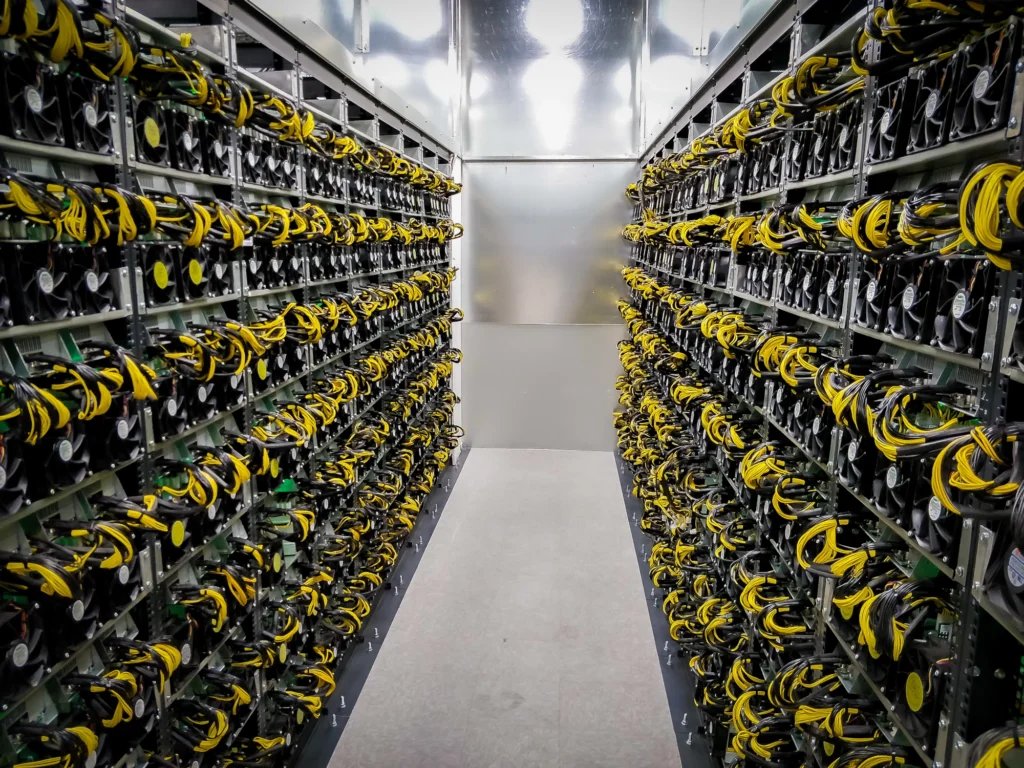
Bitcoin mining facility with large amounts of mining hardware – Wikipedia
Key Sources and References
Figures reflect data as of 13 October 2026 unless otherwise dated. Prices, holdings and fund assets change daily; verify at the time of reading.
Bybit (2025). “Bybit Security Incident: Timeline of Events and FAQs.” Bybit Learn. (Routine cold-to-warm transfer from 13:30 UTC, exploit at 14:13 UTC on 21 February 2025; tokens stolen.) https://www.bybit.com/en/learn/this-week-in-bybit/bybit-security-incident-timeline
FBI Internet Crime Complaint Center (2025). “North Korea Responsible for $1.5 Billion Bybit Hack.” Public Service Announcement I-022625-PSA. (Attribution to North Korea’s “TraderTraitor” / Lazarus.) https://www.ic3.gov/PSA/2025/PSA250226
Elliptic (2025). “The largest theft in history – following the money trail from the Bybit hack.” Elliptic. (≈$1.46 billion; “almost certainly the single largest known theft of any kind”; Dubai-based exchange.) https://www.elliptic.co/insights/bybit-hack-largest-in-history/
CertiK (2025). “Bybit Incident Technical Analysis.” CertiK. (Safe{Wallet} interface compromise; the CEO was the last signer.) https://www.certik.com/blog/bybit-incident-technical-analysis
NCC Group (2025). “Bybit Hack: In-Depth Technical Analysis.” NCC Group Research. (Compromised Safe developer machine; malicious JavaScript; 401,347 ETH plus liquid-staking tokens.) https://www.nccgroup.com/us/research-blog/in-depth-technical-analysis-of-the-bybit-hack/
TRM Labs (2025). “The Bybit Hack: Following North Korea’s Largest Exploit.” TRM Labs. (At least $160 million laundered within 48 hours; “flood the zone” laundering.) https://www.trmlabs.com/resources/blog/the-bybit-hack-following-north-koreas-largest-exploit
ForkLog (2025). “Ben Zhou: Majority of Stolen Bybit Funds Remain Traceable.” ForkLog. (Reproduces Zhou’s 20 March 2025 post: 86.29% of stolen funds converted into 12,836 BTC.) https://forklog.com/en/ben-zhou-majority-of-stolen-bybit-funds-remain-traceable/
United Nations (2024). “Security Council Fails to Extend Mandate of Expert Panel Assisting Sanctions Committee on Democratic People’s Republic of Korea.” Press release SC/15648, 28 March 2024. https://press.un.org/en/2024/sc15648.doc.htm
Chainalysis (2024). “$2.2 Billion Stolen in Crypto in 2024 but Hacked Volumes Stagnate.” Chainalysis, 19 December 2024. (North Korea: $1.34 billion in 2024, 61% of the total stolen.) https://www.chainalysis.com/blog/crypto-hacking-stolen-funds-2025/
Chainalysis (2025). “2025 Crypto Theft Reaches $3.4 Billion.” Chainalysis, 18 December 2025. (North Korea: $2.02 billion stolen in 2025, including Bybit; all-time total $6.75 billion through 2025.) https://www.chainalysis.com/blog/crypto-hacking-stolen-funds-2026/
Elliptic (2026). “Bitget attack pushes suspected North Korea crypto heists over $1 billion in 2026.” Elliptic, 25 September 2026. (Over $350 million withdrawn from Bitget hot wallets on 24 September 2026.) https://www.elliptic.co/insights/bitget-attack-pushes-suspected-north-korea-crypto-heists-over-1-billion-in-2026/
BleepingComputer (2026). “Bitget resumes Bitcoin withdrawals after $387.5 million crypto heist.” BleepingComputer, 28 September 2026. (Bitget’s revised loss figure of $387.5 million; suspected North Korean attackers.) https://www.bleepingcomputer.com/news/security/bitget-resumes-bitcoin-withdrawals-after-3875-million-crypto-heist
Chainalysis (2025). “2025 Crypto Crime Trends.” Chainalysis. (Illicit share of crypto volume 0.14% in 2024, initial estimate; stablecoins’ share of illicit volume; Tether freezes; Monero on darknet markets.) https://www.chainalysis.com/blog/2025-crypto-crime-report-introduction/
Chainalysis (2026). “2026 Crypto Crime Report Introduction.” Chainalysis. (Record of at least $154 billion received by illicit addresses in 2025.) https://www.chainalysis.com/blog/2026-crypto-crime-report-introduction/
Chainalysis (2022). “Crypto Crime Trends for 2022.” Chainalysis. (2019 as an outlier year driven by the PlusToken scheme.) https://www.chainalysis.com/blog/2022-crypto-crime-report-introduction/
CoinGecko (2026). “Bitcoin (BTC) price and market data.” CoinGecko. (All-time high of $126,080 on 6 October 2025; price about $83,000 and market cap about $1.67 trillion on 13 October 2026.) https://www.coingecko.com/en/coins/bitcoin
Coin Metrics (2026). “Community API: BTC daily reference price, market cap and fees, 2010–2026.” Coin Metrics. (Crash depths; June 2026 low of about $58,500; annual fee revenue.) https://community-api.coinmetrics.io/v4/timeseries/asset-metrics?assets=btc&metrics=PriceUSD,CapMrktCurUSD,FeeTotNtv&frequency=1d&start_time=2010-07-18&page_size=10000&paging_from=start
Strategy Inc. (2026). “Form 8-K, 5 October 2026.” US Securities and Exchange Commission. (848,000 BTC held at an aggregate cost of about $63.97 billion as of 4 October 2026.) https://www.sec.gov/Archives/edgar/data/0001050446/000119312526413164/mstr-20261005.htm
Strategy Inc. (2026). “Form 8-K, 23 March 2026.” US Securities and Exchange Commission. (762,099 BTC for about $57.7 billion.) https://www.sec.gov/Archives/edgar/data/1050446/000119312526118584/mstr-20260223.htm
MicroStrategy Inc. (2025). “Form 8-K, 6 October 2025.” US Securities and Exchange Commission. (640,031 BTC as of 30 September 2025.) https://www.sec.gov/Archives/edgar/data/1050446/000119312525230977/d49048d8k.htm
BlackRock (2026). “iShares Bitcoin Trust ETF (IBIT).” iShares. (About 805,000 BTC held on 9 October 2026; net assets about $66 billion; custody with Coinbase Prime.) https://www.ishares.com/us/products/333011/ishares-bitcoin-trust-etf
World Gold Council (2026). “Gold Demand Trends: Q4 and Full Year 2025.” Goldhub. (67% rise in the US dollar gold price; 53 all-time highs.) https://www.gold.org/goldhub/research/gold-demand-trends/gold-demand-trends-full-year-2025
World Gold Council (2025). “Gold hits US$4,000/oz – trend or turning point?” Goldhub. (Strongest calendar-year performance since 1979.) https://www.gold.org/goldhub/gold-focus/2025/10/gold-hits-us4000oz-trend-or-turning-point
Congressional Budget Office (2025). “The Long-Term Budget Outlook: 2025 to 2055.” CBO. (Debt held by the public reaches 156% of GDP in 2055.) https://www.cbo.gov/publication/61187
Congressional Budget Office (2024). “The 2024 Long-Term Budget Outlook.” CBO. (166% of GDP in 2054.) https://www.cbo.gov/publication/59711
Congressional Budget Office (2026). “Long-Term Budget Outlook Data: 2026 to 2056.” CBO, February 2026. (Debt held by the public a record 108% of GDP in 2030 and 175% in 2056 under current law.) https://www.cbo.gov/publication/62044
Reuters (2024). “Argentina annual inflation tops 211%, highest since early 90s.” Reuters. https://www.reuters.com/markets/argentina-annual-inflation-tops-211-highest-since-early-90s-2024-01-11/
Nairametrics (2024). “Naira loses 68% of its value in the official market since FX unification policy.” Nairametrics. (Official rate from ₦464.67/$ in May 2023 to ₦1,455.59/$ in January 2024.) https://nairametrics.com/2024/02/13/naira-loses-68-of-its-value-in-the-official-market-since-fx-unification-policy/
World Bank (2026). “Nigeria: Overview.” World Bank. (Exchange-rate unification among the 2023–24 reforms.) https://www.worldbank.org/en/country/nigeria/overview
World Bank (2026). “Lebanon: Overview.” World Bank. (Banking-sector insolvency since the 2019 crisis; currency lost 98% of its value.) https://www.worldbank.org/en/country/lebanon/overview
Rodríguez, F. (2022). “The end of Venezuela’s hyperinflation.” franciscorodriguez.net. (Hyperinflation from late 2017 to early 2021.) https://franciscorodriguez.net/2022/02/17/the-end-of-venezuelas-hyperinflation/
The White House (2025). “Establishment of the Strategic Bitcoin Reserve and United States Digital Asset Stockpile.” Executive Order, 6 March 2025. https://www.whitehouse.gov/presidential-actions/2025/03/establishment-of-the-strategic-bitcoin-reserve-and-united-states-digital-asset-stockpile/
The White House (2025). “Fact Sheet: President Donald J. Trump Signs GENIUS Act into Law.” The White House, 18 July 2025. https://www.whitehouse.gov/fact-sheets/2025/07/fact-sheet-president-donald-j-trump-signs-genius-act-into-law/
Legal Information Institute. “50 U.S. Code § 1702 – Presidential authorities (IEEPA).” Cornell Law School. https://www.law.cornell.edu/uscode/text/50/1702
Legal Information Institute. “18 U.S. Code § 2709 – Counterintelligence access to telephone toll and transactional records.” Cornell Law School. https://www.law.cornell.edu/uscode/text/18/2709
Legal Information Institute. “12 U.S. Code § 3414 – Special procedures (Right to Financial Privacy Act).” Cornell Law School. https://www.law.cornell.edu/uscode/text/12/3414
Bloomberg Tax (2026). “Crypto Firm Tether Says KPMG Completes Long-Promised Audit.” Bloomberg Tax. https://news.bloombergtax.com/financial-accounting/crypto-firm-tether-says-kpmg-completes-long-promised-audit
The Block (2026). “Tether taps KPMG for first financial audit.” The Block. (Engagement announced March 2026; about $184 billion USDT outstanding; attestations versus audits.) https://www.theblock.co/post/395423/tether-taps-kpmg-for-first-financial-audit
Griffin, J. M., and Shams, A. (2020). “Is Bitcoin Really Untethered?” Journal of Finance, 75(4), 1913–1964. https://doi.org/10.1111/jofi.12903
Griffin, J. M., and Mei, K. (2024, revised). “How Do Crypto Flows Finance Slavery? The Economics of Pig Butchering.” SSRN Working Paper 4742235. (First version: more than $75 billion to exchanges, January 2020–February 2024; revised version: about $27.8 billion a year into suspicious exchange deposit accounts in 2021–2023, mostly in Tether. Exchange flows, not victim losses.) https://doi.org/10.2139/ssrn.4742235
Federal Election Commission (2026). “Fairshake – committee overview (C00835959).” FEC. (Total 2023–24 disbursements of $195.8 million, including transfers to affiliated PACs.) https://www.fec.gov/data/committee/C00835959/?cycle=2024&tab=raising
CNBC (2025). “Crypto PAC Fairshake has $116 million on hand for 2026 election.” CNBC, 30 January 2025. (More than $245 million raised by crypto PACs and affiliates in 2024; nearly 300 pro-crypto lawmakers.) https://www.cnbc.com/2025/01/30/crypto-pac-fairshake-has-116-million-on-hand-for-2026-elections.html
CoinDesk (2026). “Crypto’s political power supercharged with $193 million in Fairshake, thanks to new cash.” CoinDesk, 28 January 2026. https://www.coindesk.com/policy/2026/01/28/crypto-s-political-power-supercharged-with-usd193-million-in-fairshake-thanks-to-new-cash
Public Citizen (2024). “Big Crypto, Big Spending: Crypto Corporations Spend an Unprecedented $119 Million Influencing Elections.” Public Citizen, 21 August 2024. (Crypto backers accounted for 44% of corporate contributions to the 2024 elections through 30 June 2024.) https://www.citizen.org/article/big-crypto-big-spending-2024/
US Attorney’s Office, SDNY (2013). “Manhattan U.S. Attorney Announces Seizure of Additional $28 Million Worth of Bitcoins Belonging to Ross William Ulbricht.” US Department of Justice. (Silk Road sales of more than 9.5 million bitcoins, about $1.2 billion at the seizure-date exchange rate.) https://www.justice.gov/archive/usao/nys/pressreleases/October13/SilkRoadSeizurePR.php
Office of the Pardon Attorney (2026). “Clemency Grants by President Donald J. Trump (2025–Present).” US Department of Justice. (Ross Ulbricht, 21 January 2025; Changpeng Zhao, 21 October 2025.) https://www.justice.gov/pardon/clemency-grants-president-donald-j-trump-2025-present
Decrypt (2020). “IRS Dishes Out $1.25 Million for Data Firms to Crack Monero.” Decrypt. (Two contracts worth up to $625,000 each.) https://decrypt.co/43451/irs-1-million-contracts-data-firms-crack-monero
Kraken. “Support for Monero (XMR) in Europe.” Kraken Support. https://support.kraken.com/articles/support-for-monero-xmr-in-europe
FBI Internet Crime Complaint Center (2026). “2025 Internet Crime Report.” FBI. (Investment fraud $8.6 billion; crypto-related losses $11.4 billion; Operation Level Up estimated victim savings of $225.9 million in 2025.) https://www.ic3.gov/AnnualReport/Reports/2025_IC3Report.pdf
FBI Internet Crime Complaint Center (2025). “2024 Internet Crime Report.” FBI. (Investment fraud $6.57 billion; crypto-related losses $9.3 billion.) https://www.ic3.gov/AnnualReport/Reports/2024_IC3Report.pdf
UN Human Rights Office (2023). “Hundreds of thousands trafficked to work as online scammers in SE Asia, says UN report.” OHCHR. (Report: “Online Scam Operations and Trafficking into Forced Criminality in Southeast Asia”; at least 120,000 in Myanmar and around 100,000 in Cambodia.) https://www.ohchr.org/en/press-releases/2023/08/hundreds-thousands-trafficked-work-online-scammers-se-asia-says-un-report
United Nations in Ghana (2026). “UN report details grave abuses against those trafficked into scam centres.” United Nations. (Beatings; deaths during escape attempts.) https://ghana.un.org/en/310408-un-report-details-grave-abuses-against-those-trafficked-scam-centres
FinCEN (2023). “Alert on Prevalent Virtual Currency Investment Scam Commonly Known as ‘Pig Butchering’.” FIN-2023-Alert005. (Mostly crypto, but also wires, EFTs and forex contracts.) https://www.fincen.gov/sites/default/files/shared/FinCEN_Alert_Pig_Butchering_FINAL_508c.pdf
US Department of Justice (2023). “Binance and CEO Plead Guilty to Federal Charges in $4B Resolution.” DOJ Office of Public Affairs. (BSA/AML, unlicensed money transmitting and IEEPA charges; $898 million in US–Iran trades.) https://www.justice.gov/archives/opa/pr/binance-and-ceo-plead-guilty-federal-charges-4b-resolution
US Department of the Treasury (2023). “U.S. Treasury Announces Largest Settlements in History with World’s Largest Virtual Currency Exchange Binance.” Press release JY1925. https://home.treasury.gov/news/press-releases/jy1925
FinCEN (2023). “Consent Order Imposing Civil Money Penalty: Binance Holdings Limited et al.” FinCEN Consent Order 2023-04. (More than 200 transactions with Al-Qaeda-linked wallets; Hamas-linked transactions; no SARs filed; former CCO’s conduct.) https://www.fincen.gov/sites/default/files/enforcement_action/2023-11-21/FinCEN_Consent_Order_2023-04_FINAL508.pdf
US Department of Justice (2019). “South Korean National and Hundreds of Others Charged Worldwide in the Takedown of the Largest Darknet Child Pornography Website.” DOJ Office of Public Affairs. (Leads sent to 38 countries; 337 arrests worldwide.) https://www.justice.gov/archives/opa/pr/south-korean-national-and-hundreds-others-charged-worldwide-takedown-largest-darknet-child
US Department of Health and Human Services, Office for Civil Rights. “Change Healthcare Cybersecurity Incident Frequently Asked Questions.” HHS. (Roughly 190 million individuals affected.) https://www.hhs.gov/hipaa/for-professionals/special-topics/change-healthcare-cybersecurity-incident-frequently-asked-questions/index.html
The Record (2024). “UnitedHealth CEO confirms company paid $22 million ransom in heated Senate hearing.” The Record by Recorded Future News. https://therecord.media/unitedhealth-ceo-testifies-senate-hearing
US Department of Justice (2018). “Grand Jury Indicts 12 Russian Intelligence Officers for Hacking Offenses Related to the 2016 Election.” DOJ Office of Public Affairs. (More than $95,000 laundered through bitcoin and other cryptocurrencies.) https://www.justice.gov/archives/opa/pr/grand-jury-indicts-12-russian-intelligence-officers-hacking-offenses-related-2016-election
Cornelli, G., Doerr, S., Frost, J., and Gambacorta, L. (2023). “Crypto shocks and retail losses.” BIS Bulletin No 69, Bank for International Settlements, 20 February 2023. https://www.bis.org/publications/bulletin-69-crypto-shocks-and-retail-losses
Lombrozo, E., Lau, J., and Wuille, P. (2015). “BIP-141: Segregated Witness (Consensus layer).” Bitcoin Improvement Proposals. (Block weight limit of 4,000,000 units.) https://github.com/bitcoin/bips/blob/master/bip-0141.mediawiki
0xB10C (2025). “Bitcoin Mining Centralization in 2025.” b10c.me. (Foundry about 30%, AntPool about 19%; six pool operators mine more than 95% of blocks once AntPool’s apparent proxy pools are included.) https://b10c.me/blog/015-bitcoin-mining-centralization/
0xB10C (2023). “Six OFAC-sanctioned transactions missing.” b10c.me. (F2Pool filtering of OFAC-sanctioned transactions.) https://b10c.me/observations/08-missing-sanctioned-transactions/
mempool.space (2026). “Mining pools.” mempool.space. (Pool shares over the past month: Foundry about 25%, AntPool about 21%.) https://mempool.space/graphs/mining/pools
Visa. “Transforming urban mobility.” Visa (PDF). (VisaNet “can handle more than 65,000 transaction messages a second”.) https://cis.visa.com/content/dam/VCOM/global/visa-everywhere/documents/visa-transforming-urban-mobility-accessible.pdf
Lightning Network specification. “BOLT #4: Onion Routing Protocol.” GitHub. https://github.com/lightning/bolts/blob/master/04-onion-routing.md
NIST (2024). “NIST Releases First 3 Finalized Post-Quantum Encryption Standards.” NIST, 13 August 2024. https://www.nist.gov/news-events/news/2024/08/nist-releases-first-3-finalized-post-quantum-encryption-standards
NIST Computer Security Resource Center. “Post-Quantum Cryptography.” NIST CSRC. (NIST IR 8547: quantum-vulnerable algorithms deprecated and removed from standards by 2035.) https://csrc.nist.gov/projects/post-quantum-cryptography
BIP-360 (draft, 2024). “Pay-to-Merkle-Root (P2MR).” Bitcoin Improvement Proposals. (Soft fork; protects against long-exposure quantum attacks; notes P2PK outputs such as Satoshi-era coins.) https://github.com/bitcoin/bips/blob/master/bip-0360.mediawiki
Andresen, G. (2013). “BIP-50: March 2013 Chain Fork Post-Mortem.” Bitcoin Improvement Proposals. (Chain split resolved when the BTC Guild and Slush pools downgraded to version 0.7; developers and pool operators coordinated over IRC.) https://github.com/bitcoin/bips/blob/master/bip-0050.mediawiki
BIP-361 (draft, 2026). “Post Quantum Migration and Legacy Signature Sunset.” Bitcoin Improvement Proposals. (Soft fork; phased sunset of ECDSA/Schnorr spending.) https://github.com/bitcoin/bips/blob/master/bip-0361.mediawiki
Biddle, S. (2018). “The NSA Worked to ‘Track Down’ Bitcoin Users, Snowden Documents Reveal.” The Intercept, 20 March 2018. (MONKEYROCKET; documents hint at XKeyscore use.) https://theintercept.com/2018/03/20/the-nsa-worked-to-track-down-bitcoin-users-snowden-documents-reveal/
Fortune (2024). “Mastercard-owned CipherTrace tells clients it is shutting down key products.” Fortune. https://fortune.com/crypto/2024/03/13/mastercard-ciphertrace-blockchain-analytics-chainalysis-bitcoin-fog/
US Attorney’s Office, SDNY (2025). “Founders of Samourai Wallet Cryptocurrency Mixing Service Sentenced to Five and Four Years in Prison.” US Department of Justice. (Arrested April 2024; guilty pleas in 2025; sentenced 6 and 19 November 2025.) https://www.justice.gov/usao-sdny/pr/founders-samourai-wallet-cryptocurrency-mixing-service-sentenced-five-and-four-years
The Block (2025). “Trump to review pardon for Samourai Wallet co-founder.” The Block, December 2025. https://www.theblock.co/post/382630/trump-pardon-samourai-keonne-rodriguez
US Congress (2001). “Public Law 107-56: Uniting and Strengthening America by Providing Appropriate Tools Required to Intercept and Obstruct Terrorism (USA PATRIOT ACT) Act of 2001.” GovInfo. (Signed 26 October 2001.) https://www.govinfo.gov/app/details/PLAW-107publ56
Liu, E. C. (2021). “Origins and Impact of the Foreign Intelligence Surveillance Act (FISA) Provisions That Expired on March 15, 2020.” CRS Report R40138, Congressional Research Service, updated 31 March 2021 (via EveryCRSReport). https://www.everycrsreport.com/reports/R40138.html