Last updated: · 15 min read
In brief
In September 2025, about 21 million people in Sudan faced crisis-level hunger or worse. In the same country, two Emirati firms were farming more than 50,000 hectares of fertile Nile-irrigated land for export to the Gulf. Gulf states short of water at home are buying farmland abroad, and with it someone else’s water. The law protects investors far better. They can sue a government in international arbitration for redirecting crops, while a country facing famine has no forum at all. When the war ends, any government wanting that harvest back will have to break contracts first.
Contents
In September 2025, at the peak of the lean season, about 21 million people, nearly half of Sudan’s analyzed population, were in crisis-level hunger or worse. The Integrated Food Security Phase Classification confirmed famine conditions in El Fasher, North Darfur, and Kadugli, South Kordofan. In that same country, two Emirati firms, International Holding Company (IHC) and Jenaan, were farming more than 50,000 hectares of fertile Nile-irrigated land by 2024. In 2022, IHC and Sudan’s DAL Group agreed to develop a further 162,000 hectares at Abu Hamad, to be linked to a new Red Sea port at Abu Amama that AD Ports Group would build and run. That port was never built: in November 2024 Sudan’s army-led government canceled the $6 billion deal, accusing the UAE of arming its enemy in the civil war, the Rapid Support Forces. The model, though, was clear from the start — grow in Sudan, ship to the Gulf.
The war drove the famine. The conflict between the Sudanese Armed Forces and the Rapid Support Forces destroyed supply routes, collapsed agricultural production across conflict zones, and displaced millions. The structural question runs alongside that one, at a different timescale: when the conflict ends, who will control Sudan’s farmland, and under what legal framework?
Farmland as investment and as food security
Farmland performs. Since 1992, a benchmark farmland index has returned an average of about 10 percent a year, beating most financial assets over multi-decade horizons, with lower volatility than equities and weak correlation to stock markets. Farmland tends to keep pace with inflation because the asset produces commodities whose prices move with it, and so do rents. Endowments, pension funds, and private equity took notice after the 2008 financial crisis, when the value of real assets only loosely tied to stock markets became plain.
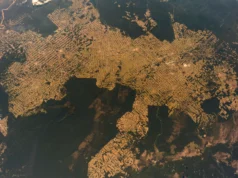
Saudi Arabia understood something else first. In 2007, the Saudi government ordered the domestic wheat production quota cut by 12.5 percent a year until the program ceased entirely at the start of the 2015-16 market year. The reason was geological. Saudi Arabia had been growing wheat in the desert since the 1970s using fossil water from deep aquifers such as the Saq in the north and the Wajid in the south — water tens of thousands of years old that, in practice, does not come back. Around Wadi ad-Dawasir the water table has fallen by as much as six meters a year since the 1980s, fast enough that hydrologists warn the aquifer could be exhausted within a few decades. Satellite imagery shows the result: circular pivot-irrigation fields, each about a kilometer across, spreading over the sand from the 1980s onward, every one of them drawing on a reserve that is not being refilled.
The decision to stop growing wheat at scale at home was driven by the depleting aquifers, and its logical sequel followed directly: farm the food somewhere else, using someone else’s water. Since 2019 the kingdom has let small farmers grow wheat again under a quota, now capped at 1.5 million tonnes a year; they harvest about 1.1 million, which covers less than a quarter of the roughly 4.6 million tonnes Saudis eat; the rest still comes from abroad.
The fossil water problem

The Saq Aquifer in northwestern Saudi Arabia is non-rechargeable on any human timescale. The aquifers that supply the UAE and Qatar do get some rain, but they are pumped several times faster than it refills them. "Virtual water," the water embedded in imported food, was theorized by the geographer Tony Allan in the early 1990s as a mechanism by which water-scarce Middle Eastern states had already been managing their deficits. They imported the water-intensive food instead of growing it at home. Farmland acquisition extends this logic: instead of buying the product of someone else's water, you buy the land the water irrigates — and you control what it grows.
King Abdullah launched the Saudi Agricultural Investment Abroad initiative as the domestic program wound down. The logic fits in four words: sell hydrocarbons, buy carbohydrates. The Saq Aquifer problem is not uniquely Saudi. The UAE imports about 90 percent of its food, and Qatar is in a similar position. Their farmland acquisition programs are forced on them by the combination of desert geography, growing populations and depleting aquifers.
For these governments, the investment case and the food-security case describe the same purchase. The land is bought both for its return and for a long-term supply of food at home.
The buyers are governments
Private equity entered farmland. Manulife Investment Management (formerly Hancock Agriculture), Nuveen’s Westchester Group Investment Management, and Macquarie Agricultural Funds all manage institutional farmland portfolios. Pension funds including TIAA hold farmland as an asset class, and so do university endowments. Foreign-held US agricultural land, about half of it forest, grew from roughly 24 million acres in 2010 to about 45 million in 2023.
But state buyers, meaning sovereign wealth funds and the government-controlled companies around them, occupy a different category. A private equity fund answers to its limited partners; it wants returns. A state buyer answers to a government; it wants returns and food security, and those two objectives are inseparable by design. The state fund that buys Australian wheat farms is managing a national supply chain. China’s COFCO offers a useful contrast: the state-owned enterprise took over Noble Agri and Nidera in 2016 and 2017, sold about 108 million tonnes of agricultural commodities in 2024, and runs its own terminal at the Port of Santos in Brazil. COFCO controls the flow of trade through its trading infrastructure, logistics and shipping, without owning the fields. Holding the land itself, through ownership or a long-term lease, and with it a legal claim to what grows on it for decades, is more consequential still.
The UAE operates through vehicles that are formally distinct but functionally sovereign. International Holding Company is chaired by Sheikh Tahnoon bin Zayed Al Nahyan, Abu Dhabi’s deputy ruler and the UAE’s national security adviser, and controlled through a chain of holding companies of which he is the ultimate beneficial owner: Pal Group, Royal Group and, at the top, Fount Trust. Jenaan Investment, the other big Emirati farmer in Sudan, is privately owned by Emirati investors, though it farms abroad as part of the same national food-security push. Across all Emirati investors, the UAE had signed 56 land agreements by early 2024, the first more than fifty years ago in Sudan, with 14 more in the pipeline. Most are in Africa, from Sudan, Egypt and Ethiopia to Zimbabwe and Angola, and Emirati investors are pushing into Uganda, Kenya and Tanzania. In Sudan, the Abu Hamad project had its export route designed in from the beginning: the Abu Amama port, which AD Ports Group was to build and operate. Sudan’s government canceled that port deal in November 2024. In Kenya, ADQ, Abu Dhabi’s sovereign investment arm, agreed a framework to invest up to $500 million in priority sectors including food production, as part of a comprehensive economic partnership agreement concluded in 2024.
Saudi Arabia set up SALIC, the Saudi Agricultural and Livestock Investment Company, by royal decree in 2009, backed by the Public Investment Fund. SALIC’s Australian arm co-owned Merredin Farms, a 78,000-hectare wheat, barley and canola operation in Western Australia, until it was broken up and sold, largely to local farmers, in early 2025. Its Ukrainian subsidiary, Continental Farmers Group, farms close to 200,000 hectares in the country’s west. At the end of June 2026, Olam Agri, the global grain trader SALIC controls, bought it outright, paying in new shares that lifted SALIC’s stake in Olam Agri to almost 82 percent. SALIC also holds 75 percent of G3 Global Holdings, the joint venture behind the Canadian grain handler G3. By SALIC’s own account, its network of investments supplied about a quarter of Saudi Arabia’s wheat in 2025.
Qatar, which imports most of its food, invests abroad through Hassad Food, the Qatar Investment Authority’s wholly owned food and agribusiness arm, set up in 2008. Gulf land holdings are only partly on the record: Land Matrix concedes that remote farms and a lack of company transparency make a true accounting of Emirati deals impossible.
When a sovereign fund or a state-controlled company buys or leases land, a government effectively controls that land. Decisions about what the land grows, who it feeds and where the harvest ships are made by one state for another state’s benefit. The transaction is bilateral in form; in substance it cedes a portion of the host country’s capacity to determine what its own land produces and who eats the result.
Buying water with the land
When an Emirati company farms Nile-irrigated land in Sudan and ships the harvest to Abu Dhabi, it imports water along with the food. Growing one kilogram of wheat takes roughly 1,800 liters of water on global average. The grain that moves to the Gulf carries with it a claim on Sudan’s water allocation.
Sudan’s Nile allocation stands at 18.5 billion cubic meters a year under the 1959 Nile Waters Agreement, a bilateral treaty between Sudan and Egypt negotiated without the participation of upstream states. Sudan has never used its full share, but every cubic meter committed to alfalfa for Gulf livestock is a cubic meter Sudan will not have when it expands irrigation to grow sorghum for its own families. The allocation has stayed fixed for sixty-seven years, while the farmland drawing on it has not.
Tony Allan theorized “virtual water” in the early 1990s while studying why Middle Eastern states had not gone to war over water scarcity. His answer was that they had been importing water in the form of food. Farmland acquisition takes this logic one step further. Importing the water-embedded product is passive arbitrage: you buy what someone else’s water grew. Owning the land the water irrigates amounts to a water right acquired through a land transaction, in a legal environment that treats the two as separate.
International water law is weaker than land tenure law. The UN Convention on the Law of the Non-Navigational Uses of International Watercourses, in force since 2014, has 43 state parties. Neither Sudan nor the UAE is among them. Controlling land with water access means acquiring a water right by other means, in a jurisdiction where land tenure law is weak and the UN watercourses convention does not apply.
Ethiopia is one of the countries where the UAE has signed land agreements, and Emirati agribusinesses such as Elite Agro operate there. In Ethiopia’s Afar region in early 2025, acute malnutrition climbed above the critical 15 percent threshold, with admissions for severe acute malnutrition up 44 percent on the same months a year earlier. The overlap of land acquired for export agriculture with acute food insecurity in the same country does not establish cause. Shipping the harvest to the Gulf is what the acquisition is for, so the food grown on leased land is not meant for hungry families in the host country.
The acquisition model, built on productive land, water access, export infrastructure and legal protections for the investor, recurs across the continent. Sudan is where it is most developed and most visibly strained, because there the gap between what the land could feed and what it does feed has become, for now, catastrophic.
What the host country loses
Sudan was historically called “the Arab world’s breadbasket.” The designation was aspirational and partly geographic: the Nile Valley’s soil, the rainfall patterns of the south, the potential for irrigated agriculture at scale. The name sounds bitter during a famine, but the land behind it is still there, and it has been allocated.
The conflict between the Sudanese Armed Forces and the Rapid Support Forces is the proximate cause of the current famine.
The structural argument operates across a different timescale. A significant slice of the land that could support domestic sorghum and wheat production at scale is under long-term lease to foreign entities for export farming, much of it not yet producing crops — Gulf companies alone have acquired roughly 1.9 million acres in Sudan, by Land Matrix estimates. The storage, logistics and planned port links around those farms were designed to move production to foreign markets. When the conflict ends, a government that wants to redirect that production toward domestic food security will have to break contracts with entities that hold investor protections.
The "idle land" myth

Land targeted by foreign agricultural investors is routinely described in deal documents and government frameworks as "idle," "unused," or "under-utilized." This framing is almost always false: the land is under customary use, supporting pastoralism, shifting cultivation, or seasonal grazing that is invisible to government cadastral surveys. The World Bank's 2010 report "Rising Global Interest in Farmland" used "uncultivated land" language that civil society organizations including GRAIN and the Oakland Institute criticized for providing analytical cover for displacement. The myth also serves as the legal predicate for deals: if the land is "idle," the state can lease it without dispossessing anyone, and the people who depended on it go uncounted.
Much of the land that foreign investors seek is held under customary tenure, with communities farming and grazing it for generations without formal legal title. Investors read these tenure systems carefully. Chinese agricultural investments in Tanzania and Zambia, for instance, cluster where land sits under private property regimes the host state backs, and are much rarer where officials allocate land at their discretion. Where deals do land on customary ground, the people using it are exposed: their rights are often only weakly recognized in formal property law, and the state can allocate the land over their heads. When a state issues a long-term lease to a foreign investor over land under customary use, the claims of customary users can be extinguished. They are neither compensated in investor-state proceedings nor parties to any instrument.
The landscape doesn’t stay still. Intensive export monoculture can wear soil down faster than the mixed farming and grazing it replaces, and the investor does not pay for that unless the lease spells out the condition the land must be returned in and someone enforces that condition. By a mid-1990s estimate, around 90 percent of rangelands and 80 percent of rain-fed farmlands in the belt running from the West African Sahel through Sudan to northeast Ethiopia and Kenya were already affected by degradation. The land being acquired is, in many cases, already compromised, and the host country is left with whatever further damage export farming does to it.
Once export infrastructure is in place, a food crisis does not automatically redirect production. A government can still redirect it, but only at a high legal cost: it has to terminate or renegotiate contracts with entities that have rights under investment protection agreements, and replace export-oriented storage with domestic distribution networks. Where a foreign state-owned company holds the port or the export corridor, it also has to recover control of facilities that were designed and funded as extraction infrastructure — which is why it mattered that Sudan canceled the Abu Amama port deal before the port was ever built.
What the law says
The primary international instrument governing how states and investors should behave when farmland changes hands is the FAO Voluntary Guidelines on the Responsible Governance of Tenure of Land, Fisheries and Forests in the Context of National Food Security — the VGGT, adopted by the Committee on World Food Security in May 2012. The VGGT creates no enforceable obligations. FAO describes the Guidelines as setting out “internationally accepted standards” for governing tenure, and since 2012 the G20 and the UN General Assembly have urged governments to implement them.
Suppose an implementing country has just signed a 99-year lease to a foreign sovereign fund. The guidelines it has pledged to implement are the same ones the lease was negotiated around. The VGGT sets no floor below which states cannot go, so a state can endorse it and still proceed without it.
No binding international law governs cross-border acquisition of agricultural land by state actors. The 2007 UN Declaration on the Rights of Indigenous Peoples is non-binding and covers only a subset of affected populations. ICESCR Article 11, the right to adequate food, is binding on 174 state parties. Sudan is among them; the UAE has never ratified the Covenant. Even where it applies, Article 11 has no enforcement mechanism that overrides foreign investor property rights or compels food redirection during an emergency. A country facing famine cannot invoke Article 11 in any international forum to void a land lease or redirect export crops, because no such forum exists.
The mechanism that has teeth runs in the opposite direction. Bilateral investment treaties and investor-state dispute settlement protect foreign investors against host government interference with their property and operations. Sudan and the UAE signed such treaties in 2001 and 2011, but neither is confirmed as in force. The investment proceeded regardless, which suggests that the investor protection architecture can operate without a confirmed treaty. Investors rely on contract-based protections: production agreements and long-term lease instruments, typically written with international arbitration in mind. Wherever a contract, a treaty or investment legislation gives the investor that right, a unilateral host-state action redirecting foreign-controlled production, such as ordering crops to be sold domestically, terminating a lease or seizing export infrastructure, can be taken to international arbitration under ICSID or UNCITRAL rules.
What that means in practice: a government redirecting export crops to feed its own population can be sued before an international arbitral tribunal by the entity whose contract was disrupted. The proceedings take years. The government must dedicate scarce legal resources to defending actions it took to feed its citizens. The investor has access to the same international system that produced the contract and can sue; the displaced smallholder farmers cannot.
The right to permanent sovereignty over natural resources, established by UNGA Resolution 1803 in 1962, has been argued to apply where land acquisitions “alienate territorial sovereignty.” Anna Jurkevics argues that large-scale land acquisition can, under certain conditions, amount to a de facto alienation of territorial sovereignty, but she doubted that sovereignty is the cure, because sovereign states themselves often shut communities out of the democratic governance of land: zoning, land use regulation and environmental stewardship, the practices through which a polity shapes its common home. The International Court of Justice has called the principle customary international law, but it has never been successfully invoked to void a land contract held by a foreign sovereign entity.
The asymmetry is structural. David Schneiderman argues that the investment protection regime was constructed to serve capital-exporting state interests through mechanisms replicating colonial-era property protections. M. Sornarajah documents the power asymmetry between capital-exporting and capital-importing states in treaty negotiation as a historical condition: the treaties were written by the states that benefited from them. Investment protection got binding rules, institutional backing and compulsory jurisdiction, while land tenure got voluntary guidelines, a gap that reflects how the system was built and by whom.
Sudan’s war will end. The question of what kind of country emerges is primarily a question of how the conflict is resolved and whether the state that emerges has the capacity and the political coherence to function at all. But nested inside that question is a narrower one about land. Gulf companies have acquired an estimated 1.9 million acres of Sudanese farmland, fertile Nile-irrigated land among it, under contracts that can carry the right to international arbitration. The export corridor meant to carry the harvest out of the country was designed by a foreign sovereign’s port company — and only Sudan’s cancellation of that deal in 2024 kept it on paper. The international rules written specifically for land tenure are voluntary, and the one binding treaty that protects the Sudanese people’s right to food has no mechanism that lets it outrank an investor’s contract.
Sudan remains formally sovereign under international law. But the formal system does not say what sovereignty means when the food grows under someone else’s flag and leaves on someone else’s ships, and there is no court where that contradiction can be resolved.
Related articles
- The science of strategic starvation: how food has been weaponized throughout history
- How a handful of seed banks are the last line against global food collapse
- Why desalination hasn’t solved the water crisis — and what actually would
Further reading
As an Amazon Associate, Eikleaf earns from qualifying purchases. The book links below are affiliate links: if you buy through them, we may earn a small commission at no extra cost to you.
 The World for Sale: Money, Power, and the Traders Who Barter the Earth’s ResourcesExplains how grain trading, transport infrastructure and political deals give companies control over food supplies across borders.
 Barons: Money, Power, and the Corruption of America’s Food IndustryShows how concentrated ownership of farming, grain trading and food distribution produces political power and weakens farmers’ control.
 Regenesis: Feeding the World Without Devouring the PlanetExamines how land use, agricultural concentration and vulnerable global food networks shape food security and demand for farmland.
Recommended videos
 6:04Saudi company draws unlimited Arizona ground water for crop illegal to grow in Saudi ArabiaCBS on a Saudi firm growing alfalfa in Arizona, a case of a water-poor Gulf state farming abroad.
 5:52Agricultural Land for Investors – Why Sudans small farmers are being displaced | Global 3000DW report on foreign agricultural investors in Sudan and the small farmers displaced.
 12:26Land-grabbing and the fight for justice in Sierra Leone | DW DocumentaryDW documentary on a large land deal in Sierra Leone and local communities’ fight for redress.
Cite this article
Lena Martin. “Why the world’s best agricultural land is increasingly owned by foreign governments.” Eikleaf, 16 May 2026, updated 2 November 2026. https://www.eikleaf.com/why-the-worlds-best-agricultural-land-is-increasingly-owned-by-sovereign-wealth-funds/
Gen AI Disclaimer
Some contents of this page were generated and/or edited with the help of a Generative AI.
Media
Key Sources and References
IPC (Integrated Food Security Phase Classification). Sudan: Acute Food Insecurity Situation for September 2025 and Projections for October 2025–January 2026 and for February–May 2026. 2025. Summarized in FAO, “Famine conditions confirmed in Sudan’s El Fasher and Kadugli as hunger and malnutrition ease where conflict subsides,” 2025. https://www.fao.org/newsroom/detail/famine-conditions-confirmed-in-sudan-fasher-and-kadugli-as-hunger-and-malnutrition-ease-where-conflict-subsides/en
GRAIN. “From Land to Logistics: UAE’s Growing Power in the Global Food System.” 2024. https://grain.org/e/7170
Sambidge, Andy. “UAE in talks to buy more African land to aid food security.” AGBI, 31 January 2024 (BMI analysis of Land Matrix data; reproduced by farmlandgrab.org). https://farmlandgrab.org/post/32030
The Maritime Executive. “As Civil War Rages, Sudan’s Government Cancels $6B UAE Port Project.” 4 November 2024. https://maritime-executive.com/article/as-civil-war-rages-sudan-s-government-cancels-6b-uae-port-project
New Lines Magazine. “The limits of the UAE’s push for food security.” 17 March 2026. https://newlinesmag.com/spotlight/the-limits-of-the-uaes-push-for-food-security/
The National. “IHC confirms Fount Trust as ultimate parent after ownership restructure.” 21 September 2026. https://www.thenationalnews.com/business/2026/09/21/ihc-confirms-fount-trust-as-ultimate-parent-after-ownership-restructure/
NCREIF Farmland Property Index (National Council of Real Estate Investment Fiduciaries). Returns summarized in FarmTogether, “Breaking Down the 2024 NCREIF Farmland Performance: Key Insights and Trends,” 2025. https://farmtogether.com/learn/blog/breaking-down-the-2024-ncreif-farmland-performance-key-insights-and-trends
Saudi Arabia, Government Resolution No. 335, November 2007. Reported in Global AgInvesting, “Saudi Arabia to Stop Wheat Production by 2016,” 2014. https://globalaginvesting.com/saudi-arabia-to-stop-wheat-production-by-2016/
USDA Foreign Agricultural Service. Saudi Arabia: Grain and Feed Annual (SA2026-0003). April 2026. https://agriexchange.apeda.gov.in/MarketReport/113510605202642115033488.pdf
NASA Earth Observatory. “Desert Crops Thrive as the Aquifer Shrinks.” 2019. https://science.nasa.gov/earth/earth-observatory/desert-crops-thrive-as-the-aquifer-shrinks-145975/
Arab News. “Saudi Arabia to target agro-investments abroad.” 2013 (reproduced by farmlandgrab.org). https://farmlandgrab.org/post/22781
SALIC (Saudi Agricultural and Livestock Investment Company). Founded by Royal Decree, 2009. Holdings include Continental Farmers Group (Ukraine, c. 200,000 ha; acquired by Olam Agri on 30 June 2026, lifting SALIC’s stake in Olam Agri from 80.01% to 81.81%), a 75% stake in G3 Global Holdings (Canada) and a controlling stake in Olam Agri (80%+, April 2026). Merredin Farms (Western Australia, 77,954 ha, co-owned with PenAgri Farms) was sold in early 2025. Sources: Global AgInvesting, “Colliers Managing Sale of Largest Corporate Broadacre Holding in WA,” 2023; Countryman, “Merredin Farms portfolio: Wheatbelt shires optimistic as WA’s biggest aggregation sells to locals,” 23 January 2025; iGrow News, “Olam Agri to Fully Integrate Ukraine’s Continental Farmers Group,” 7 July 2026; Olam Group, “Management Discussion and Analysis: Group Results for the Half Year Ended June 30, 2026,” SGX filing, 14 August 2026, p. 2; Agri Investor, “SALIC ups stake in Canadian grain JV to 75%,” 2016; vision2030.ai, “SALIC Says Its Ecosystem Supplied 25% of Saudi Wheat in 2025,” 2026. https://globalaginvesting.com/colliers-managing-sale-of-largest-corporate-broadacre-holding-in-wa/ · https://www.mbtimes.com.au/countryman/grain/merredin-farms-portfolio-wheatbelt-shires-optimistic-as-was-biggest-aggregation-sells-to-locals-c-17457035 · https://igrownews.com/olam-agri-latest-news/ · https://links.sgx.com/FileOpen/14Aug2026_H1%20FY2026%20Results_MDA.ashx?App=Announcement&FileID=901057 · https://www.agriinvestor.com/salic-ups-stake-in-canadian-grain/ · https://vision2030.ai/analysis/salic-saudi-wheat-supply-25-percent-2025/
Fanack Water. “Water Resources in Qatar.” https://water.fanack.com/qatar/water-resources-in-qatar/
Hassad Food. A wholly owned subsidiary of the Qatar Investment Authority, founded 2008. https://www.hassad.com/
The National. “Abu Dhabi firm grows in Egypt.” 13 August 2009 (Jenaan “owned by private Emirati investors”; reproduced by farmlandgrab.org). https://www.thenationalnews.com/business/abu-dhabi-firm-grows-in-egypt-1.585204 · https://farmlandgrab.org/post/6867-abu-dhabi-firm-grows-in-egypt
ADQ. “ADQ Establishes Finance and Investment Framework Agreement Worth Up to USD 500 Million to Invest in Priority Sectors of Kenya’s Economy.” 2024. Reported in GRAIN, “From Land to Logistics,” 2024. https://grain.org/e/7170
Institutional farmland managers: Agri Investor, “HNRG rebrands amid broader Manulife reorganization”; Nuveen, “Westchester Group Investment Management.” https://www.agriinvestor.com/hnrg-rebrands-amid-broader-manulife-reorganization/ · https://www.nuveen.com/global/about-us/our-people/investment-specialists/westchester-group-investment-management
USDA Farm Service Agency. Foreign Holdings of U.S. Agricultural Land through December 31, 2023 (AFIDA). 2024; AFBF Market Intel, “Foreign Investment in U.S. Ag Land – The Latest Numbers,” 2 November 2023. https://www.fsa.usda.gov/sites/default/files/2024-12/AFIDAYR2023ReportwithPageNumbers.pdf · https://www.fb.org/market-intel/foreign-investment-in-u-s-ag-land-the-latest-numbers
COFCO International. Acquisitions of Noble Agri (completed 2016) and Nidera (completed 2017); 2024 sales volume of about 108 million tonnes; STS11 terminal at the Port of Santos. Sources: Clifford Chance, 2016; Global AgInvesting, “China’s COFCO Acquires Remainder of Nidera”; The Poultry Site (Reuters), “COFCO International reports $38.5B in 2024 revenue,” 2025; DatamarNews, “Cofco International to Launch First Phase of New Terminal at Port of Santos,” 2025. https://www.cliffordchance.com/news/news/2016/03/clifford-chance-advises-cofco-on-successful-completion-of-two-ke.html · https://globalaginvesting.com/chinas-cofco-acquires-remainder-nidera/ · https://www.thepoultrysite.com/news/2025/06/cofco-international-reports-38-5b-in-2024-revenue · https://datamarnews.com/noticias/cofco-international-to-launch-first-phase-of-new-terminal-at-port-of-santos/
Allan, J.A. “Virtual Water: A Strategic Resource. Global Solutions to Regional Deficits.” Groundwater 36(4), 1998, pp. 545–546; SOAS University of London, “Tributes paid to Professor John Anthony Allan (1937–2021),” 2021 (Stockholm Water Prize 2008). https://doi.org/10.1111/j.1745-6584.1998.tb02825.x · https://www.soas.ac.uk/about/news/tributes-paid-professor-john-anthony-allan-1937-2021
Mekonnen, M.M. and Hoekstra, A.Y. “The green, blue and grey water footprint of crops and derived crop products.” Hydrology and Earth System Sciences 15, 2011. https://hess.copernicus.org/articles/15/1577/2011/
1959 Nile Waters Agreement (Agreement for the Full Utilization of the Nile Waters, Sudan and the United Arab Republic). Background: Brookings, “The limits of the new Nile agreement,” 2015; Oregon State University, Transboundary Freshwater Dispute Database, Nile case study. https://www.brookings.edu/articles/the-limits-of-the-new-nile-agreement/ · https://transboundarywaters.ceoas.oregonstate.edu/sites/transboundarywaters.ceoas.oregonstate.edu/files/Database/ResearchProjects/casestudies/nile.pdf
Asharq Al-Awsat. “Sudan Plans to Benefit from its Full Share of Nile Water.” https://english.aawsat.com/node/2066026
Convention on the Law of the Non-Navigational Uses of International Watercourses (UN Watercourses Convention). Adopted 1997, entered into force 17 August 2014. 43 state parties as of October 2026. UN Treaty Collection. https://treaties.un.org/Pages/ViewDetails.aspx?src=TREATY&mtdsg_no=XXVII-12&chapter=27&clang=_en
Première Urgence Internationale. “Ethiopia: Nutritional emergency in the Afar region.” 9 April 2025. https://www.premiere-urgence.org/en/news/ethiopia-nutritional-emergency-in-the-afar-region/
Milling Middle East & Africa. “UAE’s EAP plans to establish wheat farm project in Ethiopia.” 26 October 2023 (Elite Agro Projects already operates a flower farm in Ethiopia). https://millingmea.com/uaes-eap-plans-to-establish-wheat-farm-project-in-ethiopia/
Niblock, Tim. “Sudan’s Economic Nightmare.” MERIP, 1985. https://www.merip.org/1985/09/sudans-economic-nightmare/
World Bank. “Rising Global Interest in Farmland: Can It Yield Sustainable and Equitable Benefits?” 2010; GRAIN, “World Bank report on land grabbing: beyond the smoke and mirrors,” 2010. https://openknowledge.worldbank.org/handle/10986/2263 · https://grain.org/e/4021
Yang Yuezhou. “Politics of Rural Land Acquisition in Africa: The Evidence from Chinese Agricultural Investments in Tanzania and Zambia.” Journal of Rural Studies 119, 2025. https://doi.org/10.1016/j.jrurstud.2025.103727
Nana-Sinkam, S.C. Land and environmental degradation and desertification in Africa. Joint ECA/FAO Agriculture Division, 1995. https://www.fao.org/4/x5318e/x5318e02.htm
FAO. Leasing agricultural land. Land Tenure Notes, “Condition of the land on return” and “Arrangements for compensation.” https://www.fao.org/4/y5513e/y5513e05.htm
FAO. Voluntary Guidelines on the Responsible Governance of Tenure of Land, Fisheries and Forests in the Context of National Food Security (VGGT). Endorsed by the Committee on World Food Security, May 2012. https://www.fao.org/tenure/resources/publication/vggt/en
United Nations Declaration on the Rights of Indigenous Peoples, GA Resolution 61/295, 13 September 2007. UN Audiovisual Library of International Law. https://legal.un.org/avl/ha/ga_61-295/ga_61-295.html
ICESCR (International Covenant on Economic, Social and Cultural Rights), Article 11 (Right to Adequate Food). 174 state parties as of October 2026. UN Treaty Collection. https://treaties.un.org/Pages/ViewDetails.aspx?src=TREATY&mtdsg_no=IV-3&chapter=4&clang=_en
UNCTAD Investment Policy Hub. Sudan–United Arab Emirates BIT (2001) and Sudan–United Arab Emirates BIT (2011). Both listed as signed, not in force. https://investmentpolicy.unctad.org/international-investment-agreements/treaties/bit/2972/sudan—united-arab-emirates-bit-2001-
ICSID. Report of the Executive Directors on the ICSID Convention, Chapter V (Jurisdiction of the Centre: consent). https://icsid.worldbank.org/rules-regulations/convention/report/section-five
UNGA Resolution 1803 (XVII), “Permanent Sovereignty over Natural Resources,” 14 December 1962. UN Audiovisual Library of International Law. https://legal.un.org/avl/ha/ga_1803/ga_1803.html
International Court of Justice. Armed Activities on the Territory of the Congo (Democratic Republic of the Congo v. Uganda), Judgment of 19 December 2005, para. 244. https://www.icj-cij.org/case/116
Jurkevics, Anna. “Land Grabbing and the Perplexities of Territorial Sovereignty.” Political Theory, vol. 50, no. 1, 2022, pp. 32–58. https://doi.org/10.1177/00905917211008591
Schneiderman, David. Investment Law’s Alibis: Colonialism, Imperialism, Debt and Development. Cambridge University Press, 2022. https://doi.org/10.1017/9781009153515
Sornarajah, M. The International Law on Foreign Investment. 5th ed. Cambridge University Press, 2021. https://doi.org/10.1017/9781316459959
Land Matrix Initiative. Global Observatory on Large-Scale Land Acquisitions. https://landmatrix.org/