Last updated: · 25 min read
In brief
Leaked Revolutionary Guard papers record Iran’s 2004 firing of a torpedo listed as “HUR (Shkval)”, at better than 200 miles an hour under water. Its probability of hitting the target “was not tested”. Speed says little about hitting. The gas bubble that buys the speed also blunts the weapon’s own senses. So the Soviet original ran on a course set before launch, with a nuclear warhead to forgive the aim. North Korea now claims a “super-speed precision-guided” torpedo, but no public demonstration has shown such a weapon finding its own target.
Contents
The document is a test report, and it reads like one. Among the leaked papers from Iran’s Revolutionary Guard that the Federation of American Scientists published in January 2009 is the record of a firing off Jask, on the Gulf of Oman coast, on 5 February 2004. The weapon is listed as “HUR (Shkval)”. It ran about 10,450 metres. Its cruise speed was 90 to 95 metres a second, better than 200 miles an hour, under water.
The federation’s summary of the file adds one more line. The missile’s probability of hitting its intended target “was not tested”.
Not in that trial, anyway. Two years later, in April 2006, Iran fired a torpedo it called the Hoot during a naval exercise and announced the fastest underwater missile in the world, at 100 metres a second. Outside analysts said it looked like a copy of the Shkval. Iranian officials insisted it was entirely their own.
The Shkval is a Soviet rocket torpedo. It entered Soviet service on 29 November 1977, built to cruise at about 200 knots, roughly 100 metres a second, inside a pocket of gas it makes for itself. That’s three or four times the speed of an ordinary torpedo, and it is the number everybody remembers, Iran’s test officers included.
Speed says surprisingly little about whether a torpedo will hit anything. Every undersea weapon needs something to tell it where the target is: the launching submarine’s sonar, a wire paying out behind the weapon to carry that sonar’s updates, a seeker in the weapon’s own nose, somebody else’s sensors, or a calculation frozen at the moment of launch. Supercavitation is the extreme case, because the bubble and the noise that buy the speed also blunt the weapon’s own senses. So the useful question about a 200-knot torpedo is where its targeting information lives, and what becomes of the weapon when the honest answer is: only in the firing solution.
Making the water get out of the way
Water is so much denser than air that pushing anything through it fast costs a ruinous amount of power. A torpedo that wants a few more knots needs a disproportionately bigger engine to get them. Supercavitation tries a different trick, which is to stop touching the water.
The trick is about pressure. Water rushing past a flat, sharp-edged nose loses pressure, and when the local pressure falls to water’s vapour pressure, the liquid turns to vapour. Push hard enough and the vapour opens into one long cavity that encloses most of the body behind the nose. Depth works against you, because deeper water presses harder and squeezes the cavity smaller. Gas works for you. Blow it in behind the nose, a technique called ventilation, and the cavity grows and can form at lower speed.
The Shkval’s nose, its cavitator, is a flat elliptical plate with sharpened edges, tilted slightly off the torpedo’s axis to give a little lift. Just behind it, nozzles feed gas from a separate generator into the cavity. Most of the body then rides in gas, out of continuous contact with water. Some contact is deliberate. Spring-loaded skids at the tail touch the cavity wall and push the rear back towards the middle, and Western specialists think the whole torpedo precesses slowly as it runs, bouncing off the walls.
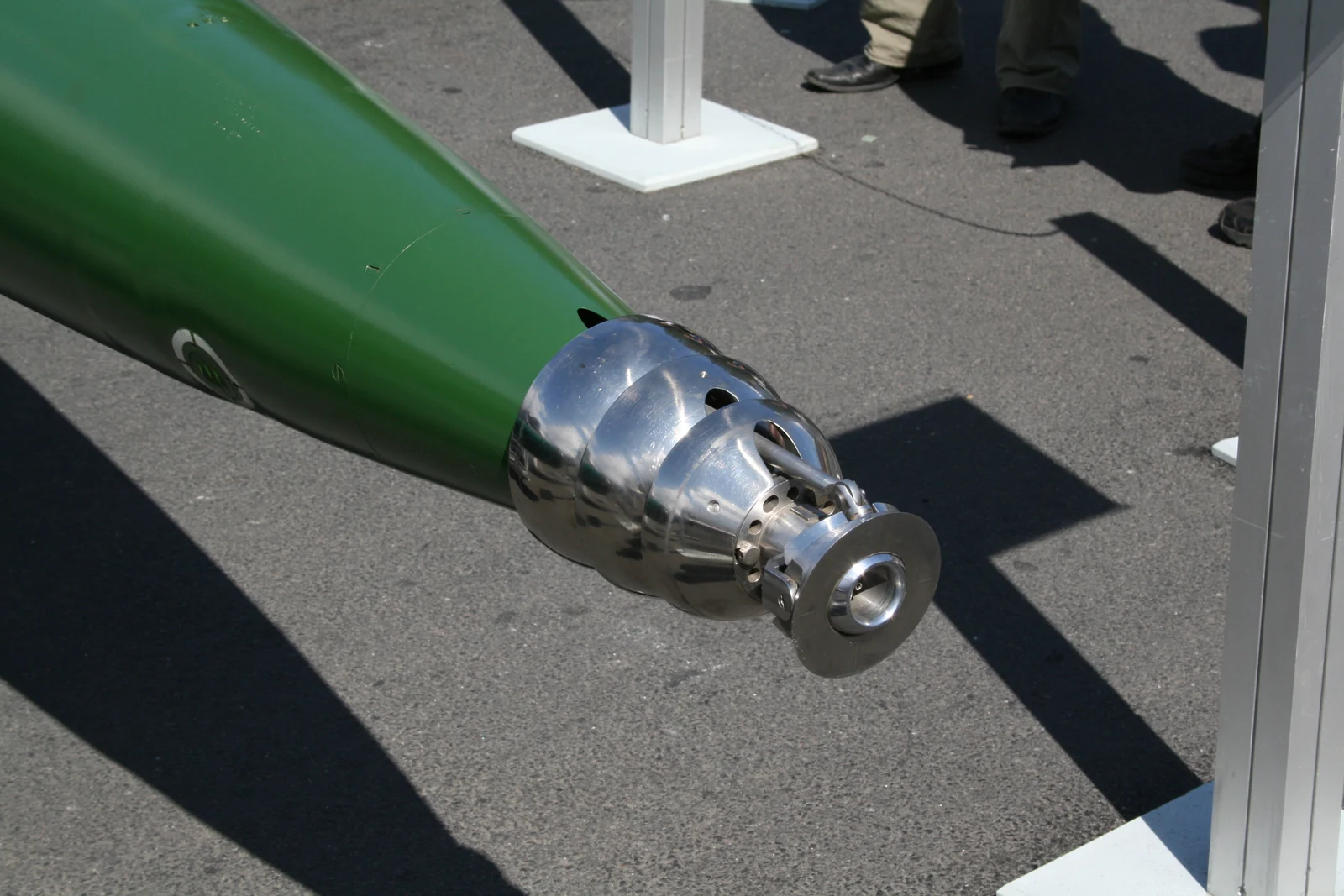
A conventional propeller turning inside the cavity would be thrashing gas. The Shkval’s reported answer is a solid-fuel booster that kicks it up to cruising speed in about four seconds and then drops away, followed by an underwater ramjet that burns aluminium, magnesium and lithium with seawater as the oxidiser. Yuriy Savchenko, whose institute in Kyiv did much of the basic science behind the weapon, reckoned a solid rocket could manage a few dozen kilometres at best, and that only gas turbines or jets burning metal fuels with the surrounding water would do. His summary of the result, offered as a joke, was exact: “really a big projectile with a rocket on the end”.
The rocket delivered half of what was asked. The 1960 specification, as the Russian military commentator Vladimir Tuchkov tells it, called for 200 knots and 20 kilometres from a standard 533 mm torpedo tube. The speed requirement was met. Accounts of the range run from 7 kilometres to about 13, depending on the variant and on who’s telling it, and the motor that produced the speed was spectacularly loud, which will matter shortly.
A subtler cost sits in the physics. A body wrapped in gas has lost the buoyancy water would otherwise give it, and Savchenko named keeping such an object stable as the main difficulty of the whole scheme. In an ordinary torpedo the water does a lot of the steadying for free. Here, stability has to be manufactured.
Pressure, depth and gas

Cavitation starts when the pressure in a flow drops to the vapour pressure of water and the liquid flashes into vapour. Speed is one way to get there, so the speed thresholds quoted for supercavitation are really statements about pressure. Near the surface, Savchenko put the supercavitating range above roughly 70 metres a second, and other accounts have blunt noses and gas jets forming such cavities above about 50. Neither is a universal limit. Go deeper and the higher pressure shrinks the cavity, which is why underwater darts lose range with depth. Ventilation, pumping gas into the cavity, lets a cavity form at lower speed and makes it bigger. DARPA, pitching its own supercavitation programme, put the drag saving at 60 to 70 per cent. The weakest part of many models is the tail of the cavity, where gas and water collapse back together in what the American theorist Marshall Tulin called "the mess at the rear".
How a firing solution is made
A torpedo attack is a chain. Somebody hears something. Somebody works out where it is, then where it will be by the time a weapon gets there. The weapon has to be kept informed as the target moves, or inform itself. And the target fights back with noise, decoys and manoeuvre. Each link can fail, and each link has to live somewhere: in a sonar room, on a wire, in a seeker, or in a computer that runs once.
Take the scenario the Shkval is most often fitted to. Unnamed Russian industrial officials laid it out in 1999, in an account published by an American military-affairs website: a Soviet submarine’s first warning that a quiet American boat was stalking it would be the sound of an incoming wire-guided Mk 48, the American heavyweight torpedo. Consider what that sound hands the Soviet crew. A bearing, for a start, though it’s a bearing to the torpedo. If the American fired at an angle and turned the weapon towards its target halfway along, a tactic raised in that same account, the line back down that bearing doesn’t point at the submarine that fired. Range, the sound doesn’t give at all.
Now fire the Shkval. On Tuchkov’s figures it covers 13 kilometres in about 130 seconds, and at the shorter 7 kilometres simple arithmetic gives about 70. Say the target is making 15 knots, about 7.7 metres a second. In 70 to 130 seconds it moves somewhere between 540 metres and a kilometre. Every uncertainty in that picture, in bearing, in range, in where the target is heading, goes into the firing solution. A weapon that can’t update the solution keeps all of them.
The original Shkval couldn’t update anything. Target coordinates and a computed lead were entered before launch, and an autopilot, rather than a homing head, held the course. Whether any version also trailed a guidance wire is disputed: one analyst inferred in 1999 that it didn’t, while another account, two years later, had a wire spool presumably fitted between the booster nozzles.
Why no seeker? Tuchkov gave two reasons. Any real manoeuvre at that speed would break up the bubble, and the torpedo is so noisy and vibrates so hard that a seeker would hear nothing but the motor. Savchenko’s group found another problem when they tested a hydrophone built into a cavitator: the cavity around it behaved like an acoustically soft surface across a very wide band of frequencies, changing what the sensor could hear. A receiver sealed off from the water by gas, sitting ahead of a roaring motor, would face both problems at once. Engineers have since proposed putting the ear on the nose plate, which stays wet.
Countermeasures cut several ways. The target, once it hears a Shkval coming, has little room. A run of 70 to 130 seconds is very little time for a big ship to turn or deploy countermeasures, and the real warning depends on when the weapon is detected. The Shkval’s own launch made early detection easy. An unnamed developer who attended tests at Lake Issyk-Kul compared firing one to the sea god Poseidon cracking a whip: a whistle and a roar and then a wake racing away across the surface, straight as an arrow. Tuchkov was blunter: the wake gave the submarine’s position away “lock, stock and barrel”. Then there’s the attacker. If the American boat has to manoeuvre and its wire snaps, it loses the ability to send its torpedo updates. It doesn’t lose the torpedo. A Mk 48 can run with or without its wire and home on its own, actively or passively, so breaking the wire alone need not stop the attack.
It can steer. It can’t look
Can it turn? A little. The Shkval’s stabilisation system tracks its heading constantly and corrects it with retractable rudders that barely touch the wall of the bubble, and by tilting the cavitator at the nose, while the skids keep shoving the tail back to the centre. Those are corrections to a straight run aimed at a precomputed meeting point, and the margin is thin. The slightest deviation risks losing the course and the cavity with it.
Push harder and the hull meets water at 100 metres a second. Ivan Kirschner, an engineer at the contractor Anteon in Connecticut, warned in 2001 that a body hitting the cavity wall would become “a crushed Coke can”. John Padgett, a retired rear admiral working for General Dynamics, observed that anything moving that fast in water tends to be unstable, and that the instability grows with speed. The optimists’ answer came from Robert Kuklinski at the Naval Undersea Warfare Center, who argued that if bow and tail controls were synchronised, so that the back followed whatever the front did, such vehicles could make sharp turns.
The clearest public case of a steered test vehicle came from Germany. Diehl BGT Defence’s Barracuda, announced in 2005, was a technology demonstrator for close-in defence against underwater targets: a solid rocket, an inertial measurement unit, an autopilot and a conical nose that an actuator could tilt to steer, at a claimed submerged speed of more than 400 km/h. About a dozen test models were built and tested, the company said, with trials focused on stabilisation, guidance and agility. It was an integrated test vehicle that steered, and it never went into production. Tuchkov in October 2016 filed it alongside Iran’s torpedo as prototypes on trial, not weapons ready for combat.
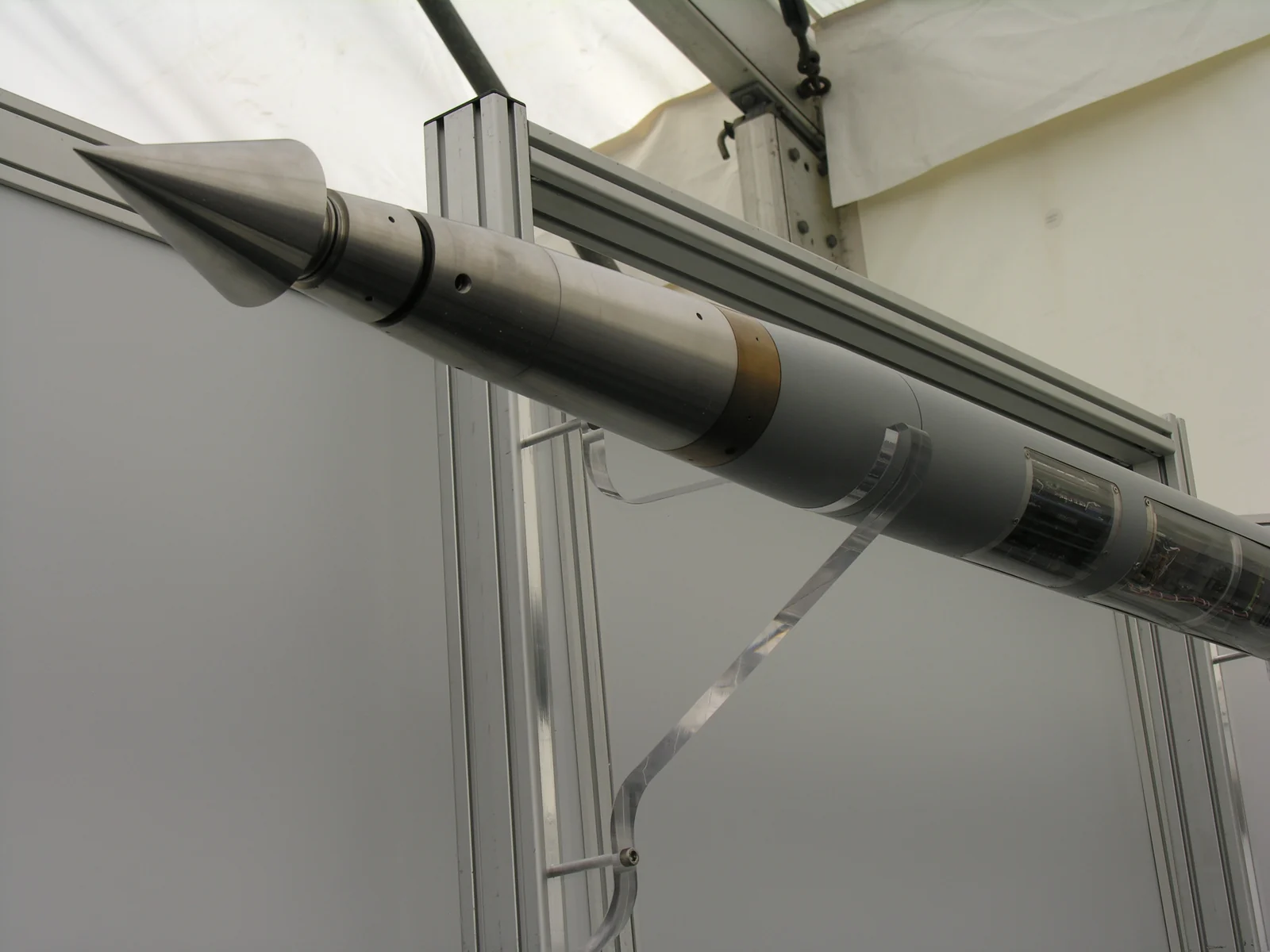
South Korea’s Agency for Defense Development is a step further back. In May 2025 it was running basin trials of a three-metre, 300 mm vehicle with an adjustable nose and cross-shaped rudders, at a stated test speed of up to 130 knots, to check that it could hold a straight line while generating its cavity. Sea trials at up to 200 knots were planned. Straight running sounds like a modest goal half a century after the Shkval, but holding a stable course inside a bubble is itself a hard control problem. No sea-trial results had been published by late October 2026. The agency’s plan in 2017 was for “a sonar in the head and fins in the back for steering”, and that remains a plan.
What the warhead forgave
In 1960 the Soviet Council of Ministers set the work going, and the design institute NII-24 was instructed to develop a high-speed underwater missile “to fight nuclear-powered submarines”. The original torpedoes were unguided, in the sense that nothing on board looked for a target, and carried only a nuclear warhead.
H I Sutton, the submarine analyst, puts the best case for it in one line: “Even if the other sub launches first it can win the race and deliver a killer blow.” On his reading, a boat that hears the enemy second can still hit first.
The gravest version of that race comes from the same unnamed Russian industrial officials. The Shkval, they said, was meant for ballistic-missile submarines and the attack boats guarding them. On hearing an incoming Mk 48, the crew would fire a Shkval back down the reciprocal bearing, and in the officials’ telling the Russians assumed a nuclear detonation underwater in a remote area “would not trigger nuclear war“. That the weapon was unguided, the account adds, “would not be a problem in such a scenario”. The writer who relayed their story then raised the dogleg objection himself, that the American may have fired at an angle, and answered it with the warhead: even then, the burst would at least have stopped the Mk 48 and blinded the attacking submarine long enough for the Russian boat to escape. Speed could not recover where the attacker was. The bomb made knowing it less necessary.
A gentler family of theories has the Shkval disrupting an attack rather than annihilating the attacker. Analysts at the Federation of American Scientists called it a “revenge” weapon, fired along the bearing of an incoming torpedo, a descendant of Soviet evasion torpedoes meant to force the attacking submarine to manoeuvre and, with luck, snap its guidance wire. Some Western intelligence services were reported to hold a similar view. A separate account has the incoming torpedo itself forced to swerve and “possibly break its guidance wires”. One mechanism acts on the launching boat, the other on its weapon, and both run into the Mk 48’s ability to home without its wire. Wire-breaking is a proposed effect, and no public test shows it defeating anything.
A third theory, credited only to informed circles, held that the Shkval was offensive, meant to set off a larger nuclear charge in the middle of a carrier group. Tuchkov’s objection is geometry. To get within 7 to 13 kilometres of a carrier, a submarine has to come inside the group’s anti-submarine screen, and then announce itself with that wake.
The theories disagree about the target, and every one of them assumes a weapon fired on what the shooter knew at the moment of launch, with nothing learned afterwards. A nuclear warhead made that tolerable, because it relaxed how accurate the solution had to be. It didn’t make aiming irrelevant: someone still had to point the tube down roughly the right line, and the dogleg objection shows how far off that line could be. The Soviet order was for a weapon to fight nuclear submarines; the bearing-and-bomb, wire-breaking and carrier-group stories come from officials, analysts and informed circles, and no published Soviet directive or named designer confirms any of them.
After the warhead came off
In the autumn of 1991 the nuclear rationale went away by announcement. On 27 September George H. W. Bush said the United States would withdraw all tactical nuclear weapons from its surface ships and attack submarines. On 5 October Mikhail Gorbachev said all tactical nuclear weapons would be removed from Soviet surface ships and multipurpose submarines. These were reciprocal unilateral pledges, not a treaty. The Shkvals, all of them nuclear-armed, were later reported to have been taken off the multipurpose submarines and put into storage.
The weapon outlived its warhead. W. Patterson, writing for the same American website in 1999, reported that the Shkval had stayed in Russian service with a conventional warhead and some unspecified guidance or control added. A conventionally armed version with autonomous programmed control was built in the late 1990s, along with an export model, the Shkval-E, with a warhead equal to 210 kg of TNT and an effective range of 7 kilometres. Norman Polmar, the naval historian, writes that later variants sold to other navies had conventional warheads, and China was reported in 1998 to have bought about forty, from Kazakhstan.
The conventional warhead changed one thing that mattered. A nuclear burst forgave a sloppy firing solution. Two hundred-odd kilograms of explosive forgive far less. The accuracy requirement came back, and it landed on the one stage the weapon could do nothing about once it was running: the solution itself. The 1999 account that relayed the officials’ story was flat about the unguided conventional Shkvals sold to China. At 10 kilometres, an unguided torpedo “could not be expected to hit”.
The sales literature said the conventional Shkval could look. The brochure for the export model, shown at an arms fair in 1999, promised “autonomous software” and added: “Target search is carried out by the missile itself.” The analysts at the Federation of American Scientists, describing the same export weapon, said it “does not have a homing warhead and follows a computer-generated program”. They also recorded a modernised version with a “guided targeting system”, first tested by the Pacific Fleet in spring 1998, and Russian advertising for a homing version that runs out at very high speed and then slows to search. None of these sources says what that version would listen with as it slowed, or whether it would still be inside its bubble.
Iran’s Hoot followed in 2006, and Sutton calls its operational service “unclear”. In October 2016 Tuchkov said that the Shkval had been removed from the inventory. Russia has been reported developing a successor, the Khishchnik, which Tuchkov described as a separate design that might get a seeker. Engineers at South Korea’s defence agency repeated claims of Russian service and terminal guidance in 2025, without operational evidence to back them. Whether Russia keeps any Shkvals in service today is unclear.
Other people’s bubbles
Other navies wanted different things from supercavitation, and they climbed different distances up the ladder that runs from proposal to experiment to demonstration to deployment.
The United States wanted, first, a fast engagement weapon. The Office of Naval Research aimed its project at close-encounter anti-submarine fights in which the response “would be measured in seconds, rather than minutes”, and its stated objectives included guidance and control “for maneuvering and homing”. In 2000 the National Research Council reviewed the work and found no analysis making a convincing case for the operational utility of such a close-in, fast-reaction weapon. It warned that “care must be taken not to oversell the concept”, and suggested a likelier first use as the terminal stage of a stealthy unmanned vehicle that would aim it first. American work also ran towards defence. Lockheed Martin patented a proposed rig for evaluating anti-Shkval weapons and a concept for a deck-launched interceptor, and the NRC’s list of torpedo-defence ideas included supercavitating anti-torpedo weapons and pellets. By a 2021 account, the Navy’s supercavitating torpedo project had been on hold since 2012, pending a better understanding of the physics. The American effort produced research and patents.
The Navy had long before chosen stealth over speed. Several later projects are built around uncrewed carriers and the links between them: DARPA’s Manta Ray, an uncrewed vehicle meant to work for long periods on its own; Excalibur, a Royal Navy uncrewed submarine that launched an inert torpedo in September 2026; and British plans to join ships, submarines, aircraft and uncrewed vessels into “a digital targeting web”. The NRC’s stealthy carrier with a fast last stage fits that picture: a short sprint at the end of a slow approach, aimed by something that has had time to listen.
DARPA wanted transport. Its Underwater Express programme set out in 2005 to demonstrate “stable and controllable” high-speed travel through supercavitation, for craft that might carry high-value cargo or small units of personnel in coastal waters. A demonstrator was planned to run at 100 knots for up to ten minutes. The request for proposals said nothing about silencing the craft, and supercavitation is extremely noisy.
Lay the programmes side by side and one requirement keeps appearing on paper without appearing anywhere else: a weapon that finds its own target after launch. ONR wrote it into its objectives. Korea’s engineers drew a sonar into the nose. A Russian brochure printed it. No public demonstration has shown it so far.
Small, short and already aimed

The Soviet APS rifle, adopted in 1975, fires long steel darts held steady by their own cavity rather than by spin. At 5 metres down its effective range is about 30 metres, falling to 11 at a depth of 40 metres as the pressure closes the cavity sooner. The American RAMICS system was built to fire supercavitating rounds from a helicopter at mines lying just under the surface. It was later removed from the Littoral Combat Ship's mine-countermeasures package after performance problems. Norway's DSG Technology says its CAV-X .50-calibre round travels 60 metres under water. What these projectiles share is an information arrangement. They get their whole propulsive push at launch and carry no motor and no seeker. The gun does the aiming. It is the Shkval's arrangement, fire control first and nothing afterwards, worked over metres instead of kilometres.The claim that names the missing stage
On 17 October 2026 North Korea’s state news agency, KCNA, announced that two days earlier it had tested the Zam-2.0, a “super-speed precision-guided torpedo weapon system”. Three separate things were claimed. The test, KCNA said, “proved the core technology for raising the efficiency of propulsion and the performance of rocket propulsion devices”. The weapon used artificial intelligence for target detection and guidance, the very stage the Shkval did without. And more than 180 rounds of related tests had been carried out over five years. Yonhap, reporting the announcement, noted that it disclosed no further details. South Korean experts quoted in the same report read “rocket propulsion” and “super-speed” as signs that it could be supercavitating.
As of 30 October, nothing published demonstrates the artificial intelligence, the homing, the supercavitation or a hit. What KCNA actually published was a propulsion claim, a test count and a capability claim.
The Jask report measured speed and distance. The Zam-2.0 announcement names target detection and guidance. What would settle it is a published test in which the weapon acquires its target and guides itself home with its own sensors while running inside its bubble.
⁂
The ear outside the bubble
In January 2008 a patent application from General Dynamics, with Ivan Kirschner, Donald Lerro and James Uhlman among its inventors, proposed giving a supercavitating body a sonar. It put the receive array on the cavitator, the nose plate that stays wet at the front of the cavity, and the transmitters on the wetted fins. Kirschner, of the crushed Coke can, had moved from warning about the wall to listening through a gap in it. The document concedes the difficulty in its own words: “the amount of acoustical power that can be transmitted via the small wetted area is limited.” That turns Tuchkov’s flat impossibility into an engineering problem, and a harder one than it first looks. The question becomes whether a small wet patch at the front, with its own transmitters pinging from the fins behind it and a motor roaring further back, can pick a faint echo out of all the noise the weapon makes for itself.
Sensing, control and the gap between them
Start with sensing. The patent’s field tests belong to earlier receive-while-transmit sonar, working at the low frequencies typical of Navy systems; the patent reports no trial of its cavitator-and-fin installation on a supercavitating vehicle. That leaves the idea at the proposal stage, a long way short of a homing weapon. Physical work on the noise has carried on elsewhere. Experiments at Boston University and Penn State measured the unsteady force that jets of ventilating gas exert where they hit the cavity wall, one source of the self-noise a nose sensor would have to hear past. Savchenko’s hydrophone-cavitator had been an early version of the same idea, and its lesson was that the cavity reshapes what the ear receives before any processing begins.
Control has had more attention, mostly in mathematics and simulation, with some hardware in the water. Control engineers describe the core difficulty as the aft body planing against the cavity wall, a force that is strongly nonlinear and couples each motion to the others. In 2005 a University of Maryland group recast tail slap, the body’s thumping from wall to wall, as a limit cycle, a self-sustaining oscillation that feedback could suppress or delay.
Two recent examples come from Harbin, in China’s north-east. One controller published in July 2026 nests a yaw loop inside a line-of-sight guidance law, steering the vehicle onto a straight path given in advance, with results reported from simulation. Another, in 2024, used event-triggered control to run its controller only when needed, about a fifth as often as a conventional every-step controller in simulation, easing the communication load and doing nothing at all to find a target. Not all of it is equations. In May 2026 a team towed a supercavitating shell model on a nose-mounted cable and measured how its structure responded, extrapolating to high speed numerically. In October 2026 another group reported experiments, alongside numerical work, on how an annular hydrofoil shapes a ventilated cavity as it forms. Cavity research is alive, and some of it is wet.
There are, broadly, three ways to put information back into a supercavitating weapon. The first is the patent’s: an ear on the wetted nose, listening while the body runs. The second is to sprint and then slow down to search, which is what the Russians advertised, and roughly what Patterson guessed in 1999 when he proposed target coordinates passed over just before launch plus a short-range terminal search, probably by an active sonar sweeping a narrow sector. Neither has been shown working in a weapon in public. The third keeps the fast weapon simple and makes its launcher smart. The NRC’s suggestion was a stealthy unmanned vehicle that creeps close, aims a supercavitating last stage at the target and sends it in on inertial guidance. That is a coherent design, and it gives up on the fast stage seeing anything at all.
Control has reached simulation, wet experiments and integrated test vehicles such as Barracuda that steer along a supplied line. Sensing has reached a sonar patent, earlier sonar-processing tests and separate acoustic experiments. No public demonstration has yet joined the two, onboard target sensing and guidance, on a supercavitating body. People inside the programmes read the same evidence more hopefully, and they have reasons. South Korea’s defence engineers argue for “the development of an anti-submarine/anti-battleship system that can be used on submarines and ships”. Kuklinski, in 2001, compared his field to aircraft designers just after the Wright brothers flew, with the advantage of knowing far more about the physics. Whether it can be done is open. What is clear is that steering and seeing are separate achievements on separate ladders, and a homing weapon needs both at once.
The bubble with no target

In August 2014 the Harbin Institute of Technology professor Li Fengchen became briefly famous for a supercavitating submarine that could cross from Shanghai to San Francisco in 100 minutes. The figure assumed a craft reaching the speed of sound in water, about 5,400 km/h, a hypothetical speed chosen for the journey sum. Li presented his technique as a way to make cruising control easier, and the trip would also have needed a great leap in underwater rocketry to give real range. No supercavitating passenger or cargo craft has been established outside research and plans. The phenomenon has other uses, though. In July 2026 a research group deposited a dataset on inactivating norovirus in water with a combined supercavitation and plasma process. The deposit records research, not a product, and it is a reminder that a bubble doesn't need a target to be useful.
Following one claim: homing
The homing Shkval has been claimed for a quarter of a century: a “modernised” version tested by the Pacific Fleet in 1998, a brochure in 1999, Patterson’s guess at a sonar search the same year, and not one test result among them. The paperwork that came later shows what kind of evidence carries the claim.
The Jask papers are the nearest thing to test data, and in the American analysts’ reading the 2004 firing measured range and speed and left hit probability untested. The same collection holds two later Iranian documents: a contract dated 3 April 2008 to design, produce and test model hydroreactive engines, whose fuel burns with seawater, for the Hoot, and a separate cost estimate of 6.2 billion rials over 23 months, about $620,000 at the time. What Iran’s own paperwork documents is propulsion work.
When the Hoot appeared, Yuri Fadeev, one of the Shkval’s designers, said flatly that “neither China, nor Iran could develop and produce a torpedo” with the features Iran claimed. Stanislav Proshkin, of Russia’s Gidropribor institute, speculated that the technology could have reached Iran in the aftermath of the Soviet breakup. The geography made that thinkable: the Shkval was produced in Almaty, a plant in Kyrgyzstan made components, and the test range sat at Karakol on Issyk-Kul.
The courtroom record is the most solid paperwork of all, and nothing reported from it mentions a seeker. Edmond Pope, a retired US Navy captain turned businessman, was arrested in Moscow on 3 April 2000; the FSB said he had been seeking plans of the Shkval. Pope denied knowingly seeking classified information. A Russian court convicted him of espionage in December 2000 and sentenced him to 20 years, and he was then pardoned. Anatoly Babkin, a Bauman University professor who headed a rocket-engine department, was tried over Shkval fuel-technology and performance data; his defence said the engine also had civilian uses, in fire-fighting, and an open patent. He was convicted on 19 February 2003 and given eight years, suspended on five years’ probation. What reached court concerned engines and performance.
Across brochures, reference pages, test paperwork, court records and the press, the evidence piles up on speed and propulsion. Homing appears only as advertisement and inference.
The wrong torpedo

The Kursk sank in August 2000 and killed all 118 people aboard. Rumours linked the loss to the test of a mysterious torpedo almost at once, and Chinese reports had a Chinese officer aboard to watch a new Shkval. The government commission that reported in July 2002 blamed an explosion caused by fuel in one of the submarine's torpedoes. That weapon was a 65-76 "Kit" practice torpedo, 650 mm wide and driven by concentrated hydrogen peroxide, and the navy's commander, Admiral Vladimir Kuroyedov, admitted the navy had "placed unfounded trust" in it. The Shkval is a 533 mm weapon driven by a solid booster and a ramjet that burns its fuel with seawater. The two share neither calibre nor fuel. The confusion survived regardless. In 2010 an economist's blog, marking the anniversary, said the Kursk had been destroyed by a leak of hydrogen peroxide from "a test Shkval torpedo".
Who connects the sensors to the weapon
If the weapon can’t carry its own information, perhaps a network can carry it on the weapon’s behalf. The defender’s version of the problem looks easier, and even that has gone badly. In 2000 the NRC found that the US Navy had no doctrine for torpedo defence. In September 2018 the Navy suspended ATTDS, the anti-torpedo torpedo system for its carriers, and the Pentagon’s weapons testers judged that its interceptor, the CAT, had “uncertain reliability”. Nobody has identified the CAT as supercavitating, and even this defensive programme stalled.
Bryan Clark, then at the Center for Strategic and Budgetary Assessments, argued in 2015 that detection may shift from passive listening towards low-frequency active sonar and non-acoustic methods, and that weapons “could be networked with long-range sensors”. He was proposing to link distant sensors to anti-submarine weapons, moving more of the targeting work off the launching platform. That is the battle network the Shkval never had.
Pieces of it have started to turn up as hardware. Manta Ray finished full-scale in-water tests in 2024, still as a demonstrator. Excalibur’s torpedo, launched in September 2026, was an inert, recoverable heavyweight, a genuine integration step between a carrier and a weapon and a long way from an autonomous kill chain. Atlantic Bastion, the Royal Navy’s plan for the targeting web, has further to go: Parliament’s Defence Committee wants proof that its sensors and links can survive cold water, keep going long enough, stay connected, and shrug off jamming and spoofing while working with crewed and allied forces. The web itself is still a plan.
None of this rules speed out, and the NRC’s quiet, well-informed carrier with a fast last stage is still a coherent way to use a supercavitating weapon. But a carrier that does its own targeting before launch is the Shkval’s arrangement with a better ear and a shorter final run. A battle network that feeds a weapon from distant sensors is a different thing, and the evidence for it is plans and demonstrators.
The original Shkval paired 200-knot speed with a course set before launch, and the steering vehicles shown in public since, from Barracuda to the Harbin controllers, have followed lines supplied from outside. A network of distant sensors is the obvious place for that line to come from, and no network has yet been shown reaching a weapon inside its bubble.
Related articles
- Dark flares: the countermeasure that saves aircraft without giving them away
- Finding the satellite is only the beginning
- How satellites changed the economics of war without firing a single shot
Further reading
As an Amazon Associate, Eikleaf earns from qualifying purchases. The book links below are affiliate links: if you buy through them, we may earn a small commission at no extra cost to you.
 The Deadly Deep: The Definitive History of Submarine WarfareExplains how torpedoes, submarine detection and countermeasures evolved together across the history of underwater warfare.Blind Man’s Bluff: The Untold Story of American Submarine EspionageBlind Man’s Bluff: The Untold Story of American Submarine EspionageShows how tracking Soviet submarines and collecting underwater intelligence supplied the information advantage behind submarine operations.The Silent Deep: The Royal Navy Submarine Service Since 1945The Silent Deep: The Royal Navy Submarine Service Since 1945Connects sonar performance, torpedo development and commanders’ decisions through documented encounters with Soviet submarines.
Recommended videos
 5:07South Korea’s Supercavitating Torpedo at MADEX 2025Shows South Korea’s prototype and explains its proposed transition from guided approach to a supercavitating sprint.
 13:18Russia’s Unstoppable Supercavitating Torpedo (VA-111 Shkval)Simon Whistler tells the story of the Soviet VA-111 Shkval and explains how running inside a gas bubble let it reach speeds no conventional torpedo could match.
 0:07초공동 어뢰 실험 영상Seven seconds of South Korean test footage from 2015: a supercavitating test torpedo races down an outdoor test channel, its trail visible under the surface and in the wake behind it.
Cite this article
Ulfur Atli. “Who tells the torpedo where to go.” Eikleaf, 2 November 2026. https://www.eikleaf.com/who-tells-the-torpedo-where-to-go/
Gen AI Disclaimer
Some contents of this page were generated and/or edited with the help of a Generative AI.
Media
Shkval-E at Army-2022 – Wikimedia Commons (Photo: Mike1979 Russia, CC BY-SA 4.0)
Export Shkval, front view, IMDS-2007 – Wikimedia Commons
Barracuda underwater missile, TechDemo'08 – Wikimedia Commons (Photo: Swadim, CC BY-SA 4.0)
Key Sources and References
Aftergood, Steven. “Iran’s Testing of Russian Shkval Torpedo Documented.” Federation of American Scientists, 21 January 2009. https://fas.org/publication/iran_testing/
Federation of American Scientists. “Iran’s Hoot / Russia’s Shkval” document collection (undated). https://nuke.fas.org/guide/iran/missile/hoot/index.html
Aftergood, Steven. “Iran’s “Hoot” Torpedo Documented.” Federation of American Scientists, 3 December 2008. https://fas.org/publication/hoot_torpedo/
Salama, Sammy, Nikolai Sokov and Gina Cabrera-Farraj. “Iran Tests Missiles for Domestic and Foreign Audiences; Origins of One Advanced System Remain Murky.” WMD Insights, Center for Nonproliferation Studies, 4 May 2006. https://web.archive.org/web/20060518151541/http://cns.miis.edu/pubs/other/wmdi060504a.htm
Federation of American Scientists. “VA-111 Shkval underwater rocket.” Updated 3 September 2000. https://web.archive.org/web/20051228084943/http://www.fas.org:80/man/dod-101/sys/missile/row/shkval.htm
Lepina, Marina. “Профессор Бабкин не шпионил” [Professor Babkin did not spy]. Kommersant, no. 226, 17 December 2002, p. 4. https://www.kommersant.ru/doc/356059
Kommersant. “Ракета, за которую пострадал профессор” [The missile for which the professor suffered]. Kommersant, no. 30, 20 February 2003, p. 7. https://www.kommersant.ru/doc/365540
Tuchkov, Vladimir. “«Хищник» — идеальный убийца авианосцев” [“Khishchnik”: the ideal aircraft-carrier killer]. Svobodnaya Pressa, 13 October 2016. https://svpressa.ru/war21/article/158446/
Mamontov, Dmitry. “Хлыст Посейдона: как устроена российская суперторпеда” [Poseidon’s whip: how the Russian supertorpedo works]. TechInsider (Popular Mechanics Russia), 5 October 2022. https://www.techinsider.ru/weapon/8847-khlyst-poseydona-supertorpeda/
Ashley, Steven. “Warp Drive Underwater.” Scientific American 284, no. 5 (May 2001), pp. 70–79. https://www.scientificamerican.com/article/warp-drive-underwater/
Ashley, Steven. “Raketen unter Wasser.” Spektrum der Wissenschaft, August 2001. https://www.spektrum.de/magazin/raketen-unter-wasser/827868
Savchenko, Yu. N. “Supercavitation – Problems and Perspectives.” CAV2001, California Institute of Technology, June 2001. https://caltechconf.library.caltech.edu/66/1/Savchenko.pdf
Patterson, W. “Russian Naval Weapons Development.” StrategyPage, 30 October 1999. https://www.strategypage.com/htmw/htsurf/articles/19991030.aspx
Cole, Stephen V. “Submarines: November 20, 1999.” StrategyPage, 20 November 1999. https://www.strategypage.com/htmw/htsub/articles/19991120.aspx
Royal Australian Navy. “Mark 48.” https://www.navy.gov.au/capabilities/weapons/mark-48
Sutton, H I. “Demystifying The Iranian Navy’s Submarine-Launched Hoot Super Weapon.” Forbes, 8 January 2020. https://www.forbes.com/sites/hisutton/2020/01/08/iranian-navys-submarine-launched-hoot-super-weapon-demystified/
Lockheed Martin Corp. US Patent 8,024,966 B2, “Test setup for a high-speed-torpedo defense system”, 27 September 2011; US Patent 8,151,710 B2, “Surface ship, deck-launched anti-torpedo projectile”, 10 April 2012. https://patents.google.com/patent/US8024966B2/en ; https://patents.google.com/patent/US8151710B2/en
Bush, George H. W. “Address to the Nation on Reducing United States and Soviet Nuclear Weapons.” 27 September 1991. https://www.presidency.ucsb.edu/documents/address-the-nation-reducing-united-states-and-soviet-nuclear-weapons
Koch, Susan J. The Presidential Nuclear Initiatives of 1991–1992. Center for the Study of Weapons of Mass Destruction, Case Study 5. National Defense University Press, September 2012. https://www.govinfo.gov/content/pkg/GOVPUB-D5_400-PURL-gpo60870/pdf/GOVPUB-D5_400-PURL-gpo60870.pdf
Polmar, Norman. “Atomic Fish.” Naval History, August 2006. https://www.usni.org/magazines/naval-history-magazine/2006/august/atomic-fish
Diehl BGT Defence. “Supercavitating underwater missile.” Company web page, 2010. https://web.archive.org/web/20100418195217/http://www.diehl-bgt-defence.de/index.php?id=550&L=1
Boland, Rita. “Underwater Travel Becomes Superfast.” SIGNAL, 1 March 2007. https://www.afcea.org/signal-media/technology/underwater-travel-becomes-superfast
Rahmat, Ridzwan. “MADEX 2025: South Korea conducts basin trials of supercavitating underwater vehicle.” Janes, 29 May 2025. https://www.janes.com/osint-insights/defence-news/industry/madex-2025-south-korea-conducts-basin-trials-of-supercavitating-underwater-vehicle
Army Recognition / Navy Recognition. “MADEX 2017: South Korea Developing a Supercavitating Torpedo.” 10 November 2017. https://www.armyrecognition.com/archives/archives-naval-defense/naval-defense-2017/madex-2017-south-korea-developing-a-supercavitating-torpedo
National Research Council. An Assessment of Undersea Weapons Science and Technology. National Academies Press, 2000. https://nap.nationalacademies.org/read/9863/chapter/4
DARPA. “Underwater Express, BAA 06-13.” 28 November 2005. https://web.archive.org/web/20061015182506/http://www.darpa.mil/sto/solicitations/underwaterexpress/
Military & Aerospace Electronics. “Northrop Grumman team eyes developing technology for a 100-mile-per-hour submarine.” 18 November 2006. https://www.militaryaerospace.com/home/article/16722513/northrop-grumman-team-eyes-developing-technology-for-a-100mileperhour-submarine
Makichuk, Dave. “No match for Russia’s 200-knot Shkval torpedo.” Asia Times, 25 July 2021. https://asiatimes.com/2021/07/no-match-for-russias-200-knot-shkval-torpedo
DefenseTech. “A super fast, (super loud) minisub.” 29 July 2009. https://web.archive.org/web/20091124215601/http://defensetech.org/2009/07/29/a-super-fast-super-loud-minisub/
Joo, Seongpil, Seonuk Heo, Junyoung Heo and Jinho Hyon. “Technical Trend of Supercavitating Rocket Propulsion System.” Journal of the Korean Society of Combustion 30, no. 1 (31 March 2025), pp. 1–9. https://www.jkosco.org/articles/xml/K4Yv/
Forgotten Weapons. “Russian APS Underwater Assault Rifle.” https://www.forgottenweapons.com/rifles/aps-underwater-rifle/
Segel, Robert G., and Philip H. Dater. “Russian Underwater Guns.” Small Arms Defense Journal, 22 September 2022. https://sadefensejournal.com/russian-underwater-guns/
O’Rourke, Ronald. Navy Littoral Combat Ship (LCS) Program: Background and Issues for Congress. Congressional Research Service, RL33741, 10 August 2012. https://digital.library.unt.edu/ark:/67531/metadc228047/m1/1/high_res_d/RL33741_2012Aug10.pdf
Snow, Shawn. “New .50-caliber round fires 60 meters under water.” Army Times, 10 October 2017. https://www.armytimes.com/news/your-army/2017/10/10/new-50-cal-round-fires-60-meters-under-water/
Kim Hyun-soo. “(2nd LD) N. Korea tests new precision-guided torpedo using AI: KCNA.” Yonhap News Agency, 17 October 2026. https://en.yna.co.kr/view/AEN20261017000752315
Kirschner, Ivan, Donald Lerro, Larry Freeman, Rudolph Martinez and James Uhlman. “Cavitating Body Sonar System and Process.” US Patent Application 2008/0002526 A1, General Dynamics Information Technology, Inc., 3 January 2008. https://patents.google.com/patent/US20080002526A1/en
Boston University Unsteady Fluid Mechanics Lab. “Supercavitating underwater vehicle performance.” https://www.bu.edu/ufmal/research/supercavitating-underwater-vehicle-performance/
Zhang, Zichen, and colleagues. “Event-Triggered Supercavitating Vehicle Terminal Sliding Mode Control Based on Non-Recursive Observation.” Journal of Marine Science and Engineering 12, 865, 23 May 2024. https://www.mdpi.com/2077-1312/12/6/865
Lin, Guojian, Balakumar Balachandran and Eyad H. Abed. “Supercavitating Body Dynamics, Bifurcations and Control.” Proceedings of the 2005 American Control Conference, Portland, Oregon, 8–10 June 2005, vol. 1, pp. 691–696. DOI: 10.1109/ACC.2005.1470038. https://skoge.folk.ntnu.no/prost/proceedings/acc05/PDFs/Papers/0126_WeB05_1.pdf
Wang, Xugang, and colleagues. “Research on Lateral Path Following for Supercavitating Vehicles Based on ADRC–HOSM.” Journal of Marine Science and Application, version of record 16 July 2026. https://link.springer.com/article/10.1007/s11804-026-00920-8
Yang and colleagues. “Dynamic characteristics and structural response of a supercavitating underwater vehicle: an experimental and numerical study.” Scientific Reports, 2 May 2026. https://www.nature.com/articles/s41598-026-51224-4
Liu and colleagues. “Investigation of formation mechanism and flow pattern evolution of ventilated supercavity regulated by cavitator geometry with annular hydrofoil.” Physics of Fluids 38, 103314, 6 October 2026. https://pubs.aip.org/aip/pof/article-abstract/38/10/103314/3406076/Investigation-of-formation-mechanism-and-flow
Chirgwin, Richard. “China building SUPERSONIC SUBMARINE that travels in a BUBBLE.” The Register, 27 August 2014. https://www.theregister.com/2014/08/27/china_researches_supersonic_submarine/
NOAA National Ocean Service. “How far does sound travel in the ocean?” 23 September 2026. https://oceanservice.noaa.gov/facts/sound.html
Zaplotnik, Rok, David Dobnik, Tamara Košir, Špela Erčulj, Gregor Primc, Beatriz Alcaine Bellido, Walter Randazzo and Arijana Filipić. “Inactivation of human norovirus and MS2 in water using supercavitation–plasma (SuperPlasma) technology: influence of water matrix and water-related parameters.” Dataset, version 3. Zenodo, 23 July 2026. https://zenodo.org/records/21505190
Kramer, Andrew. “No bail for accused American spy.” Associated Press, 13 April 2000. https://www.cbsnews.com/news/no-bail-for-accused-american-spy/
LaFraniere, Sharon. “American denies buying secrets.” Washington Post, 26 October 2000. https://www.washingtonpost.com/archive/politics/2000/10/26/american-denies-buying-secrets/3fb0a1c1-410d-4a9d-8854-93096aef399d/
European Court of Human Rights. Babkin v. Russia, decision of 8 January 2009. https://hudoc.echr.coe.int/app/conversion/docx/pdf?filename=BABKIN+v.+RUSSIA.pdf&id=001-91037&library=ECHR&logEvent=False
RFE/RL. “Russia: Commission Says Fuel Caused ‘Kursk’ Explosion.” 1 July 2002. https://www.rferl.org/a/1100150.html
Gudkov, Vyacheslav, and Sergey Dyupin. “«Курск» потопила собственная торпеда” [The Kursk was sunk by its own torpedo]. Kommersant, no. 29, 19 February 2002, p. 1. https://www.kommersant.ru/doc/311440
Esterbrook, John. “Sloppy Safety Procedures Sank Sub.” CBS News, 26 July 2002; AP and Reuters contributed. https://www.cbsnews.com/news/sloppy-safety-procedures-sank-sub/
Kudrik, Igor. “Leaking torpedo could cause ‘Kursk’ disaster.” Bellona, 5 December 2000. https://bellona.org/news/nuclear-issues/accidents-and-incidents/2000-12-leaking-torpedo-could-cause-kursk-disaster
Pirrong, Craig. “It Sank: Ten Years After.” Streetwise Professor, 12 August 2010. https://streetwiseprofessor.com/it-sank-ten-years-after/
Trevithick, Joseph. “The Navy Is Ripping Out Underperforming Anti-Torpedo Torpedoes From Its Supercarriers.” The War Zone, 5 February 2019. https://www.twz.com/26347/the-navy-is-ripping-out-underperforming-anti-torpedo-torpedoes-from-its-supercarriers
Clark, Bryan. The Emerging Era in Undersea Warfare. Center for Strategic and Budgetary Assessments, 22 January 2015. https://csbaonline.org/resource/the-emerging-era-in-undersea-warfare/
DARPA. “Manta Ray UUV Prototype Completes In-Water Testing.” 1 May 2024. https://www.darpa.mil/news/2024/manta-ray-uuv-prototype
DARPA. “Manta Ray” programme page. https://www.darpa.mil/research/programs/manta-ray
Royal Navy. “Historic first as Royal Navy launches torpedo from uncrewed submarine.” 30 September 2026. https://www.royalnavy.mod.uk/news/2026/september/30/20260930-historic-first-as-royal-navy-launches-torpedo-from-uncrewed-submarine
Ministry of Defence. Answer to written question 58343 on Atlantic Bastion, 17 June 2025. https://questions-statements.parliament.uk/written-questions/detail/2025-06-09/58343
Royal Navy. “New Royal Navy undersea warfare technology unveiled to counter threat from Russia.” 8 December 2025. https://www.royalnavy.mod.uk/news/2025/december/08/20241208-atlantic-bastion
House of Commons Defence Committee. Defence in the High North. 22 October 2026. https://publications.parliament.uk/pa/cm5902/cmselect/cmdfence/71/report.html
Military & Aerospace Electronics. “Is world ready for an undersea missile? Supercavitating torpedo offers speed of 230 miles per hour.” 19 June 2018. https://www.militaryaerospace.com/power/article/16726685/is-world-ready-for-an-undersea-missile-supercavitating-torpedo-offers-speed-of-230-miles-per-hour