Last updated: · 25 min read
In brief
In 2012 researchers went to Laos to inspect a python farm officials said could breed more than 70,000 snakes a year. The owner refused to let them in. Laos had already exported 20,000 skins under its name, recorded as captive-bred. A genuine permit can carry a false origin. A respectable skin should pass three tests, legality, sustainability and how the animal died, often checked by different people on different evidence. For a wild python, even a luxury brand’s traceability trail begins at the slaughterhouse, not in the forest.
Contents
In May 2012 a research team working for the International Trade Centre went to Laos to see a python farm. They had told the right people well in advance. They held a permission letter signed by the appropriate government department. The owner refused to let them visit.
Two reasons were given. The snakes had all been removed so the facility could be cleaned, and the owner was in Viet Nam for medical treatment and couldn’t supervise. Lao officials responsible for CITES, the convention that governs trade in threatened wildlife, had offered photographs of the farm. The photographs, the team noted in its report, did not prove that any pythons were actually being bred there.
The farm mattered because of what was leaving the country under its name. Laos had only recently begun exporting reticulated python skins, and in 2010 it sent out 20,000 of them, all reportedly bred at this one facility. Officials said it could produce more than 70,000 captive-bred pythons a year, counting three species together. The owner’s son, who also worked in the business, was an employee of the Lao Ministry of Commerce. The team concluded that breeding on anything close to the official export figures was unlikely, that the farm might be a front for laundered skins (“possible, but not proven”), and that the Lao trade in reticulated python skins was “highly suspicious”.
The doubt outlasted the visit. When IUCN specialists assessed python farms in 2014, they found no evidence of python farming in Laos at all. A global assessment of the reptile skin trade published in July 2026 says Lao claims of commercial python breeding “remain to be substantiated”, and that skins from the country should be treated with caution. Fourteen years after the locked gate, the 2026 assessment still treated Lao claims of commercial python breeding as unsubstantiated.
The Lao skins were a small stream in a big river. In 2012 the ITC put the trade at nearly half a million python skins leaving South-East Asia every year, most of them caught wild in Indonesia and Malaysia. The main buyers were about fifty tanneries, the major ones in Italy, France and Spain. More than a fifth of the reticulated python skins exported were declared captive-bred, from Viet Nam and Laos.
Those Lao skins were recorded as captive-bred although the people sent to check couldn’t establish that a single snake had been bred. Before an authority issues a CITES export permit, it has to find that the skin was legally acquired. So a permit isn’t a travel pass. It records an official finding. But the finding rests on whatever is put in front of the official, and in Laos that was a farm the ITC’s researchers had been refused permission to inspect. A genuine permit can carry a false origin.
And legality is only one of the things a skin sold as respectable is supposed to have passed. There are three tests. They overlap in places, but they’re run on different evidence, often by different people, at different points between the forest and the shop.
Three tests, three kinds of evidence
Start with legality. Reticulated pythons have been on Appendix II of CITES since 1 July 1975. The listing doesn’t ban trade. It means every export needs a permit, and the issuing authority must first make that legal-acquisition finding. Indonesia began setting harvest quotas in 1987, and in 1991 the CITES Secretariat recommended that it tag skins. By 2012 each exported skin carried an ID sticker listed on the permit. Before export, though, the domestic papers that moved skins around Indonesia traced shipments, not individual skins. A skin acquires its own identity at the export desk, after the snake has been caught, sold, killed and dried.
Sustainability is the second test, and the exporting state largely runs it too. Before wild skins go out commercially, its scientific authority has to advise that the export won’t harm the species’ survival, and the state sets its own quota. Much of what is known about this harvest comes from one herpetologist. Daniel Natusch has led many of the published studies of the python-skin trade since 2011, and his team has measured thousands of slaughtered pythons in Sumatra. Several of those studies were paid for by Kering, which owns Gucci, or through the Python Conservation Partnership that Kering set up with the ITC and the IUCN, and he directs the consultancy EPIC Biodiversity. In 2016 his team judged Indonesia’s and Malaysia’s quotas “strongly influenced” by outside parties and stakeholders. This is where the first two tests overlap. A quota is a legal ceiling and a sustainability judgment at once, and a skin over the line fails the first test whether or not it threatens the second.
The third test is how the animal died, and the permit doesn’t touch it. A CITES permit doesn’t certify how the python that supplied a skin was killed. That job falls to buyers and their critics. LVMH wrote its own standard for crocodilian farms: 231 criteria, 116 of them on animal welfare, set by the company that buys the skins. PETA Asia, from the other side, released footage in 2024 from two Thai python farms that it said supplied a Kering tannery. Natusch’s team had judged general claims of inhumane practice unsubstantiated in 2016, eight years before that footage, while conceding that misgivings about illegal trade “do have substance”.
None of this is news to specialists. The IUCN’s crocodile specialists put it flatly: traceability “by itself makes no claim as to the legality or sustainability of a product”. The trouble is that a buyer meets the three tests fused into a single reassuring word.
The hunter’s thirty-five dollars
By the mid-2010s about 300,000 reticulated pythons a year were being taken from the wild in Indonesia and Malaysia. Indonesia’s forestry ministry reckoned 190,000 people worked in the trade, most of them hunters. They are typically poor, and pythons are extra income. For a poor hunter, Natusch’s team argued, finding a snake worth up to US$40 is a real boost. The cash goes on food and clothes, on the doctor and medicine, on school fees. For many of these people, they wrote, the python trade is “not a choice, but an imperative”. Their argument leans heavily on a generalisation: that every python of marketable size people encounter is captured and killed. Much of their case against quotas rests on it, because if no snake is spared, a quota can’t shrink the harvest, only decide how much of it is legal. The snake itself is cheap: in November 2011 collectors in Indonesia sold three-to-four-metre snakes for about US$35 each.
Not every python skin starts in a forest, though. In 2014 commercial python farms were operating in China, Thailand and Viet Nam, and Burmese pythons weren’t legally harvested from the wild anywhere in their native range. Across 2000 to 2010 Viet Nam exported nearly 100,000 Burmese python skins a year on average, 97% of recorded world exports of the species, and by 2016 an estimated thousand Vietnamese households farmed and traded pythons. The ITC doubted in 2012 that farming pythons could pay. Indonesia, a wild-harvest country, reckoned a snake took four years and at least US$199 of feed to reach a skin worth about US$100; Vietnamese breeders said their Burmese pythons reached slaughter size in about ten months and could be fed for a year on about US$24 of chicken necks and heads. Two years later the IUCN’s farm assessors found the Vietnamese farmers’ feed figures realistic. Farming is real, though what a “captive-bred” label proves about any one skin is a separate question.
Where the money goes
On the ITC’s model at 2011 prices, almost all of the trade’s value ended up at the far end of the chain, with the European fashion industry. The middle of the chain was blank: traders at the export and re-export stages, Singapore’s included, refused to share commercial information, so their margins were never established. The secrecy proves nothing about where a skin came from, but it covers the same stage at which a skin’s paperwork can be rewritten.
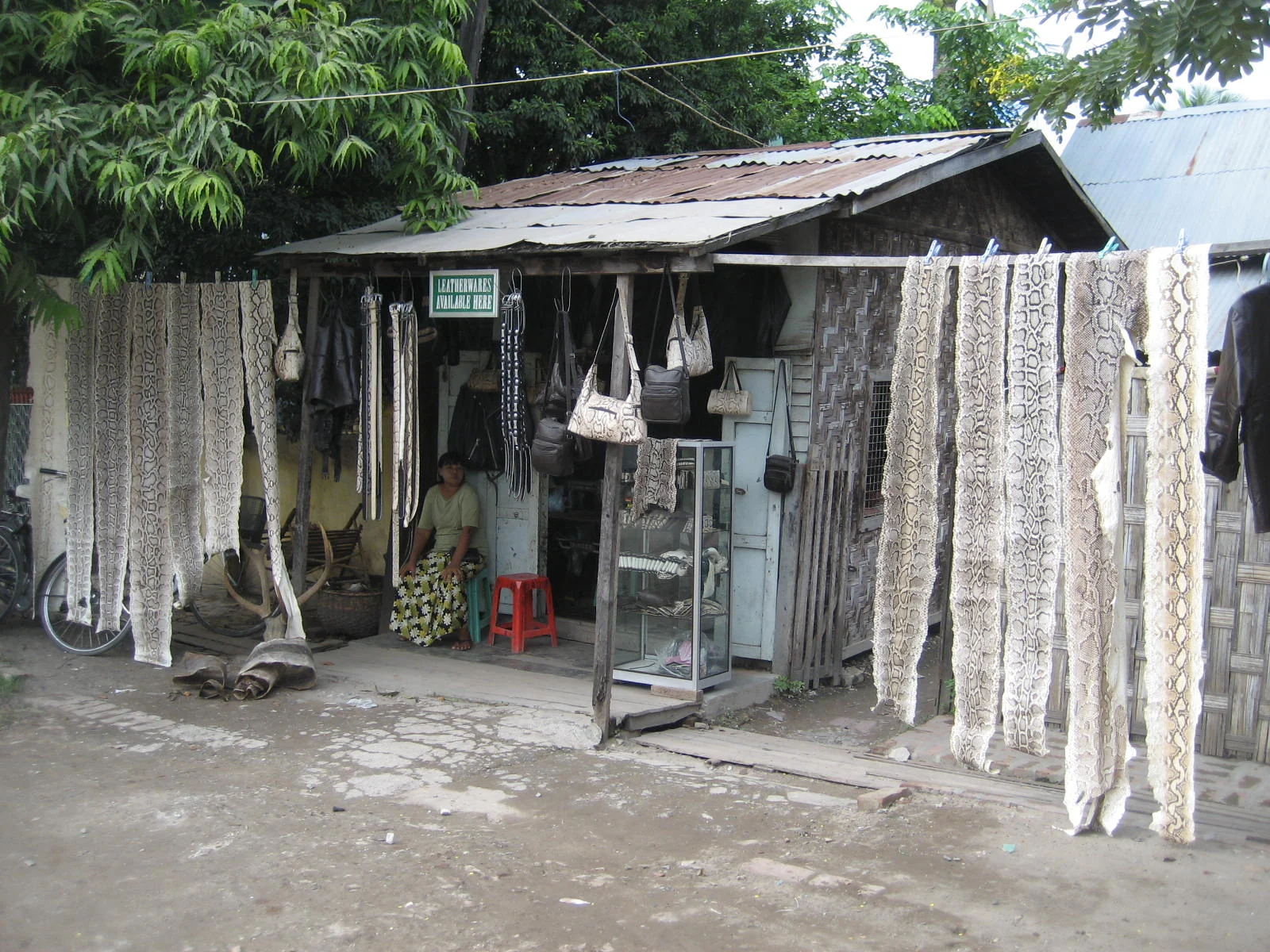
Malaysia’s wildlife department had a view of who held the power there. Since 2008 the country had capped its exports to Singapore at 90,000 skins because, the department said, Singapore’s stockpiles let traders there control price and supply. The billion dollars a year attached to the python trade since 2012 is the ITC’s model of the whole sector at 2011 prices, meat and gall bladders included; nobody measured it.
From snake to bag, at 2011 prices

One illustrative chain, built from the ITC's figures for Indonesia in November 2011 and its model of that year. A collector sells a three-to-four-metre reticulated python for about US$35. After slaughter and drying, its skin fetches about US$100; the meat brings US$3 and the gall bladder US$2. Tanned, finished and cut, half a skin can become a luxury handbag selling for US$5,000 to US$10,000, and the ITC's own value chart works with a bag of about US$6,000. On that model the hunter receives about 0.5% of a high-end bag's final value, while about 96% of the trade's value accrues to the European fashion industry. Read those as shares of a retail price. They say nothing about profit, because the exporters and re-exporters in the middle of the chain declined to share their margins.
How a skin changes its name
In 2012 Indonesia’s harvest quota for reticulated pythons stood at 175,000 skins, 90% of them for export. The ITC found that hunters, needing the money, kept hunting after the quota was filled, and that traders kept buying in order to stay on good terms with the slaughterhouses. So skins existed that no quota could cover. They had to go somewhere.
Natusch’s team argues that the quota itself is one of the culprits. They judged Indonesia’s and Malaysia’s quotas lower than the snake populations could sustain. Skins were therefore harvested beyond the quotas, and some entered trade through smuggling, laundering and falsified CITES permits. “Somewhat paradoxically,” they wrote, quotas and trade bans had created problems while conferring no apparent benefit; such restrictions “merely create illegality”. Poverty, abundant snakes and the rules themselves, on their account, combine to produce the black market.
It’s a serious argument, and their own report contains its counterweight. When supply falls, quotas can push hunters to work harder for scarcer snakes, “potentially rendering the harvest unsustainable”. The better reading is narrower than theirs. A tight quota creates an incentive to launder. It doesn’t simply put a new label on a fixed black market, and it’s one mechanism among several. Colombia, as we’ll see, ran on a different one.
Whatever their origin, most skins then passed through one city. In 2012 the ITC found that about 60% of exports were re-exported through Singapore. (The IUCN press release launching the report said 70%, which tells you how firm these numbers are.) Singapore had re-exported roughly a quarter of a million reticulated python skins a year since 2000, and its traders didn’t declare their stocks. Undeclared stocks, the ITC said, gave illegally sourced skins a route to be mixed with legal ones and sent on.
The documented methods are mostly paperwork. A re-export permit carries a source code, and since 2000 Singapore had re-exported about 378,000 skins declared captive-bred, about 134,000 declared “pre-Convention” and about 30,000 declared as seized from illegal shipments. A pre-Convention skin is one acquired before CITES covered the species, which for reticulated pythons means before 1 July 1975. The ITC estimated that a skin can be stockpiled for two to four years before it degrades. On that estimate, a skin acquired before 1975 would have degraded long before 2000.
The ITC also listed false declarations of a skin’s source and size, and sketched, as an illustration rather than a witnessed case, how whole skins could be declared as half-skins, doubling the count on paper. The IUCN farm assessors advised treating a “C” code, for captive-bred, with caution when it comes from Cambodia, Indonesia, Laos or Malaysia; in 2014 the authorities and trade bodies of Indonesia and Malaysia denied that commercial python breeding happened there at all. Three species of short-tailed python, once dried, can be told apart only by counting their belly scales. And sometimes nobody bothers with paper. In 2010 Singapore seized 470 python skins declared as synthetic leather, and burned them in 2011 after public and media pressure.
The laundering risks the investigators describe run through licensed businesses all along the chain: exporters, re-exporters, a farm the researchers were turned away from, and slaughterhouses that, traders told the ITC, went on buying after the quota was filled. The investigations of the trade document no cartels or clans running it. Jennifer Scotland and Anne-Marie Weeden of the defence think tank RUSI have described drug cartels and armed groups exploiting supposedly legitimate wildlife businesses, but in Colombia and Mexico.
How much is laundered? Nobody knows. In 2012 Tomas Waller, then chair of the IUCN’s boa and python specialists, said “a substantial proportion” of the skins in trade appeared to be sourced illegally. EPIC Biodiversity, Natusch’s consultancy, whose contributors overlap with the scientists quoted here, now says there is “no large-scale illegal trade, nor organised criminal activity” in exotic leathers. Two criminologists found that US seizure incidents involving fashion wildlife rose between 2003 and 2013, with reptiles in 84% of them; Natusch’s team replied that seizures came to about 0.44% of reptile shipments in those US import records. Both figures count what was caught. How much laundering goes undetected, neither the seizure rate nor Singapore’s missing stock records can say.
Who is supposed to be watching
The authorities’ checks are mostly made on paper. The legal-acquisition finding behind a permit is built from what the trade declares: quota shares, source codes, stock records. Whether officials do worse than take the trade at its word, the record barely says. In Laos the farm’s link to the state was the owner’s son and his job at the ministry, which by itself shows no official complicity in laundering. Malaysia’s wildlife department, PERHILITAN, grading its own country’s exports for CITES in 2021, saw little evidence of significant illegal trade from Malaysia. What it did detect involved Indonesian skins in transit, and abuse was low, it said, “partly because legal trade is so readily available”.
The importing side sometimes acts. The EU suspended imports of wild-caught reticulated python skins from Peninsular Malaysia in 2004, lifted the suspension in 2017 and reinstated it in 2019. Natusch’s team called its justification “unclear”. As of 2016, CITES’s periodic review of the countries exporting the species classed both Laos and Malaysia as of “possible concern”. Those are official doubts about how the exporting countries manage the trade, and neither accuses their officials of taking part in it.
How risky is it to cheat, and for whom? With no conviction figures to go on, this has to be reasoned from what is documented. For a poor hunter a big snake was worth up to about forty dollars, a real boost, and hunting after the quota is filled leaves no mark on a dried skin. In the middle, the ITC’s 2011 example turned a thirty-five-dollar snake into a hundred-dollar skin, and traders said they kept buying after the quota filled. The exporter’s margin is the one nobody would disclose, and the exporter’s exposure sits in the paperwork: a source code, a count, a permit. Over all of them, in 2012 the ITC found customs monitoring weak, the risk of seizure low, and penalties in the source states too light to deter smuggling. In Colombia and Mexico, Scotland and Weeden found, irregularities in licensed wildlife businesses tend to be “treated as administrative offences rather than serious crimes”.
Why isn’t it tighter? The exporting state sets the quota its exports are judged against, and a dried skin hides its identity: the species is a matter of counting scales, the origin isn’t written on it, and the individual tag starts at export. In 2012, at least, the hub’s stocks also went undeclared. In 2016 Natusch’s team proposed replacing the count with a minimum size, a dried skin of roughly 280 by 30 centimetres, which an inspector can actually check, and a monitoring fund paid for by tanneries and brands. There’s no sign of either yet. In December 2025 the parties to CITES approved developing a database to help scrutinise trade declared as captive-bred, if external funding and Secretariat resources allow. The “pre-Convention” and “seized” source codes remain in the CITES rules on permits.
Is the harvest itself sustainable? Natusch’s team compared harvested pythons in Sumatra in 1995 and 2015, found no decline in their numbers or sizes, and inferred that the quotas sit below what the populations can bear; the 2026 global assessment, using trade data that end in 2020, calls reptile-skin harvesting biologically sustainable “in the vast majority of cases”. The ecologist Vincent Nijman objects that snakes counted at processors can’t stand for the wild population, and the case remains disputed. It’s also a separate question from legality. A harvest can be sustainable and laundered at the same time.
Why the alligator is easier to count
Uncontrolled hunting nearly wiped out the American alligator. Louisiana barred all hunting in 1962, and the species came off the endangered list entirely in 1987. The state says its wild population has grown from under 100,000 to more than 3 million in fifty years, with nearly a million more on farms.
The method is ranching. Since 1986 licensed farmers have collected wild alligator eggs on private land, and they must return about 5% of their three-to-five-foot alligators to the wild. The return rate started at 17%, on the estimate that about 83% die in the egg or before reaching four feet. Surveyors fly over the coastal marshes counting nests, and in 2019 they estimated a record of nearly 68,000. The state keeps a database of who hunted or farmed each alligator and where each hide was shipped. More than 80% of the coastal wetland is privately owned, so the harvest pays landowners to keep marsh as marsh. In 2021 the state’s alligator chief, Jeb Linscombe, said the primary reason the species recovered was the elimination of the black market.
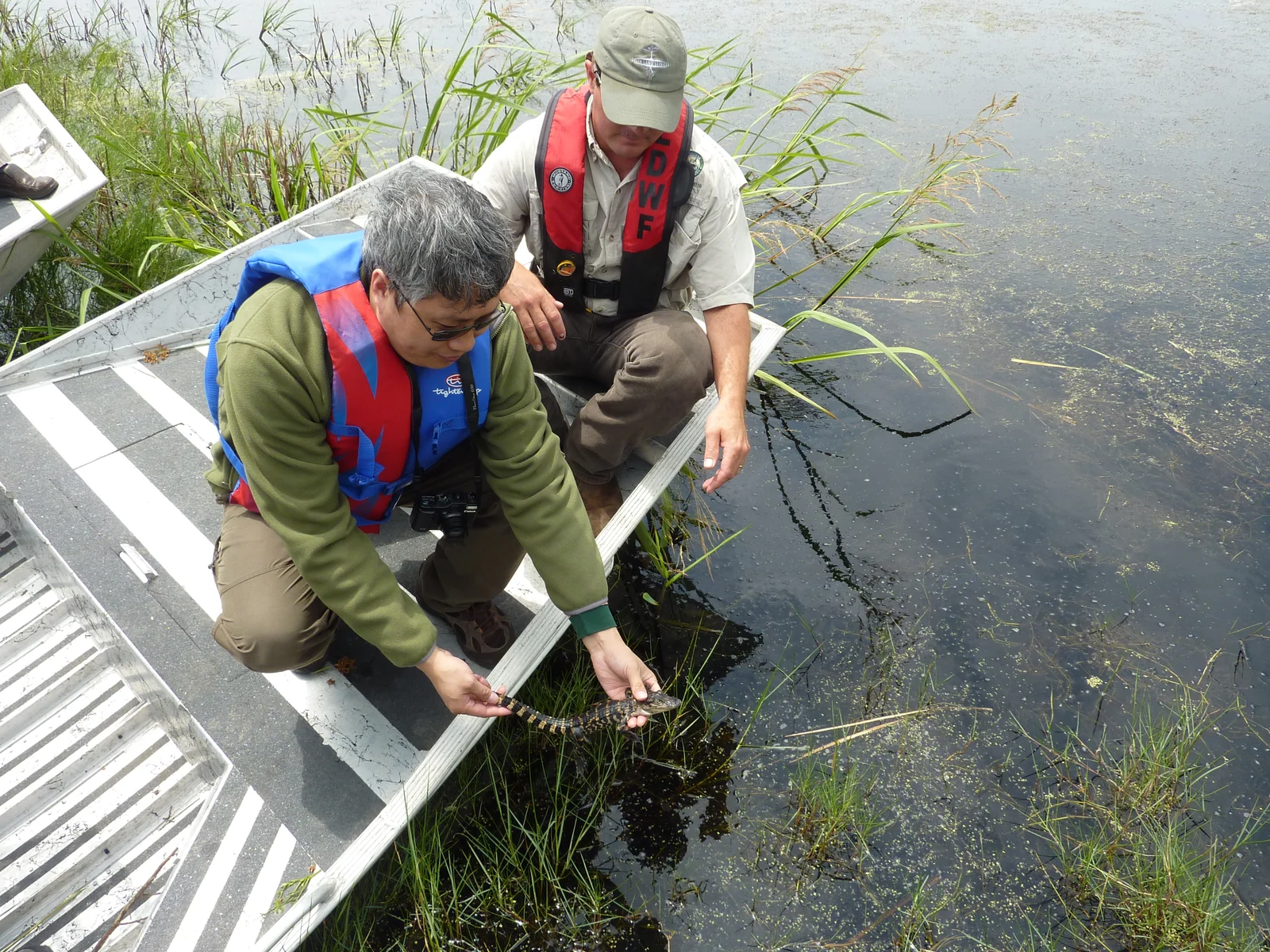
The difference isn’t the animal. Ranching ties production to things a regulator can count: nests seen from the air, eggs taken under licence on known land, a set share sent back. A wild reticulated python is caught at whatever age a hunter finds it, often before it has bred, in forest or plantation, and there’s no nest census to check its skin against.
So why not farm pythons somewhere easy to audit, in Europe or the US? What the farms need points to an answer. Louisiana’s system collects wild eggs to sustain a native species; in the US the python is an invasive pest, so the same method would serve a different purpose altogether. A closed python farm runs on cheap feed, wild-caught rodents and waste protein from food supply chains, and in Viet Nam on household labour in small satellite farms, where feeding can be labour-intensive. In 2014 the commercial farms were in China, Thailand and Viet Nam. And a farm would compete with the wild harvest: in 2011 a wild snake changed hands in Indonesia for about thirty-five dollars, and a farm in Europe wouldn’t by itself stop that harvest.
Auditable isn’t the same as clean, though. Tracking, certification and population recovery each answer a different test. In 2019, the year of the record nest count, Louisiana’s wild harvest was depressed by a worldwide oversupply of crocodilian skins, which suggests the market wasn’t short of legal ones. Colombia shows what a crocodilian trade looks like when production is self-reported.
A quota you can sell

In the mid-1980s Colombia restricted its caiman production to captive breeding. Farms reported their own stock, and export quotas followed from the reports. In 2016 the IUCN's Crocodile Specialist Group described how farms employed technicians to "work backwards": first decide the quota they wanted, which some informants estimated was commonly 40 to 70% above real production, then build the records to match. Before inspections, farms bought wild-caught juveniles to fill out the contrived stock figures. The quotas this produced became tradeable, sold on to tanneries, traders and other farms. The specialists "conservatively" estimated that more than 30% of caiman skins exported from Colombia since 1990 had been taken in breach of Colombian law, which would mean more than 4 million illegal skins. Yet in 2019 IUCN specialists, the crocodile group's chair among them, listed Colombia among the sustainable-use successes for crocodiles. Abundant caiman and a fraudulent paper trail answer different tests.
What the brands bought
Kering still owns the python tannery Caravel outright, and reports that for 2025, 98% of its precious skins were traceable “back to the farm or slaughterhouse”. For a farmed animal that’s a real endpoint. For a wild python, the slaughterhouse is where that metric’s trail begins, and the metric doesn’t say where the snake was caught. The two Thai farms in PETA Asia’s 2024 footage supplied Caravel, PETA said, and one of them confirmed a contract for 5,000 skins that year.
Hermès bought further up the chain, on the crocodile side. It owns an alligator farm in the United States and five crocodile farms in Australia. It says its farmed crocodilians come mainly from eggs collected in the wild under quotas set by local authorities, and that all the raw crocodilian hides its tanneries bought came from farms certified under the standard of the International Crocodilian Farmers Association (ICFA) by BSI, an independent certification body. Its tanneries trade exotic hides only where the source is “perfectly identified, controlled and audited”, and the company “refrains from dealing in certain species or sectors”. Python doesn’t appear anywhere in its 2025 annual report.
Chanel walked away. In December 2018 it became the first luxury house to drop crocodile, lizard, snake and stingray, and Karl Lagerfeld explained that they’d done it rather than have it imposed on them, “because it’s in the air”. Bruno Pavlovsky, Chanel’s head of fashion, added that high-quality skins were getting harder to source ethically. Neither reason was about snake numbers, and retailers have followed: in September 2026 Frasers Group promised to stop buying products containing exotic skins.
The alternatives are each partial. Farmed Burmese python exists. Imitation python printed on cowhide sold for about €12 a metre in 2011, almost seven times cheaper than good genuine skin. And in Florida, where Burmese pythons are an invasive pest, the company Inversa turns them into wallets, shoes and belts; the state counted 748 pythons removed in July 2025 against 235 in July 2024, after Inversa began working with it.
What the label can tell you
A buyer can know four things, roughly. Each proves less than it sounds.
The species, first. Historically, recorded trade in Burmese python was overwhelmingly declared captive-bred: between 2005 and 2011, 99% of it. Reticulated python mostly came from the wild. That describes a trade, and a species label authenticates no individual skin.
The source code. A “C” from Cambodia, Indonesia, Laos or Malaysia still warrants the farm assessors’ caution, and the 2026 global assessment repeats it for Laos.
The origin. A Louisiana alligator hide sits in a state database recording who farmed or hunted the animal and where the hide went, inside a system whose inputs, nests and eggs, are counted by someone other than the seller. That’s a documented chain of origin, and it’s still a record of people and shipments.
The certificate. It certifies what its standard checks. Hermès’s covers the farm. It doesn’t vouch for every proposition a buyer might read into it.
Which leaves Kering’s phrase, “back to the farm or slaughterhouse”, and what it means for a wild python. In Indonesia in 2011 a snake like that changed hands for about thirty-five dollars on its way to slaughter. The papers that then moved its skin around the country tracked shipments, not snakes, and its own sticker came later, at export.
For a wild python, the trail Kering reports begins at a building. The forest isn’t in it.
⁂
When the mark is real
In 2006 Colombia began requiring caiman farms to cut the tenth tail scute from their newborn hatchlings. The wound healed into a permanent “scar button”, a mark on the living animal that said, in effect, born on a farm. It was exactly what paper lacks: physical, carried by the animal itself, checkable by anyone who looked at the tail. Then the Crocodile Specialist Group reported that some remote farms linked to major ones allegedly took wild-caught animals, removed the same scute, waited for the scar to form, and moved the animals to the main breeding farm. If the practice happened as alleged, the mark was real, made the approved way on a real animal, and it lied about where the animal came from.
Can a skin testify?
If a mark can be manufactured, perhaps the skin itself can be made to talk. Put four questions to it and the answers come back with very different confidence.
Which species? The three short-tailed pythons, once dried, can be separated only by counting belly scales. It can be done. It needs an expert with the skin in hand, one skin at a time.
From where? Natusch’s team tested stable isotopes and trace elements, the chemical signatures that diet and place leave in tissue, on python skins of known origin from Indonesia and Viet Nam. Combined, the two techniques discriminated between diet treatments and between geographic origins with up to 100% accuracy, in a trial where the answers were known in advance, not on anonymous leather arriving at a tannery. In 2016 the team had recommended isotopes against laundering. DNA could in principle assign a skin to a wild population, and the geneticists Gillian Murray-Dickson, Mark Auliya and their co-authors, who studied the reticulated python’s population structure, argue that the structure ought to matter in assessing the trade. But tanning leaves “low concentrations of heavily degraded and fragmented DNA”. No DNA programme is known to run at the scale of the trade.
Wild or captive? The isotope trials separated snakes raised on different diets, which is the proxy for farm feeding. In 2014 Natusch and Jessica Lyons proposed that farmers keep their eggshells as evidence of breeding, to be collected and destroyed by enforcement officials each year so they couldn’t be reused. There’s no sign the idea became routine. The scar button was Colombia’s answer to the same question, and the specialists have reported how that went.
Is it the same skin all the way? Indonesia’s export stickers, each listed on a permit, follow a skin from the export desk. Louisiana’s hide database follows an alligator from hunter or farm to shipment. The CITES database approved in 2025 would scrutinise declarations of captive breeding, not follow individual skins.
The isotope authors drew their own line under all this. Their methods, they wrote, would be most applicable and cost-effective “for species with small populations of genuine conservation concern, rather than for large volume trade in species for which there is little conservation risk.” On its own terms that’s a reasonable test. Why spend scarce money protecting an abundant snake?
But it’s a conservation test, and the question a permit answers is a legality question: is this skin’s declared origin true? A forensic method that’s poor value for conserving a common species may still be the only independent check on a false permit. The cost criterion answers a question the buyer, and the customs officer, aren’t asking. Our piece on rosewood, “The paper forest”, puts the same question to timber.
Counting snakes nobody can see
The case for sustainability rests on a comparison. Natusch’s surveyors looked at more than 4,200 harvested pythons in Sumatra across surveys in 1995 and 2015, and found that numbers, mean body sizes, clutch sizes, sizes at maturity and the proportion of giant snakes had not decreased. “Thus, despite assumptions to the contrary,” they wrote, “the harvest appears to be sustainable.” From the same twenty years of stability they concluded that the quotas sit below what populations can sustain. The 2026 global assessment extends the verdict to reptile skins generally.
The same research line began more cautiously. In 2012 the ITC report, with Natusch among its authors, worried that large numbers of pythons were being slaughtered before they reached sexual maturity, and recommended a precautionary approach.
Note what the later comparison counted, though: snakes that reached processors. Snakes arriving at a slaughterhouse are a sample of the slaughterhouse. That is the heart of Nijman’s objection; there is, he writes, “no substitute for monitoring wild populations”. Stable traits among slaughtered snakes don’t by themselves show stable numbers in the wild. If hunters range further or work longer, a slaughterhouse can keep receiving snakes of the same size while the area they’re drawn from changes underneath it. Nijman’s own figures come from a different species, the blood python: sampled slaughterhouses in North Sumatra processed about 27,000 a year against a quota of 18,000. They say nothing about the biology of the reticulated python, but they show how far a count at the processor can drift from the number on paper.
Murray-Dickson, Auliya and their co-authors pressed a related point. Conclusions about sustainability, they argued, risk “ignoring the entire issue of trade dynamics”. Their study concerns how the reticulated python divides into distinct populations, which is why a skin’s origin matters biologically as well as legally. A national total can look healthy while one population is worked hard.
The defenders’ best reply is that counting the forest is brutally difficult. In Sabah, a team that included Natusch ran 527 standardised riverbank surveys and found 83 reticulated pythons: trained surveyors looking specifically for giant snakes find very few. If systematic searching yields that, the authors argue, repeated surveys of harvested snakes are the more reliable basis for judging sustainability. Regulators haven’t settled it either; the EU’s reversals over Peninsular Malaysian skins are the official version of the same uncertainty.
Funding runs both ways. Kering’s partnership funded the Sumatran work; the genetics study that criticised its conclusions received funding from LVMH. Neither fact settles anything. The questions worth asking are about method: what was counted, where, and whether it can stand for the forest.
And the fight over sustainability, however it ends, leaves the legality question where it was. A perfectly legal harvest could still drain one population while the national numbers look fine.
What owning the farm buys
World Animal Protection, a group that campaigns against crocodile farming, estimated in 2021 that Australia supplied about 60% of the world’s trade in saltwater crocodile skins, two-thirds of it from the Northern Territory. Hermès and Louis Vuitton were believed to own or control most of the territory’s farms, and the ABC reported that owners of farms the brands bought out signed non-disclosure agreements. By 2021 a company Hermès controls was planning to turn a former melon and banana farm at Lambells Lagoon into a facility for 50,000 crocodiles. The operator says stage one was running by early 2021 and stage two by early 2022. Its replacement environment-protection licence, which covers waste operations, runs to April 2036.
For the hides, Hermès points to its farms’ ICFA certificates, audited by BSI. The standard is broad: it covers welfare, traceability and product integrity, and biodiversity and environmental management, with independent annual audits. Hermès’s report doesn’t give the audit findings.
Welfare runs through the same calculation: LVMH wrote 116 animal-welfare criteria into its own crocodile standard, PETA aimed its python footage at farms it said supplied Kering’s tannery, and Chanel’s fashion chief said skins were getting harder to source ethically. Read together, those cases suggest that the welfare test lands on the brand, which can try to answer it on farms it owns or audits or, like Chanel, stop buying.
Then there are the animals on those farms, which come, as Hermès says, mainly from wild eggs taken under quotas that local authorities set. IUCN specialists described its Australian supply as drawn from a population that had recovered from devastation to near carrying capacity. So a certifier audits the farm, and the state sets the egg quota. Two checkers, two tests, which is the three-test problem again in crocodile form. Ownership closes the distance between farm and tannery but leaves the egg harvest where it was.
Does farming help the wild animal at all? One thing is documented: topping up captive stock with wild-caught animals is a recurring problem in wildlife farming. Two other claims made about farming are hypotheses. Natusch and Lyons suggested in 2014 that closed-cycle python farming, cut off from the wild, “may create commercial incentives favouring extinction”, by raising the value of captive stock, and that it spreads benefits among fewer people than a sustainable wild harvest. Sarah Veatch of the animal-welfare group Humane World for Animals worries about the opposite feedback: legal markets, she argues, normalise and legitimise wild skins and grow the demand for them. For pythons, both remain hypotheses.
And then there’s a fourth test, one the permit never pretended to cover. In September 2025 the ABC reported elevated E. coli at Lambells Lagoon. The operator’s own monitoring report, filed with the Northern Territory’s environment regulator, records 3.6 million E. coli colony-forming units per 100 millilitres of water at the farm’s irrigation pivot on 27 March 2025. Bithin Datta, a groundwater specialist, warned of contamination risks “extending beyond the property boundary”. The regulator rated the reported non-compliance a low environmental risk.
Ownership tells you who is responsible for a farm. It doesn’t tell you what the auditors found there.
Related articles
- How much are diamonds really worth?
- The underground economy that sustains the world’s poorest countries
- How Brazil cut Amazon deforestation to a record low, and what could undo it
Further reading
As an Amazon Associate, Eikleaf earns from qualifying purchases. The book links below are affiliate links: if you buy through them, we may earn a small commission at no extra cost to you.
 The Feather Thief: Beauty, Obsession, and the Natural History Heist of the CenturyInvestigates stolen bird skins and feather dealers, showing how demand for rare animal materials persists despite restrictions and uncertain provenance.
Recommended videos
 27:26Inside Malaysia’s Gruesome Snake Skin TradeFollows wild-caught pythons from Malaysian and Indonesian collectors to exporters, showing how illegal skins slip into a trade that is legal on paper.
 3:17Why are fashion houses buying up crocodile farms? BBC NewsVisits Queensland crocodile farms as Hermès and Louis Vuitton buy them, illustrating the article’s point about brands owning the farm to control supply.
Cite this article
Owen Parker. “What a legal python skin can prove.” Eikleaf, 2 November 2026. https://www.eikleaf.com/what-a-legal-python-skin-can-prove/
Gen AI Disclaimer
Some contents of this page were generated and/or edited with the help of a Generative AI.
Media
Python skin tannery, Nigeria – Wikimedia Commons (Photo: Aminucrus, CC BY-SA 4.0)
Python skins in Mandalay – Wikimedia Commons (Photo: Wagaung, CC BY-SA 2.0)
Chinese delegate releases a juvenile alligator – U.S. Fish and Wildlife Service, Wikimedia Commons
Key Sources and References
Kasterine, A., Arbeid, R., Caillabet, O. and Natusch, D. The Trade in South-East Asian Python Skins. International Trade Centre, Geneva, 2012. https://intracen.org/es/media/3071
International Union for Conservation of Nature. “Study raises concern over international trade in python skins.” Press release, 27 November 2012. https://iucn.org/node/13114
Nossal, K., Livingston, D. G., Aust, P., Kasterine, A. et al. Trade in Python Skins: Impact on Livelihoods in Viet Nam. Geneva: International Trade Centre, 2016. https://intracen.org/es/media/2781
Natusch, D. J. D., Lyons, J. A., Mumpuni, Riyanto, A., Khadiejah, S., Mustapha, N., Badiah and Ratnaningsih, S. Sustainable Management of the Trade in Reticulated Python Skins in Indonesia and Malaysia. Occasional Paper of the IUCN Species Survival Commission No. 61. Gland, Switzerland: IUCN, 2016. https://portals.iucn.org/library/sites/library/files/documents/SSC-OP-061.pdf
Natusch, D. J. D. and Lyons, J. A. Assessment of Python Breeding Farms Supplying the International High-end Leather Industry. Occasional Paper of the IUCN Species Survival Commission No. 50. Gland, Switzerland: IUCN, 2014. https://portals.iucn.org/library/efiles/documents/SSC-OP-050.PDF
Natusch, D. J. D. et al. “Jungle Giants: Assessing Sustainable Harvesting in a Difficult-to-Survey Species (Python reticulatus).” PLoS ONE, July 2016. https://doi.org/10.1371/journal.pone.0158397
Natusch, D. J. D., Carter, J. F., Aust, P. W. et al. “Serpent’s source: Determining the source and geographic origin of traded python skins using isotopic and elemental markers.” Biological Conservation 209: 406–414, May 2017. https://www.sciencedirect.com/science/article/pii/S0006320716306437
Colston, T. J., Natusch, D. J. D. et al. “A global assessment of reptiles in the skin trade.” Scientific Reports, 1 July 2026. https://doi.org/10.1038/s41598-026-58104-x
Burger, R., Natusch, D. J. D., Shine, R., Vaughan, I. P., Sipangkui, S. and Goossens, B. “Efficacy of field-based surveys for detecting and assessing demographics of giant snakes (Malayopython reticulatus) in Malaysia.” Scientific Reports 16, 26081, first published 8 June 2026; version of record 20 August 2026. https://www.nature.com/articles/s41598-026-57269-9
Nijman, Vincent. “Harvest quotas, free markets and the sustainable trade in pythons.” Nature Conservation 48: 99–121, 11 May 2022. https://doi.org/10.3897/natureconservation.48.80988
Murray-Dickson, G., Ghazali, M., Ogden, R., Brown, R. and Auliya, M. “Phylogeography of the reticulated python (Malayopython reticulatus ssp.): Conservation implications for the worlds’ most traded snake species.” PLOS ONE, 17 August 2017. https://journals.plos.org/plosone/article?id=10.1371/journal.pone.0182049
Sosnowski, Monique C. and Petrossian, Gohar A. “Luxury Fashion Wildlife Contraband in the USA.” EcoHealth 17: 94–110, 27 January 2020. https://link.springer.com/article/10.1007/s10393-020-01467-y
Natusch, Daniel J. D., Aust, Patrick W. and Shine, Richard. “The perils of flawed science in wildlife trade literature.” Conservation Biology 35(5): 1396–1404, first published 19 February 2021. https://conbio.onlinelibrary.wiley.com/doi/10.1111/cobi.13716
Webb, Grahame J. W. and Jenkins, Robert W. G. Concerns about the Production and Trade in Brown Caimans (Caiman crocodilus fuscus) from Colombia. IUCN SSC Crocodile Specialist Group, CITES SC66 Inf. 20, January 2016. https://cites.org/sites/default/files/eng/com/sc/66/Inf/E-SC66-Inf-20.pdf
IUCN SSC Crocodile Specialist Group. Traceability in crocodylian conservation and management. 2021. https://www.iucncsg.org/365_docs/attachments/protarea/1798ca7fa30db1f2d9ca905957288604.pdf
Natusch, D., Webb, G., Shine, R. et al. “Is banning exotic leather bad for reptiles?” IUCN Crossroads blog, 25 March 2019. https://iucn.org/crossroads-blog/201903/banning-exotic-leather-bad-reptiles
Scotland, J. and Weeden, A.-M. An Illusion of Legality: Wildlife Laundering in Colombia and Mexico. Royal United Services Institute, 2 December 2025. https://static.rusi.org/illusion-of-legality-wildlife-laundering-colombia-mexico_1.pdf
Khadiejah, S., Abu-Hashim, A. K., Musa, F. H., Abdul-Patah, P., Abdul Rahman, M. T., Ismail, H. I., Wahab, A. and Razak, N. A. Management and Trade in Reticulated Pythons (Malayopython reticulatus) in Peninsular Malaysia. Department of Wildlife and National Parks Peninsular Malaysia (PERHILITAN), 2021. 80 pp. https://cites.org/sites/default/files/eng/com/ac/31/Docs/E-AC31-14-03-A.pdf
U.S. Fish and Wildlife Service. “§ 23.60—What factors are considered in making a legal acquisition finding?” Code of Federal Regulations, title 50, part 23, edition revised 1 October 2025. U.S. Government Publishing Office. https://www.govinfo.gov/link/cfr/50/23?link-type=pdf&year=mostrecent
U.S. Fish and Wildlife Service. “§ 23.61—What factors are considered in making a non-detriment finding?” Code of Federal Regulations, title 50, edition revised 1 October 2025, pp. 215–217. U.S. Government Publishing Office. https://www.govinfo.gov/content/pkg/CFR-2025-title50-vol9/pdf/CFR-2025-title50-vol9-sec23-61.pdf
CITES Secretariat. Annotated CITES Appendices and Reservations, p.109. https://cites.org/eng/resources/pub/checklist08/Annotated_CITES_Appendices_and_reservations.pdf
IISD Earth Negotiations Bulletin. “Summary of the Twentieth Meeting of the Conference of the Parties to CITES.” December 2025. https://enb.iisd.org/convention-international-trade-endangered-species-wild-fauna-flora-cites-cop20-summary
CITES. Resolution Conf. 12.3 (Rev. CoP20), Permits and certificates. https://www.informea.org/en/akn/un-unep-cites/act/resolution/cop/2002-11-03/12-3/eng@2024-12-04
EPIC Biodiversity. “About” and “FAQs.” Accessed 30 October 2026. https://www.epicbiodiversity.com/about ; https://www.epicbiodiversity.com/faqs
Louisiana Department of Wildlife and Fisheries. “Alligator Management.” Accessed 30 October 2026. https://www.wlf.louisiana.gov/page/alligator-management
McConnaughey, Janet. “Louisiana gators thrive, so farmers’ return quota may drop.” Associated Press, 17 October 2021. https://www.wptv.com/news/national/louisiana-gators-thrive-so-farmers-return-quota-may-drop
Walling, Melina. “Louisiana’s alligator farms raise the reptiles for meat, skins — and conservation.” Associated Press, 13 March 2026. https://apnews.com/article/43ff84e0d13304b2925fc102bc0445bd
Hermès International. 2025 Universal Registration Document, including the annual financial report. 19 March 2026. https://assets-finance.hermes.com/s3fs-public/node/pdf_file/2026-04/1777391712/260320_hermes_urd2025_en.pdf
Kering. 2025 Universal Registration Document. 2026, p.225 (traceability) and p.422 (Caravel ownership). https://www.kering.com/api/download-file/?path=02_Universal_Registration_Document_2025_EN_216d1c494b.pdf
Caravel Pelli Pregiate. “Ethical standards.” Accessed 30 October 2026. https://www.caravelspa.com/en/profile/ethical-standards/
LVMH. 2025 Universal Registration Document. 2026. https://urd.lvmh.com/en/2025
Hicks, Robin. “Singapore, Japan driving demand for crocodile-skin handbags as plan for croc farming expansion exposed in Australia.” Eco-Business, 7 July 2021. https://www.eco-business.com/news/singapore-japan-driving-demand-for-crocodile-skin-handbags-as-plan-for-croc-farming-expansion-exposed-in-australia/
Roy, Anuska. EPL320 Monitoring Report: Lambells Lagoon Crocodile Farm. Reporting period: 1 May 2024–30 April 2025. EcOz Pty Ltd, prepared for PRI Group Pty Ltd, 28 May 2025. https://ntepa.nt.gov.au/_media/waste-and-pollution/register/epl/waste-handlers/croc-pac-pty-ltd/epl320-monitoring-report-2024-2025.pdf
NT EPA. Environment protection licence EPL320-02, commenced 12 April 2026. https://ntepa.nt.gov.au/_media/waste-and-pollution/register/epl/waste-handlers/croc-pac-pty-ltd/environment-protection-licence-epl320-02.pdf
World Animal Protection. Fashion Victims: The Trade in Australian Saltwater Crocodile Skins. July 2021. https://www.worldanimalprotection.org.au/siteassets/documents/reports/saltwater-crocodile-report-2021.pdf
International Crocodilian Farmers Association. “Standard development.” Accessed 30 October 2026. https://internationalcrocodilian.com/standard-development/
Parry, Sam. “Elevated E. coli levels recorded at major NT crocodile farm owned by luxury label Hermès.” ABC News, 25 September 2025. https://www.abc.net.au/news/2025-09-25/lambells-lagoon-crocodile-farm-nt-high-e-coli-levels-in-water/105806340
Natusch, D., Aust, P. W., Caraguel, C. et al. “Python farming as a flexible and efficient form of agricultural food security.” Scientific Reports 14, 5419, 14 March 2024. https://doi.org/10.1038/s41598-024-54874-4
Meeks, D., Morton, O. and Edwards, D. “Wildlife farming: Balancing economic and conservation interests in the face of illegal wildlife trade.” People and Nature, 19 January 2024. https://besjournals.onlinelibrary.wiley.com/doi/abs/10.1002/pan3.10588
PETA. “Video: Pythons Bashed With Hammers, Impaled on Hooks for Gucci’s Parent Company.” News release, 12 March 2024. https://www.peta.org/media/news-releases/video-pythons-bashed-with-hammers-impaled-on-hooks-for-guccis-parent-company/
Agence France-Presse. “Chanel sheds crocodile and snake skin.” 4 December 2018. https://fashionunited.uk/news/fashion/chanel-sheds-crocodile-and-snake-skin/2018120540342
Singh, Prachi. “Frasers Group commits to ending exotic animal skin sales.” FashionUnited, 7 September 2026. https://fashionunited.uk/news/fashion/frasers-group-commits-to-ending-exotic-animal-skin-sales/2026090790193
Caputo, L. “DeSantis: Python removal tripled since partnering with leather company.” Florida Phoenix, 21 October 2025. https://floridaphoenix.com/2025/10/21/desantis-python-removal-tripled-since-partnering-with-leather-company/