Last updated: · 27 min read
In brief
On 26 September 1983 a Soviet warning satellite reported five American missiles in flight. In under five minutes, Lieutenant Colonel Stanislav Petrov decided the reports were false, and he was right. Today’s argument is about Russia’s Dead Hand, after procurement records showed six years of construction tenders for its post inside Mount Kosvinsky. Yet the best insider account describes a backup command system that needs a crew to prepare the launch order. Petrov’s night points further up the chain. What matters is what warning reaches a person, how fast, and whether they can doubt it.
Contents
On 26 September 1983 the duty officer at Serpukhov-15 was Lieutenant Colonel Stanislav Petrov, and the satellite warning system in front of him reported that the United States had launched a Minuteman missile. Then another. Then more, until the count stood at five and the system, as he later put it, was “roaring”. Petrov argued with it. “When people start a war, they don’t start it with only five missiles,” he remembered thinking. Less than five minutes after the alert began, he decided the reports were false. “I had a funny feeling in my gut.”
He was right. But the reports came in so fast that, as the journalist David Hoffman reconstructed the night, an alert had already gone automatically to General Staff headquarters before Petrov could judge whether any of it was genuine. If so, and it is disputed, the machine spoke upward before the man had finished thinking.
Perimeter, the Soviet retaliation system the West calls the Dead Hand, played no part that night; it went on combat duty in January 1985. In September 2026 a joint investigation documented construction procurement from 2018 to 2024 for one of its mountain posts, Object 1335 inside Mount Kosvinsky in the northern Urals. Since then the argument has been about whether a machine now has its finger on the button. That matters. But Petrov’s night points at what the question leaves out: what reaches the person whose finger it is, how fast, and whether they are in any position to doubt it.
Eight minutes
The apparatus behind a nuclear launch is better understood as a chain than a machine: warning, assessment, authorisation, a surviving authority, transmission, launch. Any link can be human or automatic, slow or fast. The useful question is which is which.
Every link runs against a clock, and courage doesn’t solve a timing problem. By Soviet calculation, the arrival of Pershing II missiles in Europe in late 1983 cut warning of a strike on Moscow to about eight minutes, against about thirty for American ICBMs, although the Pershing II as deployed couldn’t in fact reach Moscow from its planned West German sites; Soviet estimates credited it with a longer range.
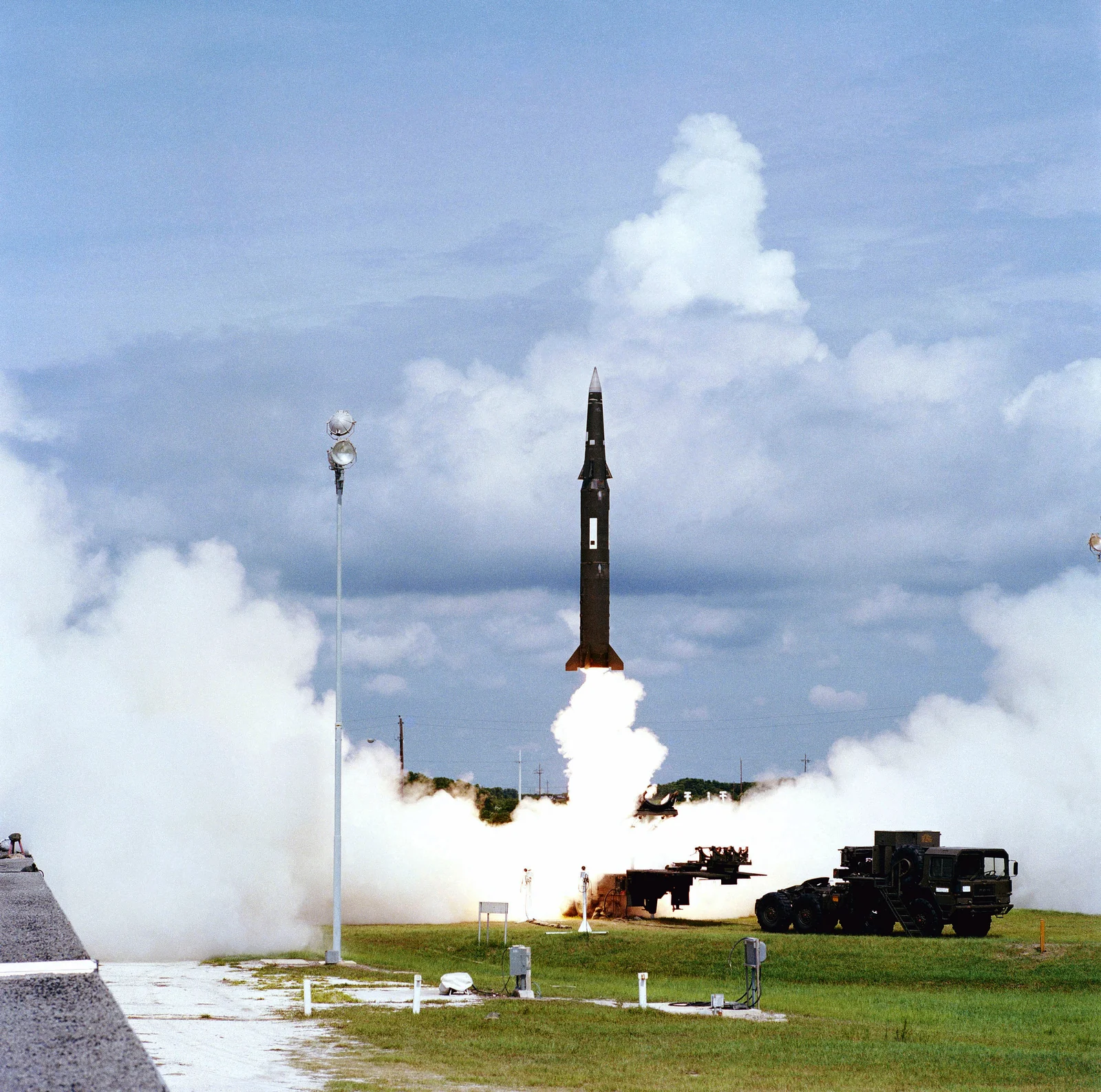
There are three ways to live with a clock like that. Launch on warning: fire on the evidence of sensors alone, before anything lands. Launch under attack: fire once the attack is confirmed and under way. Ride-out: absorb the strike, then answer. Which of these the Soviet Union really planned around is still argued.
Perimeter was ordered in 1974, years before Pershing II reached Europe, so the crunch of the early 1980s sharpened a fear it didn’t create. Bruce Blair, the former American launch officer who broke the Dead Hand story in the West, traced the anxiety behind the Urals mountain projects to the late 1970s, when US nuclear firepower “took special aim at the Communist Party’s leadership complex”. The Soviet answer was redundancy. In 1987 the Pentagon estimated more than 1,500 hardened alternate facilities for over 175,000 key Party and government personnel.
There were also two routes to a launch. In the arrangements of the mid-1990s, the leader’s nuclear briefcase didn’t fire anything. It gave permission; the General Staff ran the launch process and was authorised, in some circumstances, to act on its own. Perimeter is the branch for when that route has been cut.
A radio with conditions
Valery Yarynich, who served in the rocket forces and the General Staff and worked on Perimeter, is the best insider guide to the system in English, and his description is less cinematic than the legend: a backup command system whose main element is a set of command missiles. Before the crew in its bunker can send a launch order, three conditions must hold at once: the leadership has released a preliminary authorisation, all communication with the national command authority has been lost, and sensors of different types have reported nuclear detonations. The system, he wrote, has “no capability for preparing a launch order automatically without participation of the center’s crew”, and if no explosions are confirmed within a set period it returns to its initial status. Pavel Podvig, who tracks Russia’s strategic forces, puts it more simply: Perimeter is really a communication system. If the crew does act, the order is recorded automatically into the nose cones of missiles that carry radio transmitters instead of warheads, and they broadcast it as they fly across Russia.
Where that crew sits is disputed. Yarynich describes pre-selected officials of roughly deputy-defence-minister rank moving, in a threat period, into a super-hardened underground radio centre near the main command post; Hoffman, three duty officers in a globe-shaped bunker called Sharik, “the ball”.
Not every insider agrees even on the principle. In 1992 Varfolomey Korobushin, whom rocket-force experts regard as the father of Perimeter, described to American interviewers a system in which “there was no need for anyone to push a button.” Others in the same interviews said the automatic trigger “was never realized”, and Yarynich says the fully automatic designs of the years before 1985 were turned down by the high command.
Three practical questions follow.
Could Perimeter start a war? Not as Yarynich describes it. His crew can act only on confirmed nuclear detonations at home, lost communications and a preliminary authorisation, which is to say a war already under way. By those rules Petrov’s false alarm came nowhere near the threshold, and neither did the 1995 scare described below. Insiders, though, disagreed about whether a sensor-driven mode was ever used on duty, and nobody has shown that today’s system keeps these rules. Viktor Khalin, a retired major general who led its 2005–10 upgrade, writes of retaliation against attacks “with conventional or nuclear warheads” (our translation). And Perimeter is only the fallback: Russia’s declared policy lets the president authorise nuclear use in specified circumstances before any detonation, including attacks threatening its ability to retaliate.
Is it on all the time? In December 2011 the commander of the Strategic Rocket Forces, Sergei Karakayev, said publicly that the system existed and was on combat duty. Several accounts, Korobushin’s and Yarynich’s among them, describe something switched on from the top in a crisis rather than kept cocked. Hoffman has heard that Boris Yeltsin may have disabled the pre-delegation step, and says he can’t be sure. Whether it is enabled under Vladimir Putin is simply not known.
Who can refuse? The crew. “The people in this facility can—I would like to underline can—launch,” Yarynich said in 2009. In the mid-1970s, roughly a decade before Perimeter went on combat duty, a technical fault at the rocket forces’ command centre sent an automatically transmitted preliminary order out to the troops, and every duty officer recognised it as an error except one, in a single division command post, who began to carry it out. After the crew, the vote narrows. For surviving silo-based missiles that receive the order, Podvig describes automatic launch without further crew procedures.
The last messenger

The command missile at the heart of Perimeter was the 15A11, ordered by a Central Committee and Council of Ministers decision of 30 August 1974. It first flew in December 1978, finished flight tests in March 1982 and went on combat duty in January 1985. A mobile version, Gorn, rode on the SS-20 and was retired when Moscow and Washington agreed to destroy that class of missile; a later mobile variant, Sirena, was built on Topol. The chain has carried real traffic. On 9 February 2000 a command for an actual launch of a Topol-M from Plesetsk passed through Grot, the reserve command post inside Kosvinsky. The Dossier Center reports that in December 2019 a deputy defence minister, Alexei Krivoruchko, promised a new generation on a Yars booster, Sirena-M, by 2025. Analysts at the Federation of American Scientists assessed in 2026 that it "has recently replaced the older Sirena command module", a judgement Russia has not confirmed. In 2003 Yarynich counted speed among the system's shortcomings: 35 to 40 minutes to get the order to the most distant armed missiles.
Six years inside Kosvinsky
On 26 September 2026 Danwatch, The Sunday Times and the Dossier Center published what they had found by scraping more than two million Russian military procurement documents from a public database the authorities kept trying to restrict. Among them were thousands of tenders for “Object 1335”, dated from 2018 to August 2024. One describes “equipment for control, communications and security systems, as well as permanent accommodation for personnel on combat readiness”, and adds that applicants need an FSB licence for work that constitutes a state secret. The secret, in other words, was advertised. Tenders record what was bought, not what was installed. Satellite imagery shows work on what appear to be six new entrances to the mountain, where an iron door leads into the rock beside a machine-gun tower.
What the place is comes from the unit’s own history poster, photographed and published by the Dossier Center. In February 1981, it says, the military-industrial commission ordered proposals for “Grot” as the rocket forces’ reserve central command post, in rock confirmed to be radio-transparent, and construction began in 1982. Khalin writes that a secret presidential decree of 5 May 2005 placed a new Perimeter control link here.
Was the Dead Hand “reactivated”, as Danwatch’s headline put it? Jeffrey Lewis of Stanford called the simplest explanation that “the Russians are probably putting the Dead Hand back into operation.” Podvig answered within days. “You cannot reactivate the Dead Hand since it has never been deactivated,” he wrote, and “nothing suggests that its function has changed.” Hoffman doubts the word too, and the rocket forces’ commander had called the system on combat duty fifteen years earlier. The fair verdict is a continuous system, heavily rebuilt.
Rebuilt for what? Andy Weber, a former US assistant secretary of defense, says “Putin is very paranoid about decapitation strikes.” Tom Røseth of the Norwegian staff college reads the paperwork as hardening against American bunker-busters: “they therefore have to dig even deeper”. The tenders begin in 2018, so the wars of the 2020s can’t explain why the work started. The Kremlin didn’t answer the investigators. And Podvig supplies the proportion: Object 1335 is “only one of many reserve command posts”.
The other mountain
Yamantau, in the southern Urals near Beloretsk, is the mountain popular accounts tie to the Dead Hand. American imagery analysts mapped it in January 1984 and wrote that its function, “which does not resemble a mining operation, has not been determined”. In 1997 a leaked CIA report, as described in the press, still called Yamantau’s rationale “unclear”, while crediting the command post at Kosvinsky with the means to retaliate.
Americans have asked to look inside. In 1997 Congress asked Russia to explain Yamantau in writing, with drawings, and to admit an American delegation, noting that Russian officials had toured Cheyenne Mountain. Curt Weldon, the congressman behind the request, said that September that his letter to Yeltsin, written in Russian, had gone unanswered. Former conscripts interviewed for the 2026 investigation describe Kosvinsky’s interior; one says buses run through its tunnels.
The Dead Hand link rests on one documented contemporary allegation: according to the 1997 congressional record, sources of the Moscow paper Segodnya had tied Yamantau to the system in 1996. The Dossier Center notes that Grot was sometimes wrongly placed at Yamantau. Neither fact proves Yamantau has no command role.
The strongest supported interpretation is a leadership shelter. Blair, working from diagrams and notes given to him by senior Strategic Air Command officers, called it “a wartime relocation facility for the top Russian political leadership”. A 2001 ruling of Russia’s Supreme Court cites a letter from GUSP, the president’s Main Directorate of Special Programmes, the body that runs the leadership bunkers, and a unit of GUSP has reportedly been stationed in the closed town of Mezhgorye since 2020. That suggests a model: one mountain to keep the decision-makers alive, another to keep the decision alive if they die, each a node among many.
Automatic or automated
The 2026 headlines leaned on one sentence. Khalin writes that after the upgrade Russia’s leadership has a practically reliable technical toolkit for retaliation “in both automated and automatic mode”. He also dates a new generation of what he calls a special device at Object 1335 to combat duty in 2023. New equipment is not a new decision rule. His word “automatic” raises one specific question: does a crew still have to prepare the launch order, as Yarynich described? The Dossier Center read “automatic” as no human in the final decision. Steven Pifer, a former US ambassador, said that “it sounds like you are taking the human out of the loop.” Hoffman said the evidence didn’t convince him. If a reserve post can now fire without a person, Yarynich’s safeguard is gone, and nothing public settles the question either way.
Podvig’s reply moves the ground. Once the preliminary command has been given and the conditions are met, “does it really matter how the key is turned?” An operator deep in a mountain looking at a red light, or the red light wired straight to the key: the outcome barely differs, and the surviving silos launch automatically either way. “The automation we should worry about is elsewhere,” he writes, at the point where early-warning data is assessed and the preliminary command issued.
Official Russia says almost nothing, and says it oddly. It recognised Perimeter officially only in 1999, years after the system’s builders had described it to American interviewers. In July 2025 Dmitry Medvedev, deputy chair of the Security Council, turned the official silence into a taunt: mocking Donald Trump, he told him to remember how dangerous a “dead hand” that “does not exist in nature” could be, and added a laughing emoji.
The alarm and the officer
Go back up the chain to 1983 and take the night apart.
Detection failed first. The satellite had read sunlight reflected off the tops of clouds as missile launches, and the software meant to filter out such signals was afterwards rewritten. Petrov already distrusted the system. It had been rushed into service, he said, and was “raw”.
In Hoffman’s account, forwarding was automatic and outran Petrov’s judgement. Then assessment. Petrov consulted colleagues and reported his judgement to his superiors, but the judgement was his. His reasoning was the count of five. His cross-check was ground radar, which had not corroborated a launch, and he didn’t treat that as settling anything; he later said he had been “only 50/50”. He had less than five minutes. When investigators asked why he hadn’t written everything down that night, he said: “Because I had a phone in one hand and the intercom in the other, and I don’t have a third hand.”
What happened above the General Staff is unknown. Perimeter wasn’t in service, and the leader’s nuclear briefcase was still under development; it entered service just as Mikhail Gorbachev took office.
The second false alarm went further up. On 25 January 1995 a Norwegian–American research rocket, Black Brant XII, lifted off from an island off Norway’s northwest coast. Norway’s letter notifying its neighbours had been lost in the Russian bureaucracy and never reached the radar crews. In Hoffman’s reconstruction the alert ran from the Krokus terminal through the Kavkaz network to all three Cheget briefcases, with Yeltsin, the defence minister and the chief of the General Staff. Even that account is not settled: it is still unclear whether the Norwegian rocket was in fact what caused a nuclear alert in Russia. The witnesses split on the danger. General Eugene Habiger, a former head of US Strategic Command, said “All they did was activate a communications link,” and the Russian general Vladimir Dvorkin called it “an empty alarm”; Blair saw “definitely a risk of a mistaken launch”. The briefcase’s chief designer, Nikolai Devyanin, drew the plainer lesson: “The safety of mankind should not depend on anyone’s carelessness.”
Neither night is known to have brought a launch close, and side by side they run against the legend. Both were false alarms that travelled up the chain, and both exposed problems upstream of any launch authority. In 1983 the satellite reports were false; in 1995, on the usual account, radar saw a real rocket and officers passed their uncertainty about it upward. The people who stopped the error, or let it dissolve, worked with little time, partial evidence and, in 1983 at least, no second channel that settled the question.
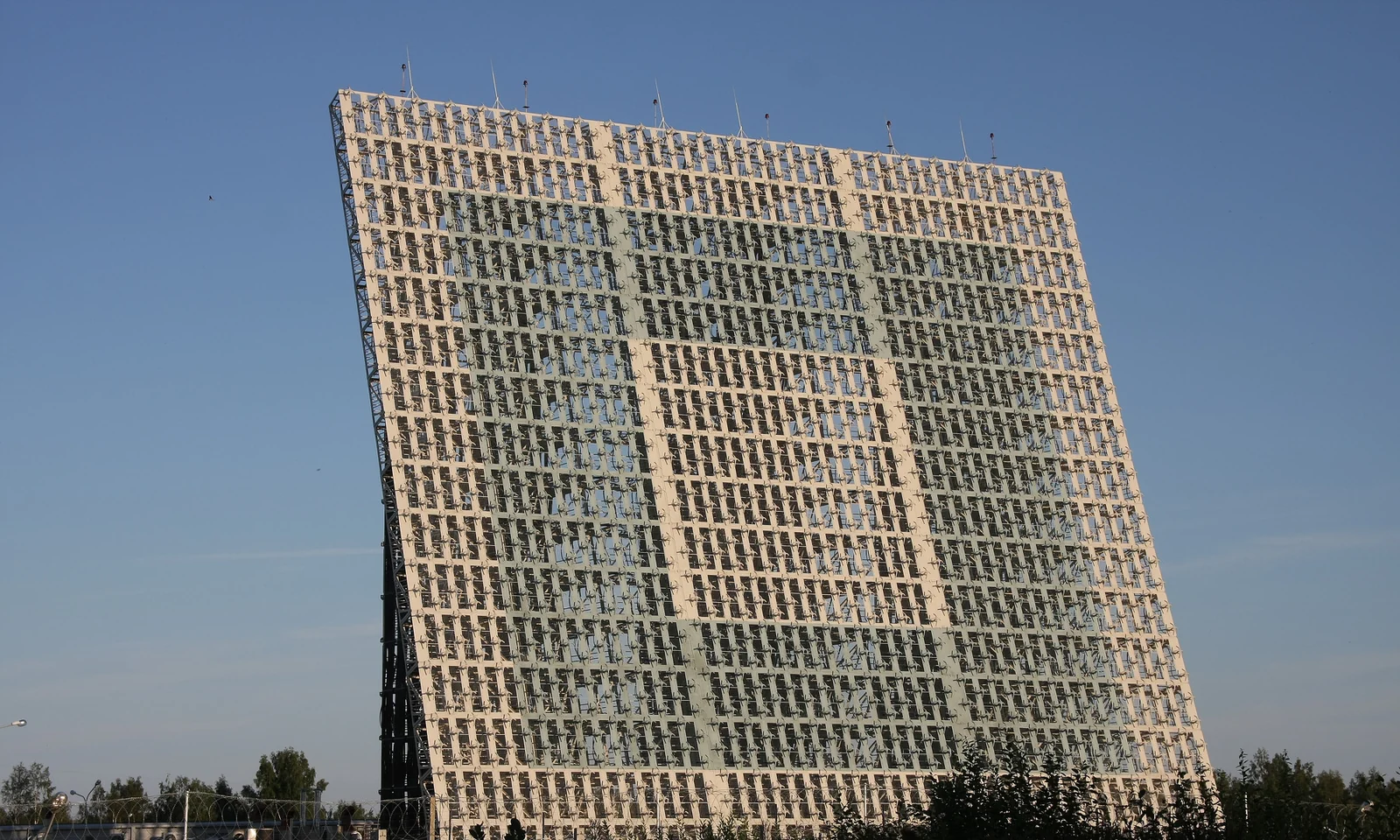
The warning layer has since come under fire itself. Ukrainian drones struck the early-warning radars at Armavir on 23 May 2024, and in August 2026 Podvig wrote that “it is not known whether the radars have resumed operation after the strike.” James Acton of the Carnegie Endowment warned years ago that attacks on dual-use warning and command assets could produce escalation through “misinterpreted warning”.
Permission to wait
The makers’ case for Perimeter is a case for patience. Yarynich wrote that on a warning that might be false, the leadership could “temporarily switch the responsibility” for the decision to people who might survive, and called the system’s role “exclusively stabilizing”. “That is why we have the system,” he said. “To avoid a tragic mistake.” Alexander Zheleznyakov, described as a former Soviet space official, said the point was “to cool down all these hotheads and extremists”, and continued: “No matter what was going to happen, there still would be revenge. Those who attack us will be punished.” Yarynich listed the trade-offs himself. Fewer tragic mistakes, surer retaliation, and a “relatively slow speed of operation”.
Did it work? The rationale was real to its builders, but its effect can’t be measured: the evidence that would show it, how leaders actually weighed a fast option against a slow one in a crisis, isn’t public, and the answer turns on the posture argument left open earlier. Podvig draws on a veteran official of the Soviet Military Industrial Commission to argue that the Soviet Union “has never relied on launch on warning and would wait for actual nuclear explosions on its territory”. If so, Perimeter relieved less pressure than its makers claimed. Yarynich framed the system as the alternative to acting on a warning that, “in theory, can be false”. If the eight-minute clock described the real choice, Perimeter offered an alternative that a frightened leader was still free to ignore. A fallback can sit beside a faster option without replacing it.
Then the secrecy. Hoffman argues that the Soviets “hid it so that it had no deterrent value, and therefore I think it was more dangerous.” Yuli Kvitsinsky, the lead Soviet arms negotiator when it was created, said: “I was never told about Perimeter.” One official’s ignorance isn’t everyone’s, and an adversary can know a state is able to retaliate without knowing how. Inside the apparatus the opposite case was made. In 1985 a Central Committee memo complained that a proposal for a fully automated retaliatory system, activated from the top in a crisis and announced to the adversary, was getting too little attention. Kubrick’s doomsday machine was useless because nobody had been told about it. Someone in the Central Committee wanted the real one advertised.
The Americans built command rockets and flying command posts too, and an airborne crew could launch missiles whose ground crews had been destroyed, which is close to the Soviet logic. But the United States never combined sensors and command rockets into automatic retaliation, and it publicised its airborne command post, Looking Glass, so that it would deter.
The American backups

The United States met the same survival problem with similar hardware and a different doctrine. Its Emergency Rocket Communications System put UHF transmitters carrying prerecorded force-execution messages on Minuteman II missiles; the system became operational on 10 October 1967 at Whiteman Air Force Base in Missouri and was later inactivated. From 3 February 1961 to 24 July 1990 an airborne command post known as Looking Glass kept an Air Force general and a battle staff aloft over the central United States around the clock. Its crew could launch Minuteman missiles by radio, but only if the ground crews had been destroyed or gave them access. The Navy's E-6B aircraft took over the mission in 1998. On the ground, continuity runs through places like Raven Rock Mountain, home to a signal battalion supporting national command communications.What the promises cover
Three different things travel under the word automation, and the policy argument goes wrong when they blur. Perimeter’s logic is rule-based automation: if these conditions hold, that action follows. AI decision support, software that sorts sensor data and recommends, is what today’s human-control debate is mostly about. Autonomous employment is a machine that chooses, like the US system two American defence analysts proposed in 2019, in which “the system itself would determine the response based on its own assessment of the inbound threat.”
Now the promises, at their real scope. At Lima in November 2024 Joe Biden and Xi Jinping affirmed “the need to maintain human control over the decision to use nuclear weapons.” That covers the decision. The United States, Britain and France went further in a 2022 working paper for the Non-Proliferation Treaty review, pledging to “maintain human control and involvement for all actions critical to informing and executing sovereign decisions concerning nuclear weapons employment”. The three reaffirmed the commitment in 2026. All five recognised nuclear powers have made human-control statements of some kind. In December 2025 Russia voted against UN General Assembly resolution 80/23 on AI in nuclear command, as did the United States, Britain and France, calling it “counterproductive to extract the nuclear aspects” of AI from the broader context of strategic stability.
On paper, then, the strongest promises already reach upstream into “informing”. They promise deliberation time and safeguards. What they don’t set is a common, measurable standard for what makes a human review of machine advice meaningful. Eva-Nour Repussard of the British American Security Information Council puts the missing piece plainly: “The organizational structures around that person must make it possible to exercise judgement.” She means training, workload, time, verification, and the institutional standing to reject what a machine recommends. Lay that list beside Serpukhov-15. The second channel hadn’t corroborated anything. The clock was under five minutes. Both hands were full. Michael Horowitz of the University of Pennsylvania named the failure mode in 2019: the risk in a world of automation bias is “that the Petrov of the future doesn’t use his judgment”, or “that there is no Petrov.” Russia’s statements blur the boundary further. Its 2026 report to the treaty review gives human involvement and judgement “a decisive role” over nuclear weapons, while its broader military-AI submission rejects “meaningful human control” and says control “can be ensured by means other than direct control.”
Which leaves the one person the whole fallback design preserves: the officer in the deep bunker, whose task arises only after everything else has failed, Moscow has gone silent and the detonations are confirmed. In March 2009, at the Iron Gate restaurant in Washington, Yarynich whispered to Wired’s Nicholas Thompson that the Perimeter system was “very, very nice”. Yarynich’s design preserves someone to choose. It can’t choose for them. Asked what he would do as that surviving operator, Yarynich said: “I cannot say if I would push the button.”
⁂
What the paperwork cannot prove
On 15 May 2003 the Military Collegium of Russia’s Supreme Court decided case 3n-279/02, and its legal question could hardly have been humbler: what field allowances were owed to servicemen who had built a “special object” in Bashkortostan. To answer it, the court had to cite the paperwork behind the mountain: a Central Committee and Council of Ministers resolution of 19 June 1978, a government decision of 22 June 1979, and the secret presidential decree of 8 July 1995 that turned the object into the closed town of Mezhgorye. Then it sent the case back to the Ufa garrison court to be heard again. Wherever testimony about these mountains gives out, the story leans on paper, a tender here, a poster there, a court record for Yamantau, as if documents were the solid ground under a slippery story. They are firmer. They are also narrower, because a document answers the question its author was asked. So a revealing public document about Yamantau is a pay dispute that dates the project and names its sponsors, and settles neither the builders’ claim nor what the mountain is for.
The paper trail
There are two cases, and they shouldn’t be blended. The earlier one is a separate dispute. On 30 October 2001, in determination 49-G01-99, the Supreme Court found that construction of the “objects and the combine” in Mezhgorye was still unfinished. As its evidence it cited a March 1999 letter from the secretary of the Security Council and a July 2000 letter from GUSP. It also lists the military units stationed at Beloretsk-15 that built the town’s objects. Beloretsk-15 and Beloretsk-16, military settlements about 20 kilometres apart, were merged to form Mezhgorye, a town a Russian weekly put at about 15,000 people in 2022. Put the two cases together and the courts establish dates, sponsors, and a construction project still unfinished a decade after the Soviet Union ended. They state no purpose, because no claimant needed one.
The American view from above is just as exact and just as mute. The 1984 imagery map labels an “Operations Area”, housing and support areas to the north and south, a materials receiving area, and rail lines completed, under construction and projected. Its text pages say what the site is not. The released copy marks five pages denied. American analysts have had imagery of Yamantau since at least 1984, and the most informative sentence it has yielded publicly is a negative.
Kosvinsky’s paper is richer and says even less about purpose. Tenders specify tonnages, cable lengths and licences; the plainest statement of what the place is for came from the unit’s own history poster.
Object 1335 by the numbers

These are tendered minimums, the purchases the investigators could document between 2018 and August 2024, and not proof of what was delivered or installed. At least 22,000 tonnes of steel and 170 kilometres of steel pipe. At least 56,500 tonnes of cement, which Per Goltermann, a construction engineer, reckons would make around 150,000 cubic metres of concrete. Six hundred kilometres of cable, 14,000 lamps and 182 ventilation units. Construction documents read by the Dossier Center describe at least 24 separate underground rooms served by a compressed-air network, about two and a half kilometres in a straight line between the main and emergency exits, and roughly five megawatts of chilling equipment bought in 2019. Satellite imagery adds work on what appear to be six new entrances. Danwatch, which compiled the list, calls it a minimum it can document with certainty.
Was any of this meant to be found? Weber thinks some of the tenders could be authorised leaks. “What good is such a system if the other side doesn’t know about it?” he asks. There is a precedent for exposure through tenders. In 2025 the same database yielded hundreds of original blueprints of rocket-force bases near Yasny, which Hans Kristensen of the Federation of American Scientists called “completely unprecedented”. Against the signalling theory stand Russia’s repeated attempts to lock the database. The question is open, and it puts the old secrecy argument back on the table with its sign unknown. Hoffman thought a hidden Perimeter more dangerous. A half-hidden one, leaking through tenders, is a new kind of message, if it is a message at all.
Then there is survival after 1991, which deserves mechanisms before motives. Funding for Yamantau appeared in the Russian federal budget for the first time in 1997, and Yeltsin and his prime minister, Viktor Chernomyrdin, endorsed the bunker programme, by the leaked CIA report’s account. GUSP was involved. And the construction chief, Leonid Tsirkunov, argued in 1996 that abandoning the work was “economically inadvisable” and that mothballing it would cost even more, though he called that “only my personal opinion”. Those are the documented reasons it kept going. Why leaders wanted it is a different question. Peter Pry, a former CIA analyst, read the persistence as evidence of Russian beliefs about fighting and surviving a nuclear war; Yamantau, he told Congress in 2000, “has only one purpose: to survive a nuclear conflict.” The duller explanation is ordinary continuity of government, which the United States pays for too. The two can coexist.
The competing explanations

By 1996 current and former Russian officials had described Yamantau as a mining site, a repository for Russian treasures, a food storage area, a dump for nuclear materials and a bunker for the country's leaders. Its construction chief, Leonid Tsirkunov, settled on State Reserve warehouses for food and clothing: "There's no secret at all here." The local paper then conceded that all the earlier versions, including the official story of a rare-earth mining combine, "were knowingly false". A former Bashkir party boss, M. Shakirov, said it was a bunker for the country's top leadership; Tsirkunov said his report did not correspond to reality. The commander of the Strategic Rocket Forces, Igor Sergeyev, denied construction "connected with the deployment of nuclear arms", which was a narrower denial than it sounded. In 1997 congressional conferees wrote that it appeared Russia had "deliberately misled the United States" about the facility's purpose. Russian ministers gave Congressman Curt Weldon the most candid answer of all: "We know of this project, but we cannot talk about it. You have to go to President Yeltsin."
The archive that argues with itself
Between 1990 and 1993 the American defence contractor BDM interviewed former Soviet officials for a study of Soviet intentions, and in 2009 the National Security Archive released the transcripts. On Perimeter they contradict one another flatly. Korobushin described a Dead Hand that “would have been triggered by a combination of light, radioactivity, and overpressure”, with “no need for anyone to push a button”, and added that “the system is not on” and would be activated only in a crisis. Vitaly Kataev, a Central Committee defence adviser, said the decision maker at the centre “unblocks” the no-fire mechanism, releasing launch control to automatic triggers on each command missile, and that this was “definitely operational by the early 1980s”. Viktor Surikov, a former deputy director of the missile institute TsNIIMash, said his team designed the trigger, that Marshal Sergei Akhromeyev rejected it, and that it “was never realized”. General Andrian Danilevich of the General Staff was blunter: “automation is automation”, the idea was dangerous, and “this idea was rejected and it was not developed in practice.” Surikov also names the adviser on whose recommendation Akhromeyev threw out the trigger: Korobushin.
Yarynich, summarising Blair’s four Russian sources, records the same split down the middle. Two said both a sensor-driven mode and a code-only mode existed. Two said the system had the sensor capability but didn’t operate it on duty, because Akhromeyev had rejected it on safety grounds.
These men aren’t always contradicting each other about the same thing. They are often describing different layers of the system and different moments in its life. Kataev’s “unblocks” describes a human decision taken at the centre, early, after which the triggers act alone. That is pre-delegation pushed down into hardware, and “operational” is not the same as used. Korobushin’s “the system is not on” fits the crisis-activation model that Yarynich and Podvig describe. Surikov’s “never realized” concerns a trigger mechanism; Danilevich’s “not developed in practice” concerns a fully automatic system. Blair, in 1993, wrote that “only a small team needs to be present to carry out certain mechanical procedures; the rest of the doomsday apparatus is totally automated.” Set beside Yarynich’s “no capability for preparing a launch order automatically without participation of the center’s crew”, that looks like a head-on collision. It is closer to a disagreement about what the small team’s procedures amount to: a mechanical step, or a decision. None of them settles that. Inventing a composite system that satisfies all of them would be fiction.
Then come the later layers. In January 2014 Rossiyskaya Gazeta, the government’s paper, ran an explainer calling the system “полностью автоматизирована”, fully automated, with the human factor “excluded or minimal”, and handing the launch decision to a software complex “based on artificial intelligence”. Automated is not automatic, and a state newspaper’s explainer is not evidence of AI; the Stockholm International Peace Research Institute, six years later, could not determine to what extent the upgrades involved AI. Khalin’s 2025 “automatic mode” is the newest stratum.
The documents add something the memoirs can’t. In 1985, the year the system went on combat duty, Oleg Belyakov of the Central Committee was still lobbying for the fully automatic version, which tells you it hadn’t been adopted. Podvig reads that memo as showing “the Soviet Union never built this automatic Doomsday Machine”, and finds no documentary evidence that the Soviet system ever ran fully automatically.
So on the best documentary evidence, full automation was designed and argued for and had not been adopted by 1985. Insiders disagreed then and they disagree now. Whether anything changed later is unproven.
How deep is deep enough
A command post has to talk. That is the contradiction inside every deep bunker: the rock that protects the room also stands between it and the forces it commands. The Grot poster says Kosvinsky was chosen for radio-transparent rock, with long-wave and short-wave radio centres at depths of tens to hundreds of metres. Blair wrote that Kosvinsky talks to Russia’s forces by very-low-frequency radio “that can burn through a nuclear war environment”, under roughly 1,000 feet of granite, and that US targeteers regard it as “the crown jewel of the Russian wartime nuclear command system”. The Dossier Center, however, describes the massif as made mainly of dunite and pyroxenite, not granite, and nobody should draw radio physics from rock names. Yamantau, by Blair’s account, was “more a shelter than a command post, because the facility’s communications links are relatively fragile”.
The targeting response has a paper trail of its own. In 2001 the Pentagon and the Energy Department told Congress that the intelligence community suspected over 10,000 potential hardened and buried targets worldwide. The National Research Council reckoned in 2005 that about a fifth had a major strategic function. Its physics runs in an order that is easy to scramble. An earth-penetrating weapon burrows only a few metres; about three metres captures most of the gain from coupling the blast into the ground. Once coupled, a 300-kiloton weapon could destroy targets down to about 200 metres, and a 1-megaton weapon to about 300. Such shallow burial wouldn’t contain the explosion, and the same report expected blast, radiation and fallout. A few command complexes sit at 500 or even 700 metres. A Los Alamos weapons director warned in 2000 that “superhard targets, such as those found under certain Russian mountains, may not be able to be defeated reliably by even high-yield nuclear weapons.” Blair argued that Yamantau and Kosvinsky were the “top two candidates” behind American interest in a nuclear bunker-buster. Congress cut funding for the Robust Nuclear Earth Penetrator, the bunker-buster programme of the day, in the 2005 appropriations. In 2011 the director of the Defense Intelligence Agency told senators that Russia was upgrading “massive underground facilities that provide command and control of its strategic nuclear forces”. Røseth’s “dig even deeper”, applied to the 2018–24 work at Kosvinsky, is the latest reading in that sequence.
The contest may be moving somewhere depth can’t follow. Acton, writing with Ankit Panda in July 2026, warned that AI-assisted surveillance could end up “potentially threatening (or at least appearing to threaten) the survivability of U.S. nuclear forces, SSBNs especially.” Their argument concerns ballistic-missile submarines, the SSBNs, hidden at sea, not a mountain in the Urals. But it marks the direction. For anything that survives by not being found, the race is shifting from how deep to how visible.
What depth buys is the ability to transmit after everything else is gone. It can’t vouch for what is transmitted, or for the picture on which somebody decided to transmit it. In January 1997, with both mountains still being dug, Russia’s defence minister, Igor Rodionov, put it without decoration: “No one today can guarantee the reliability of our control systems.”
Related articles
- The myth of nuclear zero: why the demand at the heart of the Iran talks cannot be met as written
- Who tells the torpedo where to go
- How satellites changed the economics of war without firing a single shot
Further reading
As an Amazon Associate, Eikleaf earns from qualifying purchases. The book links below are affiliate links: if you buy through them, we may earn a small commission at no extra cost to you.
 The Bomb: Presidents, Generals, and the Secret History of Nuclear WarShows how US presidents and military planners have divided authority, shaped retaliation options and handled nuclear crises.
 Raven Rock: The Story of the U.S. Government’s Secret Plan to Save Itself—While the Rest of Us DieProvides the American counterpart to Kosvinsky and Yamantau through reporting on surviving leadership, command communications and emergency succession.
Recommended videos
 7:41How to Launch a Nuclear MissileA Titan missile museum demonstration makes authentication, crew safeguards and the chain from launch order to execution concrete.
 1:17Stanislav Petrov, who averted possible nuclear war, dies at 77 – BBC NewsA brief account of the false alarm that opens the article, illustrating why human judgment matters in early warning.
 18:04DeadHand – Russia’s Doomsday Weapon From Beyond the Grave.Traces how the Soviet Perimeter system was conceived, how it is thought to work, and why its mere suspected existence shaped deterrence.
Cite this article
Johan Karlsson. “Who decides after the first strike.” Eikleaf, 2 November 2026. https://www.eikleaf.com/who-decides-after-the-first-strike/
Gen AI Disclaimer
Some contents of this page were generated and/or edited with the help of a Generative AI.
Media
Mount Bolshoy Yamantau, Bashkortostan – Wikimedia Commons (Photo: Максимов Дмитрий, CC BY-SA 4.0)
First Pershing II test launch, 22 July 1982 – U.S. Department of Defense, Wikimedia Commons
Voronezh-M radar – Wikimedia Commons (Photo: RussianArms, CC BY 3.0)
Key Sources and References
Valery E. Yarynich, C3: Nuclear Command, Control, Cooperation, Center for Defense Information, 2003. https://archive.org/details/c3nuclearcommand00vale
David E. Hoffman, “‘I Had a Funny Feeling in My Gut'”, The Washington Post, 10 February 1999, p. A19. https://www.washingtonpost.com/wp-srv/inatl/longterm/coldwar/shatter021099b.htm
David E. Hoffman, “Cold-War Doctrines Refuse to Die”, The Washington Post, 15 March 1998. https://www.washingtonpost.com/archive/politics/1998/03/15/cold-war-doctrines-refuse-to-die/c73be619-8d9d-4ab4-b23e-3764584e6439/
Nicholas Thompson, “Inside the Apocalyptic Soviet Doomsday Machine”, Wired, 21 September 2009. https://www.wired.com/2009/09/mf-deadhand/
Terry Gross, “‘Dead Hand’ Re-Examines The Cold War Arms Race” (interview with David E. Hoffman), Fresh Air, WHYY/NPR, 8 October 2009. https://freshairarchive.org/segments/dead-hand-re-examines-cold-war-arms-race
Алена Ицкова, “Мы находимся в начале второй гонки вооружений” (interview with David E. Hoffman), Новая газета Европа, 4 October 2026. https://novayagazeta.eu/articles/2026/10/04/my-nakhodimsia-v-nachale-vtoroi-gonki-vooruzhenii
Pavel Podvig, “Is the Dead Hand back? Well, it never went away”, Russian Strategic Nuclear Forces, 30 September 2026. https://russianforces.org/blog/2026/09/is_the_dead_hand_back_well_it_.shtml
Pavel Podvig, “Does Russia have a launch-on-warning posture? The Soviet Union didn’t”, Russian Strategic Nuclear Forces, 29 April 2019. https://russianforces.org/blog/2019/04/does_russia_have_a_launch-on-w.shtml
Pavel Podvig, “Russian early-warning radar network in 2026”, Russian Strategic Nuclear Forces, 19 August 2026. https://russianforces.org/blog/2026/08/russian_early-warning_radar_ne.shtml
Pavel Podvig, “Dr. Strangelove meets reality”, Russian Strategic Nuclear Forces, 14 April 2006. https://russianforces.org/blog/2006/04/dr_strangelove_meets_reality.shtml
Thomas Gösta Svensson and Mathias Glistrup, “Military documents reveal how Russia has reactivated a top-secret doomsday system”, Danwatch, in collaboration with The Sunday Times and Dossier Center, 26 September 2026. https://danwatch.dk/en/military-documents-reveal-how-russia-has-reactivated-a-top-secret-doomsday-system/
Dmitry Sukharev, “Мертвая рука Путина”, Dossier Center, 26 September 2026. https://dossier.center/dead-hand/
Viktor Khalin, “Размышления вслух отставного генерала”, Veteran-raketchik No. 4 (175), 2025. https://rvsn.ruzhany.info/0_2023/vr175_2025_4_1.html
BDM Federal, Soviet Intentions 1965–1985, Vol. II (interviews with V. Korobushin, V. Kataev, V. Surikov and A. Danilevich), released by the National Security Archive, Electronic Briefing Book 285, 11 September 2009. https://nsarchive2.gwu.edu/nukevault/ebb285/
National Photographic Interpretation Center, “Yamantau Mountain Underground Construction Project, USSR”, CIA, 10 January 1984, document CIA-RDP84T00171R000301360001-9. https://www.cia.gov/readingroom/docs/CIA-RDP84T00171R000301360001-9.pdf
Supreme Court of the Russian Federation, Military Collegium, Determination No. 3n-279/02, 15 May 2003. https://normativ.kontur.ru/document?documentId=62880&moduleId=7
Supreme Court of the Russian Federation, Determination No. 49-G01-99, 30 October 2001. https://web.archive.org/web/20120306034413/http://lawrussia.ru/texts/legal_484/doc484a255x255.htm
Bruce G. Blair, “We Keep Building Nukes For All the Wrong Reasons”, The Washington Post, 24 May 2003 online; 25 May 2003 print, p. B01. https://www.washingtonpost.com/archive/opinions/2003/05/25/we-keep-building-nukes-for-all-the-wrong-reasons/31f29388-7ddc-4b15-b538-f20aa859950b/
Bruce G. Blair, “Russia’s Doomsday Weapons”, The New York Times, 8 October 1993. https://sgs.princeton.edu/sites/default/files/2021-02/Blair-1993b.pdf
National Research Council, Effects of Nuclear Earth-Penetrator and Other Weapons, National Academies Press, 2005. https://nap.nationalacademies.org/read/11282/chapter/2
Hans M. Kristensen, Matt Korda, Eliana Johns and Mackenzie Knight-Boyle, “Russian nuclear weapons, 2026”, Bulletin of the Atomic Scientists 82(3), 221–254, published online 13 May 2026. https://thebulletin.org/premium/2026-05/russian-nuclear-weapons-2026/
Beyza Unal with Julia Cournoyer, Calum Inverarity and Yasmin Afina, Uncertainty and Complexity in Nuclear Decision-Making: Balancing Reason, Logic, Cognition and Intuition at Strategic and Operational Levels, Chatham House, March 2022. https://www.chathamhouse.org/sites/default/files/2022-03/2022-03-07-nuclear-decision-making-unal-et-al_0.pdf
Vincent Boulanin, Lora Saalman, Petr Topychkanov, Fei Su and Moa Peldán Carlsson, Artificial Intelligence, Strategic Stability and Nuclear Risk, SIPRI, June 2020. https://www.sipri.org/sites/default/files/2020-06/artificial_intelligence_strategic_stability_and_nuclear_risk.pdf
Eva-Nour Repussard, “AI in combat: When humans are in the loop, but not in control”, Bulletin of the Atomic Scientists, 30 October 2026. https://thebulletin.org/2026/10/ai-in-combat-when-humans-are-in-the-loop-but-not-in-control/
France, United Kingdom and United States, “Principles and responsible practices for Nuclear Weapon States”, NPT/CONF.2020/WP.70, 29 July 2022. https://documents.un.org/doc/undoc/gen/n22/446/53/pdf/n2244653.pdf
President’s Foreign Intelligence Advisory Board, “The Soviet ‘War Scare'”, 15 February 1990, released by the National Security Archive, Electronic Briefing Book 533, 24 October 2015. https://nsarchive2.gwu.edu/nukevault/ebb533-The-Able-Archer-War-Scare-Declassified-PFIAB-Report-Released/
US Department of Defense, Soviet Military Power 1987, March 1987. https://archive.org/details/DTIC_ADA189858
Vladimir Isachenkov, “Stanislav Petrov, Who Averted Nuclear War, Dies at 77”, Associated Press, 19 September 2017. https://www.voanews.com/a/stanislav-petrov-who-averted-nuclear-war-dies-at-77/4035266.html
Jamie Withorne and Raven Witherspoon, “What this Norwegian close call says about a world without New START”, Bulletin of the Atomic Scientists, 13 April 2026. https://thebulletin.org/2026/04/what-this-norwegian-close-call-says-about-a-world-without-new-start/
“How Close Did We Come?”, Frontline: Russian Roulette, PBS, 1999. https://www.pbs.org/wgbh/pages/frontline/shows/russia/closecall/howclose.html
Bill Gertz, “Moscow builds bunkers against nuclear attack”, The Washington Times, 1 April 1997. https://www.globalsecurity.org/wmd/library/news/russia/1997/bmd970404a.htm
Michael R. Gordon, “Despite Cold War’s End, Russia Keeps Building a Secret Complex”, The New York Times, 16 April 1996. https://www.nytimes.com/1996/04/16/world/despite-cold-war-s-end-russia-keeps-building-a-secret-complex.html
A. Urtsev and V. Yeldashev, “What Is That There Under the Mountain?”, Beloretskiy Rabochiy, 24 March 1996, p. 1 (FBIS translation). https://www.globalsecurity.org/wmd/library/news/russia/1996/druma104_s96004.htm
Interfax, “General Denies Nuclear Construction in Urals”, 18 April 1996 (FBIS translation). https://www.globalsecurity.org/wmd/library/news/russia/1996/drsov076_b_96007.htm
US House of Representatives, National Defense Authorization Act for Fiscal Year 1998, Conference Report 105-340 to accompany H.R. 1119, 23 October 1997. https://www.govinfo.gov/content/pkg/CRPT-105hrpt340/pdf/CRPT-105hrpt340.pdf
US House of Representatives, “Sense of Congress on Need for Russian Openness on the Yamantau Mountain Project” (proposed amendment), Congressional Record, 19 June 1997, p. H3943. https://www.govinfo.gov/content/pkg/CREC-1997-06-19/pdf/CREC-1997-06-19-pt1-PgH3934-2.pdf
Curt Weldon, remarks concerning Russia and the Yamantau Mountain project, Congressional Record, House, 24 September 1997, p. H7828. https://www.govinfo.gov/content/pkg/CREC-1997-09-24/pdf/CREC-1997-09-24-pt1-PgH7821.pdf
Jonathan Medalia, “‘Bunker Busters’: Sources of Confusion in the Robust Nuclear Earth Penetrator Debate”, Congressional Research Service RL32599, 10 January 2005. https://www.everycrsreport.com/files/20050110_RL32599_57bfad280c1ecf3bbc1800f63c16ea1b6e0e62b7.html
Jonathan Medalia, “Nuclear Earth Penetrator Weapons”, Congressional Research Service RS20834, 27 January 2003. https://www.everycrsreport.com/files/20030127_RS20834_1745e1a8e4cc02deddcc184666753d43ee5bdb4f.html
Jeffrey T. Richelson (ed.), “Underground Facilities: Intelligence and Targeting Issues”, National Security Archive, Electronic Briefing Book 372, 23 March 2012. https://nsarchive2.gwu.edu/NSAEBB/NSAEBB372/
James M. Acton, “Escalation through Entanglement: How the Vulnerability of Command-and-Control Systems Raises the Risks of an Inadvertent Nuclear War”, International Security 43(1), Summer 2018, pp. 56–99. https://doi.org/10.1162/isec_a_00320
James M. Acton and Ankit Panda, “Nuclear Weapons and the Future of American Power”, Carnegie Endowment for International Peace, 2 July 2026. https://carnegieendowment.org/research/2026/07/nuclear-weapons-and-the-future-of-american-power
Federation of American Scientists, “Strategic Command and Control: Russian/Soviet Nuclear Forces”, Nuclear Forces Guide, updated 5 October 2000. https://nuke.fas.org/guide/russia/c3i/
Federation of American Scientists, “Emergency Rocket Communications System (ERCS)”, Nuclear Forces Guide, updated 29 April 1998. https://nuke.fas.org/guide/usa/c3i/ercs.htm
Jim Boensch, “The Strategic Air Command Airborne Command Post System and Its Connection to Minuteman Missiles”, National Park Service, 31 January 2024, updated 8 February 2024. https://www.nps.gov/articles/000/the-airborne-command-post-system.htm
Tracy Lynge, “21st Signal Brigade holds change of command ceremony”, US Army, 6 June 2024. https://www.army.mil/article-amp/277062/21st_signal_brigade_holds_change_of_command_ceremony
“Командующий РВСН генерал-лейтенант Сергей Каракаев: «Владимир Владимирович был прав – мы можем уничтожить США быстрее чем за полчаса»”, Komsomolskaya Pravda, 16 December 2011. https://www.kp.ru/daily/25805/2785953/
Meduza, “Медведев затеял перебранку с Трампом в соцсетях. В итоге президент США куда-то отправил атомные подлодки”, 2 August 2025. https://meduza.io/feature/2025/08/02/medvedev-zateyal-perebranku-s-trampom-v-sotssetyah-v-itoge-prezident-ssha-kuda-to-otpravil-atomnye-podlodki
Mathias Glistrup and Thomas Gösta Svensson, “A deep dive inside Putin’s new nuclear bases”, Danwatch, 28 May 2025. https://danwatch.dk/en/a-deep-dive-inside-putins-new-nuclear-bases/
“Секретные бункеры Путина”, Sobesednik, 30 November 2022. https://web.archive.org/web/20221201150103/https://sobesednik.com/rassledovanie/20221130-sekretnye-bunkery-putina-gde-i-kak-prez/
Anton Valagin, “Гарантированное возмездие: как работает российская система ‘Периметр'”, Rossiyskaya Gazeta, 22 January 2014. https://rg.ru/2014/01/22/perimetr-site.html
US House of Representatives, Committee on Government Reform, hearing of 24 January 2000 (testimony of Peter Pry). https://www.govinfo.gov/content/pkg/CHRG-106hhrg66968/html/CHRG-106hhrg66968.htm
Adam Lowther and Curtis McGiffin, “America Needs a ‘Dead Hand'”, War on the Rocks, 16 August 2019. https://warontherocks.com/2019/08/america-needs-a-dead-hand/
Matt Field, “Strangelove redux: US experts propose having AI control nuclear weapons”, Bulletin of the Atomic Scientists, 30 August 2019. https://thebulletin.org/2019/08/strangelove-redux-us-experts-propose-having-ai-control-nuclear-weapons/
The White House, “Readout of President Joe Biden’s Meeting with President Xi Jinping of the People’s Republic of China”, 16 November 2024. https://bidenwhitehouse.archives.gov/briefing-room/statements-releases/2024/11/16/readout-of-president-joe-bidens-meeting-with-president-xi-jinping-of-the-peoples-republic-of-china/
Arms Control Association, “‘Human in the Loop’ and Nuclear Weapons Use at a Glance”, last reviewed July 2026. https://www.armscontrol.org/factsheets/human-loop-glance
Russian Federation, “Национальный доклад Российской Федерации к Конференции по рассмотрению действия ДНЯО 2026 года” [National report of the Russian Federation to the 2026 NPT Review Conference], United Nations, NPT/CONF.2026/14, 2 March 2026. https://docs-library.unoda.org/Treaty_on_the_Non-Proliferation_of_Nuclear_Weapons_-EleventhReview_Conference_(2026)/NPT_CONF.2026_14_-_14._ADVANCE_National_Report_-_Russia.pdf
Anya L. Fink, “Russia’s Nuclear Weapons”, Congressional Research Service, In Focus IF12672, updated 27 May 2026. https://www.congress.gov/crs_external_products/IF/PDF/IF12672/IF12672.13.pdf
Russian Federation, submission pursuant to UN General Assembly resolution 79/239, UNODA, 2025. https://docs-library.unoda.org/General_Assembly_First_Committee_-Eightieth_session_(2025)/79-239-RussianFed-en.pdf
Maÿlis Mennesson and Manoj Harjani, “Global Governance of the AI–Nuclear Nexus: Unpacking UNGA Resolution 80/23”, RSIS, IP26002, 7 January 2026. https://rsis.edu.sg/wp-content/uploads/2026/01/IP26002.pdf
Alice Saltini, “Lessons from the UN’s first resolution on AI in nuclear command and control”, Bulletin of the Atomic Scientists, 22 December 2025. https://thebulletin.org/2025/12/lessons-from-the-uns-first-resolution-on-ai-in-nuclear-command-and-control/
Thomas Shattuck, “Assessing existing proposals at the nexus of artificial intelligence and nuclear risk reduction”, Perry World House, 12 October 2026. https://perryworldhouse.upenn.edu/news-and-insight/assessing-existing-proposals-at-the-nexus-of-artificial-intelligence-and-nuclear-risk-reduction/