Last updated: · 17 min read
In brief
The Gulf’s crude exports are back to their pre-war level, but its refined-fuel exports are still about half. So diesel traded near $200 a barrel in Europe while crude sat just under $110. Diesel is made in refineries and then shipped, and the wars in the Gulf and Ukraine damaged both. Drones hit refineries from Saudi Arabia to Russia, and soaring freight shut the route from America into Europe. More crude cannot fix that. The first Russian diesel loaded for the United States under a new deal amounts to about five hours of American exports.
Contents
On Monday 2 March 2026, debris from two intercepted drones caused a “limited” fire at Ras Tanura, Saudi Arabia’s largest oil refinery. Aramco shut the 550,000-barrel-a-day plant as a precaution while it assessed the damage. Ras Tanura is a key supplier of diesel to buyers in Europe and makes smaller quantities of gasoline.
Iran was attacking energy installations across the Gulf that day, and oil prices jumped. Crude in London rose about 9%, to near $79 a barrel. Gasoil futures on the ICE exchange, the traded price for diesel and heating oil, rose by more than 20%, their biggest gain within a single day since March 2022. A single refinery cannot account for that difference. Diesel’s far sharper jump suggested that traders feared a worse disruption to fuel supplies than to crude.
Almost eight months later diesel was still the scarcer of the two. By 22 October the Gulf’s crude exports had climbed back to their pre-war level, but its exports of refined fuels were still about half of what they had been. On 21 October Brent crude for December delivery traded just under $110 a barrel, while November gasoil futures in Europe traded close to $200. “Diesel is propping up the complex,” wrote Kpler, a firm that tracks cargoes at sea, “while the rest of the barrel drags it down.” In mid-October the International Energy Agency (IEA), the rich countries’ energy watchdog, put diesel benchmarks at “nearly double the price of crude oil”.
The gap reaches well beyond trading screens. In the United States, trucks and trains with diesel engines carry most of the goods people buy, and most farm, construction and military machinery runs on diesel. The IEA says record diesel prices were already raising the cost of goods and eating into real incomes. Recovering crude exports could not repair damaged refineries or supply the tankers to carry their fuel. Diesel is made in refineries and then shipped, and in 2026 the wars in the Gulf and in Ukraine damaged the making and the shipping alike.
Where the diesel used to come from
In February 2026 two regions dominated the trade. The Gulf states and Russia together accounted for almost 45% of the world’s seaborne diesel and gasoil trade, counted as net exports, what each region shipped out minus what it brought in. Gasoil is the family of middle-weight fuels that includes diesel and heating oil.
Preliminary figures for September put the combined net exports of the Middle East and Russia at 820,000 barrels a day, 1.3 million barrels a day less than a year earlier, a drop of more than 60%. Other exporters filled only part of the gap. The United States and China shipped 610,000 barrels a day more than a year before, and world diesel exports in September were still 700,000 barrels a day lower than in September 2025.
The Gulf’s refineries were hit directly. Goldman Sachs estimated in early October that roughly 2 million barrels a day of Middle Eastern refining capacity was still offline. Saudi Arabia’s Jizan refinery on the Red Sea, which Yemen’s Houthis have attacked, is not expected back until the end of December. The plants that did run struggled to get fuel out. Attacks in the Strait of Hormuz intensified in mid-October, and in the week before 19 October no gasoil or diesel at all left the Gulf.
Russia’s refineries were hit by Ukraine. By the IEA’s estimate, a drone successfully struck a Russian refinery once every three days, on average, in the first eight months of 2026. By mid-September, on Reuters’ calculation, three of Russia’s six largest diesel refineries were shut or running at about a quarter of capacity, and those six make roughly half the country’s diesel. By 20 October Kpler judged that nearly 40% of Russia’s refining capacity was idle. Moscow kept what diesel it had at home. It banned diesel exports from 8 July, and on 30 September it extended the ban for producers to 31 October, citing the need to keep the domestic market stable during the harvest, when demand for motor fuel rises.
Winter diesel and the kerosene tug-of-war

Jet fuel and diesel are cut from overlapping slices of crude. Kerosene-type jet fuel must finish boiling by 300°C, and gasoil boils between 180°C and 380°C, so some of the same molecules can go to either. Refiners can widen the kerosene cut into the lighter naphtha range below it and into the gasoil range above it. In summer 2026, with jet fuel tight, refiners maximised kerosene output, and the IEA found that this cut their gasoil yields. Russia meets the same trade-off every autumn from the other side. In early autumn its fuel market shifts from summer diesel to winter diesel, a frost-resistant grade that usually dominates by October and November. Few refineries make winter diesel in the warm months, and Russian refineries make only about 80–90% of the winter diesel the country uses. The rest is blended from summer diesel and aviation kerosene. Russia kept its ban on jet fuel exports in place until 30 November. In a Russian autumn, kerosene that leaves the country cannot go into winter diesel.
In October the ban began to loosen. From 10 October, under what Moscow described as agreements between Vladimir Putin and Donald Trump, Russia allowed 500,000 tonnes of diesel onto the world market “at this stage”. The producers’ ban remained formally in force until 31 October. Russian diesel scheduled to load in October reached 173,000 barrels a day, the highest since June, and tankers were again signalling voyages to Turkey and Brazil. Those are loadings and destinations, not deliveries. Russia’s room to export was thin in any case: Kpler put its diesel production at about 1.4 million barrels a day against home demand of about 1.2 million. The IEA judged that easing the export ban was unlikely to change the global balance much, because what held Russian exports down was a lack of working refineries.
What a refinery can and cannot change
A complex refinery does three things: it separates crude oil, converts part of it and treats what comes out. Simpler plants do little or no converting. Separation is distillation. Crude is heated, and its components, called fractions, are drawn off by boiling point. Gasoline comes from the light end, boiling between 35°C and 215°C. Gasoil is a middle distillate, boiling between 180°C and 380°C, between the light fuels and the heavy residue. In the United States a 42-gallon barrel of crude ends up as about 19 to 20 gallons of gasoline and 11 to 13 gallons of distillate, most of it sold as diesel. Those yields move from month to month as refiners chase demand and profit.
The distillation column does not settle how much diesel a barrel can give. Much of every barrel boils above the diesel range, and conversion units turn some of that heavy oil into lighter fuel. The most widely used method is cracking, which uses heat, pressure, catalysts and sometimes hydrogen to break heavy molecules into lighter ones. A hydrocracker is the kind of cracker that adds hydrogen, and among its main products are the components of middle distillates. A refinery’s diesel therefore comes partly straight off the column and partly from oil that was too heavy to be diesel when it arrived.
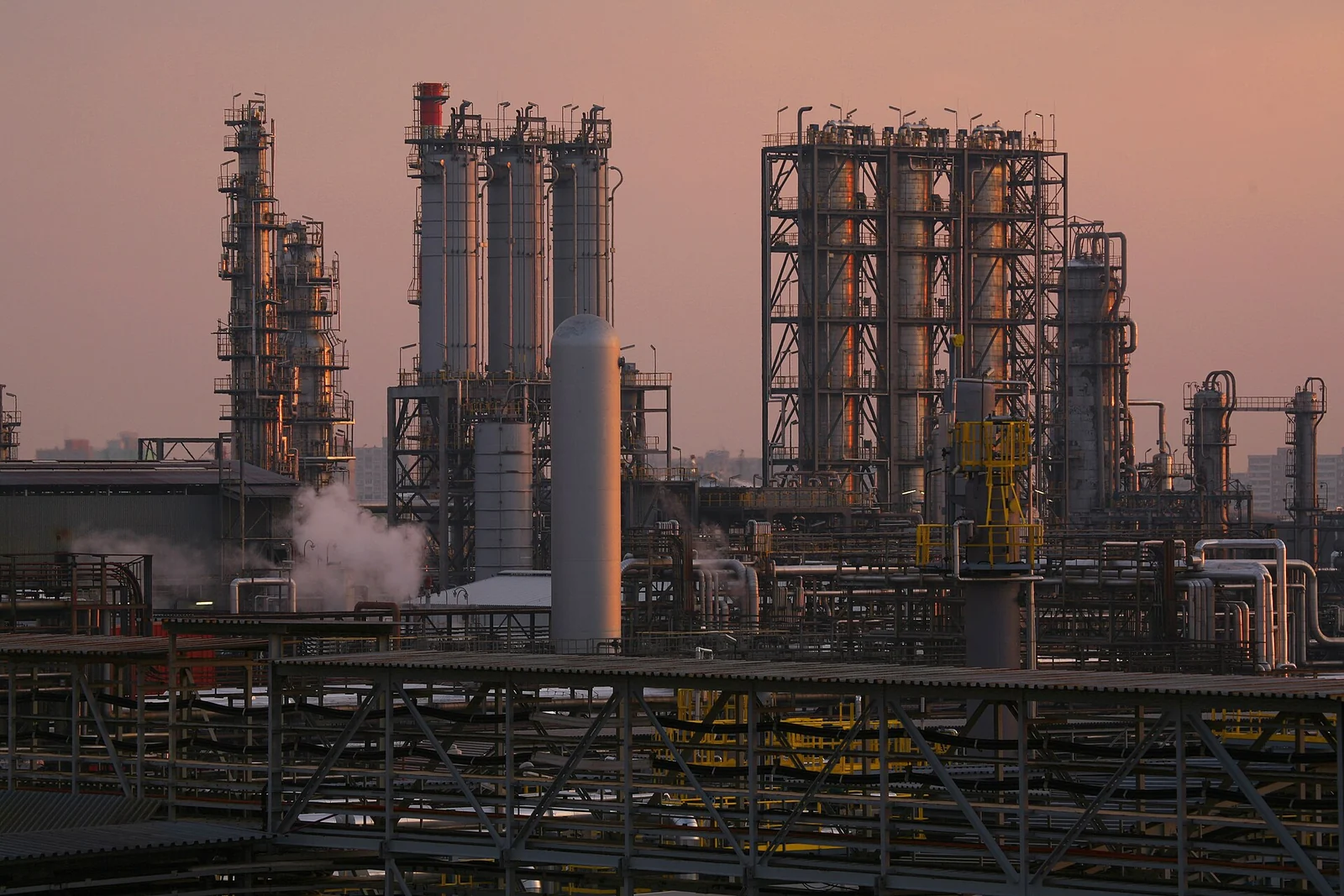
How a hydrocracker makes diesel from heavier oil

A typical hydrocracker is fed vacuum gas oil, a stream that boils between 350°C and 550°C, most of it too heavy to sell as diesel. The work happens in tall, thick-walled, rocket-shaped reactors. Inside, hydrogen and a catalyst at high pressure split long, heavy molecules into shorter ones that fall within the naphtha and middle-distillate ranges. Many refineries also run a catalytic cracker, which breaks heavy molecules with heat and a catalyst and adds no hydrogen. A refinery with both units has a dial. When the market swings toward diesel, operators raise the hydrocracker's severity, the intensity of the reaction, and convert more of its feed into low-sulphur diesel. When gasoline demand peaks, they turn the hydrocracker down and send more heavy oil to the catalytic cracker to make more gasoline. The same heavy oil can end up in either fuel, depending on which way the refinery has turned its dial.
In 2026 refiners turned these dials hard. They redirected heavy feed from catalytic crackers to hydrocrackers, ran hydrocrackers in the mode that maximises distillates, and set catalytic crackers to make more of a stream called light cycle oil, even at the expense of gasoline, then upgraded that stream into diesel. Kpler estimates that all such adjustments together can raise the yield of middle distillates, jet fuel and diesel combined, by about 7 to 10 percentage points of the whole barrel, depending on how a refinery is built and what crude it runs. That push is hydrogen-hungry and capped by the size of the units. Russia shows the limit from another angle. Its refineries raised their diesel yield from 33% to 37% over several years, but a larger share of a much smaller run still leaves less diesel.
The crude sets the starting point, because each grade breaks down into its own mix of light, middle and heavy fractions. Kpler describes the Gulf’s export crude as “inherently middle distillate rich”. In 2026, the IEA found, disrupted supply forced refiners to process crude grades that suited their equipment badly.
Treatment finishes the job, removing sulphur and other impurities so that the fuel meets its specification. The diesel engine has no spark plug and ignites its fuel by compression. To replace a refinery that has been knocked out, someone else needs spare distillation, spare conversion units, hydrogen, suitable crude and treating capacity, all at the same time.
Running flat out on a smaller base
The obvious candidates were already running near their limits. American refineries ran at more than 95% of capacity on average from May to September, the highest rate for those months since 1998, and the US Energy Information Administration (EIA) says tight global supplies of distillate were the main driver. Their total output was still only the highest since 2019, because American refining capacity has shrunk by 4% since then. Two closures in 2025, LyondellBasell’s refinery in Houston and Phillips 66’s in Los Angeles, removed about 400,000 barrels a day, and Valero’s Benicia refinery in California has since stopped refining. Beyond the United States the trend points the same way. Goldman Sachs expects refining capacity outside China to shrink by roughly 300,000 barrels a day in 2026.
Running refineries harder for diesel has a side effect. Once refiners have shifted their yields as far as their units allow, making more diesel from petroleum means running more crude, so extreme tightness in diesel adds to the demand for crude and pushes up its price.
The United States did ship more. It is the world’s largest diesel exporter, shipping about 1.4 million barrels a day in October. Over the past year the US Gulf Coast supplied almost half of Northwest Europe’s diesel imports, a much larger share than a year earlier. Europe had come to lean on one distant supplier above the rest.
New capacity exists, but it is small next to the hole. Nigeria’s seaborne exports of refined products rose from an average of 46,000 barrels a day in 2023 to 350,000 in the second quarter of 2026, carried by the Dangote refinery, which can now process 700,000 barrels of crude a day.
Near $200 a barrel, with few profitable routes
Even the diesel that existed did not always reach the buyers who needed it most. Fuel moves between regions through what traders call the arbitrage: the difference between what a cargo costs once delivered, freight included, and what a buyer at the destination will pay. When the arbitrage is positive, a trader can buy diesel in Houston, ship it to Rotterdam and sell it at a profit. When it turns negative, that trade no longer pays, although refiners exporting diesel they have made themselves may still find it worth shipping.
In October freight closed it. Kpler’s analysis is blunt: freight, not the relative price of diesel, shut the American route into Europe. Rates for prompt cargoes from the US Gulf Coast climbed from around 250 to more than 400 on worldscale, the tanker industry’s index of freight rates. In the week to Friday 16 October alone, rates for medium-range product tankers rose by almost 30%, closing the routes from the US Gulf Coast into Northwest Europe and the Mediterranean. For cargoes arriving in Rotterdam in November, every origin on Kpler’s board showed a loss. Gasoil was close to $200 a barrel, and a trader buying diesel on the US Gulf Coast to sell in Rotterdam at that price would still have lost money.

The same freight squeezed refiners from the other side. The usual gauge of refining profit is the crack, the difference between the price of a refined product and the price of crude. The IEA found that diesel cracks for European refiners fell from about $100 a barrel to close to $60 by early October. Diesel had not become plentiful. Soaring freight had raised the delivered cost of crude. The energy economist Philip Verleger puts Northwest European refinery margins at $54 a barrel at the start of September and as low as minus $11 on 5 October. In the IEA’s account, record freight and crude costs crushed refining margins in Europe and Asia, while American refiners, with access to discounted crude, made new highs.
By 20 October margins had turned negative for the simplest plants, the topping refineries of Singapore and the hydroskimming refineries of Northwest Europe, which do little or no conversion. Kpler warned that if diesel prices fell further, refiners might cut their runs, which would tighten supplies of gasoline and jet fuel as well as diesel. A lower diesel price could, in other words, mean less diesel being made. In late October the refiners that still made money kept going. In Kpler’s phrase, “Refiners keep running because they earn the crack, and the diesel has to go somewhere.”
Who pays at the pump and the farm gate
People did use less diesel, though less than supply fell. The IEA estimates that world deliveries of diesel and gasoil fell by 1.1 million barrels a day year on year in the second quarter of 2026, and by 750,000 barrels a day in the third. Production fell faster: by 1.5 million barrels a day in the second quarter and an estimated 1.7 million in the third. Diesel and gasoil make up nearly 30% of the world’s oil demand, and because diesel use is tied so closely to economic activity, the IEA calls it relatively insensitive to price. Trucks still have to deliver and harvests still have to come in.
At the American pump, diesel averaged $3.81 a gallon in the week of 23 February, the last week before the war. On 21 September it reached a record $6.53, which works out to about 70% more. On 19 October it was still $6.28.
Farmers felt it in the middle of the harvest. At a rally in Grand Island, Nebraska, on 5 October, Trump signed an order allowing red-dyed diesel, the untaxed fuel used off the road, to be used temporarily on highways, and deferring the federal excise tax. Nebraska’s governor, Jim Pillen, said high diesel prices were “impacting everything they do – from field operations to transportation of their products and livestock.” Patrick De Haan of GasBuddy, which tracks fuel prices, had already noted that such an order could save money for road users but not for farmers, who already use red diesel. “Taxes aren’t the problem, supply is,” he wrote. On 19 October Trump announced an $8 billion harvest fuel relief programme, to be paid through the Department of Agriculture’s Farm Service Agency as one-time payments.
American stocks were low and rising at the same time. In the week to 16 October American distillate stocks stood at 104.3 million barrels, 9% below the five-year average, after rising 1.7 million barrels in that week. On our count of the EIA’s weekly figures, which go back to 1982, no earlier year had a lower level for that week; the previous low, 106.2 million barrels, came in 2022. It is a seasonal low, not an all-time one. On the East Coast, stocks fell 32% below their five-year seasonal average in September. Elsewhere stocks were rebuilding. Through the third week of October, independently held gasoil stocks in the Amsterdam-Rotterdam-Antwerp (ARA) hub averaged 6% more than in September, and middle-distillate stocks in Singapore 10% more.
In Europe the problem was cost, not empty tanks. On 2 October the European Commission said EU diesel supply remained stable “for the time being” but prices remained high. On 21 October Kpler judged that for November and December arrivals Europe “is not in dire straits”, though it depended on a narrow set of marginal suppliers. Poorer importers had less cushion. Middle Eastern diesel exports to Africa fell in August to their lowest in almost nine years, and Asian cargoes replaced them. Kpler put Indonesia’s gasoil forward cover at about 17 days in late October, down from 22 before the Hormuz crisis, although the government said national fuel stocks were above the required minimums and blamed local shortages on delayed tanker deliveries. The IEA warns that delivered diesel prices in Europe, Africa and Latin America, the largest gasoil-importing markets, could rise again.
Hold it, release it, license it
Kpler estimates that the world faced a diesel deficit of about 1 million barrels a day going into the winter, when demand peaks. Governments answered in three ways: they held on to their own diesel, released stored diesel, and tried to restart trade that politics had closed.
Russia’s export ban was the largest act of holding on, but not the only one. Chinese refiners suspended fuel exports for October to protect domestic stocks, although the IEA says the worry eased once Beijing resumed issuing export licences in mid-October. At the start of October Washington threatened a ban on American diesel exports to push Germany and France into drawing down their emergency stocks. On 2 October G7 leaders reaffirmed their commitment not to restrict energy exports among themselves, and called on producers to avoid bans.
The releases followed. On 15 October IEA members agreed to speed up the remaining releases from the collective stock action they launched in March, including more than 20 million barrels of diesel as soon as possible. Kpler estimates that European stock releases, together with any extra Russian diesel, could temporarily cut the deficit in half over about 90 days. The estimate is illustrative: it assumes that the releases go ahead and that Russian barrels add to world supply rather than being diverted from other buyers.
The third route ran through Russia. On 9 October the US Treasury issued General License 135, which authorises transactions in diesel of Russian origin, including imports into the United States, until 7 April 2027. It temporarily waives specified American sanctions on Russian diesel; the European and British bans stay in force. It also sits uneasily with a 2022 law that lets the president lift the ban on Russian oil imports only after certifying to Congress that Russia has met conditions on regional security and Ukrainian sovereignty, and on 15 October a bipartisan group of 22 House members asked for the licence to be revoked. The White House said it would increase global supply and lower prices. Converted into barrels by Kpler, the tranches Trump announced come to more than 2.2 million at once, 3.7 million in November and 7.5 million shortly after, at least 13.4 million barrels in all, with a further 22.4 million possible depending on the state of Russia’s refineries. Set against a deficit of about 1 million barrels a day, 13.4 million barrels covers about 13 days. Kpler’s view of the American side was plain: the United States “certainly has a diesel price problem”, but “does not have a supply problem”.
The hardest bargaining concerned the refineries themselves. On 10 October Trump warned Volodymyr Zelensky that he had “better damn well stop” attacking them, and the next day he posted: “Effective immediately, there is an ENERGY CEASEFIRE in the War between Russia and Ukraine. Both parties have agreed.” There was no word from Moscow. Zelensky then declared the truce, which Moscow had spurned, over, and within hours, early on 15 October, Ukraine struck the Ryazan refinery. On 18 October it launched one of its largest drone attacks of the year, hitting the St Petersburg Oil Terminal. Ukraine said Omsk, Russia’s largest refinery, which it struck on 8 October, was supplying fuel to the Russian army, and Russia never stopped bombarding Ukraine’s energy plants and cities. Zelensky rejected the blame for fuel prices, saying “everybody in the world” knew the war in the Middle East mattered more, and warned that the diesel deal would embolden Moscow’s attacks and cost more civilian lives. On 22 October a presidential determination declared American refining and fuel logistics essential to national defence, and the Energy Department announced plans for up to $150 million to expand output at American refineries, with the projects still to be chosen.
Will the shortage fix itself?
The strongest case against alarm is that this is a wartime shortage and it is already easing. Russian loadings in October were the highest since June, and Moscow says exports could return to their usual 3 million to 3.5 million tonnes a month by the end of the year. Stocks in the ARA hub and Singapore were higher in October than in September. Dangote is adding supply. Kpler forecasts that world demand for gasoil and diesel will fall by 500,000 barrels a day in 2026, and the IEA expects the gasoil market to return to surplus in the first quarter of 2027. Further out, the trucks are changing: one in four trucks sold in China in 2025 was electric.
Those forecasts still leave a deficit to work through first. The IEA expects gasoil supply to fall short of demand in the last quarter of 2026. It says the surplus of early 2027 will not make up for the deficit built up during 2026, and that rebuilding lost stocks is unlikely before the second half of 2027. The recovery depends on product supply from the Middle East coming back. Failing that, the agency warns, “further demand reductions and the heavy economic costs these will entail may be needed.” It expects the oil market as a whole to stay in deficit until the end of the year. Goldman Sachs forecasts that diesel and jet fuel cracks will average above $40 a barrel in 2027, more than twice their usual level of about $20.
On 22 October the Malta-flagged tanker Agioi Fanendes loaded 40,000 tonnes of ultra-low-sulphur diesel at Primorsk, Russia’s Baltic port. It was the first Russian diesel loaded for the United States under the Putin–Trump deal, and the tanker initially signalled New York, with arrival expected on 7 November, four days after the US midterm elections of 3 November. Trump had announced the deal as part of his effort to bring down diesel prices before those elections. By 23 October the tanker’s destination read “for orders”, and its owner said the discharge port was not yet confirmed. The cargo holds about 300,000 barrels. Divided by the 1.4 million barrels of diesel a day that the United States exported in October, that comes to about five hours of American exports.
Related articles
- What OPEC actually is now: the economics of a cartel that is slowly dismantling itself
- How France’s school protests met the cost-of-living revolt
- How insurance companies quietly govern the world’s oceans
Further reading
As an Amazon Associate, Eikleaf earns from qualifying purchases. The book links below are affiliate links: if you buy through them, we may earn a small commission at no extra cost to you.
- Petroleum Refining in Nontechnical Language — William L. Leffler (1985). A plain-language guide to how refineries split crude into diesel and other products, and why yields differ.
- The World for Sale: Money, Power, and the Traders Who Barter the Earth’s Resources — Javier Blas, Jack Farchy (2021). How commodity traders move crude and products around the world.
- The New Map: Energy, Climate, and the Clash of Nations — Daniel Yergin (2020). A broad guide to today’s oil geopolitics, from Russia to the Middle East.
Recommended videos
 1:11Why Is Diesel Trading More Than $100 Above Crude? | Presented by CME GroupBloomberg on why diesel trades far above crude, matching the article’s crack-spread question.
 7:52Crack Spreads Hit Records While Oil Refineries Sit IdleStoneX market analysis on record refining margins and idle refineries.
 6:42How diesel prices could start to threaten the economy in 2026Yahoo Finance on how high diesel prices feed through to the wider economy.
Cite this article
Ulfur Atli. “Why diesel remains scarce as crude exports recover.” Eikleaf, 24 October 2026, updated 25 October 2026. https://www.eikleaf.com/why-diesel-remains-scarce-as-crude-exports-recover/
Gen AI Disclaimer
Some contents of this page were generated and/or edited with the help of a Generative AI.
Media
Night aerial view of the Moscow Oil Refinery – Wikimedia Commons (Photo: Artem Svetlov, CC BY 2.0)
Hydrocracking plant, Slovnaft refinery – Wikimedia Commons (Photo: Mikulova, CC BY-SA 3.0)
Product tanker Essex Star, Port of Rotterdam – Wikimedia Commons
Key Sources and References
International Energy Agency. “Oil Market Report – October 2026.” 14 October 2026. https://www.iea.org/reports/oil-market-report-october-2026
International Energy Agency. “Oil Market Report – September 2026.” 11 September 2026. https://www.iea.org/reports/oil-market-report-september-2026
International Energy Agency. “Oil Market Report glossary.” Accessed 24 October 2026. https://www.iea.org/articles/oil-market-report-glossary
International Energy Agency. “IEA Governing Board statement on energy markets and security.” 15 October 2026. https://www.iea.org/news/iea-governing-board-statement-on-energy-markets-and-security
International Energy Agency. “Global EV Outlook 2026: Trends in other EV modes.” 2026. https://www.iea.org/reports/global-ev-outlook-2026/trends-in-other-ev-modes
U.S. Energy Information Administration. “U.S. refineries have been running at very high rates in 2026.” Today in Energy, 22 October 2026. https://www.eia.gov/todayinenergy/detail.php?id=68344
U.S. Energy Information Administration. “U.S. refining capacity decreased during 2025.” Today in Energy, 29 June 2026. https://www.eia.gov/todayinenergy/detail.php?id=67807
U.S. Energy Information Administration. “Dangote refinery drives increase in petroleum shipments from Nigeria.” Today in Energy, 24 August 2026. https://www.eia.gov/todayinenergy/detail.php?id=68004
U.S. Energy Information Administration. “Refining crude oil: the refining process.” Accessed 24 October 2026. https://www.eia.gov/energyexplained/oil-and-petroleum-products/refining-crude-oil-the-refining-process.php
U.S. Energy Information Administration. “How many gallons of gasoline and diesel fuel are made from one barrel of oil?” Accessed 24 October 2026. https://www.eia.gov/tools/faqs/faq.php?id=327&t=9
U.S. Energy Information Administration. “Use of diesel.” Accessed 24 October 2026. https://www.eia.gov/energyexplained/diesel-fuel/use-of-diesel.php
U.S. Energy Information Administration. “Short-Term Energy Outlook, October 2026.” 6 October 2026. https://www.eia.gov/outlooks/steo/archives/oct26.pdf
U.S. Energy Information Administration. “Weekly U.S. Ending Stocks of Distillate Fuel Oil.” Released 21 October 2026. https://www.eia.gov/dnav/pet/hist/LeafHandler.ashx?n=PET&s=WDISTUS1&f=W
U.S. Energy Information Administration. “Weekly U.S. No 2 Diesel Retail Prices.” Released 20 October 2026. https://www.eia.gov/dnav/pet/hist/LeafHandler.ashx?n=PET&s=EMD_EPD2D_PTE_NUS_DPG&f=W
Exarheas, Andreas. “USA Crude Oil Stocks Drop 3MM Barrels WoW.” Rigzone, 22 October 2026. https://www.rigzone.com/news/usa_crude_oil_stocks_drop_3mm_barrels_wow-22-oct-2026-184911-article/
Ritolia, Sumit. “Refiners flip the barrel as distillate markets tighten.” Kpler, 3 April 2026. https://www.kpler.com/blog/refiners-flip-the-barrel-as-distillate-markets-tighten
Sweeney, Jonah. “US reopening quickly fades as freight climbs.” Kpler, 19 October 2026. https://www.kpler.com/blog/us-reopening-quickly-fades-as-freight-climbs
Brouhard, Michelle. “Russia to the rescue? Not with these freight rates.” Kpler, 20 October 2026. https://www.kpler.com/blog/russia-to-the-rescue-not-with-these-freight-rates
Jones-Lux, Phil. “Diesel arbitrage: why freight has shut the Europe import window.” Kpler, 21 October 2026. https://www.kpler.com/blog/diesel-arbitrage-why-freight-has-shut-the-europe-import-window
Kpler. “Kpler Media Briefing, 23 October 2026.” 23 October 2026. https://marketing.kpler.com/hubfs/Media%20Briefings%20pdfs/Kpler%20media%20briefing%2023%20Oct%202026.pdf
Patel, Raj. “Hydrocracking Design Fundamentals.” Topsoe, 2004. https://www.topsoe.com/hubfs/Science%20Library/HC/Article_Hydrocracking_2004_Hydrocracking%20Design%20Fundamentals.pdf
Verleger, Philip K. “The Hidden Pressures Prolonging the Diesel Crisis.” Energy Intelligence, 23 October 2026. https://www.energyintel.com/000001a1-6799-d7e9-adaf-67994c780000
Tan, Matthew. “Goldman: Diesel prices set to stay high through 2027 as refineries struggle to meet demand.” CNBC, 6 October 2026. https://www.cnbc.com/2026/10/06/diesel-oil-refinery-price-capacity-demand.html
El Wardany, Salma, and Nicholas Lua. “Drone strike forces shutdown of Aramco’s 550,000-bpd Ras Tanura refinery.” Bloomberg, via World Oil, 2 March 2026. https://worldoil.com/news/2026/3/2/drone-strike-forces-shutdown-of-aramco-s-550-000-bpd-ras-tanura-refinery/
Reuters, via Hydrocarbon Processing. “Asia’s diesel exports to Africa jump in August, replace Mideast supply.” 31 August 2026. https://hydrocarbonprocessing.com/news/2026/08/asias-diesel-exports-to-africa-jump-in-august-replace-mideast-supply/
Geiger, Julianne. “Drone Strikes Cripple Half of Russia’s Top Diesel Refineries.” Oilprice.com, 15 September 2026. https://oilprice.com/Latest-Energy-News/World-News/Drone-Strikes-Cripple-Half-of-Russias-Top-Diesel-Refineries.amp.html
Ship & Bunker. “US Lifts Sanctions on Russian Diesel for Six Months After Trump-Putin Call.” 9 October 2026. https://shipandbunker.com/news/world/445068-us-lifts-sanctions-on-russian-diesel-for-six-months-after-trump-putin-call
Interfax. “Russia extends diesel export ban for producers to Oct 31.” 30 September 2026. https://interfax.com/newsroom/top-stories/119335/
Interfax. “Russia’s Finance Ministry expects damper for diesel imports to cease functioning following partial ban on diesel exports – deputy finance minister.” 20 October 2026. https://interfax.com/newsroom/top-stories/119602/
Reuters, via Euronext. “Exclusive-First Russian diesel from Putin-Trump deal heading for US, data shows.” 23 October 2026. https://live.euronext.com/en/financial-news/exclusive-russian-diesel-heads-us-after-putin-trump-deal-data-shows
U.S. Department of the Treasury, Office of Foreign Assets Control. “General License No. 135.” 9 October 2026. https://ofac.treasury.gov/media/937216/download?inline=
Clyde & Co. “Sanctions Alert: OFAC Authorizes US Imports of Russian Diesel, But Beware of Limitations.” 13 October 2026. https://www.clydeco.com/en/insights/2026/10/ofac-authorizes-us-imports-of-russian-diesel
Newsweek. “Bipartisan Lawmakers Demand Trump Revoke Russia Diesel Deal, Citing Lindsey Graham.” 15 October 2026. https://www.newsweek.com/trump-russia-diesel-deal-lindsey-graham-sanctions-law-12574804
Reuters, via ARY News. “Europe agrees to release diesel stocks, Trump says.” 2 October 2026. https://arynews.tv/europe-agrees-to-release-diesel-stocks-trump-says
Reuters, via ARY News. “Trump announces Ukraine energy ceasefire with Russia, surprising Zelenskiy.” 12 October 2026. https://arynews.tv/trump-announces-ukraine-energy-ceasefire-with-russia-surprising-zelenskiy
Associated Press, via Bay News 9. “Ukraine resumes attacks on Russian oil refineries, officials say, after brief truce.” 15 October 2026. https://baynews9.com/fl/tampa/ap-top-news/2026/10/15/ukraine-resumes-attacks-on-russian-oil-refineries-officials-say-after-brief-truce
Reuters, via The Korea Times. “Ukraine says it hit Russia’s largest oil refinery.” 9 October 2026. https://koreatimes.co.kr/world/20261009/ukraine-says-it-hit-russias-largest-oil-refinery
Lister, Tim, and Daria Tarasova-Markina. “Trump slams Zelensky after Ukraine defies US president with major attack on Russia.” CNN, 18 October 2026. https://www.cnn.com/2026/10/18/europe/ukraine-russia-drone-attack-trump-intl
G7 Leaders. “G7 Leaders’ statement on global energy security and market stability.” 2 October 2026. https://www.pm.gc.ca/en/news/statements/2026/10/02/g7-leaders-statement-global-energy-security-and-market-stability
The White House. “Presidential Determination Pursuant to Section 303 of the Defense Production Act of 1950, as Amended, on Domestic Petroleum Production, Refining, and Logistics Capacity.” 22 October 2026. https://www.whitehouse.gov/presidential-actions/2026/10/presidential-determination-pursuant-to-section-303-of-the-defense-production-act-of-1950-as-amended-on-domestic-petroleum-production-refining-and-logistics-capacity-c139/
European Commission, Directorate-General for Energy. “Energy Union Task Force meets to ensure coordination on diesel supplies and prices in Europe.” 2 October 2026. https://energy.ec.europa.eu/news/energy-union-task-force-meets-ensure-coordination-diesel-supplies-and-prices-europe-2026-10-02_en
KOLN 10/11 NOW, via WOWT. “President Trump signs executive order at Grand Island rally to address rising diesel prices.” 5 October 2026. https://www.wowt.com/2026/10/06/president-trump-signs-executive-order-grand-island-rally-address-rising-diesel-prices/
Associated Press, via WOWT. “Trump signs order extending tax-free use of red-dyed diesel, saying it will save farmers ‘millions’.” 6 October 2026. https://www.wowt.com/2026/10/06/trump-signs-order-extending-tax-free-use-red-dyed-diesel-saying-it-will-save-farmers-millions/
Richardson, Mark. “Trump says USDA to launch $8 billion harvest fuel relief program to help farmers offset diesel costs.” FOX 9, 20 October 2026. https://www.fox9.com/news/diesel-fuel-relief-us-farmers
ENGINE. “ARA fuel oil stocks rise 7% in October so far.” 23 October 2026. https://www.engine.online/news/ara-fuel-oil-stocks-rise-7-pc-in-october-so-far-831c
ENGINE. “Singapore fuel oil inventories fall 6% despite higher net imports.” 23 October 2026. https://www.engine.online/news/singapore-fuel-oil-inventories-fall-6-pc-despite-higher-net-imports-831e
Georgiou, Georgios. “First Russian diesel shipment to US in the making following sanctions waiver.” Riviera, 23 October 2026. https://www.rivieramm.com/news-content-hub/first-russian-diesel-shipment-to-us-in-the-making-following-sanctions-waiver-90357
Matsuyama, K., and A. Longley. “Oil Surges 4% After Deadly Saudi Attacks.” Bloomberg, via Rigzone, 22 October 2026. https://rigzone.com/news/wire/oil_surges_4_after_deadly_saudi_attacks-22-oct-2026-184912-article
U.S. Department of Energy. “Energy Department to Use Defense Production Act Funding to Restart American Refinery and Expand Refining Capacity.” 22 October 2026. https://www.energy.gov/articles/energy-department-use-defense-production-act-funding-restart-american-refinery-and-expand
ANTARA. “Government assures national fuel reserves remain secure: Bahlil.” 23 October 2026. https://en.antaranews.com/amp/news/437519/government-assures-national-fuel-reserves-remain-secure-bahlil