Last updated: · 25 min read
In brief
Over lunch near Banjul, a trafficker laid out how he would move rosewood from Senegal into the Gambia. The ministry said it knew of not a single cubic centimetre entering. A log is cut in the forest but admitted on paper, and whoever issues, forges or accepts that paper decides whose wood gets sold. The leverage sits at the document. In the Gambia, a president’s own company charged other exporters $3,000 a container. After CITES recommended suspending trade with Nigeria, China’s imports from it fell thirtyfold, and the crews moved on to the next tree.
Contents
One May, at a restaurant on the outskirts of Banjul, a man the Al Jazeera reporter calls Lamin cleaned the meat off his chicken drumsticks and laid out how he would move rosewood from Senegal into the Gambia. “All of this has to be secret,” he whispered.
He was less secretive about the numbers. A container, he said, holds 80 to 90 logs and can fetch more than $15,000, of which a trafficker like him takes up to $1,000. Traffickers said 200 loaded containers were sitting in Banjul’s port, waiting for a ship to China. As Lamin left one of the depots, a police officer jokingly asked him where his timber was. Asked about the findings before Al Jazeera published them in January 2024, the Gambian ministry said it had issued no permits and was not aware “of 1 cubic centimetre of rosewood entering the country”.
The wood is kosso, Pterocarpus erinaceus, the only West African species among the 29 that China’s national standard recognises as hongmu, the “red wood” of classical Chinese furniture. Gambian forestry officials have told UN researchers that nearly all the rosewood their country exports is cut across the border in Casamance, in southern Senegal. In 2017, 99% of the kosso exports reported to CITES, the endangered-species trade convention, went to China. A CITES briefing on 8 October 2026 still listed the Gambia among the countries subject to a recommendation to suspend kosso trade, and the committee that makes such recommendations meets in Geneva from 2 to 6 November.
Lamin’s lunch doesn’t show a shipment clearing. It shows a gap: the ministry denies all knowledge, while the men who move the wood describe a port full of it. A rosewood log is cut in the forest, but it is admitted on paper. Whoever controls that paper, by issuing it, forging it or deciding whether to accept it, controls access to the legal market and collects along the way. The paper doesn’t make the wood valuable. It decides who gets to sell it.
A wood defined by its buyer
“Rosewood” is a trade word, not a botanical one, and for want of a definition there are no global statistics on the market at all. Two lists stand in, easily confused. One is China’s hongmu standard, which a December 2025 review left in force. The commercial trade is wider, taking in at least 50 species of the pea family. Neither list decides what may legally cross a border.
The buyer is China. In 2014 it imported 1.96 million cubic metres of rosewood logs and sawn timber, worth $2.6 billion, and more than 99% of the raw rosewood it imported stayed in the country.
Three forces drove that, and they’re better kept apart. The first was culture. Naomi Basik Treanor of Forest Trends tied the boom to a revival of Ming and Qing taste, to fast-rising incomes, and to the 2008 stimulus and the housing boom it fed. The second was money looking for somewhere safe to sit. By one 2014 estimate, Siamese rosewood log prices had risen fifteenfold since 2005, and households wary of savings accounts, shares and property appear to have stockpiled logs instead. The geographer Annah Lake Zhu argues that the boom was “largely the result of speculative investment”; one of her interviewees put it shorter: “They use it as a bank.” The third force was scarcity. Mali’s export price for kosso logs more than tripled between 2017 and 2019, as the tree got both rarer and more closely watched; UNODC, the UN’s crime office, calls the two effects “difficult to disentangle”.
Then the fall. People in the industry blamed existing stockpiles, the anti-corruption campaign and younger buyers’ taste for lighter, cheaper furniture; UNODC added oversupply after the speculation, and a slower housing market. China’s hongmu imports fell steeply in 2015, and by 2020 they were a fifth of their 2014 level.
Culture set the floor of demand and speculation built the bubble on top of it. Taste explains rosewood chairs; it doesn’t explain households hoarding raw logs.
How did a Chinese furniture category end up emptying West African woodland? By moving. Asian rosewoods were overexploited first. By one 2011 estimate Thailand had fewer than 100,000 Siamese rosewood trees left, and two unlisted species, Burmese rosewood and padauk, “filled the void”. In Madagascar’s 2009 political crisis, thousands of loggers invaded national parks. From about 2011 kosso left West Africa in great volumes, and because it wasn’t yet listed, importers could take it legally even where it had been cut illegally. China’s rosewood imports from Africa rose 700% between 2010 and 2014; by 2020 Africa supplied more than 83% of them. The traders moved within the region too, from Benin into Nigeria around 2014. Treanor described networks moving “from species to species … and country to country with alarming ease”.
What "most trafficked" actually counts

Rosewood is often called the world's most trafficked wild product. The claim rests on UNODC's seizure data, and the answer depends on the edition. In its latest ranking, covering 2015 to 2021, "cedars and other Sapindales" made up 24% of seizures and rosewoods 18%, ahead of pangolins and rhinoceros at 14% each and elephants at 7%. In the 2016 edition, covering 2005 to 2014, rosewood alone stood at 35%. The periods, coverage and methods differ, so the two numbers are not a trend line. The index prices every seizure at a standard value so that logs and horns can be added together, and UNODC says it gives relative shares only; it isn't meant to estimate the size of any market. It shows that timber dominates what customs officers catch. It can't show what gets through.
Who cuts, who carries, who gets paid
The best-documented chain runs from Taraba State, in eastern Nigeria, to the port of Lagos. UNODC researchers pieced it together from interviews, and the fees and wages below date from 2018.
It begins with scouts, often hunters or herders. A trader then “activates” local leaders with a one-off fee: interviewees cited $138 to $193 for a district head and $28 to $55 for a village head. Before any of that, the trader needed licences from state and local government. Chainsaws had to be registered, their operators were unionised, traders had to join a national association, depots needed authorisation, and each step carried a fee. The paperwork starts at the stump.
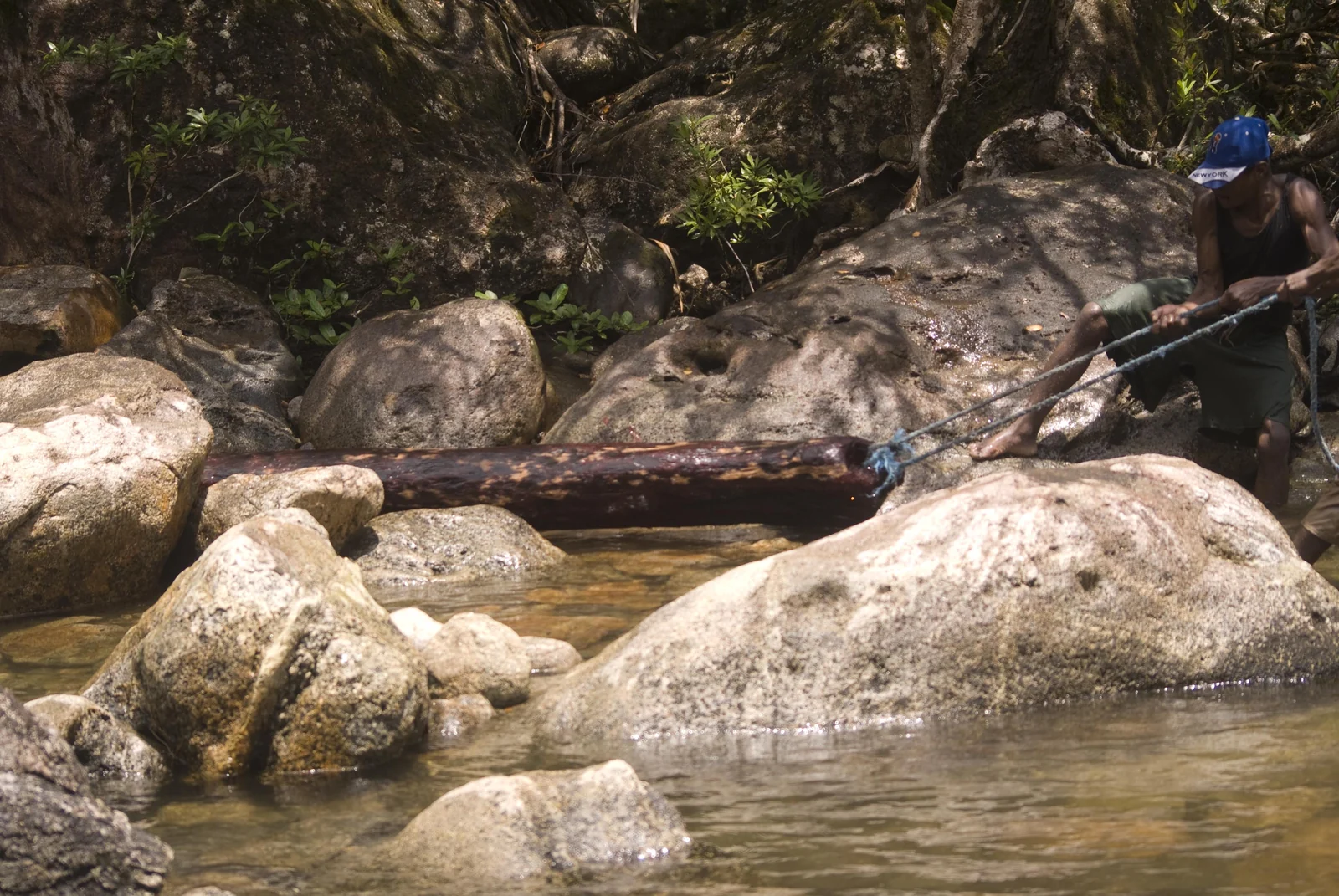
Then the labour. A kosso log is usually one whole tree. Chainsaw operators were paid $8.28 a log; “pushers”, who manhandle it to the depot, got $5.52; loaders got $1.38, divided among a team of five or six. The work was generally done without safety equipment.
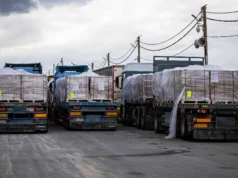
Drivers took 10% of a trip’s income after expenses. One respondent counted more than 50 places between Taraba and Lagos where police expected a tip, plus 25 military checkpoints, which cost more. Several sources said truckers carried 80,000 to 150,000 naira, about $170 to $330, for these payments, which generally never reached the government’s accounts. In the June-to-October rains logging mostly stopped and log prices “skyrocketed”. At Lagos, APM Terminals runs the Apapa Container Terminal under a concession, and interviewees told UNODC that because it charged the government daily storage, questionable containers were usually sent back to the shippers rather than seized.
Why would anyone lift a log for a sixth of $1.38? Traditional leaders said the trade had cut crime by giving young men work and, taxed by many authorities formal and informal, spread money across “hundreds of families”.
Casamance runs on the same logic, with donkeys. Gambian and Senegalese middlemen act for Chinese traders based mainly in the Gambia; local people fell the trees and haul them by donkey cart to the border, where they go into hidden depots and then out through Banjul. Ziguinchor and Kolda are among Senegal’s poorest regions, and in 2020 people there were swapping timber for bags of rice.
Where does the money pile up? In Zambia, a study of mukula, a central African rosewood, led by Paolo Omar Cerutti and using 2012 to 2016 data, put cutters’ average profit at about $23 a cubic metre, while Chinese manufacturers paid importers about $1,000 to $1,100. Those are different transactions that happen to share a unit, not two ends of a markup. Lamin’s claim, up to $1,000 of a container worth more than $15,000, is one man’s account. The gap pays for transport, aggregation, risk, financing and rents all at once.
Nor are the traders a single syndicate. UNODC found that Asian expatriates appeared to be the main illegal exporters from Africa, living mostly in the port cities because the source areas were dangerous: kidnappers went after traders, loggers, drivers and even forestry officials. Interviewees in Nigeria described many traders as young, heavily in debt and “desperate to succeed”. In Indonesia, by contrast, Vincent Nijman found the illegal trade “dominated by Indonesians rather than foreign nationals”. No nationality owns it.
Cutting and carrying, then, are cheap, local and replaceable. The leverage sits at the document.
What a permit is supposed to prove
Until 2016 kosso needed no CITES permit at all. UNODC states the old rule plainly: “Even when illegally harvested, the timber became legal to trade for most countries once it had left the national borders.” Many importing states had no legal basis for stopping it. The exception was the United States, where since May 2008 the Lacey Act has made it illegal to import wood taken or exported in breach of another country’s laws.
Senegal put kosso on CITES Appendix III on 9 May 2016, and it moved to Appendix II on 2 January 2017. The whole Dalbergia genus, the other great rosewood group, was listed from the same date, because its species are so hard to tell apart. An Appendix II export permit isn’t a receipt. It rests on two findings by the exporting country: that the wood was legally acquired, and that exporting it won’t harm the species’ survival, the so-called non-detriment finding. By March 2022 not one kosso range state had produced an acceptable version of either.
Permits went out anyway, and they failed in at least four ways.
They were issued when they shouldn’t have been. Nigeria had a national ban on timber exports, yet CITES permits for kosso were issued; the CITES Secretariat called the result “lawful but awful”. In 2017 EIA, the Environmental Investigation Agency, a campaign group, said the then environment minister had “allegedly signed thousands of retroactive CITES permits in January 2017”. She answered: “No permits were backdated or illegally signed by me.”
They were forged. In Guinea, the Organized Crime and Corruption Reporting Project (OCCRP) has reported, officials allegedly issued fake export certificates for at least 377 containers of kosso, and a shipping line said more than 1,200 containers had left during a period when the quota allowed 14,000 tonnes.
They were hacked. INTERPOL lists “even the hacking of government websites to obtain permits” among the ordinary crimes of the forestry business.
Above all, they went unchecked. If Nigeria exported around 750,000 cubic metres of kosso in 2017, as UNODC estimated, that was nearly 40,000 containers, more than 100 a day, and the forestry inspection unit had one officer designated to inspect loads leaving the two Lagos ports. Exporting countries rarely have the capacity to unload or scan timber containers, so planks across the outer third can hide the logs behind. Interviewees in Nigeria alleged that cutting logs into components helped exporters evade inspectors who were looking for logs. Before the Gambia’s 2022 ban, EIA found exporters there labelling rosewood containers as peanuts or scrap metal; in China’s import data the same containers frequently appeared as rosewood. They left as peanuts and landed as timber.
From outside, the failures show up as arithmetic. China keeps a customs code just for tropical rosewood logs, so its side of the books is legible. Between 2016 and 2020, EIA calculated, importers reported 1.9 million tonnes more kosso than exporters did. Over 2010 to 2018 the Gambia reported $471 million less in timber exports than its partners recorded receiving. Mirror-trade gaps have dull causes too, so these are discrepancies consistent with misreported or undeclared trade, not proof of fraud. Still, 1.9 million tonnes is a great deal of timing.
At the receiving end, the paper did its job. Forest Trends wrote in 2022 that Chinese customs “must rely on CITES permits, which are seen as the exporter’s responsibility – once the paper is in-hand, it is accepted. But permits are often fraudulent.” The same distance between a valid permit and a verified origin runs through the python-skin trade, which our companion piece follows.
One log, one tree

A standard kosso log is about 2.1 metres long and averages about 200 kilograms, roughly a fifth of a cubic metre. Its girth varies, but in most cases one log is one entire tree. That makes kosso unusually easy to count. CITES parties reported importing more than 825,000 cubic metres of kosso logs in 2017, and UNODC worked out that this was equivalent to about four million trees. That estimate rests on an average log and holds for kosso logs alone, not for sawn timber or other species. It does turn a volume in a customs table back into something with roots, and it is the same unit in which Taraba's chainsaw crews and loaders were paid.
When the permit belongs to the president
From 2014 the export of kosso from the Gambia ran through one company. President Yahya Jammeh, EIA reported on the testimony of senior officials, set up his own export firm, Westwood, and every other exporter paid it $3,000 a container for access. In 2016, when the CITES management authority tried to collect export data, soldiers warned it to stop. In effect, a head of state’s company charged its competitors for the right to compete, while the army discouraged the bookkeeping.
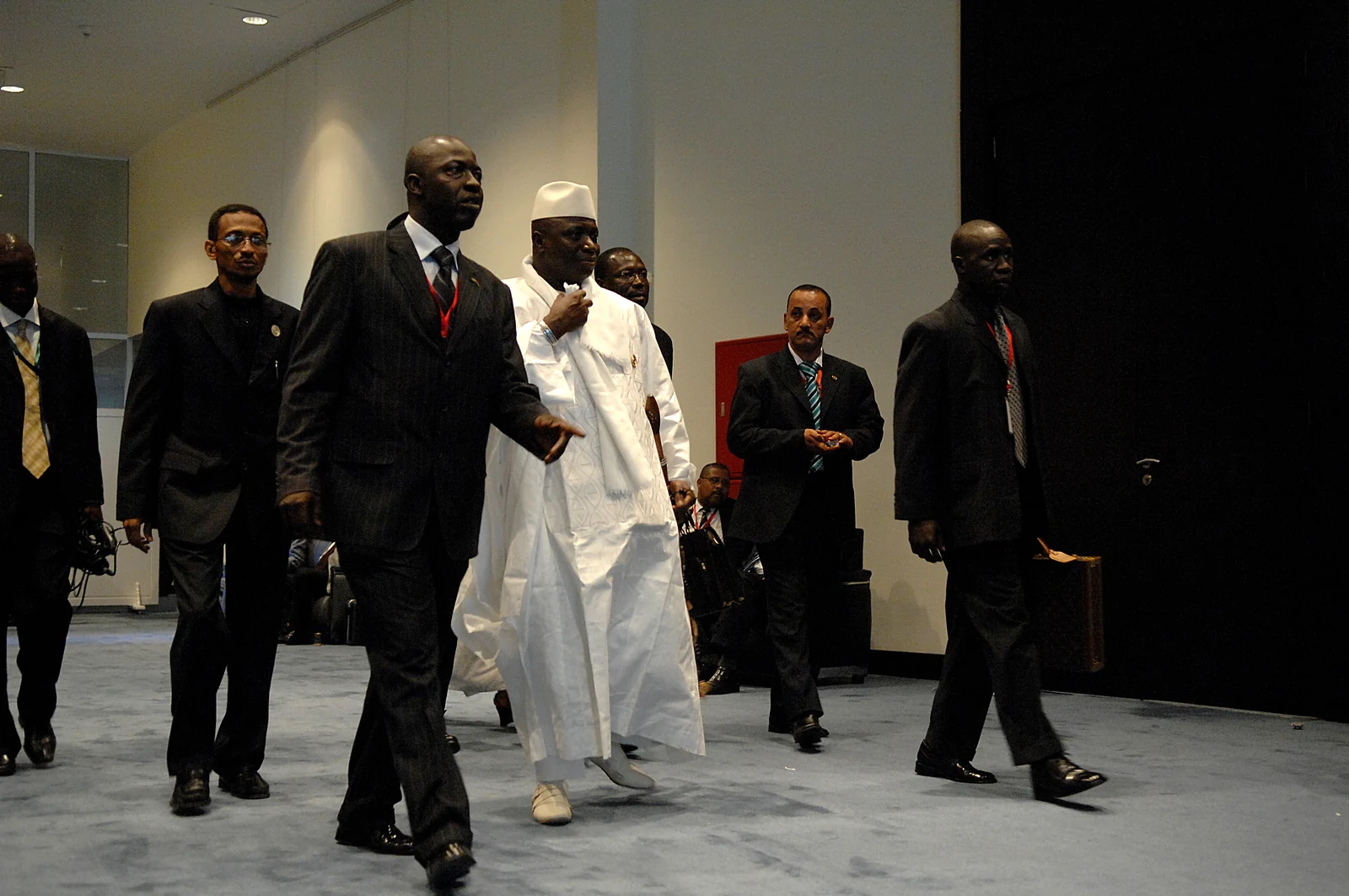
After Jammeh left power, a Gambian commission of inquiry found that Westwood had exported at least 15,000 containers of rosewood between 2014 and 2016, for $45.3 million in revenue (revenue, not profit). Kanilai Family Farms, Jammeh’s company, which held half of Westwood, collected $7.8 million in dividends. “The government received zero,” JusticeInfo reported. A UNODC and CITES threat assessment in 2019 put illegal rosewood exports at about half the value of everything the Gambia exported and about a tenth of its GDP. When Jammeh banned log imports from Casamance in September 2016, experts called it a “big charade”.
His successor, Adama Barrow, banned exports in February 2017. Between then and April 2020, China reportedly imported 329,351 tonnes of rosewood from the Gambia. Another ban followed in 2022. EIA says it slowed the trade, though the ban itself appeared to trigger a rush: China imported more than 15,000 tonnes of rosewood from the Gambia that July and August. When Al Jazeera’s report ran in January 2024, the ministry was still denying any knowledge.
Most of the wood came from Casamance, a conflict zone, and the rebels there had paper of their own. TRIAL International, a Swiss legal charity, says the Casamance separatist movement, the MFDC, controlled the precious-wood business in its areas by issuing “logging authorizations and transport permits” and guaranteeing the loads’ security. For some factions, roughly between 2010 and 2017, timber was a major income, though cannabis paid for the conflict too; by 2020, as logging moved east, the rebels were reported to be less involved. EIA also alleges complicity within the Senegalese forces stationed in Casamance.
Nor is the Gambia unique: Patrick Waeber and colleagues describe Madagascar’s forest rules being loosened around elections to pay for campaigns, and UNODC research suggested Nigerian involvement reaching high-ranking politicians. INTERPOL puts the cost of forestry corruption at about $29 billion a year and has found criminal networks bribing officials for “safe passage” on routes that also carry drugs and firearms. In the Gambia and Casamance, organised crime and corrupt authority met at the same point: the decisive documented actor was whoever held the authorisation.
The criminal consequences have been modest. Westwood was never charged in a Gambian court, though the assets of the company and its owners were forfeited after a state inquiry’s white paper in September 2019. By mid-2022 Switzerland’s attorney general was investigating the trafficking and had sent Banjul a first request for judicial assistance; in late 2023 the attorney general’s spokesperson said there were no current proceedings against a Swiss citizen in that context. By then no court had ruled.
Why not grow it?
If the wild tree is the problem, plant one. Rosewood is cultivated. In Indonesia, Indian rosewood grows in mixed plantations with teak or mahogany, and on Java, by 2024, the managed harvest was felling trees planted around 50 years earlier. Indonesia’s legal exports of Indian rosewood averaged about 84,000 cubic metres a year in 2017–2021, though Nijman notes that the harvest’s sustainability has yet to be assessed. In China, researchers found three ten-year-old plantation trees of Dalbergia odorifera that had already formed heartwood, the dense, dark core the trade pays for, and showed experimentally that a fungus could promote it.
The limits are concrete too. Lamin says the older and fatter the log, the more it’s worth; Java runs on a half-century clock. Edward Webb of the University of Helsinki warns that loopholes let traffickers pass wild timber off as plantation-grown to qualify it for a CITES permit. Commercial supply exists, then. Our companion piece on python skins describes a model worth setting beside it: Louisiana’s alligator ranching, which ties supply to things a regulator can count, from nest surveys and licensed egg collection to a quota of young returned to the wild. Rosewood plantations keep harvest plans and records too; the question is whether those records can tell a planted tree from a wild one.
Outside China, most people meet rosewood in smaller things. Since late 2019, finished musical instruments, parts and accessories made from the Dalbergia species the exemption covers have needed no CITES permit, after the convention’s parties found that trade not detrimental; Brazilian rosewood, and species listed on other terms, still need separate checks. Scott Paul of Taylor Guitars estimates that instruments use under a tenth of one percent of the rosewood trade, and Hanika, a German maker, was selling guitars of thermally modified domestic wood by 2017. Indian rosewood also turns up in knife handles. For those same species, finished products holding no more than 10 kilograms of that wood per shipment are exempt too, but raw handle scales aren’t finished goods.
So the buyer’s rule is short. A finished guitar is the easy case. For furniture, carvings, handle scales or raw boards, ask which species, from which country, and which documents apply to that product crossing that border, and if the seller can’t say, don’t buy. A permit or a label is a claim about origin, not proof of it.
Where the paper stops working
The gap has closed, in particular places and years.
Nigeria is the sharpest case. In October 2018 the CITES Standing Committee recommended that parties suspend kosso trade with Nigeria. The next year China’s imports of Nigerian rosewood fell thirtyfold. Forest Trends also credits national export bans, permit difficulties and Covid for other suppliers’ declines, so the suspension is a strong association, not a sole cause. In June 2022 CITES suspended trade in kosso harvested after 2017 from all 16 range states, none of which had produced an acceptable non-detriment finding. Since then the position has shifted country by country; the Gambia was still listed in October 2026.
What followed Nigeria was relocation. In 2021 Sierra Leone and Mali supplied almost two-thirds of China’s kosso imports by volume. Mali has protected the species since 1995. It exported more than 80,000 cubic metres of rosewood in 2018.
Madagascar shows a closure decided at the source. In its 2025 review of the Atsinanana rainforests, UNESCO’s World Heritage Committee recorded “the halting of the exploitation and export of precious woods (rosewood, ebony) for the last ten years”, and warned in the same decision that “the exploitation of palisander continues within the country to date”. In 2026 it noted that Madagascar had submitted a zero export quota covering old stocks and finished products. An export channel can be shut by a decision at home while felling for domestic use carries on.
Then there’s the importer’s law. Kerstin Canby of Forest Trends argues that a “species-focused” CITES can’t protect forests as a whole, while laws requiring all wood to be legal are already getting illegal timber off markets in the US, the EU and Australia. China’s position has three parts. On prohibition, Article 65 of its Forest Law forbids anyone to “purchase, process, and transport woods in full awareness of their illegal origins”. On import rules, Forest Trends found no import regulation or traceability requirement in 2022. On practice, Chinese timber firms surveyed in 2022 most often cited domestic law as their reason for seeking legality documents from suppliers, for imported wood too.
Why isn’t the trade better controlled? Partly because inspectors often can’t tell what they’re looking at. Partly capacity: one inspector, two ports. Partly because those holding the authorisation profit from it. And partly because enforcement lands at the bottom, on cutters and smallholders.
The strongest objection is that paper is a symptom. Demand set the trade’s size and depletion ended its booms. An agent in Taraba said that “even without CITES, rosewood trade would have come to an end because the tree is exhausted in the forest.” Concede it: depletion ends local booms, and demand sets the scale. But depletion doesn’t explain who collected (a president’s company taking $3,000 a container), or which forests stayed open (Mali exporting a species it had protected since 1995), or the one sharp fall that coincided with an importer refusing the paper. Demand decides how much wood moves. Documents decide whose wood moves, and who is paid for it.
Taraba is where that ran its full course. After the 2018 suspension, traders who had invested heavily were bankrupted or taken to court over unfulfilled contracts and defaulted loans. The scouts, saws, depots and trucks turned to apa, a timber from the genus Afzelia. In interviews in 2022, traders said apa was already close to exhausted in Taraba’s forests, and respondents said another timber, tali, was in demand. Of the original tree, the agent said: “there is still demand for rosewood, but there is none left in the forest.”
In December 2025 Nigeria’s government imposed a nationwide ban on exporting wood and revoked “all previously issued licences and permits”. A prohibition on exporting certain wood products took legal effect on 1 May 2026.
The state withdrew the paper. The last account of the crews and depots that grew up around it, from 2022, has them working on the next tree.
⁂
What a log can prove
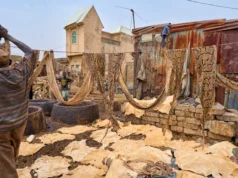
Shutting a border settles what may leave. It settles nothing about the wood already felled, seized or stacked, whose ownership and history then become the whole question. In November 2017 Rowan Moore Gerety described for Mongabay the courtyard outside the office of Chantal Rasoanirina, a forestry official in Antalaha, in north-eastern Madagascar. More than half of it was filled to head height with wet, weathered rosewood logs, each marked with a faded barcode left by auditors who had come from the capital in late 2015. “It would be good if this rosewood disappeared,” she said, “so there wouldn’t be any more questions about it.” In March 2015 Madagascar’s environment minister, Ralava Beboarimisa, had told a meeting at Chatham House that when a stockpile was identified, smugglers often replaced the logs with ordinary timber painted to look like rosewood. The minister called these “elastic stockpiles”, which is unusually candid for a minister.
The stockpile and the transit port
Madagascar’s stockpiles come in three kinds: wood seized and stored by the state, wood declared to the state but still held by the timber barons, and wood hidden in places nobody declared. A CITES document from 2016 put the hidden logs at possibly two million. Some operators declared more than they had, observers told Mongabay, so that they could keep topping the pile up with freshly cut logs. A declared stockpile with spare room is a laundering account.
What to do with the wood has split the people who care about it. The World Bank led a business plan whose stated objective was “to clear uncontrolled stockpiles, so as to facilitate normal enforcement and sustainable forest management efforts in the future”. Waeber, Derek Schuurman and Lucienne Wilmé called that plan a “sophisticated way of legalising the illegal stocks”, and argued that any proposition of sustainable use of these slow-growing hardwoods “is a myth”. In 2018 Madagascar proposed paying the holders: $400 a tonne in dividends from an international sale, or $250 a tonne up front. The CITES Standing Committee rejected it that October. Susanne Breitkopf of EIA said the main problem was rewarding people involved in illegal activity, which “would set a very worrying precedent”.
The next idea kept the wood at home. In 2022 the government proposed that about 30,000 “controlled” logs be used domestically, with finished items under 10 kilograms allowed to leave the island; the first use, renovating the Queen’s Palace in Antananarivo, was “plagued by opacity” in the view of EIA and Transparency International. By February 2025 those groups and WWF were reporting that the two stockpiles inventoried for the scheme were only a small part of the 30,000 logs slated for domestic trade. The CITES conference in late 2025 deleted the old decisions specific to Madagascar’s rosewood and ebony, which did not amount to permission to export, and in 2026 Madagascar submitted a zero export quota covering pre-Convention stocks, derivatives and finished products.
Every one of those positions runs into the same obstacle. A stockpile is a records problem with weight. Each log has to be matched to a document, and in Madagascar the documents are as contested as the wood.
Singapore shows the same problem inside a courtroom. In 2014 it seized a shipment of Malagasy rosewood, 29,434 logs by the court’s later count. The importers were convicted of importing it without a valid permit, and on 8 April 2019 the Court of Appeal quashed the convictions: importation was “not made out”. A transit charge, the judges noted, “could have been brought under s 5(1)” of the endangered-species law, but the prosecution had switched away from one and failed to switch back. The papers were contested throughout. The CITES Secretariat told Singapore that the Malagasy ministry’s email account had been hacked. In January 2015 Anthelme Ramparany, then environment minister, had written that the documents were “established in due form by the signatories authorities during the period of transition”; in February 2016 Madagascar’s prime minister repudiated the approvals. The court never decided whether the wood was lawfully sourced, and where the logs are now has not been established.
What would count as proof
If a permit is only a claim, what else can establish a log’s species, origin, custody and legal acquisition?
Species first. Logs and boards lack the leaves and flowers botanists use, so often the most precise identification available is the genus. That is why CITES listed all of Dalbergia at once rather than species by species. In 2015 Pamela McClure, Gabriela Chavarria and Edgard Espinoza used a mass-spectrometry technique called DART-TOFMS to separate Siamese rosewood and Madagascar’s Dalbergia from each other and from two then-unprotected relatives, Indian rosewood and African blackwood, across 235 specimens of 21 species. Those comparison species have been covered by the genus listing since 2017, so the test now separates a listed tree from other listed trees. The Wood ID smartphone tool from TRAFFIC, a wildlife-trade monitoring network, could identify 31 species, Siamese and Burmese rosewood among them, with more than 90% certainty, its team said in December 2025; TRAFFIC now reports testing it on 43 high-risk species. Because its answers are probabilities, they can’t yet be used in court.
Origin is harder. One exploratory study reached 86.6% cross-validation on declared timber origin by combining stable-isotope ratios with element profiles. Cady Lancaster, a forensic chemist, gives the limit: for the same species from different regions, “sometimes there isn’t enough difference in the metabolomic fingerprint to tell them apart”. Waeber, Schuurman and Wilmé go further for Madagascar and call identifying a logged tree’s species and site of origin “difficult if not impossible”. The positions are less opposed than they sound. One is a laboratory result with good reference samples; the other describes logs in a Malagasy yard.
The border is where both limits bite. At the CITES conference in late 2025, Canada opposed removing African padauk from the appendices because border agents lacked technology to distinguish processed timber within a single region; a proposal to delist six populations of Afzelia bipindensis was also rejected. ATIBT, the tropical-timber industry association, complained afterwards that legal trade was becoming harder than the illegal kind. That’s an industry’s grievance, but it describes something real: if officers can’t tell the wood apart, honest exporters carry the burden of the doubt.
Each method answers a different question. Chemistry and image tools can name the species of a listed taxon, given good reference collections. Origin can sometimes be inferred, under conditions. Custody and legal acquisition, who held the wood and whether they were entitled to sell it, are still established by records and by what people knew. That is where the best-known Western case turned.
What Gibson was told

Since May 2008 the Lacey Act has made it illegal to import into the United States plants and wood taken or exported in breach of another country's laws. In June 2008 people travelling on Gibson Guitar's behalf visited its supplier's exporter in Madagascar and were told that the wood at the facility was under seizure and could not be moved. Between October 2008 and September 2009 Gibson received four shipments of Madagascar ebony fingerboard blanks from that supplier. In August 2012 the company signed a criminal enforcement agreement that deferred prosecution: it paid a $300,000 penalty and $50,000 to the National Fish and Wildlife Foundation, and withdrew its claims to seized wood. The agreement covered ebony from Madagascar and rosewood and ebony from India. It was not a conviction. The decisive evidence was what the company had been told, not anything a laboratory found.
Who pays for a closed border
When a gap closes, the first people to feel it are the ones with the least paper. In Zambia in 2018, researchers estimated that mukula was being extracted at about 110,000 cubic metres a year, with about $1.7 million in bribes paid to state officials. Cerutti and his colleagues warned that formalising that trade risked “further criminalisation of the lower levels of the production pyramid — the cutters and smallholders, and their families”. Xiaoxue Weng and colleagues, working in the same country, put it more starkly: “While the environmental benefits of the regulations are not yet clear, the livelihoods of rural loggers have changed for the worse.”
Compare who was in the room. The Dalbergia listing of January 2017 brought commercial trade in finished musical instruments under permit requirements, and in the United States, Taylor Guitars says, the Fish and Wildlife Service’s annual CITES permit workload rose from roughly 20,000 to more than 60,000, most of the additional requests concerning instruments. Scott Paul called the rule “hastily drafted with insufficient consultation”. At the next conference, in 2019, the music trade body NAMM gathered more than 100 stakeholders, and the parties found instrument trade not detrimental to the species and exempted it from 26 November that year. The instrument makers organised around a documented ecological case. The Taraba research documents lost livelihoods and depleted forests; it records no one carrying the cutters’ case to the conference.
Then there’s the question of what kind of enforcement to build. INTERPOL compares forestry crime to “the global war against drugs” and urges police to use the tactics they use against drug traffickers. Its stated strategy goes further, aiming at corruption, financial crime and the heads of criminal networks. Treanor observed that the middlemen behind illegal harvesting are rarely targeted, often because of political connections. TRIAL’s Montse Ferrer argues the Gambian case is pillage: “Exploiting natural resources from a conflict zone is a war crime that must be punished.” Pillage can be prosecuted; the International Criminal Court convicted Germain Katanga in 2014 of war crimes that included pillaging.
What gets lost with the tree isn’t only timber. Kosso grows in dry country with thin forest cover. It fixes nitrogen, resists fire and feeds animals. It is also one of the cheapest rosewoods, and UNODC judged that “its ecosystem value as a species seems to exceed its export value”. Apa, the tree Taraba’s crews turned to, is fodder for Fulani pastoralists’ cattle, and they have been known to respond violently when it is cut down. Weng’s evidence says that whatever is tried has to be judged on livelihoods as well as on trees. The alternatives are thin. Community forests hold some of the last populations of rosewood in the Greater Mekong, Riina Jalonen of the Alliance of Bioversity International and CIAT told Mongabay, and the groups that guard them need money and technical support to do it.
The drug-war analogy fits the scale; the mechanism decides whether it works. A bag of street cocaine is contraband wherever it turns up. A rosewood log has a legal twin, and the decisive acts in its trade happen at desks that issue documents and desks that accept them. A strategy aimed at chainsaw crews and truck drivers would hit the people paid $8.28 and $1.38 a log, while the desks go on deciding whose wood moves.
Related articles
- How Brazil cut Amazon deforestation to a record low, and what could undo it
- How much are diamonds really worth?
- The economic history of spices: how flavor changed the world’s power structure
Further reading
As an Amazon Associate, Eikleaf earns from qualifying purchases. The book links below are affiliate links: if you buy through them, we may earn a small commission at no extra cost to you.
Recommended videos
 45:41The Trees That Bleed: How rosewood is smuggled from Senegal into Gambia – BBC Africa Eye documentaryInvestigates the article’s central Senegal–Gambia–China route, showing how rosewood trafficking survives export bans and political change.
 11:19Bloodwood: Rosewood Trafficking Is Destroying This National Park | National GeographicShows the Southeast Asian side of the rosewood trade, connecting Chinese luxury demand with trafficking networks and dangerous forest enforcement.
 4:04The Rosewood RacketThe EIA’s own short summary of its investigation into Nigerian kosso reaching China on CITES paperwork, the case at the heart of the article.
Cite this article
Owen Parker. “The paper forest.” Eikleaf, 2 November 2026. https://www.eikleaf.com/the-paper-forest/
Gen AI Disclaimer
Some contents of this page were generated and/or edited with the help of a Generative AI.
Media
Rosewood stockpiles in Antalaha – Wikimedia Commons (Photo: Anonymous, CC BY-SA 3.0)
Illegal rosewood logging, Masoala National Park – Wikimedia Commons (Photo: Anonymous, CC BY-SA 3.0)
Yahya Jammeh at the African Union summit, 2008 – U.S. Air Force, Wikimedia Commons
Key Sources and References
Popoviciu, Andrei. “‘Conflict timber’: Gambian traffickers continue rosewood trade despite ban.” Al Jazeera, 23 January 2024. https://www.aljazeera.com/features/2024/1/23/conflict-tinder-gambian-traffickers-continue-timber-trade-despite-ban
Geneva Environment Network. “Briefing on the 81st Meeting of the CITES Standing Committee (SC81).” 8 October 2026. https://www.genevaenvironmentnetwork.org/events/briefing-on-the-81st-meeting-of-the-cites-standing-committee-sc81/
UNODC. World Wildlife Crime Report 2020: Trafficking in protected species. United Nations Office on Drugs and Crime, July 2020, pp. 37–46. https://sherloc.unodc.org/cld/uploads/res/bibliography/2020/world-wildlife-crime-report-trafficking-in-protected-species-2020_html/World_Wildlife_Crime_Report_2020_english.pdf
United Nations Office on Drugs and Crime. World Wildlife Crime Report 2024: Trafficking in Protected Species. Vienna: United Nations, May 2024, revised July 2024, pp. 61–63 and 183–195. https://digitallibrary.un.org/record/4047217/files/Wildlife2024_Final.pdf
United Nations Office on Drugs and Crime. World Wildlife Crime Report 2016: Trafficking in Protected Species. Vienna: United Nations, May 2016, p. 16, figure 3. https://digitallibrary.un.org/record/4042915/files/1401856_EN.pdf
State Administration for Market Regulation (China). National standards platform entry for GB/T 18107-2017, last reviewed 8 December 2025. https://std.samr.gov.cn/gb/search/gbDetailed?id=71F772D826B9D3A7E05397BE0A0AB82A
Treanor, Naomi Basik. China’s Hongmu Consumption Boom: Analysis of the Chinese Rosewood Trade and Links to Illegal Activity in Tropical Forested Countries. Forest Trends, December 2015. https://www.forest-trends.org/wp-content/uploads/imported/for173-china-rosewood-report-letter-16-0329-hr-no-crops-pdf.pdf
Zhu, Annah Lake. “China’s Rosewood Boom: A Cultural Fix to Capital Overaccumulation.” Annals of the American Association of Geographers 110(1), 2020. https://doi.org/10.1080/24694452.2019.1613955
Treanor, Naomi Basik. “CITES takes unprecedented steps to stop the illegal African rosewood trade.” Forest Trends, 28 March 2022, updated 8 June 2022. https://www.forest-trends.org/blog/cites-takes-unprecedented-steps-to-stop-the-illegal-african-rosewood-trade/
Global Witness and Environmental Investigation Agency. “Illegal Malagasy timber trade worth up to $460,000 a day.” Revised 2 December 2009. https://globalwitness.org/en/press-releases/illegal-malagasy-timber-trade-worth-up-to-460000-a-day/
Dasgupta, Shreya. “Victory for forests: Rosewood gets enhanced protection at wildlife summit.” Mongabay, 4 October 2016. https://news.mongabay.com/2016/10/victory-for-forests-rosewood-gets-enhanced-protection-at-wildlife-summit/
Cerutti, Paolo Omar, Davison Gumbo, Kaala Moombe, George Schoneveld, Robert Nasi, Nils Bourland and Xiaoxue Weng. Informality, global capital, rural development and the environment: Mukula (rosewood) trade between China and Zambia. IIED and CIFOR, March 2018. https://www.iied.org/sites/default/files/pdfs/migrate/13603IIED.pdf
APM Terminals. “Our Terminal.” Apapa terminal website, undated. Accessed 30 October 2026. https://akamai.apmterminals.com/en/apapa/about/our-terminal
Hunt, Louise. “Chinese demand and domestic instability are wiping out Senegal’s last forests.” Mongabay, 5 November 2020. https://news.mongabay.com/2020/11/chinese-demand-and-domestic-instability-are-wiping-out-senegals-last-forests/
Nijman, Vincent. “The illegal trade in rosewood in Indonesia.” European Journal of Forest Research, 23 March 2024. https://link.springer.com/article/10.1007/s10342-024-01674-0
US Department of Justice. “Gibson Guitar Corp. Agrees to Resolve Investigation into Lacey Act Violations.” 6 August 2012. https://www.justice.gov/archives/opa/pr/gibson-guitar-corp-agrees-resolve-investigation-lacey-act-violations
Environmental Investigation Agency. The Rosewood Racket. 9 November 2017. https://eia.org/report/the-rosewood-racket/
TheCable. “EXCLUSIVE: How I tackled illegal wood export and deforestation, by Amina Mohammed.” TheCable, 11 November 2017. https://www.thecable.ng/exclusive-tackled-illegal-wood-export-deforestation-amina-mohammed/
Skrdlik, Josef. “Guinea Orders Legal Action Over Rosewood Export Fraud.” OCCRP. https://www.occrp.org/en/news/guinea-orders-legal-action-over-rosewood-export-fraud
OCCRP. “Interpol: Illegal Timber Industry Endangers Both Humans and Wildlife.” https://www.occrp.org/en/news/interpol-illegal-timber-industry-endangers-both-humans-and-wildlife
Environmental Investigation Agency. “International convention cracks down on world’s largest illicit rosewood trade.” Press release, 30 March 2022. https://old-vp-site.eia-global.org/press-releases/20220330-international-convention-cracks-down-on-worlds-largest-illicit-rosewood-trade-pr
Environmental Investigation Agency. Cashing In On Chaos. June 2020. https://eia.org/wp-content/uploads/2020/06/EIA-Cashing-In-On-Chaos-LowRes.pdf
Darboe, Mustapha K. “Swiss first step to investigate environmental crimes in Gambia.” JusticeInfo.net, 27 June 2022. https://www.justiceinfo.net/en/102680-swiss-first-step-investigate-environmental-crimes-gambia.html
TRIAL International. “Westwood: Dealing in conflict timber across The Gambia and Senegal.” 23 March 2020, last modified 8 June 2026. https://trialinternational.org/latest-post/westwood-dealing-in-conflict-timber-across-the-gambia-and-senegal/
ADF. “Peace Proves Elusive in Casamance as Trafficking Fuels Violence.” Africa Defense Forum, 7 February 2023. https://adf-magazine.com/2023/02/peace-proves-elusive-in-casamance-as-trafficking-fuels-violence/
Vyawahare, Malavika. “Conservationists call for lasting ban on trade in Malagasy precious timber.” Mongabay, 3 May 2019. https://news.mongabay.com/2019/05/conservationists-call-for-lasting-ban-on-trade-in-malagasy-precious-timber/
INTERPOL. Global Forestry Enforcement: Strengthening Law Enforcement Cooperation Against Forestry Crime. April 2019. https://www.interpol.int/content/download/5149/file/Global%20Forestry%20Enforcement%20Prospectus%202019-web.pdf
Dou, H., C. Fan, X. Liu, X. Chen and J. Wei. “Analysis of the culturable endophytic fungi in Dalbergia odorifera and screening of the fungi inducing heartwood formation.” Frontiers in Plant Science, 31 March 2026. https://www.frontiersin.org/journals/plant-science/articles/10.3389/fpls.2026.1755005/full
Cowan, Carolyn. “Overexploited and underprotected: Study urges action on Asia’s rosewoods.” Mongabay, 13 June 2022. https://news.mongabay.com/2022/06/overexploited-and-underprotected-study-urges-action-on-asias-rosewoods/
Paul, Scott. “Rosewood musical instruments exempted from requiring CITES permits.” Taylor Guitars, 9 September 2019. https://blog.taylorguitars.com/rosewood-musical-instruments-exempted-from-requiring-cites-permits
NAMM. “CITES Issues Official Notification for Dalbergia Annotation Change.” Update, 3 October 2019. https://www.namm.org/cites-issues-official-notification-dalbergia-annotation-change
Hanika. Native models brochure. 2017. https://www.hanika.de/en/service/information-section/brochures-images.html?file=files/global/downloads/broschueren/HANIKA+Native+Gitarren+EN+2017.pdf
Indian Council of Forestry Research and Education. Xylarium record, Dalbergia latifolia (cbrw004). https://iwst.icfre.gov.in/database/Xylarium/ifgtb/accessno/ts/cbrw004.htm
CITES Secretariat. Notification to the Parties No. 2016/063: Amendments to Appendices I and II of the Convention. 29 November 2016, p. 6; amendments effective 2 January 2017. https://cites.org/sites/default/files/notif/E-Notif-2016-063.pdf
Rijksdienst voor Ondernemend Nederland (RVO). “Dalbergia-hout.” Content checked 4 December 2024. Accessed 30 October 2026. https://www.rvo.nl/onderwerpen/cites/cites-soort/hout/dalbergia
UNESCO World Heritage Committee. Decision 47 COM 7A.14, Rainforests of the Atsinanana. 2025. https://whc.unesco.org/en/decisions/8681/
UNESCO World Heritage Committee. Decision 48 COM 7B.90, Rainforests of the Atsinanana. 2026. https://whc.unesco.org/en/decisions/?id_decision=9146
People’s Republic of China. Forest Law of the People’s Republic of China. Revised 28 December 2019. English text hosted by the Ministry of Ecology and Environment, credited to China Daily. https://english.mee.gov.cn/Resources/laws/envir_elatedlaws/202102/t20210207_820735.shtml
Samejima, Hiromitsu. Status of Timber Legality Verification by Business Entities in China. IGES and ITTO, March 2023. https://www.iges.or.jp/en/pub/status-timber-legality-verification-business-entities-china/en
Environment and Climate Change Canada. “Outcomes of species proposals: 20th Conference of the Parties.” Accessed 30 October 2026. https://www.canada.ca/en/environment-climate-change/services/convention-international-trade-endangered-species/conference-of-parties/20-species-proposal-outcomes.html
Federal Ministry of Environment, Nigeria. “FG bans wood export, revokes licences.” 20 December 2025. https://environment.gov.ng/2025/12/20/fg-bans-wood-export-revokes-licences/
World Trade Organization. Quantitative Restrictions database, Nigeria notification 11238. https://qr.wto.org/en/qrs/11238
Moore Gerety, Rowan. “Logjam: Inside Madagascar’s illegal-rosewood stockpiles.” Mongabay, 8 November 2017. https://news.mongabay.com/2017/11/logjam-inside-madagascars-illegal-rosewood-stockpiles/
Beboarimisa, Ralava. Tackling the Illegal Rosewood Trade in Madagascar. Meeting summary; chaired by Alison Hoare. Chatham House, 26 March 2015. https://www.chathamhouse.org/sites/default/files/field/field_document/20150326RosewoodMadagascar.pdf
Carver, Edward. “CITES rejects another Madagascar plan to sell illegal rosewood stockpiles.” Mongabay, 24 October 2018. https://news.mongabay.com/2018/10/cites-rejects-another-madagascar-plan-to-sell-illegal-rosewood-stockpiles
Moore Gerety, Rowan. “Madagascar proposes paying illegal loggers to audit or buy their rosewood.” Mongabay, 8 August 2018. https://news.mongabay.com/2018/08/madagascar-proposes-paying-illegal-loggers-to-audit-or-buy-their-rosewood/
Environmental Investigation Agency and Transparency International. Convention Evasion: Madagascar’s Plan to Pull Rosewood Stockpiles Out of CITES. 3 March 2022. https://old-vp-site.eia-global.org/reports/20220303-convention-evasion-madagascars-plan-to-pull-rosewood
Environmental Investigation Agency, WWF and Transparency International. “Unless domestic rosewood and ebony trade in Madagascar are tightly regulated, the country’s rainforests are still in jeopardy.” 4 February 2025. https://eia.org/press-releases/unless-domestic-rosewood-and-ebony-trade-in-madagascar-are-tightly-regulated-the-countrys-rainforests-are-still-in-jeopardy/
IISD Earth Negotiations Bulletin. Summary of CITES CoP20. December 2025. https://enb.iisd.org/convention-international-trade-endangered-species-wild-fauna-flora-cites-cop20-summary
Singapore Court of Appeal. Kong Hoo (Pte) Ltd and another v Public Prosecutor [2019] SGCA 21. 8 April 2019. https://www.elitigation.sg/gdviewer/gd/2019_SGCA_21/pdf
McClure, Pamela J., Gabriela D. Chavarria and Edgard Espinoza. “Metabolic chemotypes of CITES protected Dalbergia timbers from Africa, Madagascar, and Asia.” Rapid Communications in Mass Spectrometry 29(9), 2015. https://doi.org/10.1002/rcm.7163
Zimmer, Katarina. “New technologies offer hope in fight to save the world’s imperiled rosewoods.” Mongabay, 15 December 2025. https://news.mongabay.com/2025/12/new-technologies-offer-hope-in-fight-to-save-the-worlds-imperiled-rosewoods/
Rees, Gareth. Verifying the declared origin of timber using stable isotope ratio and multi-element analyses. MSc by research thesis, University of York, 2015. https://etheses.whiterose.ac.uk/id/eprint/9522/
Russell, Victoria. “Wood Chemistry: Tracking Illegal Logging Using Forensics.” ChemMatters, American Chemical Society, April 2026. https://www.acs.org/education/chemmatters/articles/wood-chemistry-tracking-illegal-logging-using-forensics.html
TRAFFIC. “Tech for trees.” Accessed 30 October 2026. https://www.traffic.org/what-we-do/thematic-issues/promoting-sustainable-trade/leveraging-legality-along-chinas-timber-supply-to-reduce-deforestation/tech-for-trees/
Monthe, Franck, and Nicolas Bayol. Après la CoP20 de la CITES : quels enjeux et quelles marges de manœuvre pour les forestiers d’Afrique centrale ? Webinar slides. ATIBT, 16 December 2025. https://www.atibt.org/files/upload/newsletter/newsletter_1912225/161225_CITES_Webinaire_FM.pdf
Weng, Xiaoxue, Paolo Omar Cerutti, Penias Banda and Davison Gumbo. “Saving trees or improving lives?” IIED, 19 April 2017. https://www.iied.org/saving-trees-or-improving-lives
International Criminal Court. “Germain Katanga found guilty of four counts of war crimes and one count of crime against humanity committed in Ituri, DRC.” Press release ICC-CPI-20140307-PR986, 7 March 2014. https://www.icc-cpi.int/news/germain-katanga-found-guilty-four-counts-war-crimes-and-one-count-crime-against-humanity
Louisiana Department of Wildlife and Fisheries. “Alligator Management.” Accessed 30 October 2026. https://www.wlf.louisiana.gov/page/alligator-management